Straw Bonnet Critique

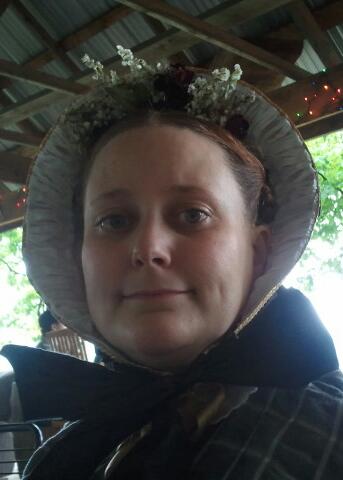
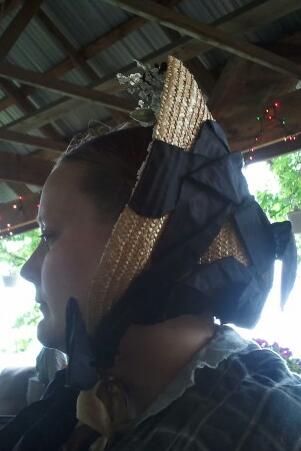
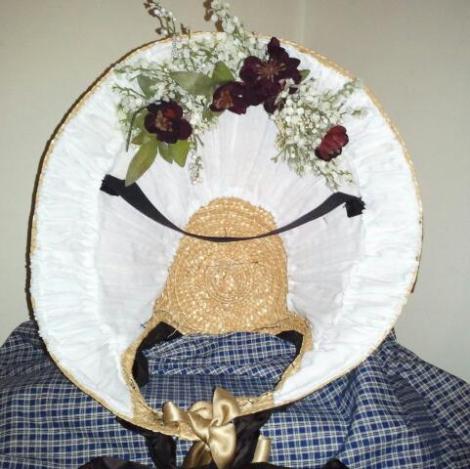
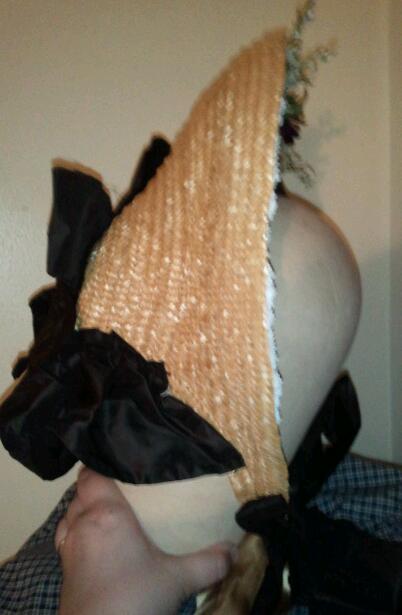
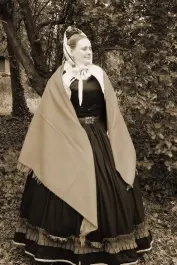
When someone asks for an opinon on a bonnet, it can be difficult to try to explain what is not quite right about a bonnet for a variety of reasons – technology based conversations, trying to be sensitive, not knowing who will take offense, etc. Well, this is the bonnet I made in NM out of what I could find at the local shops in a couple days for an event we never actually made it to. I’m going to go through it this week talking about the shape, materials… basically ‘the good, the bad and the ugly.’

image

image

image

image

Published in: on June 11, 2012 at 5:34 am  Leave a Comment  
Tags:

Fanciful Utility News!!!!

Fanciful Utility: Victorian Sewing Cases & Needle-books

Take a look at the lovely Video Liz has put together…

… there is a special announcement at the end!!!

Published in: on June 4, 2012 at 4:12 pm  Comments (4)  
Tags:

Anatomy of a Bonnet

There is a helpful little file here for developing a better understanding of late 50s & early 60s millinery. Use it alongside browsing museum collections.
https://annaworden.wordpress.com/welcome/pdf-pages/

Published in: on May 29, 2012 at 7:39 pm  Comments (1)  
Tags:

A little survey

I’m trying to figure out what size shawls people are looking for. This is for wool, silk, sheer & domestically made shawls. Please let me know if you would prefer:
A) a square shawl 36″ square (this is called a handkerchief shawl)
B) a rectangular shawl about 40″ by 80″ (this is called a three-quarters shawl)
C) a square shawl less than 50″ square
D) a square shawl between 50″ and 55″
E) a rectangular shawl 50″x100″ to 55″x110″
F) a square shawl between 55″ and 60″ square
G) a rectangular shawl 55″x110″ to 60″x120″
H) a square shawl between 60″ and 65″ square
I) a rectangular shawl 60″x120″ to 70″x140″
J) a square shawl greater than 70″ square
K) a rectangular shawl greater that 70″x140″

Published in: on May 9, 2012 at 6:20 am  Leave a Comment  

Shawls on Etsy!

Just a quick note with a proper post later including photos.
I finally have 5 of my shawls listed on Etsy. There are 5 100% wool shawls including a brown & blue plaid, two natural white, a red and blue. Each are light weight, ideal for spring & fall as well as chilly summer nights.
Enjoy!

Published in: on May 4, 2012 at 6:28 am  Leave a Comment  

Embroidered Shawl Update

Thank you all who selected their favorite embroidery choices in the previous post. Since I already loved #3 and several of you like it as well, that is the one I’m going to work from. #3 is a nice balance of floral and paisley.
I’ve blown up the image and sketched out the design. (You’ll see a rejected larger cone motif on the right.) The wool is thin enough to see the illustration through. This will make tracing the design on to the wool to follow fairly easy. I just need to decide whether to trace out the enirety or the major lines then section by section. I’m leaning towards the latter.
For colors, I am thinking a duo or trio of greens and blues. Since the original is red, I may use a brown instread of the pale yellowish color for the vining bits. I may also accent with a red yet to be determined. I don’t know if the brown should be reddish or something paler. We shall see.

image

Published in: on April 5, 2012 at 6:13 am  Leave a Comment  

Painting on Velvet

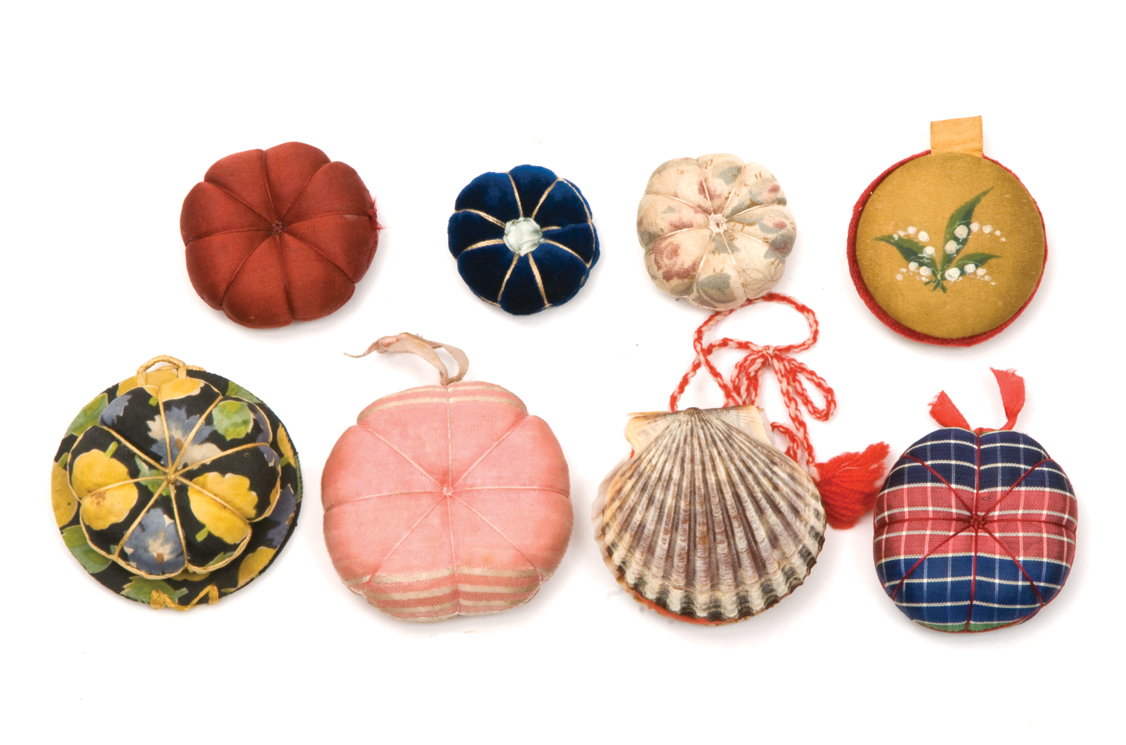
Something odd has been happening lately. Over and over, I keep running into theorem pieces. It is even happening in the oddest of places including the dressing room of a second hand shop. (Granted, I know the manager and suspect she is why it is there.) The first little piece that I can recall is the cutest little shell pincushion at an antique show. The design was faded to almost not being there. Then came several more similar pincushions in a photo with very bright flowers still on the velvet. A couple weeks later I noticed the one in the dressing room. A few more glimpses later, I get a message from Eileen with a link to a photo in the OSV collection which has several items with small pieces of theorem.

All these little run-ins is making me quite a bit camp sick because theorem used to be a hit among the Pioneer Days campers at Stone Tolan House.

With that in mind, I just have to make some of these little shell pincushions with the theorem. I’ve been wanting to make the pincushions with the shells. I even have shells saved from our first anniversary. Now that I’ve been seeing so many with the theorem, I just have to do that bit as well.

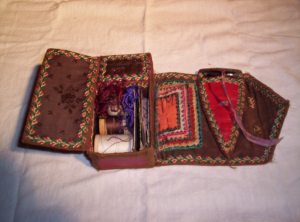
This little sewing case is darling with its theorem just inside the cover. It is also rather unusual to see the large pocket on the back side.  

Published in: on March 22, 2012 at 4:14 pm  Comments (5)  
Tags:

Chairs, Seats and Cushions, pt 3

This one should say Chairs and Sofas….

Another aspect of the chair seats I feel we need to look at is cushions. Take a look at what is said in The Workwoman’s Guide about cushions. (I’ll admit, I hadn’t thought about cushions to take to church.) Cushions and coverings not only made the chairs and sofas more comfortable, but protected them as well.

When chairs and sofas are fitted up with damask, merino, stuff, horse hair, or other material that does not wash, they are generally covered with Holland, chintz, or glazed calico, and protects them from dust and dirt, and are easily removed, when required for company. Holland covers are the most durable, but look cold; chintz to fit the chair or sofa, with or without piping at the edge, and with loops fastened down by passing one of the strings through the three loops, and making it tie. Ottomans generally have the covers to fit along beneath the edging of wood, in which case, they must be pinned to the stuffing with very strong pins, which from their length are called sofa pins.

Arm Chairs

It is a good plan to make a kind of case of Holland to fit half way down the cushion, A B C D, which protects the cover from being soiled by the head, on leaning back. Each arm chair should have two or three of these cases for wash and wear.

Church Basses

Flat circular ones are often in use. Sometimes straw ones are covered with green or crimson cloth, and look very neat. Basses may be filled with mill-puff, straw, chaff, bran, or bits of cloth, &c. Some persons prefer a simple cushion or flat pillow to kneel upon, in which case, they may be filled with feathers.

Church Seats

Church pews are generally lined with cloth, and fastened by brass nails andn binding laid on. The cushions, are oblong, and made like a very soft mattress.

They have pieces of cloth, bound round and sewed to them in front, to give an air of comfort and neatness  to the seat. The ground or floor is generally covered with a drugget of the same coulour as the lining of the seat.

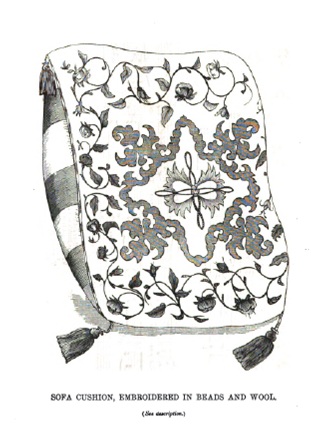
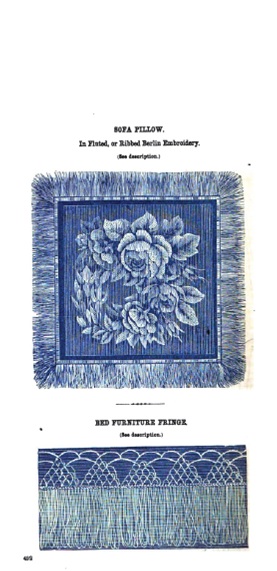
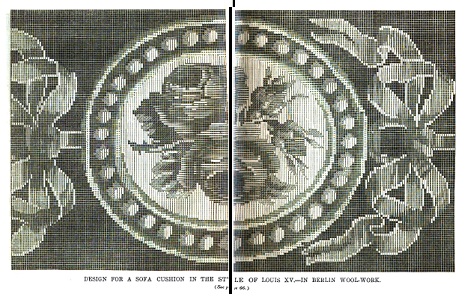
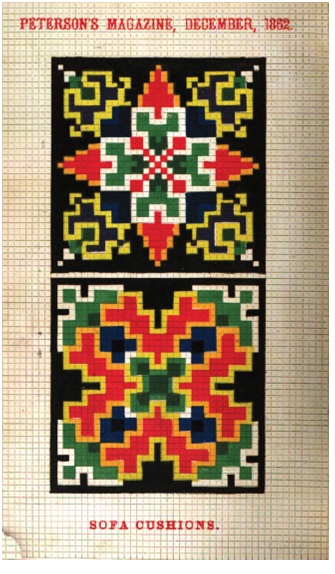
This color plate from Peterson’s shows two colorful sofa cushions.
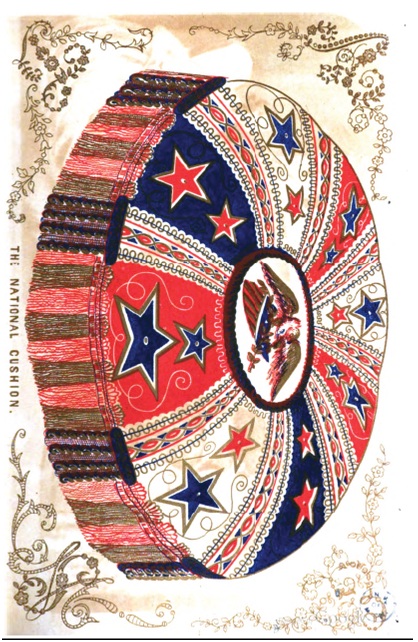
This patriotic cushion comes from an 1850 Godey’s rather than one during the CW.
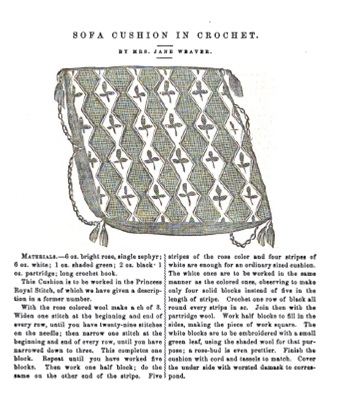
This is a crochet cushion from Petersons in 1862.
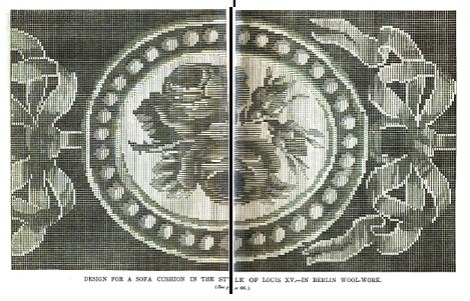
 1857 was a popular year for chair and sofa cushions in Godeys with these three included:
Published in: on February 13, 2012 at 1:07 am  Leave a Comment  

Chairs, Seats and Cushions, pt 2

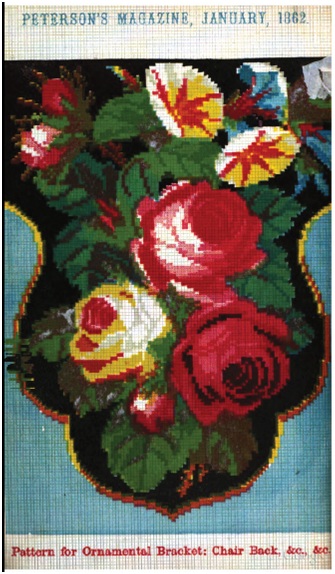
Based on the number of color plates found in Peterson’s and Godey’s in the 1850s and 1860s, I would like to assume there was some level of popularity in making chair seats. This chair seat shows the curved edge shape generally seen with some variation in the publications. Worked in needlepoint, it has a floral pattern that covers nearly the entire seat.

While the previous seat is symmetrical, this chair back is asymmetrical in its floral design.  

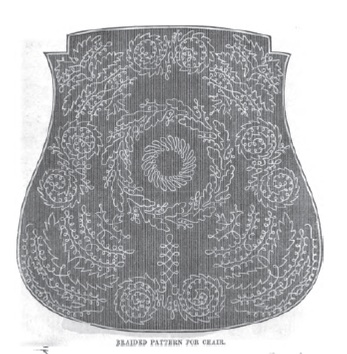
This seat, done in braid, is from Peterson’s 1857. You can see the notches at the top where the seat will fit into the wooden construction of the chair. I would like to find extant examples of a braided seat to see how well they did or did not wear.

When I saw this faded, horribly scanned seat design, I just had to share it. I pieced it back together from Google Books’ edition of Peterson’s. The symmetrical geometric design has a sorta southwest feel to me. Now, I highly doubt that is how those originally reading the magazine, looking at this illustration would have seen this though.  

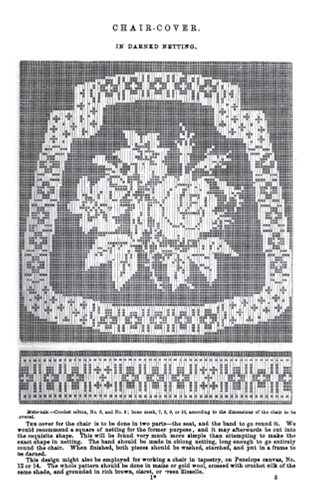
 This chair cover also has the distint shape of the chair’s seat.

Published in: on February 8, 2012 at 1:59 am  Comments (2)  

Chairs, Seats and Cushions

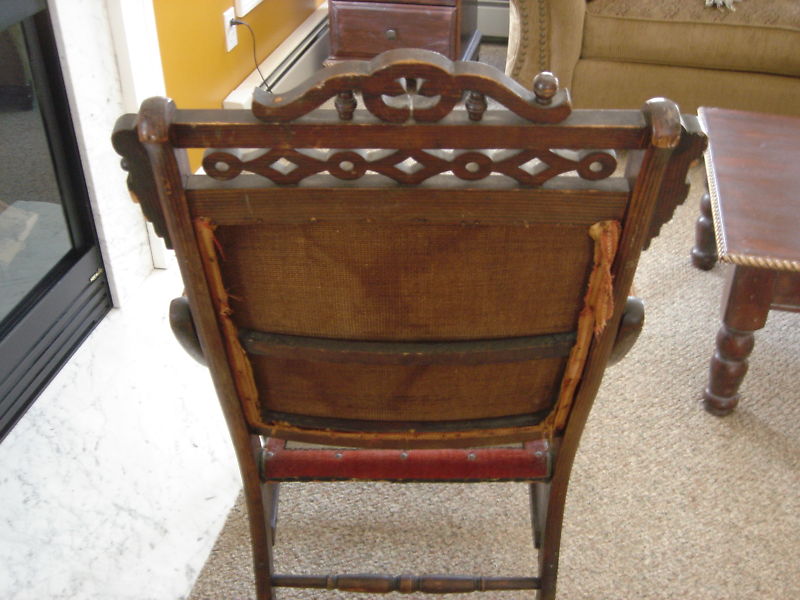
EDIT June 2015 – I am receiving an increased number of requests for information on particular chairs and appraisals. While I love to see original chairs, I am not in a position to give advice on the value or restoration of chairs. I simply find patent furniture to be a fascinating research subject. 

A while back I was asked to look into the seats for chairs, especially folding chairs. It has been quite some time and technically I just have a bunch of notes. Over the next several posts, I’ll be sharing some of these notes in a roughly organized format. We will look at the original seats on chairs, illustrations for homemade seats and cushions.

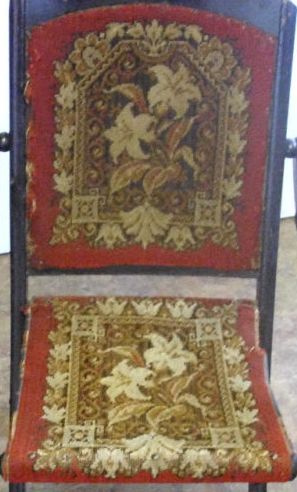
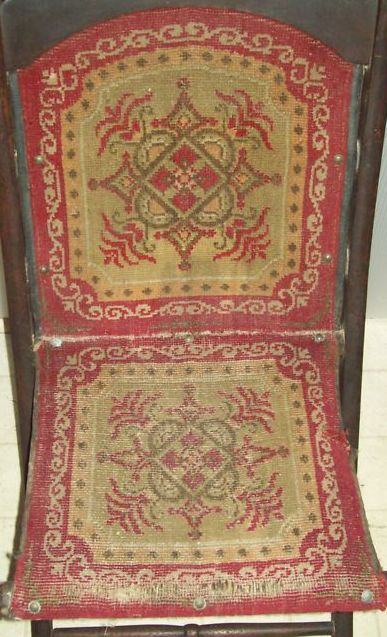
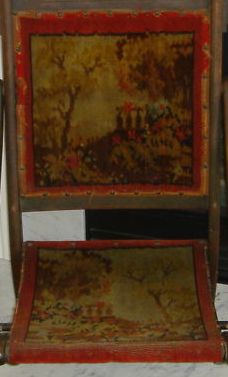
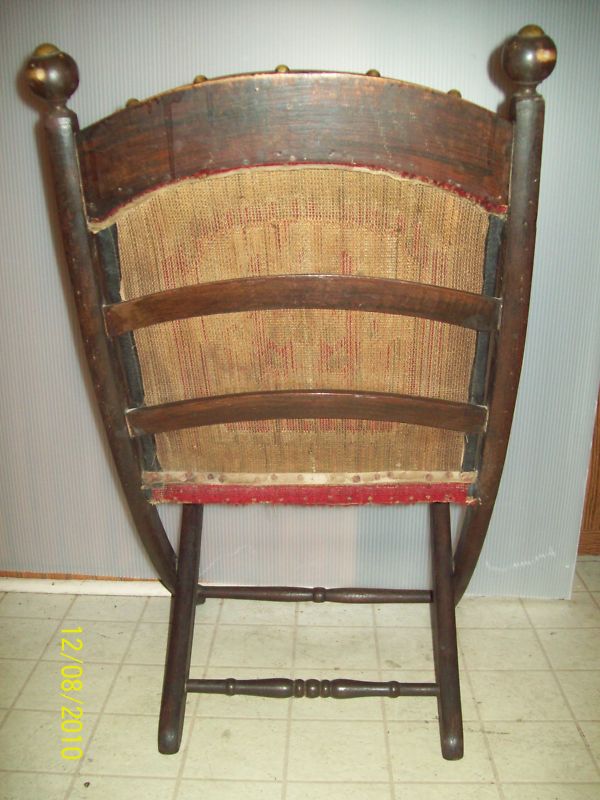
Let’s start by looking at the seats and backs on some original folding chairs. Each of these chairs are appear to have their original seats and backs. The chairs date from the 1860s through the end of the century.

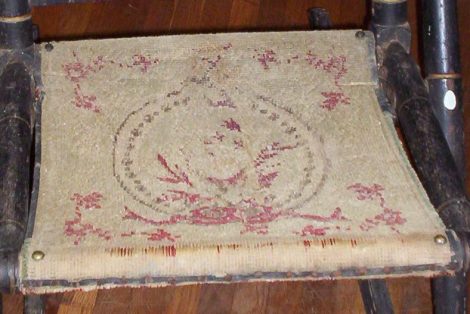
This faded and worn seat comes from my later century chair. Notice the wreath central design and floral corner motifs. The use of a central motif surrounded by corner or border motifs seem to be fairly common for these chairs. The seats and backs seem to mostly be either tapestry twill woven similar to an ingrain carpet or done in needlepoint.

This chair, circa 1870-90s, has a duo of lilies as the central motif. The borders are a combination of geometrics and florals.

This chair, the one of this set closest to the CW era, has a central design with a floral-esque border. You will notice that the red color can be found in each of the chair seats and backs here. I do not know if this was because this was a common color or if this color just lasted well.

These scenic designs are found on an Eastlake style chair. I wish I could get a closer look at this one to determine the construction method. The lines in the edge of the red appear to be carpet-like.

IMAGES ADDED…..

Published in: on February 5, 2012 at 2:59 pm  Leave a Comment