From Trials and Confessions of an American Housekeeper. Philadelphia, 1854
I Have a pleasant story to relate of a couple of fashionables of our city, which, will serve to diversify these “Confessions,” and amuse the reader. To the incidents, true in the main, I have taken the liberty of adding some slight variations of my own.
A lady of some note in society, named Mrs. Claudine, received a very beautiful bonnet from New York, a little in advance of others, and being one of the rival leaders in the fashionable world, felt some self-complacency at the thought of appearing abroad in the elegant head-gear, and thereby getting the reputation of leading the fashion.
Notwithstanding Mrs. Claudine’s efforts to keep the matter a secret, and thus be able to create a surprise when she appeared at church on the next Sunday, the fact that she had received the bonnet leaked out, and there was some excitement about it. Among those who heard of the new bonnet, was a Mrs. Ballman, who had written to a friend to get for her the very article obtained first by Mrs. Claudine. From some cause or other a delay had occurred, and to her chagrin she learned that a rival had the new fashion, and would get the eclat that she so much coveted. The disappointment, to one whose pleasures in life are so circumscribed as those of a real fashionable lady, was severe indeed. She did not sleep more than a few hours on the night after she received the mortifying intelligence.
The year before, Mrs. Claudine had led the fashion in some article of dress, and to see her carry off the palm in bonnets on this occasion,
when she had striven so hard to be in advance, was more than Mrs. Ballman could endure. The result of a night’s thinking on the subject was a determination to pursue a very extraordinary course, the nature of which will be seen. By telegraph Mrs. Ballman communicated with her friend in New York, desiring her to send on by the evening of the next day, which was Saturday, the bonnet she had ordered, if four prices had to be paid as an inducement to get the milliner to use extra exertions in getting it up. In due time, notice came back that the bonnet would be sent on by express on Saturday, much to the joy of Mrs. Ballman, who from the interest she felt in carrying out her intentions, had entirely recovered from the painful disappointment at first experienced.
Saturday brought the bonnet, and a beautiful one it was. A few natural sighs were expended over the elegant affair, and then other feelings came in to chase away regrets at not having been first to secure the article.
On the day previous, Friday, Mrs. Ballman called upon a fashionable milliner, and held with her the following conversation.
“You have heard of Mrs. Claudine’s new bonnet, I presume V
“Yes, madam,” replied the milliner.
“Do you think it will take?” asked Mrs. Ballman.
“I do.”
“You have not the pattern?”
“Oh, yes. I received one a week ago.”
“You did!”
“Yes. But some one must introduce it. As Mrs. Claudine is about doing this there is little doubt of its becoming the fashion, for the style is striking as well as tasteful.”
Mrs. Ballman mused for some moments. Then she drew the milliner aside, and said, in a low, confidential tone.
“Do you think you could get up a bonnet as handsome as that, and in just as good taste?”
“I know I could.” In my last received London and Paris fashions are several bonnets as handsome as the one that is about being adopted in New York, and here also without doubt.”
“I am not so sure of its being adopted here,” said the lady.
“If Mrs. Claudine introduces it, as I understand she intends doing on Sunday, it will certainly be approved and the style followed.”
“I very much doubt it. But we will see. Where are the bonnets you spoke of just now?”
The milliner brought forth a number of pattern cards and plates, and pointed out two bonnets, either of which, in her judgment, was more beautiful than the one Mrs. Claudine had received.
“Far handsomer,” was the brief remark with which Mrs. Ballman approved the milliner’s judgment. “And now,” she added, “can you get me up one of these by Sunday?”
“I will try.”
“Try won’t do,” said the lady, with some excitement in her manner. “I must have the bonnet. Can you make it?”
“Yes.”
“Very well. Then make it. And let it be done in your very best manner. Why I wish to have this bonnet I need hardly explain to you. I believed that I would have received the bonnet, about to be adopted in New York, first. I had written to a friend to procure it; but, by some means, Mrs. Claudine has obtained her’s in advance of me. Mine will be here to-morrow, but I don’t mean to wear it. I wish to lead.”
“If you were both to appear in this bonnet, the fashion would be decided,” said the milliner.
“I know. But I have no wish to share the honor with Mrs. Claudine. Make me the bonnet I have selected, and I will see that it puts her’s down.”
“You will remember,” said the milliner, ” that her’s has been already adopted in New York. This will be almost sure to give it the preference. It would be better that you did not attempt a rivalry, than that you should be beaten.”
“But I don’t mean to be beaten,” replied the lady. “I have taken measures to prevent that. After Sunday you will hear no more of the New York bonnet. Mine will go, and this, I need not tell you, will be a feather in your cap, and dollars in your pocket; as I will refer to you as the only one who can get it up. So do your best, and improve the pattern we have selected, if it will bear improvement.”
The milliner promised to do her “prettiest,” and Mrs. Ballman returned home in a state of considerable elation at the prospect of carrying off the palm, and humiliating her. rival at the same time.
Mrs. Claudine, though a little vain, and fond of excelling, was a woman of kind feelings, and entirely superior to the petty jealousies that annoyed Mrs. Ballman, and soured her towards all who ‘succeeded in rivalling her in matters of taste and fashion. Of what was passing in the mind of the lady who had been so troubled at her reception of a new style of bonnet from New York, she was entirely ignorant. She was not even aware that Mrs. Ballman had ordered the same article, nor that she had suffered a disappointment.
Saturday came. Mrs. Claudine was busy over some little article of dress that was to add to her appearance on the next day, when an Irish girl, who had formerly lived with her, entered her room.
“Ah! Kitty!” said the lady pleasantly. “How do you do?’
“I’m right well, mum, thankee,” replied Kitty, with a courtesy.
“Where do you live now, Kitty?” inquired Mrs. Claudine.
“I’m living with Mrs. Ballman,” said the girl.
“A very good place, I have no doubt.”
“Oh, yes, mum. It is a good place. I hain’t much to do, barrin’ going out with the children on good days, and seein’ after them in the house; and I get good wages.”
“I’m very glad to hear it, Kitty; and hope you will not give up so good a home.”
“No, indeed, mum; and I won’t do that. But Mrs. Claudine—”
Kitty’s face flushed, and she stammered in her speech.
“What do you wish to say?” inquired the lady, seeing that Kitty hesitated to speak of what was on her mind.
“Indade, mum,” said Kitty, evincing much perplexity, “I hardly know what I ought to do. But yez were good to me, mum, when I was sick, and didn’t send me off to the poor house like some girls are sent; and I never can forget yez while there’s breath in me body. And now I’ve come to ask yez, just as a favor to me, not to wear that new bonnet from New York, to-morrow.”
It was some moments before the surprise, occasioned by so novel and unexpected a request, left Mrs. Claudine free to make any reply.
“Why, Kitty!” she at length exclaimed, “what on earth can you mean?”
“Indade, mum, and yez mustn’t ask me what I mane, only don’t wear the bonnet to church on the morrow, because—because—och, indade, mum, dear! I can’t say any more. It wouldn’t be right.”
Mrs. Claudine told Kitty to sit down, an invitation which the girl, who was much agitated, accepted. The lady then remained silent and thoughtful for some time.
“Kitty,” she remarked, at length, in a serious manner, “what you have said to me sounds very strangely. How you should know that I intended appearing in a new bonnet to-morrow, or why you should be so much interested in tbe matter is more than I can understand. As to acting as you desire, I see no reason for that whatever.”
This reply only had the effect of causing Kitty to urge her request more strenuously. But she would give no reason for her singular conduct. After the girl had gone away, Mrs. Claudine laid aside her work—for she was not in a state of mind to do any thing but think—and sat for at least an hour-, musing upon the strange incident which h%d occurred. All at once, it flashed upon her mind that there must be some plot in progress to discredit or rival her new bonnet, which Kitty had learned at Mrs. Ballman’s. The more she thought of this, the more fully did she become satisfied that it must be so. She was aware that Mrs. Ballman had been chagrined at her leading ofl’ in new fashions once or twice before; and the fact, evident now, that she knew of her reception of the bonnet, and Kitty’s anxiety that she should not wear it on Sunday, led her to the conviction that there was some plot against her. At.first, she determined to appear in her new bonnet, disregardful of Kitty’s warning. But subsequent reflection brought her to a different conclusion.
The moment Mrs. Claudine settled it in her mind that she would not appear in the new bonnet, she began dressing herself, hurriedly, to go out. It was as late as five o’clock in the afternoon when she called at the store of the milliner who had been commissioned by Mrs. Ballman to get the rival bonnet.
“Have you the last fashions from abroad?” enquired Mrs. Claudine.
“We have,” replied the milliner.
“Will you let me see them?”
“Certainly, ma’am.”
And the patterns were shown. After examining them carefully, for some time, Mrs. Claudine selected a style of bonnet that pleased her fancy, and said—
“You must get me up this bonnet so that I can wear it to-morrow.”
“Impossible, madam!” replied the milliner. “This is Saturday evening.”
“I know it is; but for money you can get one of your girls to work all night. I don’t care what you charge; but I must have the bonnet.”
The milliner still hesitated, and seemed to be confused and uneasy. She asked Mrs. Claudine to sit down and wait for a little while, and then retired to think upon what she had better do. The fact was, Mrs. Claudine had pitched upon the very bonnet Mrs. Ballman had ordered, and her earnestness about having it made in time i to wear on the next day, put it almost beyond
her power to say no. If she were to tell her that Mrs. Ballman had ordered the same bonnet, it would, she knew, settle the matter. But, it occurred to her, that if both the ladies were to appear at church in the same style of bonnet, the fashion would be sure to take, and she, in consequence, get a large run of business. This thought sent the blood bounding through the milliner’s veins, and decided her to keep her own counsel, and take Mrs. Claudine’s order.
“She’s as much right to the bonnet as Mrs. Ballman,” settled all ethical questions that intruded themselves upon the milliner.
“I will have it ready for you,” she said, on returning to Mrs. Claudine.
“Very well. But mind,” said the lady, “I wish it got up in the very best style. The hurry must not take from its beauty. As for the price, charge what you please.”
The milliner promised every thing, and Mrs. Claudine went home to think about the important events of the approaching Sabbath. On Sunday morning both bonnets were sent home, and both the ladies fully approved the style, effect, and all things appertaining to the elegant affairs.
At ten o’clock, Kitty, who was a broad-faced, coarse-looking Irish girl, came into the chamber of Mrs. Ballman, dressed up in her best, which was not saying much for the taste and elegance of her appearance.
“Are you all ready?” asked her mistress.
“Yes, mum.”
** Very well, Kitty, here’s the bonnet. Now, remember, you are to go into the pew just in front of ours. The Armburner’s are all out of town, and there will be no one to occupy it.”
Kitty received the elegant bonnet which had come on express from New York, and placed it upon her head.
“You really look charming,” said the lady.
But Kitty was not nattered by her words, and evinced so little heart in what she was doing, that Mrs Ballman said to her, in a half threatening tone, as she left the room—
“Mind, Kitty, I shall expect to see you at church.”
“Oh, yes, mum; I’ll be there,” replied Kitty, courtesying awkwardly, and retiring.
Not long after Kitty had retired, Mrs. Ballman, after surveying, for many minutes, the effect of her new bonnet, becoming more and more pleased with it every moment, and more and more satisfied that it would “take,” left her room, and was descending the stairs for the purpose of joining the family, who were awaiting her below. Just at that unlucky moment, a servant, who was bringing down a vessel of water, slipped, and a portion of the contents came dashing over the head and shoulders of the richly attired lady, ruining her elegant bonnet, and completely destroying the happy frame of mind in which she was about attending public worship. No wonder that she cried aloud from the sudden shock and distress so untoward an event occasioned; nor that she went back weeping to her chamber, and refused to be comforted.
Mr. Ballman and the children proceeded alone
to church on that day. On their return home, they found the lady in a calmer frame of mind. . But Mr. Ballman looked grave and was unusually silent. Kitty came home and gave up her elegant head-dress; and when her mistress told her that she might keep it, she thanked her, but declined the present.
“You went to church, of course,” she said.
“Oh, yes, mum,” replied Kitty.
“And sat in the Armburner’s pew?”
“Yes, mum.”
“Alone.”
“Yes, mum.”
“Was Mrs. Claudine there?”
“Yes, mum.”
“Did she wear her new bonnet?”
“Yes, mum.”
“It was exactly like this?”
“Oh, no, mum, it was exactly like the new one you had sent home this morning.”
“What!” The face of the lady flushed instantly. “Wasn’t it like this?”
“No, mum.
Mrs. Ballman sunk into a chair.
“You can retire, Kitty,” she said, and the girl withdrew, leaving her to her own feelings and reflections, which were not of the most pleasing character.
The appearance of Kitty at church, fully explained to Mrs. Claudine the ungenerous game that had been played against her. Her first thought was to retaliate. But reflection brought other and better feelings into play. Instead of exposing what had been done, she destroyed the bonnet received from New York, and made an effort to keep what had occurred a secret. But Kitty’s appearance at church in such an elegant affair, naturally created some talk. One surmise after another was started, and, at last, from hints dropped by the milliner, and admissions almost extorted from Mrs. Claudine, the truth came out so fully, that all understood it; nor was Mrs. Ballman long left in ignorance on this head.
As to the fashion, Mrs. Claudine’s bonnet became the rage; though, as might be supposed, Mrs. Ballman refused to adopt it.
Who will be the successful rival next season, I am unable to predict. But it is believed that Mrs. Claudine intends giving Mrs. Ballman an advance of two weeks, and then coming in with a different style, and beating her in spite of the advantage.
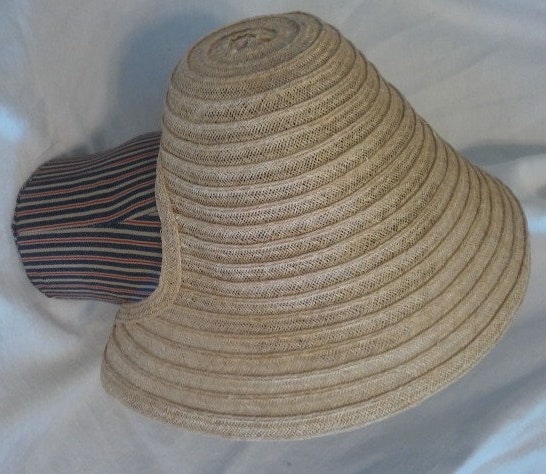
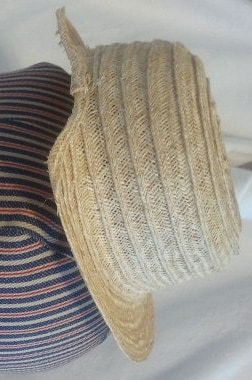
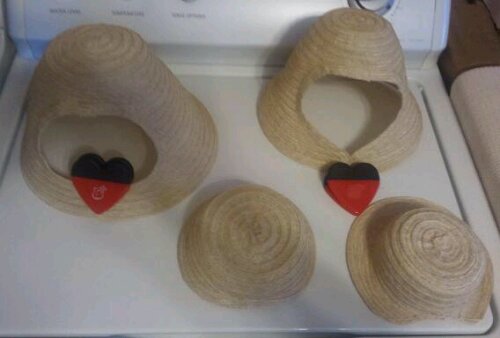
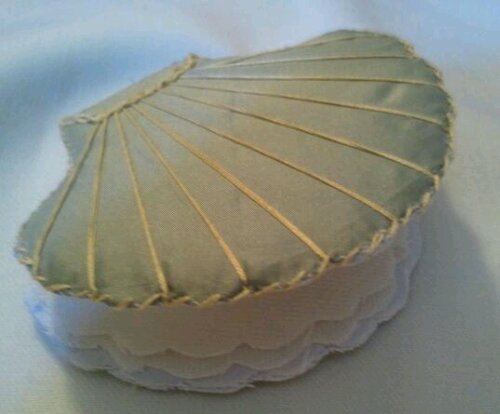
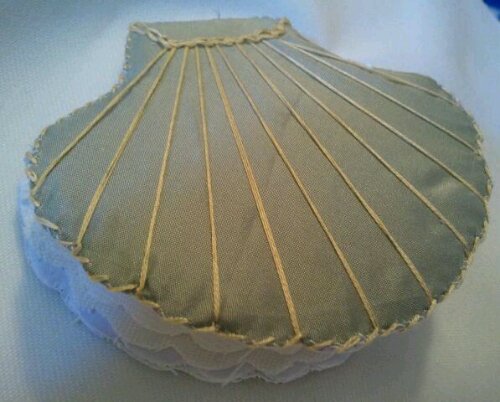
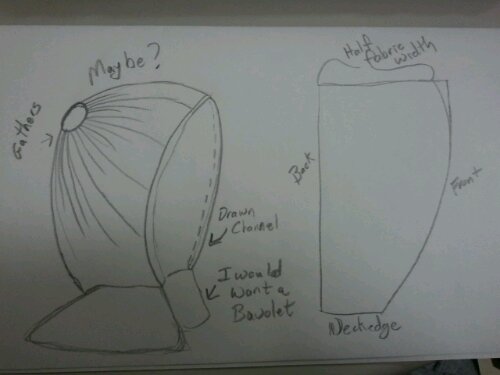
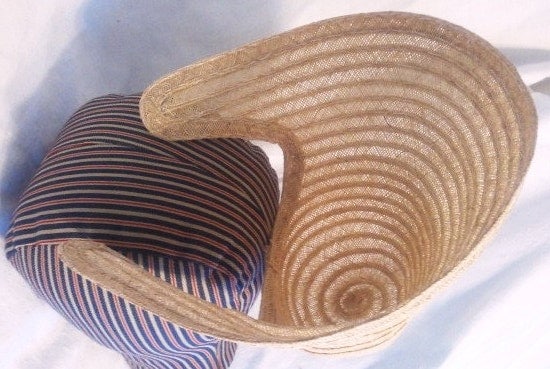 Here is the Marie Stuart several people asked for. This was quite to fussy shape to work with.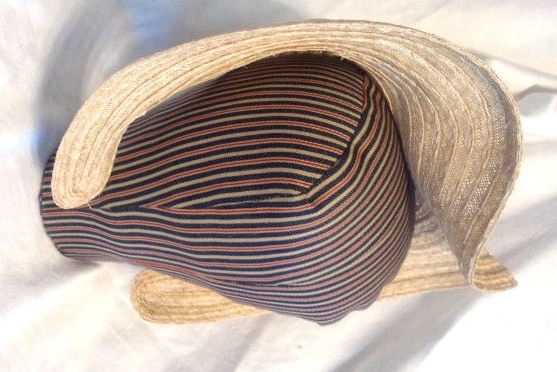







 If I Had My Own Blue Box: