Third Summer Bonnet

Okay, I really need beter titles for these.
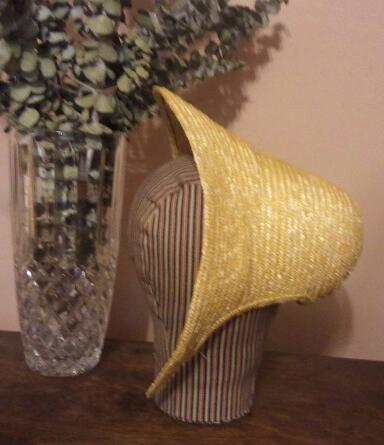
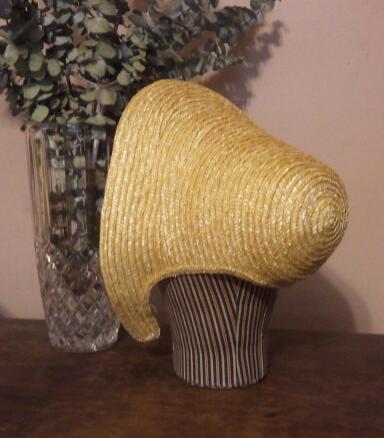
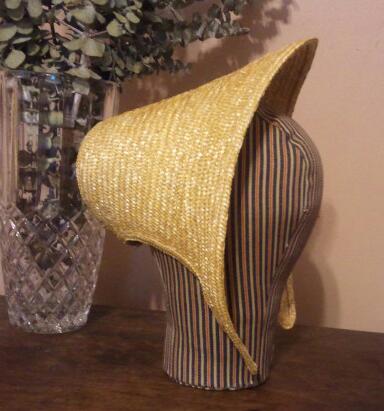
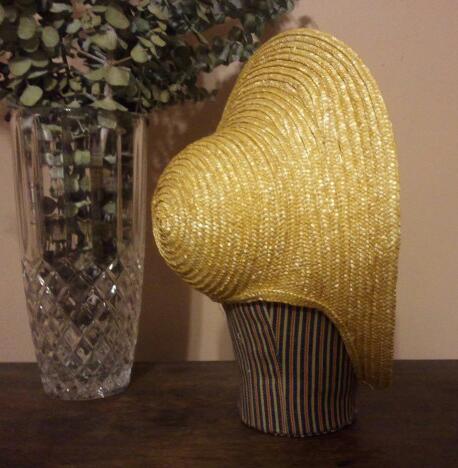
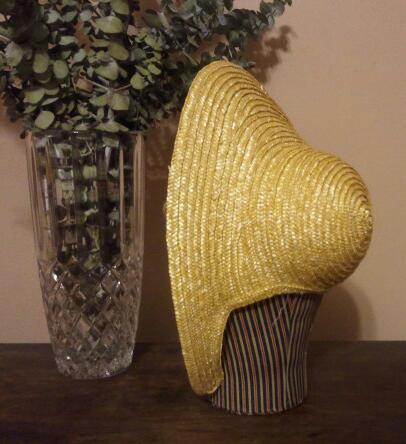
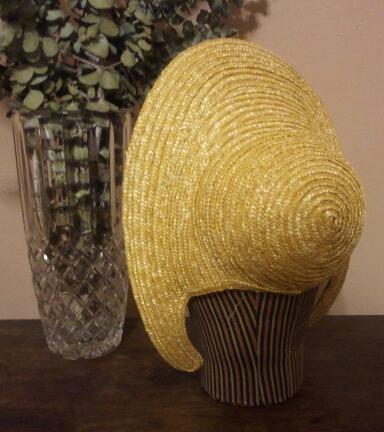
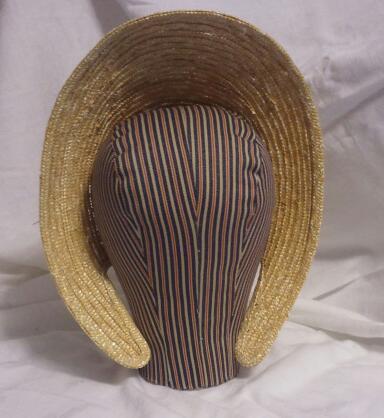
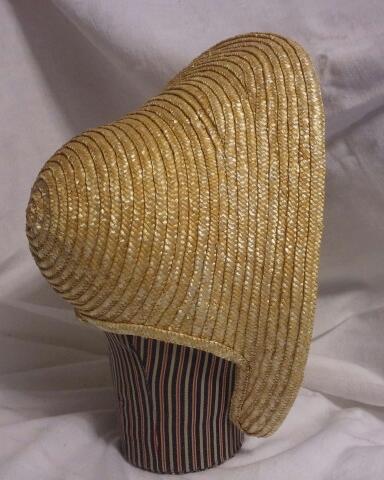
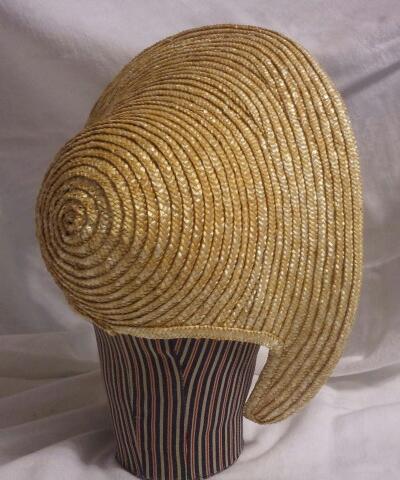
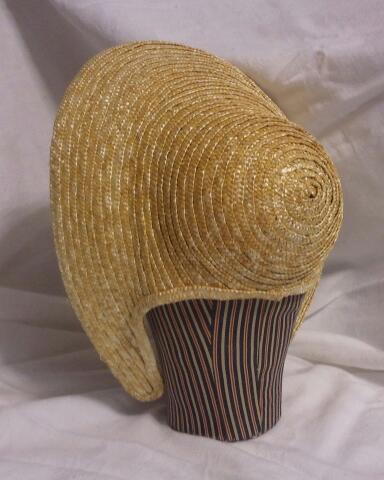
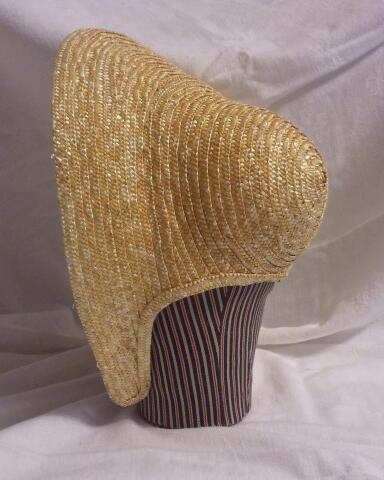
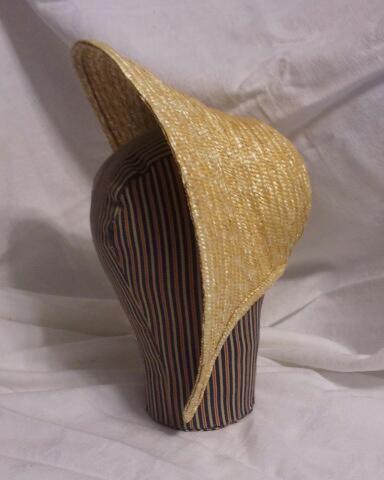
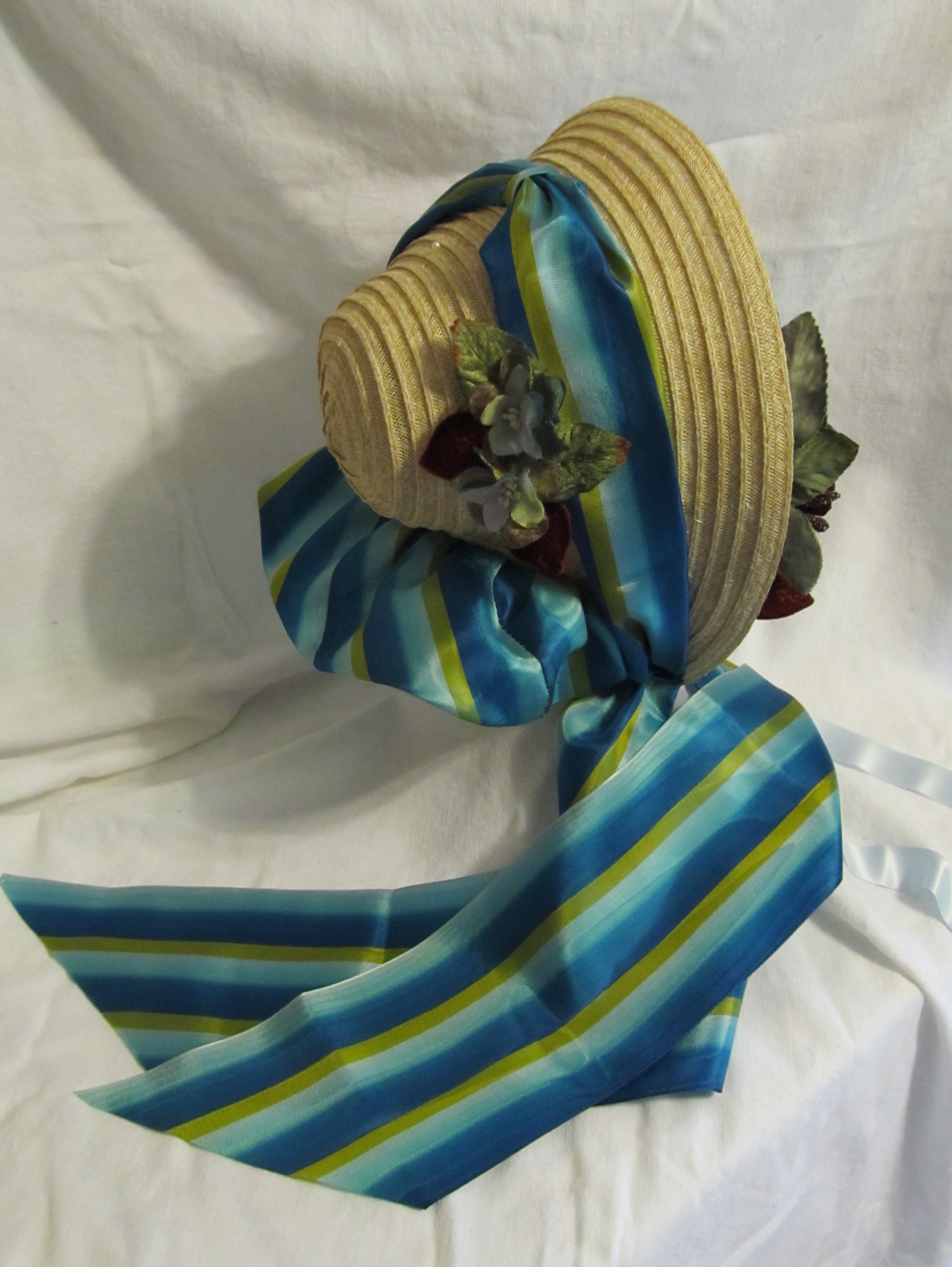
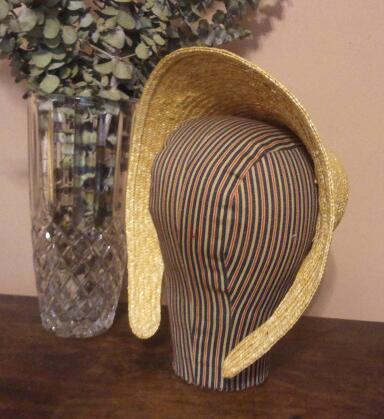
This bonnet already has a new home. I happen to love how the shape came together. It has a gentle rise from the tip to the crown. The brim has the very popular spoon shape.
Like all my bonnets, this is hand sewn. It is wire through the brim & cheektabs.

image

image

image

image

Please visit my Etsy store to see each of my bonnets as they become available.

Second Bonnet of Summer

Here is the second bonnet of this week’s sewing spree. This is the bonnet for someone who want the brim further back from their face. It is a high-brim with a gentle curve to the brim. This is a small to medium size high brim bonnet. It is entirely hand sew. The straw is a narrow whole plait of real straw with a beautiful rage of golden tones. It is wired through the brim and cheektabs.
image

image
image

Please visit my Etsy Store for each of my straw bonnets (and other goodies) as they become available.

First Bonnet of the Summer

This is my first straw bonnet of the summer. Right now I’m with a fantastic narrow whole straw plait. I love the golden colors it has. I also love the sweet smell of the straw.
This bonnet has already found its new owner. It is an average size high brim spoon bonnet popular in the early 1860s. The rows of straw plait are hand sewn, with the brim and cheektabs wired.
Please visit my Etsy Store to see each of my bonnets as they become available.
image

image

image

image

image

image

Among the Milliners

This humorous article is far less about milliners or millinery than it is about the follies of the ‘reporter.’ It is such a level of ridiculousness, I do hope you enjoy it. (I also have other suspicions) 

Among the Milliners.

Beau Hackett as a fashion reporter. I was fowling in the marches of Calumet when I received your note. I was preying remorselessly upon the feathered tribe generally, with a double-barreled shot gun. My ammunition was about exhausted. I had startled with a quarter bottle full of powder in my breast pocket, but tha tall was gone except a ‘snit.’ My shot pouch was almost  empty, too, but I did not care for that. A man can hunt well enough without shot if only he has plenty of powder – the kind that flies to the head.

Your message arrived in good time to be heeded. I had just got a splendid duck – by falling off a log into a stream of muddy water. I felt so much elated by my success that I was ready to quit. Only a few hours previous to that I had slain a dozen of the plumpest ducks I ever saw. Before I had time to collect them together the owner appeared upon the field of carnage, and informed me that they were his ducks, and were not wild, and had never been. The owner’s name was Drake. – You can image how I felt  when I learned that my ducks were all Drake’s. I gave them up, like a reasonable man, and charged him nothing for killing them. I can be generous whenever I want to.

After so many repeated successes it is not strange that I felt ready to leave the field. I read the cabalistic line of your message, ‘come up and do the openings.’ I wanted to come bad enough, but I had no idea what the missive meant. There were so many openings in the world, so many things that can be opened. There are letters, for instance; letter that belong to you and letters that don’t; and there is champagne that can be opened; and so can ink bottles, so can a bank, so can oysters (can oysters). When I arrived at oysters I stopped a while, and it occurred to me that I had caught your idea. Somebody was going to open a can of oysters (the first of the season, may be), and you wanted me to report the affair. Accordingly I came to the city in great haste, my speed being accelerated by knowledge of the fact that my powder was all gone, and there is no good powder outside of Chicago I was disappointed, not disagreeably, however, when I was informed that the grand season of opening millinery and straw goods had arrived, and that I was wanted to make a tour of Lake street and make an article on the fall fashions.

I felt complimented when I was told that I was the man for the position, because I had a more intimate acquaintance with milliners, and could get information from the fair sex better than anybody else. I am susceptible of flattery, a little, and I felt complimented, but I mistrusted my ability. I have not had much experience in reporting. I wrote local items for three days on a country newspaper six years ago, and some of them are going the rounds of the press yet. I ought to have had them copyrighted for they are never credited to me. I will give one of them – the first I ever wrote – and which is reproduced in the papers every month or two. It is pretty good, and will give you an inkling of my style:

“ACCIDENT – Yesterday a team attached to a wagon rushed madly down one of our principal streets a distance of a mile or two, and were only prevented from running away by gentleman who, at the hazard of his life, seized them by the reins and stopped them. We are fearfully and wonderfully made.”

If you hear of anybody that wants to engage a man to write that sort of items all the time, I wish you would let me know it.

I commenced at the foot of Lake street to do the fashions. I went through the great union depot from one end to the other, and up stairs and down, but I could find no millinery store there. I then struck out boldly up Lake street, and came to a large house nearly opposite a large house on the opposite side of the street. I am thus precise in giving localities that the public may know where the millinery store is to be found. A reliable gentleman, to whom truth is a greater stranger that fiction, told me that the second story of the large house on the opposite side of the street was a bonnet and straw goods establishment. That was the information I was looking for, and I bounded up stairs.

‘Like a wild gazelle,”

If I may be allowed to institute a comparison. At this time I was absorbed in deep meditation, thinking how I should begin my article, and whether I should puff anybody. I was abstracted, I think, and I sailed up the stairway with my body bent forward about nineteen degrees from the perpendicular, a pencil under my arm and a reporter’s book over my right ear. I reached the head of the stairs suddenly, inasmuch as I was going very rapidly, and as a consequence of my abstractedness, or something else, I drove my head plump into a bonnet that the proprietress was showing to a customer, and tried to stammer an apology, but it was a no go.

The proprietress looked reaping machines at me. I threw my pencil down and begged pardon for smoking in her presence, thinking it was a cigar. Told her I hoped I hadn’t smashed anything, and she smiled a little and said I hadn’t. Then I felt a little better, and told her I was a reporter. Then she looked milder than ever, and said, “Oh, indeed!” and immediately afterward she became insufferably inquisitive, asked me a volley of incomprehensible questions, and stared at me all the time as though she was counting the plaits in my shirt ruffles or the links in my watch chain, or the brilliants in my breastpin, or anything else you like.

“Are you long hand or short hand?” she asked.

“Neither,” said I, “I am a new hand, and I rather dislike the business, as far as I’ve got”

The proprietress conducted me through a long hall into a large room occupied by about twenty bonnets and sixty milliners, saleswomen, etc. I did not look at the bonnets for the first half hour, but devoted myself exclusively to taking an inventory of the young ladies.

“This is a charming bonnet – golden dun – Marie Stuart front,” said the lady-in-chief.

“Yes, she is,” I replied, “but her hair is a little too red.”

I discovered my mistake when it was too late to correct it. That’s my luck.

As soon as the divine little milliners learned who I was, they gathered around me in a circle, and all were anxious to see who could say the most and best things. One was descanting upon the beauties of a chip bonnet, and another handed me a bunch of grapes to examine. I bit one of the grapes, my mouth was full of broken glass. Then I thought I would rather report a camp meeting than a millinery store; then I thought I wouldn’t, and I mustered my courage and made another note in my note-book, (grapes, not sour, but sharp.) my tongue bled fearfully, and I spoiled my best embroidered handkerchief wiping it away the blood. The circle diminished, and the crowd (perhaps I should say bevy) came closer. I began to want fresh air severely. Too many females in a close room render the atmosphere oppressive.

“This is beautiful,” said a charming creature with pearly eyes and black teeth, “this is a dear duck of a bonnet.”

“Is it a wild duck?” said I, “I’ve had enough of wild ducks, especially if they belong to a man by the name of Drake.”

“Price, seventy-five dollars,” she continued, paying about as little attention to me as a man of my qualifications could expect.

I asked her if she would sell it in small lots, and how much one of the straws would come to, but before I had finished the question she was showing me something else.

The ladies became less timid as they became more acquainted, and approached so near me when they wanted to give me a bonnet to look at, that my ruffles were in danger of being crushed. They piled bonnets upon me till I had both arms full and the tops ones began to fall off, and every time I stooped to pick up one I dropped two. It required some skillful engineering to keep from being engulphed in the ocean of crinoline that surrounded me; and in making a desperate effort to escape from one billow that came fearfully near me, I plunged both feet into a magnificent French chip bonnet (that was the name of it,) with a Marie Stuart or Louisa Jane Susan Smith front, I forget which. There was another crash of glass artificial, a bunch of wheat was crushed to flour, and a fine blush rose blushed for the last time.

The milliners all screamed – the circle was broken; some rushed one way and some another, and some rushed in an opposite direction. I rushed to a window and measured the distance to the ground with my mathematical eye. I had not made up my mind exactly when a ten-year-old whom I had not seen before (I think she was an apprentice) sung out in a shrill voice “Ma says if you don’t pay her for the last shirt she made for you she’ll prosecute you in the court-house.”

I should have been proud to know that I had an acquaintance there if I had not been in a hurry. I threw myself out upon the sidewalk without breaking a bone, and – I still live. When next I go to report a millinery affair I shall go in a full suit of armor.

I am, feelingly, Beau Hackett. (Lancaster Intelligencer.  November 10, 1863. Reprinted from the Chicago Post. http://digitalnewspapers.libraries.psu.edu)
Published in: on June 8, 2013 at 9:00 am  Leave a Comment  

Making a Hat Stand

I know several people found my fabric headform post helpful. Check out this realy nice ‘how-to’ on making a wooden hat/bonnet stand.

Tea in a Teacup

Ever thought a hatbox didn’t do justice to your collection of hats? Ever wanted to display your hat-making skills to the world, or at least to your visitors? Why not try making a hatstand!

After seeing some hatstands at a friend’s house, I have been keen to make a pair to display my Regency bonnets. Having my bonnets on display means that I could spend time admiring and enjoying my handiwork as a decoration, rather than always having them packed away awaiting my next costuming event.

Hatstands, both as larger hall furniture and as smaller dressing table pieces, became popular during the Victorian era. They could be made from wood or cast iron, and could be covered with a fabric, such as velvet. They were also often weighted in the base, which increased the stability of the stand once a hat was placed on the top.

This week I have…

View original post 655 more words

Published in: on May 27, 2013 at 12:38 pm  Leave a Comment  

Fun Fifty’s Bonnet

???????????????????????????????I wrapped up a tremendously enjoyable custom bonnet today. The recipient is truly one of those fun customers that you jump to work for. Together we picked out the flowers and ribbons for this 50s bonnet. The amazing striped ribbon is a vintage piece from Italy. The flowers are a combination of vintage and current done in luscious velvet including the strawberries.

??????????????????????????????????????????????????????????????

Thank You, B, for asking me to make this bonnet for you. I hope you enjoy wearing it as much as I enjoyed making it.

The Faux Customer

You already know I enjoy stories of my favorite topics be it travel, shawls or millinery. This story had me do a double take. It comes from  a book I’ve been enjoying, The Diary of a Milliner , by Belle Otis in 1867:

“To illustrate the importance of what I have been saying I will tell a tale of to-day. Those who like to turn every thing to instruction may whittle a moral therefrom

A well-dressed lady came up to me, and asked me to show her some of our handsomest bonnets.

I asked. “Are you looking for any particular style or color?”

“No. I wish to see what will become me best.”

She deliberately took off her own bonnet and commenced trying those that were on the saloon table. One after one she took them up, and put them on her head, till she had seen about thirty casting their differently combined tints over her complexion. She invited my comments and suggestions upon each one. She viewed herself in each in the five mirrors of the saloon, in all the various light she could command, and placed herself in ever conceivable attitude before them.

One thing or another was at fault with every one of them. She had asked the price of all, and cheapened each to the lowest possible fraction for which they could be bought.

She then went to the side-table, and performed the same operation with fifteen or twenty more. There were none that exactly suited.

“Haven’t you put some away in drawers?” she asked. I went the same rounds with a dozen drawers containing six or eight bonnets apiece.

When those were exhausted she pointed to the window, and asked if I would be kind enough to bring here two handsome bonnets that were hanging there.

Something in the inner life, probably it was that attribute of the dual denomination penetration, admonished me that she didn’t wish to purchase a bonnet, but was seeking an afternoon’s entertainment at our expense. Another something, whether it was a spirit tapping, tapping at the inner door I know not, admonished me that there are times when to practice the forbearing policy of the remarkable patriarch, of whom I have been speaking, is to cast pearls before swine. Instead of starting for the desired bonnets, looked at her steadily in the eye while I modulated my voice to a very respectful tone, and replied:

“If you really wish to buy a bonnet, I will go down and get them; but I fear that will suit you no better than the others have done.”

She saw that her role was played to the end and a successful actress she had proved herself. She had confined her audience in the closest attention for about  two hours. The other two bonnets were beyond her reach. With the most inimitable coolness and unconcern she looked me back and replied:

“I don’t wish to buy a bonnet. I bought mine last week.”

If she had struck me in the face I wouldn’t have been more startled and surprised than I was at the exhibition of such boldness. I could scarce refrain from crying out, “O shame, where hides thy blush!”

After a moment, the ease with which she had accomplished her consummate piece of impudence. Moderated by my indignation to a sort of admiration. I would like to know more about you, I thought.

I could conceive of no motive that could induce a lady – so she appeared on the surface – to make so irredeemably mean an exhibition herself. I abnegated self in apparent interest in her affairs, and quietly asked:

“If you didn’t wish to purchase, why have you tried on so many bonnet?”

“I wanted to find out your prices, to see if I got cheated in mine. If I did I’ll never trade at the place where I bought  it again.”

She had told me the truth, but not the whole truth. I like to sift truth to the bottom, so I pursued:

“You needn’t have tried all those bonnets to find out the prices. I would have told you that, with pleasure, if it would have given you satisfaction.

“Oh, I wanted to see, too, if you had a bonnet in your store more becoming to me than mine. My milliner told me if I could find one in the whole city more so I might keep the bonnet and she would give me the money back!”


After extensive internal exasperation for the milliner, the discussion continues revealing the faux-customer had every intention of retrieving her money and leaving the bonnet she purchased as a way of punishing the shopkeeper, claiming “I haven’t worn it but three times, – once to church, once out to Roxbury, and once to the Museum.” and Store-keepers do tell such shocking lies in order to sell their goods, I see no other way but to keep strict watch of them, and bring them up to the mark when they overreach and don’t tell the truth.

Published in: on May 25, 2013 at 8:00 am  Leave a Comment  

Friday Night Millinery

With Dan off to an event, I slept in. How lovely is that? Now, before I dive into a full day of sewing, I want to share last night’s.
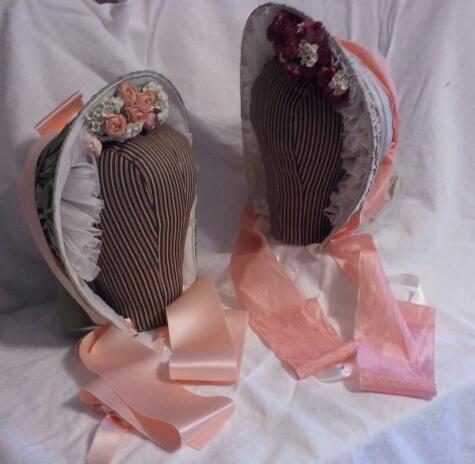
I lost track of time for ordering the pink ribbons to finish off the bonnets that have been dangling in the livingroom. Carole, at The Ribbon Store, came through for me. Here are the two bonnets with her pink ribbons. The green on the left is Lily’s. The pearl gray is mine, which I’ll be wearing tomorrow at GCV for their Red Day.
image
image
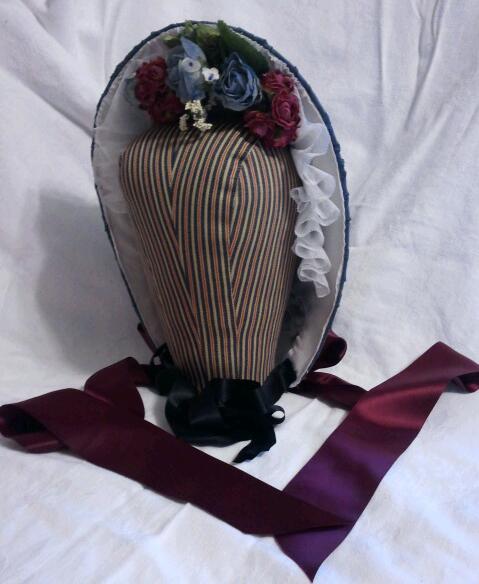
To wrap up the trio, the slate grey bonnet finally got its ribbon and flowers attached too.
image
I also moved the waist gathers on the green dress to eliminate that odd tug at the top closure. (Hopefully photos of that dress tomorrow)
So, now that I’ve read my 37 Saurday morning emails, it is time for a late breakfast followed by my Netherfield Ball dress.

Published in: on May 18, 2013 at 9:09 am  Leave a Comment  
Tags:

To Clean a Bonnet

Miss Leslie’s Lady’s House-book; a Manual of Domestic Economy Containing Approved Directions for Washing, Dress-making, by Miss Eliza Leslie, 1850.

TO CLEAN A STRAW OR LEGHORN BONNET

Having separated the crown from the brim and the cape or neck-piece, and removed the lining and wire, the next thing is to take out whatever stains may be found in the bonnet, the crown of which should be put on a wooden block. For grease, rub on with your finger some powdered Wilmington clay, or a little magnesia; and in an hour or two brush it off, and renew the application, if necessary. For other stains use either cream of tartar or salt of sorrel, put on a little wet. If salt of sorrel,must be washed off again almost immediately, lest it injure the straw by remaining on it. Afterwards (keeping the crown still on the bonnet-block) go over the whole surface of the bonnet with a brush dipped in a weak solution of pearl ash in lukewarm water, (a tea-spoonful to a quart.) Then scour it off at once, with a strong lather of brown soap and cold water, put on with a clean brush. When all the bonnet is well cleaned, rinse it in cold water, and hang it in the sun to dry. Bonnet cleaning should never be undertaken in damp weather. When the bonnet is perfectly dry, you may proceed to whiten it. Fill a chafing dish or portable furnace with burning charcoal; carry it into a small close room or into an empty press or closet, and by a line suspended across, hang the bonnet over the charcoal, at a safe distance, so that it will be in no danger of scorching. Then strew over the coals an ounce or two of powdered brimstone, and immediately go out and shut the door, seeing that no air whatever can get into the room. After the bonnet has hung in the vapour six or seven hours, throw open the door, (having first left open an outside door or window, so as to admit immediately the fresh air,) and go into the room as soon as you find you can do so without inconvenience from the fumes of the charcoal and sulphur. Then bring out the bonnet, and hang it in the open air till the smell of the brimstone has entirely left it. If the day is windy, so much the better; but the bonnet must on no account be hung out if the weather is damp, and it must be brought in before sunset. If it is not sufficiently white, repeat next day the process of bleaching it with charcoal and brimstone.

The next thing is to stiffen the bonnet. To make the stiffening, boil in two quarts of soft water, a quarter of a pound of vellum shavings, (the vellum of buffalo’s hide is best,) filling it up occasionally, if it seems to be boiling too dry. It must boil or simmer slowly for six or seven hours. Then, when you take it from the fire, let it stand a while to settle; after which,

pour it off into a basin, and it will become a thick jelly. To the sediment left in the pot, you may add a second two quarts of water; and after a second boiling, it will form another jelly or sizing, strong enough for similar purposes. When you are going to use it for a bonnet, melt up a pint of this jelly, and mix with it a small half-tea-spoonful of oxalic acid, (not more, or it will injure the straw,) and then with a clean sponge or brush go all over the bonnet, inside and out, with the sizing. Dry the bonnet; and when quite dry, go over it again with a second wash of the stiffening. Dry it again, and then spread over it a wet piece of jaconet muslin; or damp the bonnet all over with a sponge and lukewarm water, and then cover it with a fine white handkerchief, while you press it hard and evenly with a warm box-iron, exerting all your strength. The crown must be pressed while on the bonnet-block; the brim may be done on an ironing-table. Afterwards expose the bonnet to the air, till it becomes perfectly dry; and next day it will be ready for putting together, lining, and trimming; first mending whatever defective places may be found in it.

The front of a bonnet will keep its shape much better if the wire is thick and stout. In lining a bonnet, the best way for a novice in the art, is to pin a large sheet of thin soft paper on the outside of the brim, and (having fitted it smoothly) cut it of the proper shape and size, allowing a little for turning in at the edge. Then pin the paper into the inside of the brim, and if it fits perfectly smooth, cut out the silk lining by it. A piece of oiled silk sewed all round the inside of the crown, at the joining place, and extending down a little upon the brim, will prevent the stain from perspiration, that so frequently disfigures that part of a bonnet.

—Without a regular cleaning in the preceding manner, a discoloured straw bonnet may be improved in appearance, if previous to putting on a fresh trimming, you stretch the bonnet on a block, (or something that will answer the purpose,) and go all over it with a sponge dipped in lukewarm water, in which has been dissolved pearl-ash, in the proportion of a small tea-spoonful of pearl-ash to a pint of water; afterwards rinsing it off, wiping it hard with a flannel, and drying it well. Next, go over it with a clean sponge dipped in strong rice-water, which will be the better for having dissolved in it a half-teaspoonful of sugar of lead. Then dry the bonnet, and having damped it all over with a wet sponge, cover it with thin muslin, and press it hard with a heavy and moderately warm iron.

TO TAKE CARE OF BEAVER HATS A hat should be brushed every day with a hat-brush; and twice a day in dusty weather. When a hat gets wet, wipe it as dry as you can with a clean handkerchief, and then brush it with a soft brush, before you put it to dry. When nearly dry, go over it with a harder brush. If it still looks rough, damp it with a sponge dipped in vinegar or stale beer, and brush it with a hard brush till dry.

A good beaver hat should always, when not in constant use, be kept in a hat-box, with a hat-stick extended inside of the crown.

Published in: on May 18, 2013 at 8:00 am  Leave a Comment  
Tags: ,

Pair of Hats

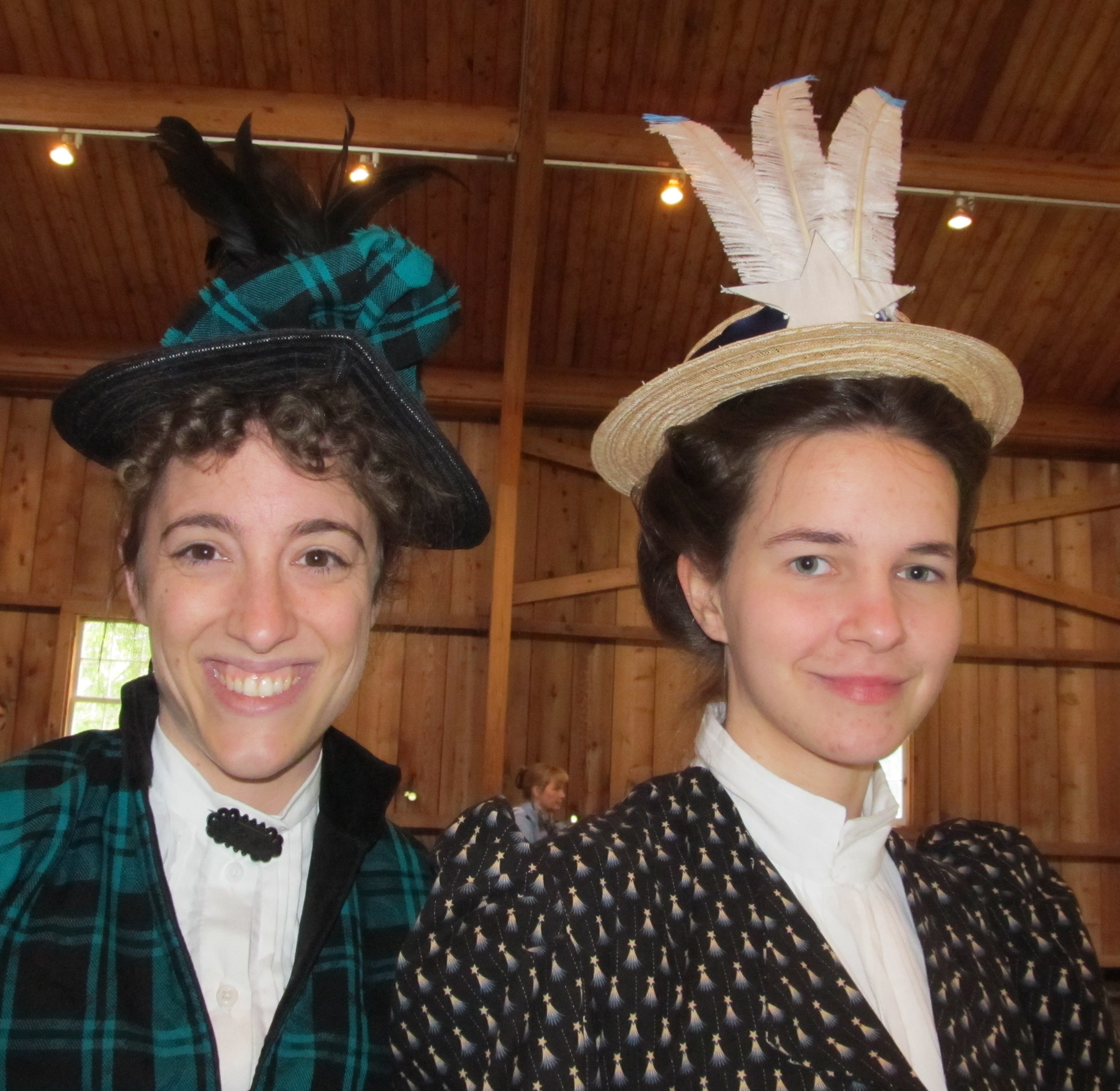
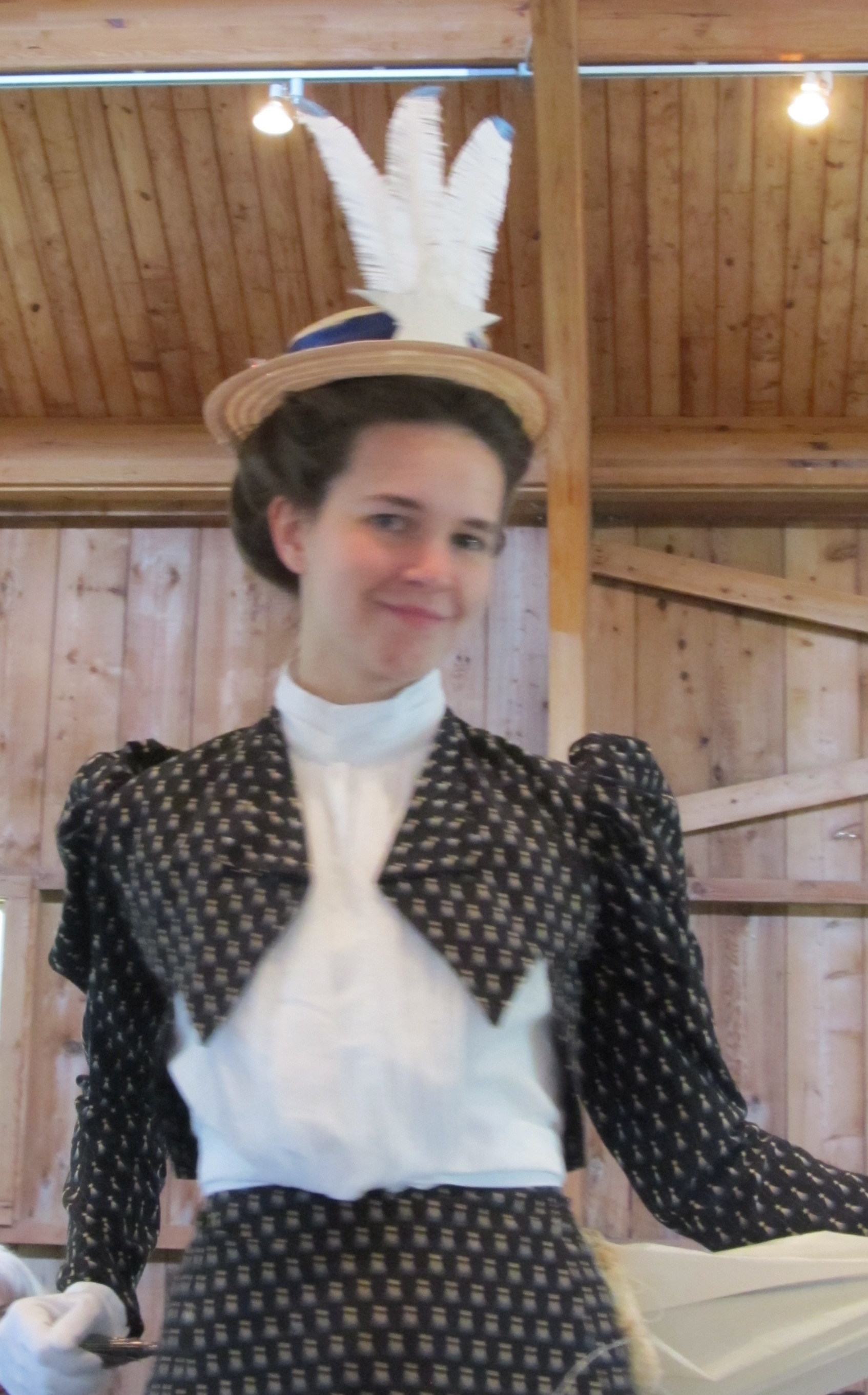
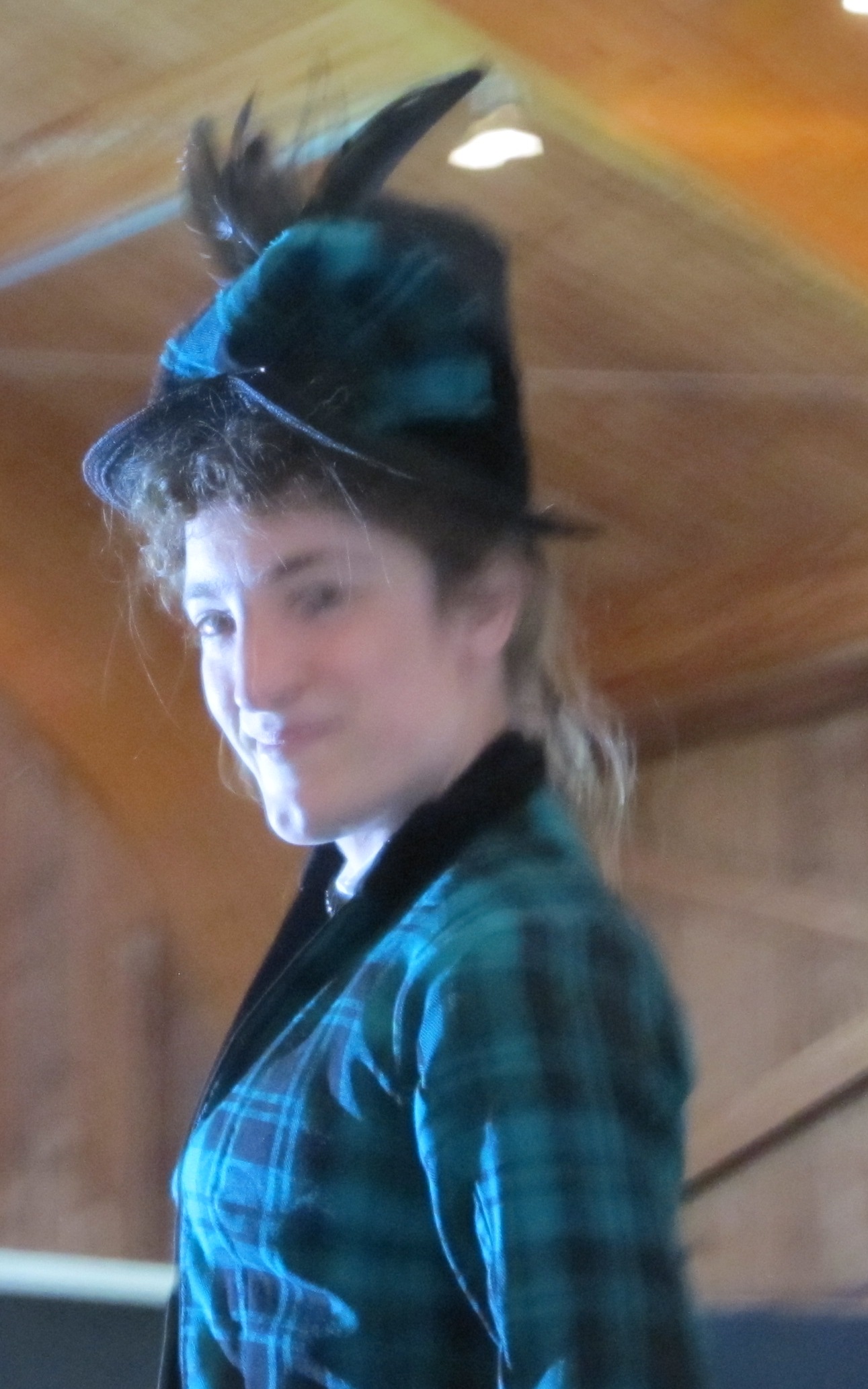
Up until this year, I stuck firmly in the mid-century for straw millinery. When Bevin suggested I give the 80s and 90s a try I soon became ‘wowed’ by the shapes of the 80s. Talk about an era of amazing lines, shape, curve, height. What fun. I can’t wait to do more.

Finally, I get to show you the pair of hats as they were worn in the Genesee Country Village’s Mother’s Day fashion show. I did the straw forms of fine hemp plait. Each one is hand sewn, wired and blocked freehand. Bevin had the fun of doing the feathers. (Now, the photos aren’t the best as I need to check the camera’s settings.)

???????????????????????????????

 ??????????????????????????????? ???????????????????????????????