FanU Cotton Swap – Sign-up Day

Today is the day to sign-up for the FanU Cotton Swap!

To Sign-up, simply comment below with your email and mailing address. (I’ll erase those before approving your comment, so the whole world doesn’t have that info.) You can also email me or send me a message on Facebook.
sewing group

What is a Swap?

This is a chance for to exchange fabric with a small group of people. Each group will have 8 people exchanging pieces of fabric. All you need is a half yard of fabric and envelops along with your copy of Fanciful Utility.

To Participate:

1: Sign Up Day! On sign-up day, groups will be assigned on a first-in basis; the first eight will be the first swap group, second eight in the second group, etc.

Cotton Sign-Up Day: July 15 Silk Sign-Up Day: August 19 Crazy Sign-Up Day: September 23

2: Mail-Out Day: Place a 9×9″ piece of fabric suited to the mid-19th century in envelopes for each of the 7 other people in your swap group, stamp them (be sure to double check at the post office, but the small 9×9″ pieces should mail in a regular envelope with a normal stamp), and send them off no later than the Mail-Out Day. Cotton Mail-Out Day: July 23 Silk Mail-Out Day: August 26 Crazy Mail-Out Day: September 30

3: Get Fanciful! Use your Fanciful Utility templates and techniques to make a project from the book, or copy your own from 19th century sources. We’ll all look forward to seeing your projects! You don’t have to sew right away, but don’t keep us waiting forever to see all the fun things!

(If you need a copy of Fanciful Utility, you can purchase them from the publisher at www.thesewingacademy.com

Fabric Guidelines:

  1. For the cotton and silk categories, your fabric should be mid-nineteenth century appropriate. (If there is a want for an earlier or later group, we can do that.) Prints and motifs should reflect those available in the 1840s, 50s and 60s. Cotton should be 100% cotton. Silk should be 100% silk.
  2. To keep the swap and sewing possibilities interesting, please avoid solids as best we can.
  3. Fabrics that do not work well for sewing cases should not be swapped. These include sheers, gauzes, heavy, thick, easy-to-fray, slippery and stretch fabrics.
  4. For the “crazy swap” category, think crazy quilt in a sewing case. This could include satins, velvets, textured fabrics. Quality synthetic fabrics are invited.

Q&A

Yes, you can participate in 1, 2 or 3 of the swaps.

Yes, if we end up with multiple groups, you can participate in more than one group to swap more fabric. If you participate in 2 groups, you should swap 2 fabrics.

Yes, you can swap large and small scale prints.

Yes, you can swap now and sew later.

Yes, we would love to see what you’ve made with the swapped fabric.

Yes, you can use your own fabric in your swapped project.

Published in: on July 15, 2013 at 6:00 am  Comments (12)  

Faniciful Utility Book Signing!!!

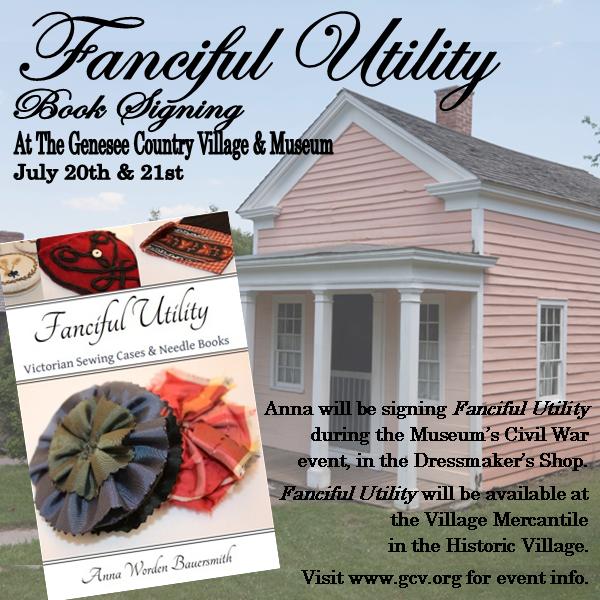
Come visit me at the Genesee Country Village and Museum. I will be signing Fanciful Utility in the Dressmaker’s Shop.

FanU GCVM book signing July 2013

This is the adorable pink building I enjoyed spending the day in a couple weeks ago. It is just off the village square. Directly across the road is the Village Merchantile where Fanciful Utility will be available. Stop in to say ‘hi’ and get your copy signed.

Announcing the FanU Fabric Swaps

Love Fanciful Utility? Want more fabrics to play with? Here is just the thing for you – FanU Fabric Swaps!!!

To meet a variety of interests, we’ll have three different swaps – a Cotton Swap, a Silk Swap and a Crazy Swap; sign up for one or more! You can even sign up to be in more than one swap group within each category if you’d like.

sewing group

What is a Swap?

This is a chance for to exchange fabric with a small group of people. Each group will have 8 people exchanging pieces of fabric. All you need is a half yard of fabric and envelops along with your copy of Fanciful Utility.

To Participate:

1: Sign Up Day!
On sign-up day, groups will be assigned on a first-in basis; the first eight will be the first swap group, second eight in the second group, etc.

Cotton Sign-Up Day: July 15
Silk Sign-Up Day: August 19
Crazy Sign-Up Day: September 23

2: Mail-Out Day:
Place a 9×9″ piece of fabric suited to the mid-19th century in envelopes for each of the 7 other people in your swap group, stamp them (be sure to double check at the post office, but the small 9×9″ pieces should mail in a regular envelope with a normal stamp), and send them off no later than the Mail-Out Day.
Cotton Mail-Out Day: July 23
Silk Mail-Out Day: August 26
Crazy Mail-Out Day: September 30

3: Get Fanciful!
Use your Fanciful Utility templates and techniques to make a project from the book, or copy your own from 19th century sources. We’ll all look forward to seeing your projects! You don’t have to sew right away, but don’t keep us waiting forever to see all the fun things!

(If you need a copy of Fanciful Utility, you can purchase them from the publisher at www.thesewingacademy.com

Fabric Guidelines:

  1. For the cotton and silk categories, your fabric should be mid-nineteenth century appropriate. (If there is a want for an earlier or later group, we can do that.) Prints and motifs should reflect those available in the 1840s, 50s and 60s. Cotton should be 100% cotton. Silk should be 100% silk.
  2. To keep the swap and sewing possibilities interesting, please avoid solids as best we can.
  3. Fabrics that do not work well for sewing cases should not be swapped. These include sheers, gauzes, heavy, thick, easy-to-fray, slippery and stretch fabrics.
  4. For the “crazy swap” category, think crazy quilt in a sewing case. This could include satins, velvets, textured fabrics. Quality synthetic fabrics are invited.  

Q&A

Yes, you can participate in 1, 2 or 3 of the swaps.

Yes, if we end up with multiple groups, you can participate in more than one group to swap more fabric. If you participate in 2 groups, you should swap 2 fabrics.

Yes, you can swap large and small scale prints.

Yes, you can swap now and sew later.

Yes, we would love to see what you’ve made with the swapped fabric.

Yes, you can use your own fabric in your swapped project.
Published in: on July 3, 2013 at 1:46 pm  Comments (4)  

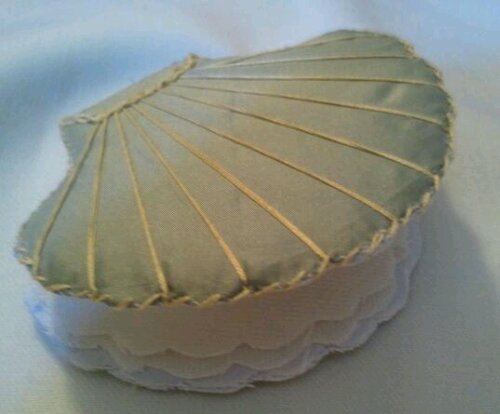
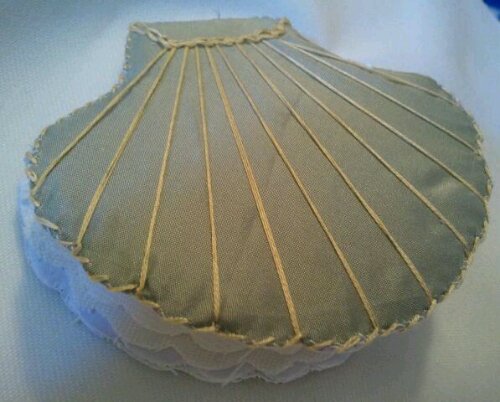
Fanciful Utility – Free Spring Template – A New Seashell

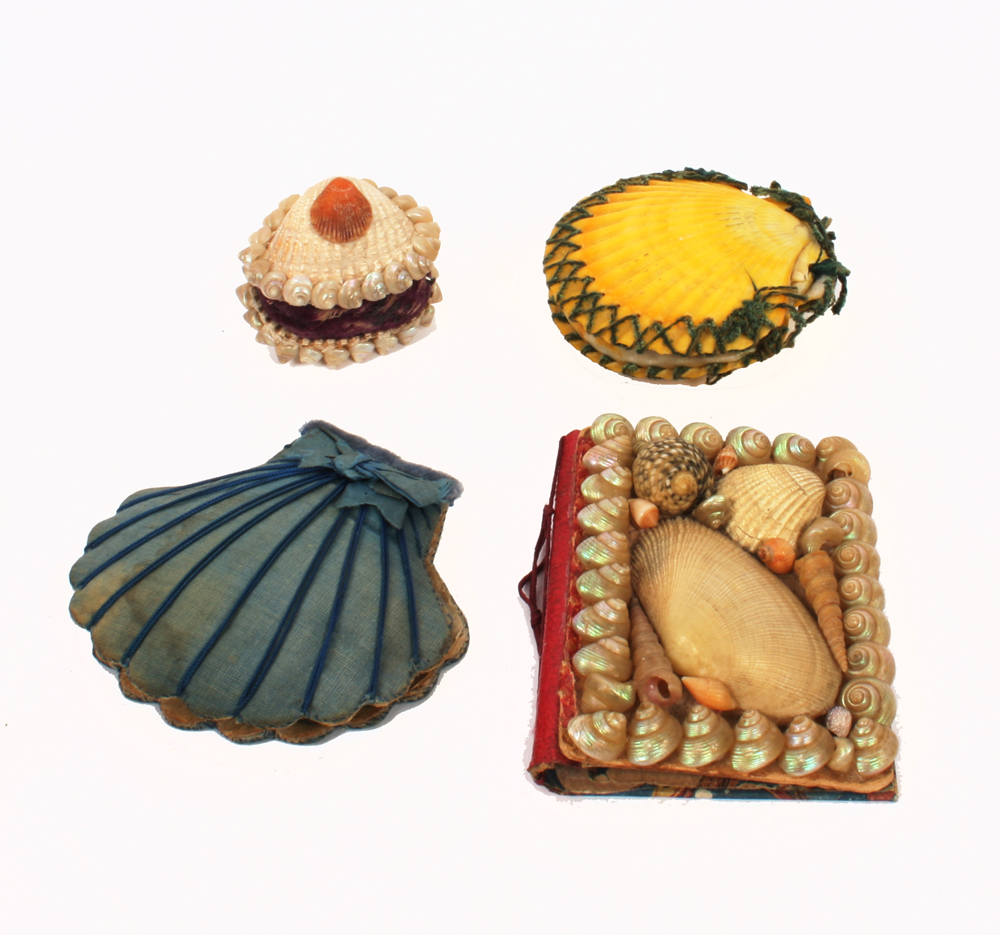
In celebration of Spring, I have a new, Free, template for is post is for all my Fanciful Utility readers out there.  Seashells were a very popular shape for needle-books and pin cushions through the nineteenth century. This sweet, silk seashell is based on a beautiful original needle-book done in blues. The original shell was constructed in a now faded dark blue silk, trimmed in a deep blue embriodery and similarly colored ribbon.

My interpretation uses a soft, pale green that remindes me of the seaside and a spring-like gold for the embroidery. I opted for a chain stitch at the top to tie it together until I find the perfect color silk ribbon.  

With your copy of Fanciful Utility  in hand, you can make this lovely needle-book using this Free Template (in PDF). image

image

Don’t own Fanciful Utility: Victorian Sewing Cases and Needle-Books yet? Order yours by visiting  ESC Publishing.

Published in: on March 21, 2013 at 5:00 pm  Leave a Comment  
Tags:

Up-coming Needle-Book Workshop

Join me on Saturday, February 16th for a Fanciful Utlity workshop at the Genesee Country Village as we make a needle-book.

319456_10150420792912846_3350978_n

“Spend the afternoon making one of the popular shaped needle-books from the Victorian era.

 You will create a seashell-shaped needle-book with beautiful silk and embroidery. This needle-book is excellent for the novice sewer while giving the experienced needle-worker a place to display her or his skill. Please bring your sewing basket with you, including scissors, needles and thimble.  Age 16 to adults.  Registration deadline February 7.”

Full program details and registration information is here.  All registration goes through the Museum itself. Simply click on the “Reservation Form” on the Museum’s adult education page; fill it out and mail it in. Reservation questions – 585-538-6822.

Keep reading for information on an up-coming book signing tea for Fanciful Utility: Victorian Sewing Cases and Needle-books at the Mumford Library.

Published in: on December 18, 2012 at 10:29 am  Leave a Comment  

Fanciful Utility – Fun Ways for Fabric Pieces

Anyone working on or planning their sewing case projects from Fanciful Utility knows just how much fun bits & pieces of fabric are.
For those shopping online for bundles of fabric pieces, check out these period correct cotton scrap packs. She is including an assortment of good size pieces for a great price. With the approximate yard and a half in each pack, you could make several sewing cases.
Another fun way to fun way to make the most of fabric? How about a fabric swap! Either in person or by mail, a group of sewing friends could get together to swap fabric. Figure if a dozen friends sent each other a 6″ by 12″ piece of fabric, each person would have a dozen pieces to play with. Each could make several cases with their new stash. Your group could pick a theme of mid-century cotton, late-century cottons, silks or something modern. Remember to share yur photos after!
If you haven’t picked up your copy of Fanciful Utility yet, please visit the Sewing Academy. to order your copy.

Published in: on November 18, 2012 at 10:23 am  Leave a Comment  
Tags:

“Painted like an apple, plum, or peach”

For those wondering “can I make these for….”, here is a follow up to the strawberry emery post.

This is a clip from the 1833 edition of A Girls Own Book, by Lydia Child:

This comes from Eliza Leslie’s 1831 American Girl’s Book:

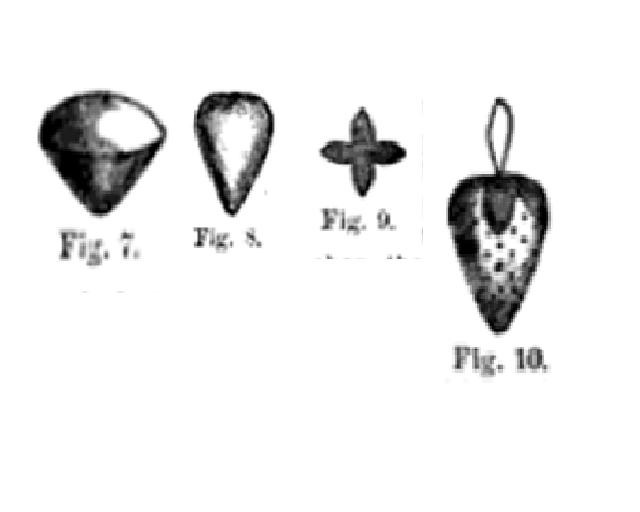
“This pincushion is made of a piece of coarse linen, about half a quarter square, cut into two triangular or three-cornered halves, stuffed with bran and covered with scarlet cloth; which cover must be sewed neatly on the wrong side, and then turned. The top or broad part must be gathered so as to meet all round, and concealed by sewing on a small round piece of green velvet, scalloped in imitation of the cap of green leaves that surround the stem where it joins the strawberry. The stem must be imitated by sewing on a small green silk cord. To represent the seeds, the strawberry must be dotted over with small stitches, made at regular distances with a needle-full of yellow silk, and close to each yellow stitch must be a stitch of black.

Emery bags are often made in this manner, but of course much smaller; not exceeding the size of a large strawberry.”

From Godey’s Lady’s Book in 1869, we have this pear:

Published in: on October 25, 2012 at 2:15 pm  Leave a Comment  
Tags:

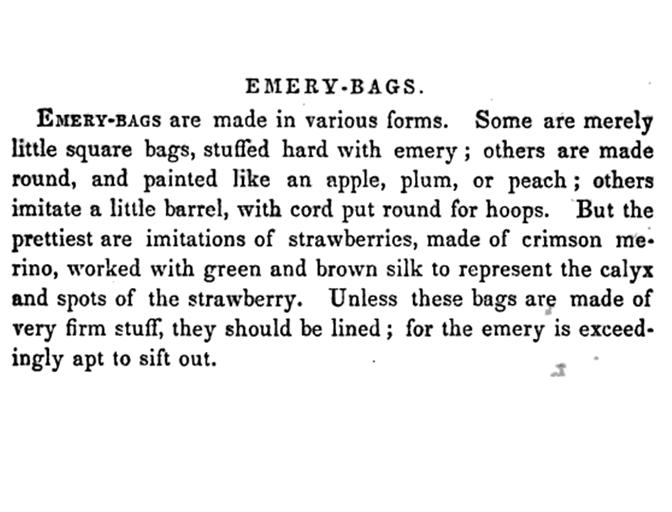
Strawberry Emory

Most of us have grown up with the tomato pin-cushion from which dangles the strawberry emery. This fruit and veggie pair seems to be the strongest survivors of almost tasty looking fruit and vegetable shaped pin-cushions that appear to have peaked in popularity towards the end of the nineteenth century. Often made of velvets, silks and wools, these take shape as apples, pears and carrots to name just a few. These fruit and vegetable shapes are an occasional curiosity of mine. So, when I stumbled upon this fun description of the strawberry emeries, I had to share it with you.

“She was just telling me she had finished stitching the strawberry seeds into the emeries, and wanted another job. She made most of the emeries. I cut out the strong cotton bags, and let her sew them up over a similarly shaped woolen sack filled with emery. She made the red silk sacks, and fastened them on, ready for the green leaves and the cord. She stitched in the seeds with yellow saddler’s silk. I think they are very pretty, and she is delighted with them.”(American Agriculturalist, December 1867)

By the way, this conversational passage, which goes on, was followed by this nifty little labyrinth:

UPDATE

Here is another strawberry emery, knit, found in both Peterson’s and Godey’s in 1859:

A Sampling of Fanciful Utility

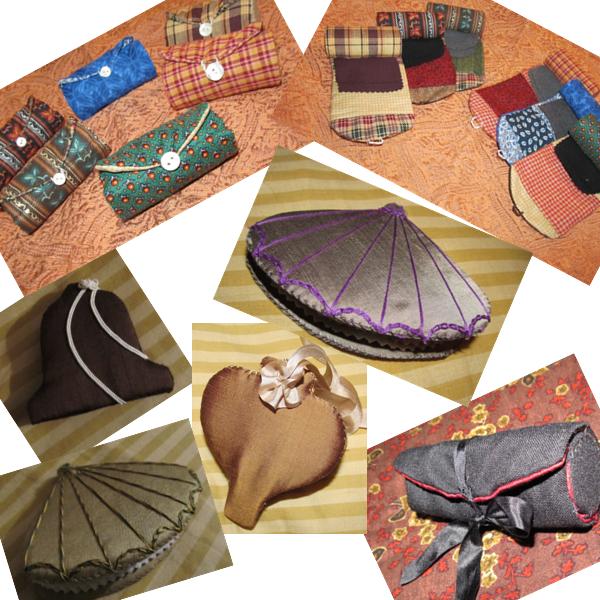
As I anxiously await seeing what the first readers of Fanciful Utility: Victorian Sewing Cases & Needle-books create, I would like to share with you a sampling of pieces I made. Each of these can be made with the directions and templates found in Fanciful Utility.

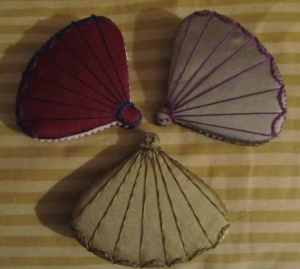
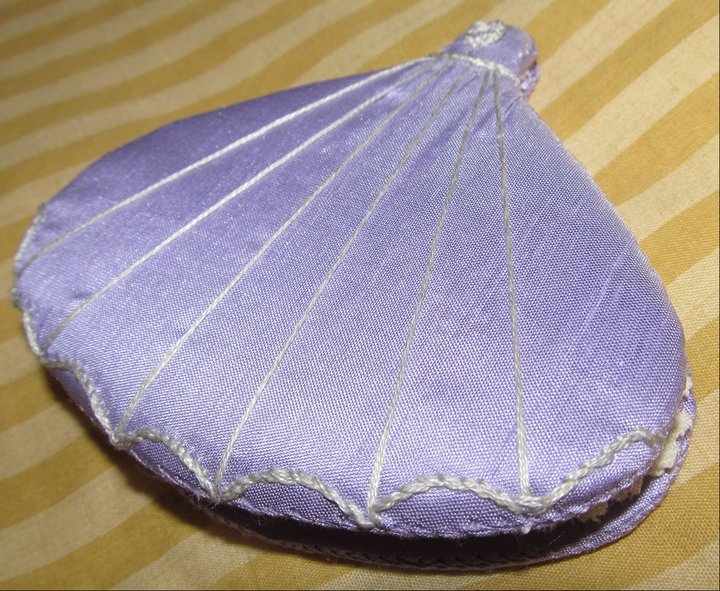
This shell shaped needle-book is one of my favorite shapes to work with. Shell and shell shaped needle-books appear frequently in nineteenth century magazines and guide books.

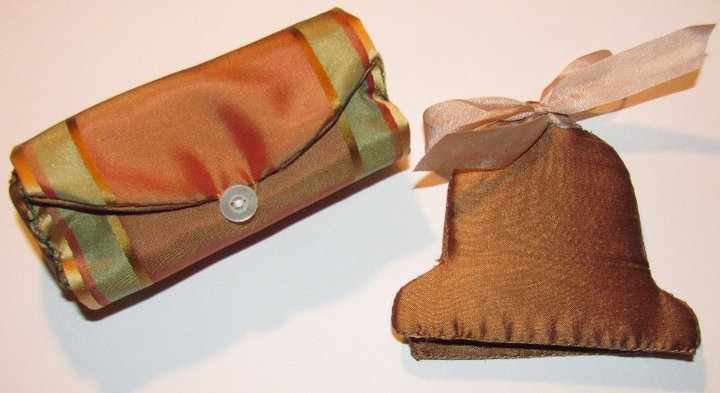
This bell shaped needle-book shows the effect a variated silk can add to a piece.


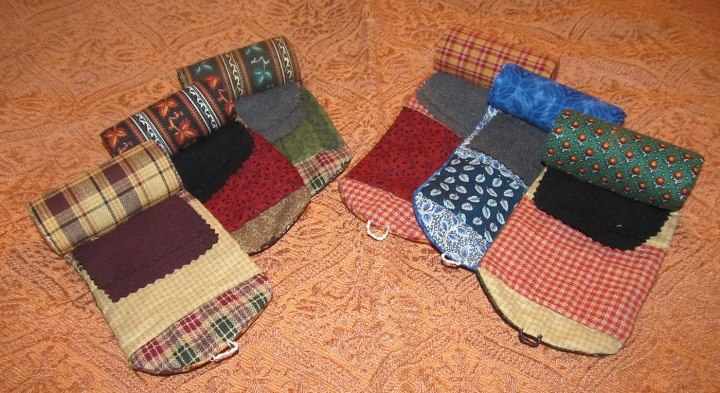
These cotton rolled sewing cases are those popularly recognized in Civil War reenacting as “Housewives” or “Huswifes”. These little cases can hold a great deal.

The same case can be done in silk as well. Rolled cases were also often made with leather, oiled silk or painted canvas exteriors fo men.

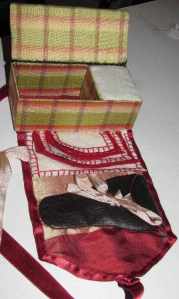
This structured sewing case is made of silks and wools. The central box of the case can easily hold thread, scissors, thimbles and other sewing notions.

This case, another personal favorite style, has a place for just about everything. The looks are almost endless depending on the combination of materials you use.

Published in: on October 22, 2012 at 2:00 pm  Comments (2)  
Tags:

Fanciful Utility with a Christmas twist

Thank you to everyone who has purchased a copy of Fanciful Utility as well as those of you who will be in the future.
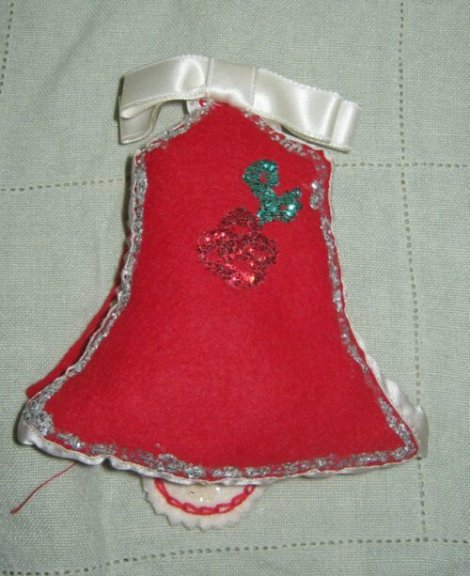
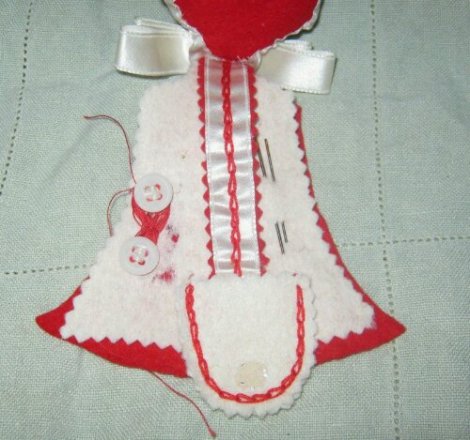
As Christmas approaches, I wanted to point out that the techniques in Fanciful Utility work nicely for gifts. You can make beautiful needle-books and sewing cases using holiday colors. Here is a vintage example currently on ebay:

image

image

You can also use the needle-book template shapes in Fanciful Utility to make ornaments.

Published in: on October 19, 2012 at 11:27 am  Leave a Comment  
Tags: