A Year in Millinery Fashion – 1864

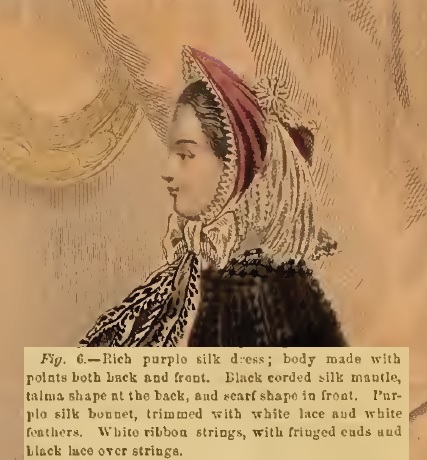
Bonnets are certainly smaller than they were a year ago, and have now, we think, attained a very good size. In Paris, efforts have been made to have the bonnets very small, but without success, as all the ladies of decided taste cling to a “just medium.” (Peterson’s, April, 1864)

1

Soft Crown Straw Bonnets

(Okay, I’ll add text later.)

image

image

image

image

image

image

image

image

image

image

image

image

image

image

image

image

Published in: on March 15, 2014 at 2:36 pm  Comments (2)  
Tags:

A Year in Millinery Fashion – 1864

2(Peterson’s, March 1864)

Exploring Soft Crown Bonnets – pt 4

Soft Crown Bonnets – 1864-65

 (Peterson’s, February, 1864)

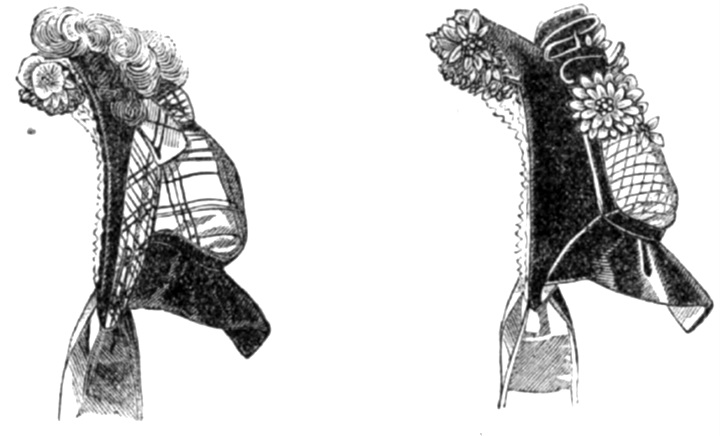
A Black Velvet Bonnet, with plain front and cap crown, from Mrs. Cripps, 912 Canal street, New York. On the left side is a heavy rosette of black velvet, under which is fastened a magnificent cherry willow feather, which sweeps over the front and down the right side to the bottom of the cape. On the inside are mixed black and white ruches on both sides; on the top is a full white ruche, a rich bow of cherry velvet, with an end on the lower side; on the right is a bunch of black feather flowers. Broad black strings. (Peterson’s, February, 1864)

1

White corded silk front, with puffed silk crown edged with black velvet ribbon, which is fastened inside the front of the bonnet, is carried to the centre of the crown, where it finishes in a point from which to hang clusters of grapes with foliage. Inside trimming is of tulle, scarlet velvet, and purple grapes.

3

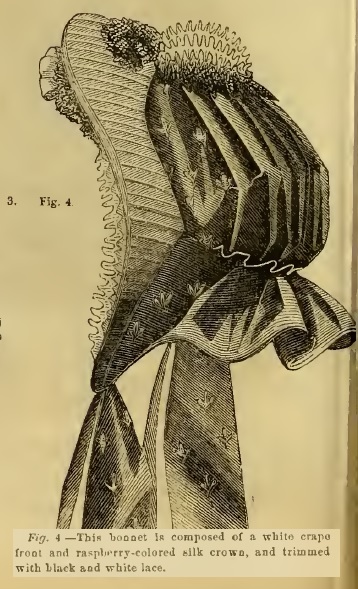
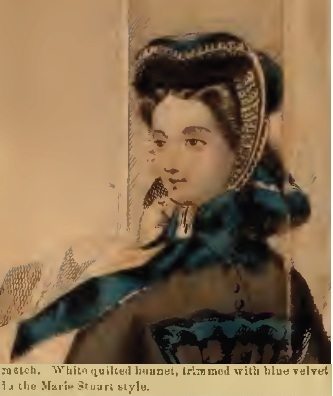
The front of the bonnet is of quilted gray silk. The crown is soft, and of plain silk crossed with black velvet. Deep blue flowers are arranged on the lower part of the crown, and instead of the curtain are loops of ribbon and lace. The inside trimming is of tulle, black lace, and blue flowers

1

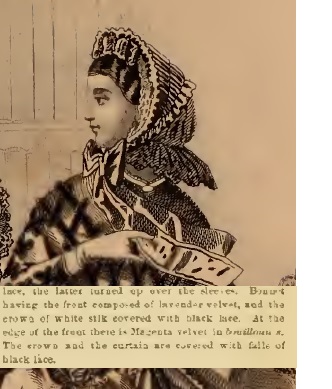
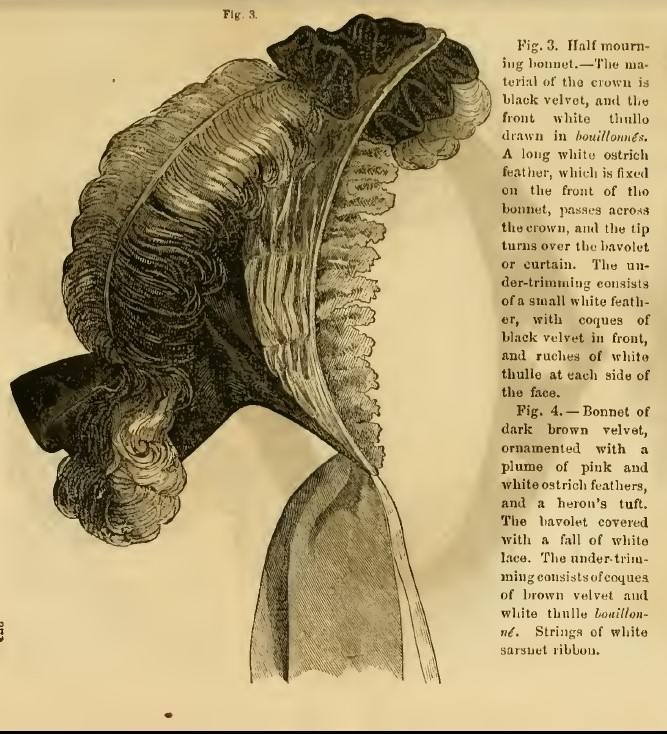
Bonnet for light mourning. The front is of black silk, with a fall of chenille fringe drooping over the front. The crown and cape are of white silk, trimmed with a chenille fanchon. The inside trimming is white roses, black grass, and white tulle. (Godey’s, October, 1864)


2

Bonnet of white silk, with puffed front and cap crown. The cape is very short, and raised on the right side it display a rose and bud. A bunch of roses with leaves is placed over the crown. Roses and black velvet with blonde are arranged as an inside trimming. (Godey’s, October, 1864)


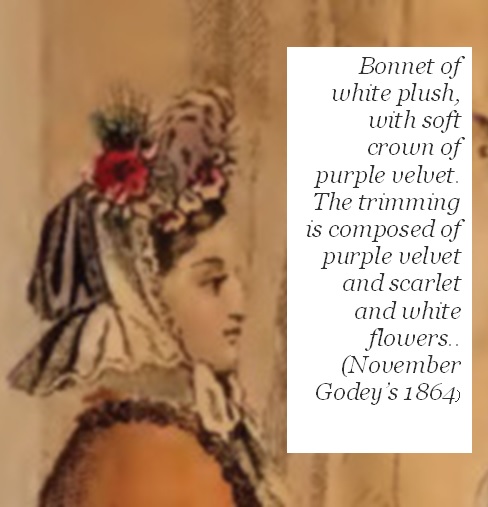
SC Godeys Nov 1864


Published in: on March 7, 2014 at 6:00 pm  Leave a Comment  

Exploring Soft Crown Bonnets – pt3

Soft Crown Bonnets – 1863

La Follet, September, 1863

La Follet, September, 1863

From La Follet, November 1863: “A bonnet, having the front and curtain of black velvet, with soft crown of plaid velvet, blue and green; the curtain lined with white satin. At the front-edge, a catalane of peacocks’ feathers, surrounded with black lace, which is carried en herbes on each side, and tied under the chine over the plaid velvet strings. Torade of green velvet, with peacock’s feathers inside.”

La Follet, November 1863

La Follet, November 1863

La Follet, December 1863

La Follet, December 1863

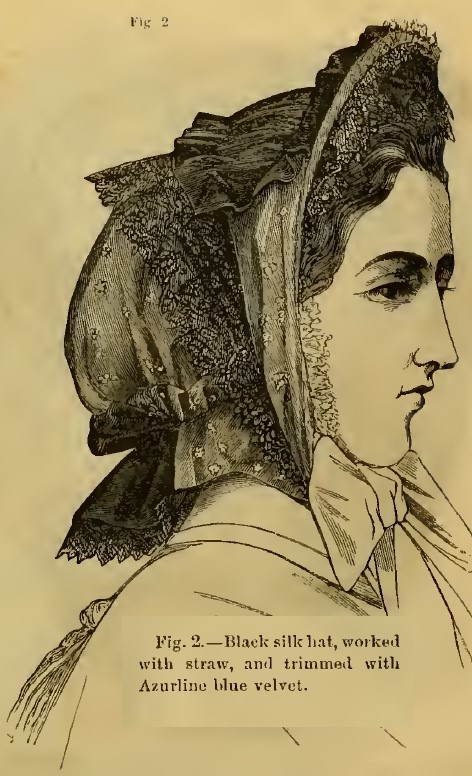
From The Lady’s What-not,  1863 (a London publication) “A bonnet with a soft crown of violet-colour velvet, and a front of white pique satin, edged with a quilling of violet-colored satin ribbon with a few small feathers at the side mingled white and violet, is extremely pretty; as also are bonnets made of the satin pique of various colours, such as azurine-blue, Russian leather-coloured, and violet. Plush bonnets of the same colours are also making their appearance, and are expected to be held in high esteem when the next winter arrives. Another pretty bonnet is made with a soft corwn in black silk, laid in broad box plaits, a curtain of the same, a front of fine white straw, and a bunch of cornflowers in brilliant blue.”

Published in: on March 6, 2014 at 6:00 pm  Leave a Comment  

Exploring Soft Crown Bonnets – pt2

Soft Crown Bonnets – 1861-62

Godey's, July 1861

Godey’s, July 1861

Godey's, October 1861

Godey’s, October 1861

Godey's, November 1861

Godey’s, November 1861

Godey's, December 1861

Godey’s, December 1861

SC Sept 1862 Godey

Godey’s, September 1862

SC October 1862 Godeys

Godey’s, October 1862


Published in: on March 5, 2014 at 6:00 pm  Leave a Comment  

Exploring Soft Crown Bonnets – pt 1

Soft Crown Bonnets – 1858-60

From Grahams, July 1858: “Tuscan bonnets are in great favor, and are generally trimmed with wild flowers and oats, or with a large rose, foliage and buds; sometimes with a tulle trimming, embroidered with jet, and finished with a brown fringe; a brown silk curtain and brown strings. Young ladies wear white crape bonnets, ornamented with ruches and loops of white ribbon, inside; acrss the head there is a bandeau formed of a red rose surrounded with wheat ears and grass. Many bonnets are made of a soft crown of spotted tulle; the edge of pink crape, with blonde falling over the front, and a bouquet of white and pink roses on the left side. A bandeau of the same roses crosses above the forehead, inside of the bonnet.”

SC December 58 Godeys

From Arthur’s Home Magazine, February 1860: “The latest style of bonnet is the soft crown. It is not generally adopted here, but is coming in. It is our province to keep the readers of the Home Magazine apprised of what is the reigning mode, and as nearly as we can – to indicate to them the tendency of the fickle goddess, Fashion.”
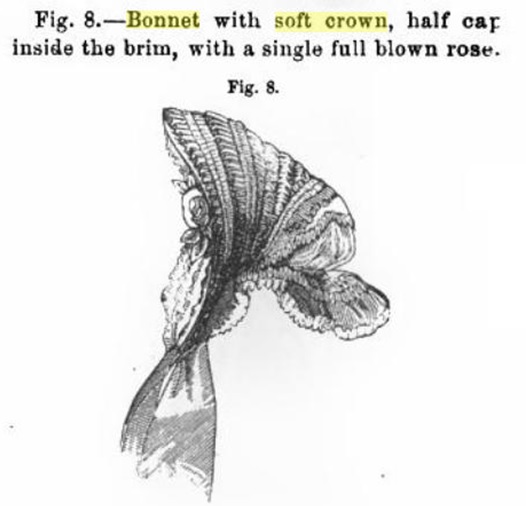
From Arthur’s Home Magazine , March 1860: “The plain style of bonnet with soft crown and distinguished in form, is aldo in vogue. It is large and plain in the border all round; but it has a cache of elegance, owing to the flat appearance of the plaited crown.”
Arthur’s Home Magazine , May1860: “The soft crown was of plaits of straw and green silk, alternating. Each ear-ring was of massive gold, in the form of a ring two inches in diameter, like an infinitesimal cart-tire with the outer edge chased.”

From Draper and Clothier, May 1860: “And in the same house, we saw a rice-straw bonnet, with soft crown of plaited tulle. A ruche of mauve ribbon across the front. A bow with rather long ends behind. In the cap, small bunches of lilac all round the face. Wide mauve ribbon strings.”

From Draper and Clothier, June 1860: “A very pretty bonnet has a soft crown of white crape, covered with black spotted tulle, and the front consisting of plain white straw. The trimming, on the outside, is a tuft of red rosebuds, in the inside of the trimming consists of a demi-bandeaux formed of loops of black ribbon, finished at the each end by tufts of rosebuds like those on the outside of each bonnet.”

Published in: on March 4, 2014 at 6:00 pm  Comments (1)  

Marie Stuart Bonnets – pt 2

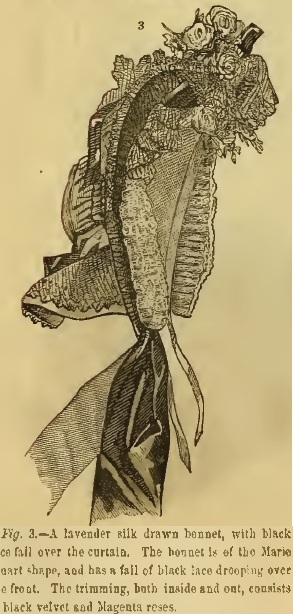
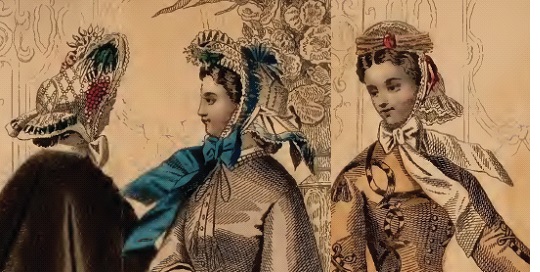
The Marie Stuart bonnet appears in both American and European (London and Paris) publications during the Civil War. The distinctive Marie Stuart shape of the crown varies in the depth of the dip as well as the curviness of the dip. The overall size of the bonnet varies, as does the width. In general, bonnets become smaller late in the war (while emphasising height). Some Marie Stuart bonnets seem to narrow though the sides as well.

MS Feb 1863MS Sept 1863 a

“The Important Subject of Bonnets, and the form they are likely to assume during the forth coming summer, is still a disputed point. Will they continue to be worn high, or are we to wear Marie Stuarts? are questions anxiously asked, but which as yet nobody can answer with any degree of certainty. All we can say on the  subject is, that we have not as yet seen the Marie Stuart bonnets adopted at any of the fashionable resorts, although we are constantly assured, on what would generally be considered reliable authority, that nothing else is to be worn. In Paris the same indecision prevails; the ladies of the Court and of the Chaussee d’Antin continue to wear the high upright bonnets, while the fair denizens of Faubourhs Saint-Germain and Saint Honore have all adopted the Marie Stuart form – not the decided Marie Stuart with a pointed front, as the title would indicate, but with the front slightly coming forward and lowered, imparting a very modest quiet appearance to the wearer – so much so that French milliners have christened this form “The Quaker bonnet.” But one thing is certain, whether the Marie Stuarts are ultimately adopted in London or not, and that is that all the newest forms are made much smaller and less exaggerated, and follow more closely the outline of the face than was the case a month or six weeks ago.” Arthur’s Home Magazine, July 1863MS La Follet Dec 1863

The later war years finds these references:

“One was of black tulle, and of the Marie Stuart form; a fringe of bugles was placed round the front. This bonnet was covered with a fanchon of white guipure. In place of the curtain was a puffing of black tulle, on which were fastened a few black cherries drooping on to the back hair. The strings were of broad black ribbon; over the ends was a broad patte of quipure. A white tulle scarf was fastened under the fanchon of lace, and tied under the chin, over the strings.” (La Follet, July 1864)

“Bonnet of crape. Curtain covered with lace. At the edge of the front is a scarf, with a bunch of flowers on the top. Marie Stuart pointe, edged with lace, falling over the flowers in the cap, and strings of ribbon.” (La Follet, March 1864)

MS La Follet April 1864

Published in: on March 3, 2014 at 4:00 pm  Leave a Comment  

Marie Stuart Bonnets

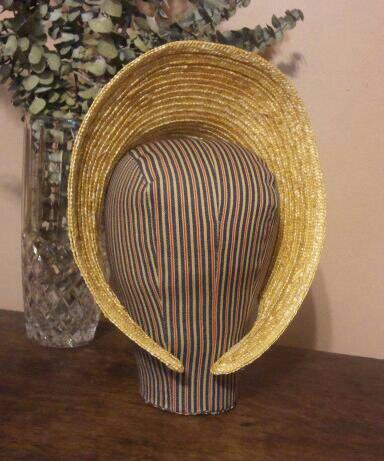
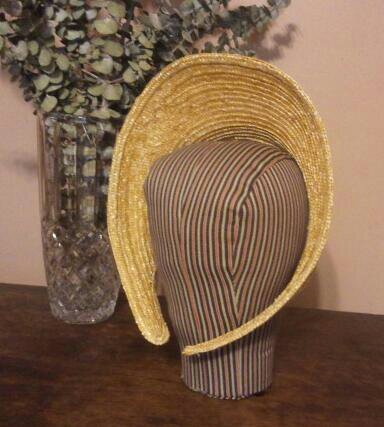
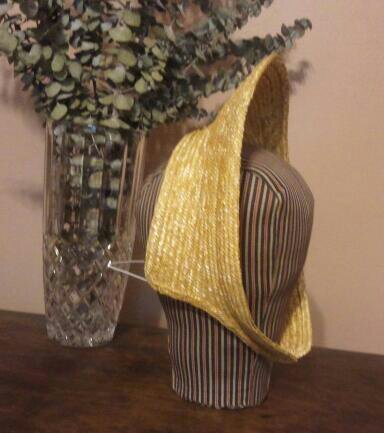
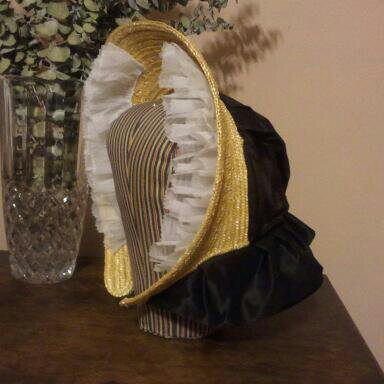
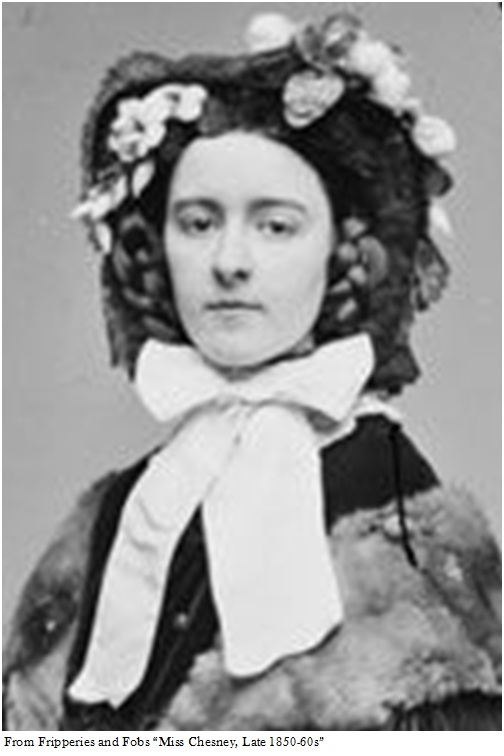
Here is a survey of fashion illustrations, CDVs and extant Marie Stuart bonnets to accompany my newest bonnet on Etsy – This fashionable Marie Stuart Straw Bonnet.

I was trying to track back this photo for permisions but my computer wasn't agreeing. I had to base my caption from the Pin note.If this is your's, please let me know. If you want, I can remove it.

Variations of the Marie Stuart shaping to millinery appear in caps and bonnets off and on through the century.

In the years just prior to the Civil War we see the Marie Stuart bonnet reammerge along side the cottage bonnet and the spoon bonnet:

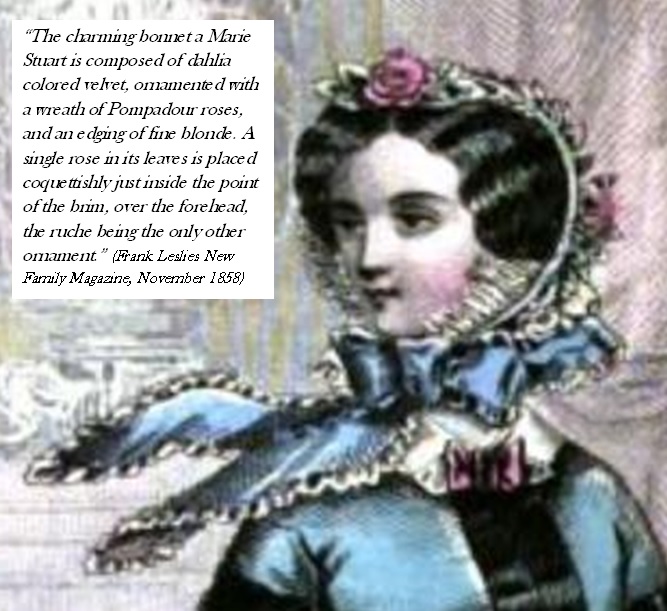
“Marie Stuart bonnets of white crape or lisse are very distinguished, ornamented only with a fall of very fine guipure lace, thrown back from the front and extending over the curtain. In Paris black ribbon is associated with blue, green or groseille in the decoration of rice, straw, chip or Leghorn bonnets.” (Frank Leslie’s New Family Magazine, August,1858)

“The shape if the bonnet is of the Marie Stuart genre, approaching near the forehead in front, and (evasee) sprung our at the sides, the ears being long and edged with lace, very narrowly. The brides or strings are of blue and white diagonal striped taffetas.” (Arthur’s Illustrated Home Magazine, February 1859)

I have no source info for this photo. It was cached in Pinterest. If it your's, let me know. I'll remove it if you like.

Marie Stuart Bonnet

“There are two shapes of bonnets which divide favor nearly equally; these are the Cottage and Marie Stuart patterns. The latter is distinguished for flaring away from the side of the head and rising to a point at the top of the head three inches back from the forehead. Milliners, who have a supply of bonnet foundations without the point in front are forming it of other material, which proves that bonnets which are not of the cottage shape must have a pointed border over the forehead, or they are ignored by our demoiselles.” (Arthur’s Illustrated Home Magazine, March 1859)

The Marie Stuart is, by most of our Milliners, regarded as the only style; but the Cottage Bonnet, with shirred crown, and the cap crown, is silently and surely winning its way for the next rage.” (Arthur’s Illustrated Home Magazine, May 1859)

For those wondering “Why this shape?”, here is a painting of Mary Stuart showing her distinctive millinery.
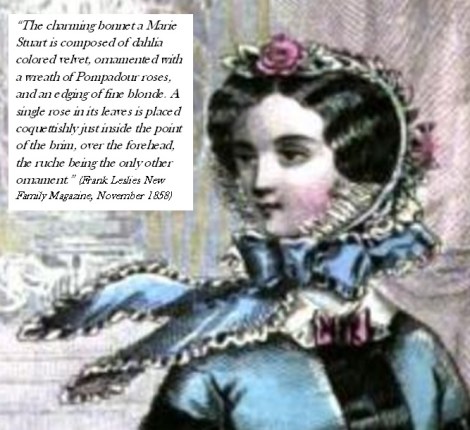
MS Frank Leslies Nov 1858

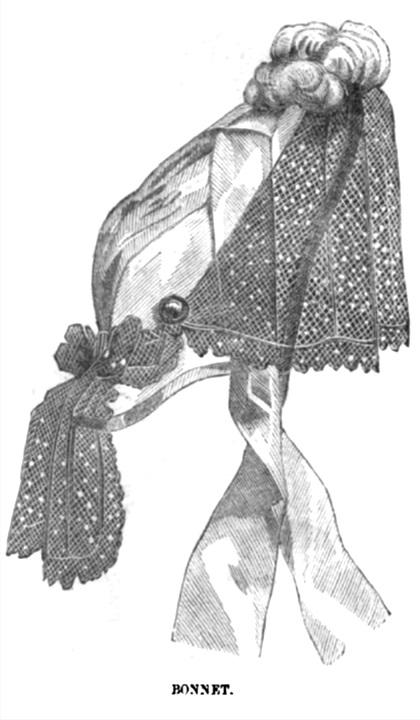
The “Maybe or Maybe nots”….. There are some bonnets that may or may not be Marie Stuart bonnets. If only we could actually hold them.

This bonnet from the MET’s collection may be a Marie Stuart or it may just have a squashed brim. The top of the brim does dip slightly creating a shallow curve in.

This image comes from The Graceful Lady. I wish I could get a closer look.
Published in: on March 2, 2014 at 4:29 pm  Leave a Comment  

A Year in Millinery Fashion 1864

In this demi-season, when there is a perfect stagnation of fashion, and when milliners and dressmakers lament that there is positively nothing new, we find at Mme. N. Tilman’s, of Ninth Street, a choice lot of new importations.

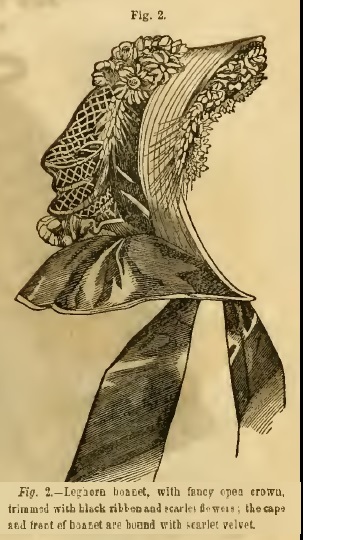
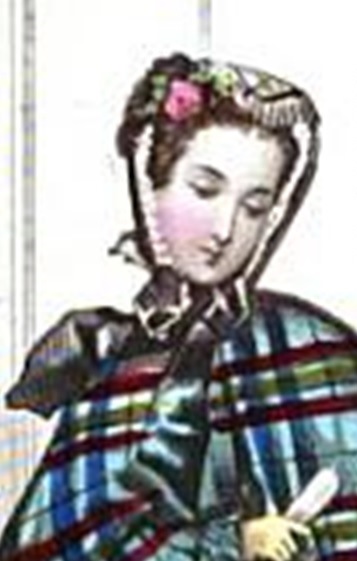
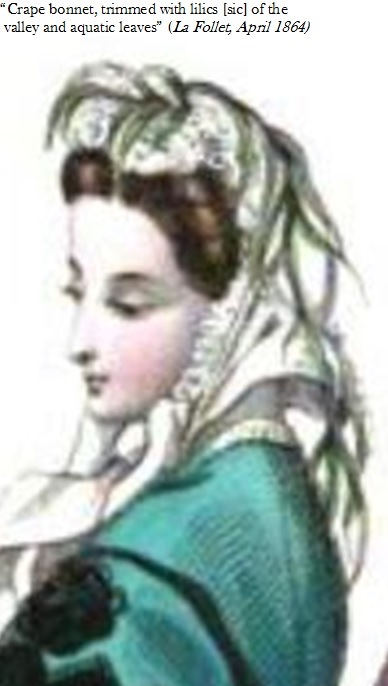
Among the bonnets was a very peculiar one of black tulle, with scarlet velvet front, and the crown was formed of one large scarlet velvet carnation pick. The inside trimming was of scarlet carnations, and the strings of scarlet and black striped ribbon, quite Scotch-like, and a novelty; for until now plain ribbons alone have been tolerated for bonnet strings. The length of the strings should be one yard and three-quarters. Another very exquisite bonnet was of felt-colored velvet trimmed with aigrette of blonde lace and a heron plume. Inside more Scotch flowers, consisting of tufts of scarlet, green, and blue berries with gold spikes, interwoven with golden veined ivy. The tout ensemble of this bonnet was very charming. (Godey’s, March, 1864)
1