Why Green?

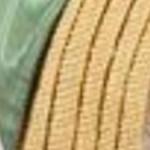
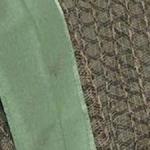
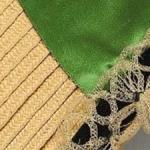
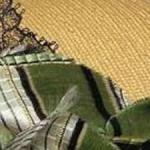
This week I had the pleasure, rather joy, of truly seeing why green was used as often as it was with straw. I was applying this vintage satin back velvet ribbon in an olivey-green shade to a straw hat that is being mailed today. (I’ll share those photos once the recipient receives it.) As I stitched, I was caught by how the green brought out the golden richness of the straw. The hat was pretty before. But, the green ribbon made it almost glow.

After seeing numerous green ribbons on straw bonnets over the years, I finally saw what they saw. I saw how the green worked with the natural straw. It just works and work really well.

What does the original cast say of green for millinery?

For fair-haired women “A green bonnet is advantageous to fair or rosy complexions. It may be trimmed with white flowers, but preferably with rose. A rose-colored bonnet must not be too close to the skin; and if it is found that the hair does not produce sufficient separation, the distance from the rose-color may be increased by means of white, or green, which is preferable. A wreath of white flowers in the midst of their leaves, has a good effect.” (“Color and Ornament”, Home Circle. Nashville, Tenn, 1856)

The main relations of color to be borne in mind are these: Green is the opposite, and the complement, to red; green, therefore, reddens adjacent hues, and red adds a green tinge to them; but green and red set off each other to the best advantage when placed side by side – the green looking greener, the red redder – and this is, of course, most thoroughly the effect when the two colors are alike in depth of tone. What green is to red, yellow is to violet, and blue to orange. In the same way it may be said that the yellow tints of green suggest their compliments and opposites, the violet-reds; the yellow-oranges contrast with violet-blues, and the orange-reds with blue-greens.

Thus the pink of the complexion is brought out by a green setting in dress or bonnet; and any lady who has a fair complexion, that admits of having its rose tint a little heightened, may make effective use of the green color, but it should be a delicate green, since it is of importance to preserve harmony of tone. When there is in the face a tint of orange mixed with brown, a brick-red hue will result from the use of green; if any green at all used in such a case it should be dark.  (“Something for the Ladies About Color“, Harper’s New Monthly Magazine, November, 1854)

A green bonnet is advantageous to fair or rosey complexions. It may be trimmed with white flowers, but preferably with rose….. A green bonnet is suitable to fair and light rosey complexions; rose, red, or white flowers are preferable to all others. (“How to Choose Colors in Dress“, Peterson’s Magazine, 1855)

Worded another way in the London Quarterly Review: A delicate green is favourable to all fair complexions which are deficient in rose, and which may have more imparted to them without inconvenience. But it is not favourable to complexions that are more red than rosy, nor to those that have a tint of orange mixed with brown, because the red they add to this tint will be of a brick-red hue. In the latter case a dark-green will be less objectionable than a delicate green. (1855) (you can tell there was plenty of quoting and paraphrasing going on.)
thumb 6 thumb 5 thumb 4 thumb 3 thumb 2 thumb 1


Published in: on May 23, 2014 at 12:25 pm  Comments (1)  
Tags:

A Year in Millinery Fashion – 1864

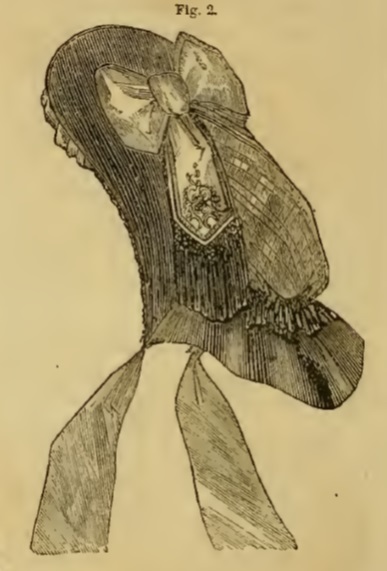
Bonnet for second mourning. The front of the bonnet is of black silk. The crown is of a light lavender silk, covered with a network of black chenille. The bow on the top of the bonnet is of lavender silk, edged with black velvet, and the ends embroidered and trimmed with black chenille. The inside trimmings is composed of white and black lace, and loops of lavender-colored ribbon. (Godey’s, May 1864)

1

A Year in Millinery Fashion – 1864

1

This bonnet has a front of drawn green silk. The graceful soft crown is of white silk. The trimming consists of a tuft of meadow grass and field flowers, also loops of white silk placed directly over the crown. The inside trimmings is of white and black lace and field flowers. (Godey’s, May 1864)

A Year in Millinery Fashion – 1864

1

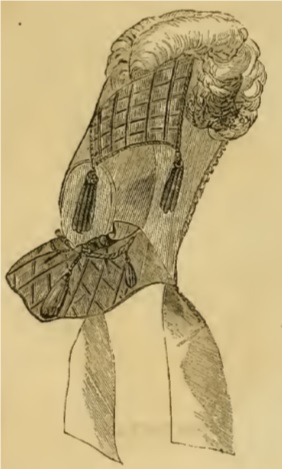
Spring bonnet of white crepe, trimmed with a fanchon of bright plaid velvet and chenille tassels. The cape is of plaid velvet, ornamented by chenille cord and tassels. A long white
plume curls over the front of the bonnet. The inside trimmings is composed of Scotch thistles and heather. (Godey’s, May 1864)

Bonnets are very much more becoming in shape that formerly. They are very close to the face at the sides, but not nearly so high at the top, and slightly flattened at the forehead. The trimming is place at the side or on the crown near the top. If flowers are used, it is generally a large one, such as an iris, or water-lily, and the leaves are left to fall gracefully over the crown. If a single rose, either pink or yellow is used, with one spray of leaves; then, at the side of the flower, there is a bow of ribbon, not the ordinary bow, but a collection of loops standing upright and arranged carelessly; from these loops an end of ribbon is carried across the crown, and finished off at the curtain with a smaller rose, or bouquet of flowers, then at the top of the crown. (Peterson’s, May 1864)

A Year in Millinery Fashion – 1864

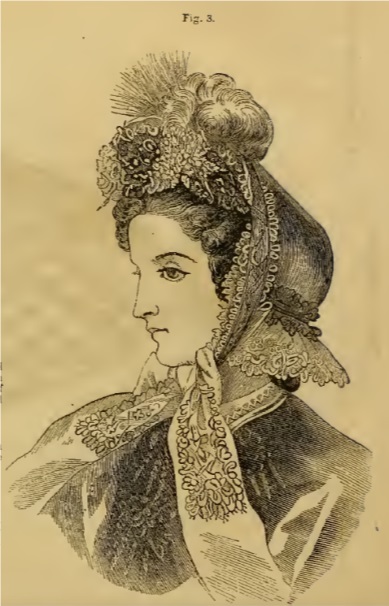
White crepe bonnet, made over white silk. A straw guipure lace falls over the face, and trims the outside of the bonnet. A straw colored feather is laid gracefully over the front. (Godey’s, May 1864)

4


A Year in Millinery Fashion – 1864

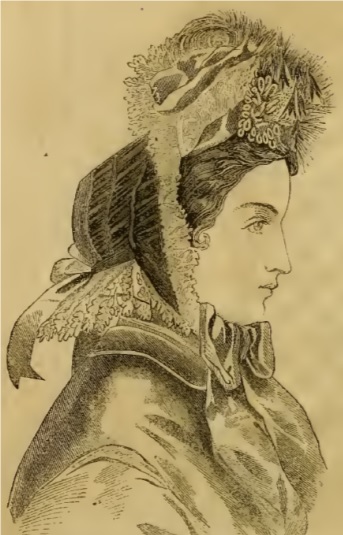
Violet crepe bonnet, trimmed on the front with a black lace insertion. The cape is covered by a rich white blonde, headed by a black lace. On top of the bonnet is a light violet
feather, and a pompon of spun glass. The inside trimming is of black and white lace, mixed with scarlet-berries and fancy grasses. A black lace barbe is tied in with the violet strings. (Godey’s, May 1864)

3

A Year in Millinery Fashion – 1864

The bonnet of drawn cuir-colored crepe, trimmed on the front with a fanchon of white lace, loops of green ribbon, and Scotch feathers. The inside trimming is of bright flowers, of the
Scotch colors. The cape is covered with a fall of white blonde. (Godey’s, May 1864)

2

A Year in Millinery Fashion – 1864

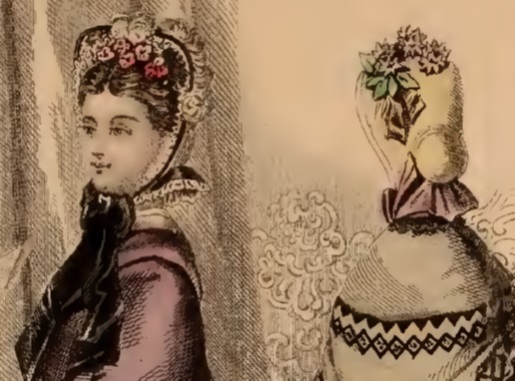
Left – The bonnet is of black and white crin, or horsehair, bound with black velvet, and trimmed with a natural feather. The inside trimming is of scarlet geraniums, and the strings are of black ribbon.

Right – Leghorn bonnet, with violet silk cape, and trimmed with violet-colored flowers. (Godey’s, May 1864)

1

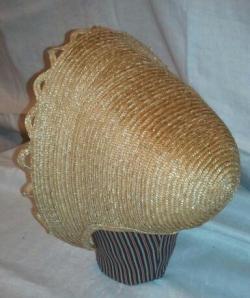
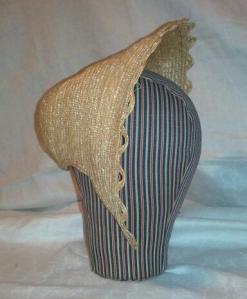
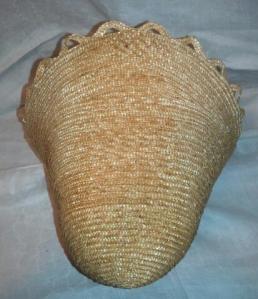
Scallop Brim Straw Bonnet

2014-04-01 06.15.04-1 2014-04-01 06.15.40-1 2014-04-01 06.16.11-1

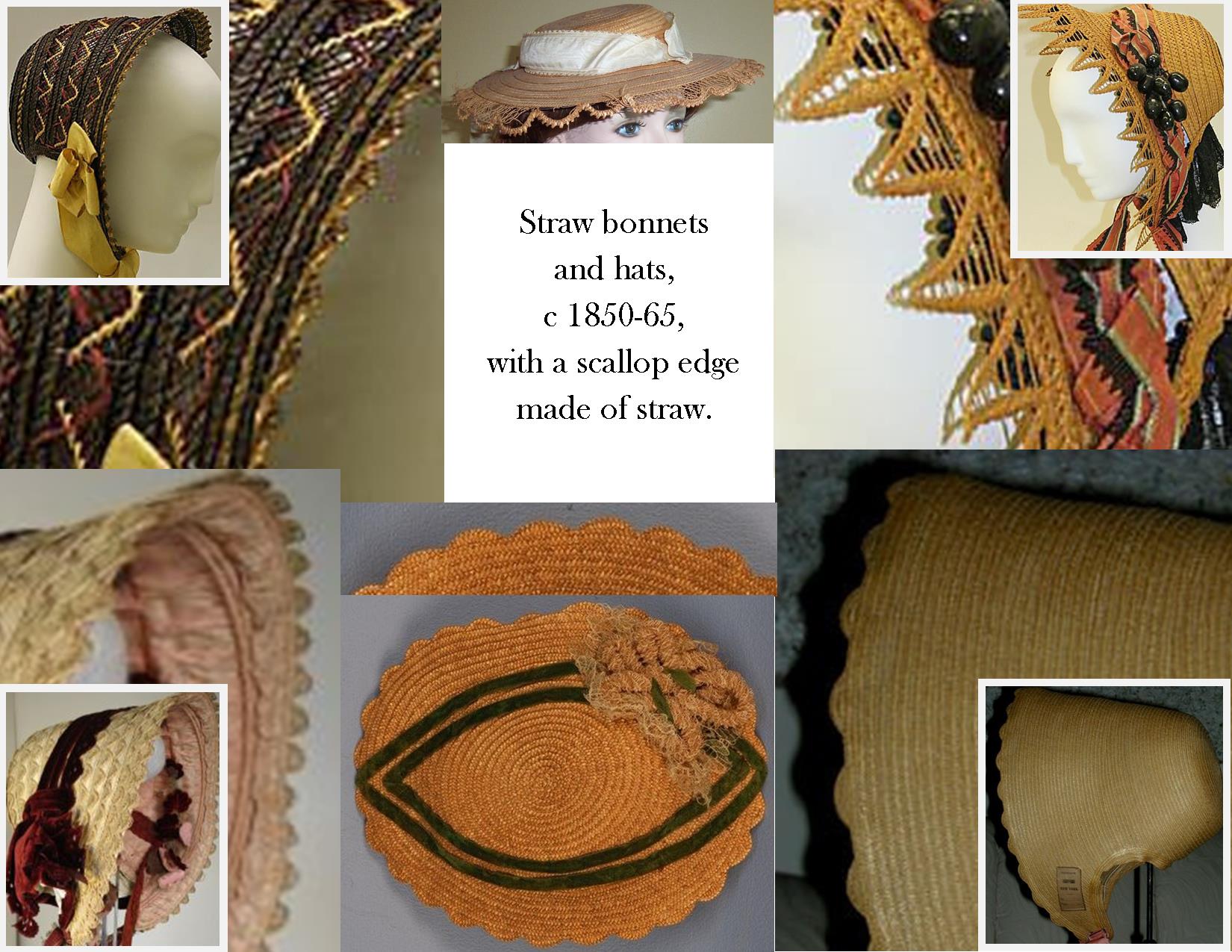
For weeks, okay months, I’ve been wanting to replicate the scallop brim edge on extant bonnets & hats. I finally figured out a good way to make the braid wavy and a way to attach it that I am happy.  Scallop edge 1

Published in: on April 1, 2014 at 5:47 am  Leave a Comment  

A Year of Millinery Fashion- 1864

In bonnets we see a great variety of colored chips trimmed with ribbon to match or a good contrast. The fashionable flowers seem to be the elegant scarlet cactus, in bright, soft shades of velvet, which give it a peculiar lustre, magnolias, water-lilies, and geranium. Bright flowers, with brown grass and heather, have an excellent effect on the caps of bonnets which are trimmed with plaids.

Black crin, or horse-hair bonnets, are very much worn, and the new color Milan, which is between a salmon and a corn color, looks particularly well on them. Roses of this color, with scarlet berries and black ribbon, make a very stylish trimming.

Another new color is called flame de punch, from its resembling the bright, flickering light from the punch bowl. This color is particularly pretty for a white straw or ship bonnet. Amethyst is also one of the new colors.

Black crin also look[s] well trimmed with feathers having plaid tips. This is arranged by tipping each little feathery strand with a different color, which produces a plaid-like effect. Anther style of trimming for a black bonnet is a green and blue ribbon or velvet, and peacock’s tips; the last being very fashionable for children’s hats, for head-dress, and for trimming of ball dresses.

Tufts of feathers studded with jet, steel, and crystal, are much in vogue for bonnets and headdresses.

Travelling bonnets are made of silk to match the dress, or of colored straw. They are very much trimmed with chenille fringe, tipped with large beads falling over the face and crown.  (Godey’s, April, 1864)