A Decoration Day Divided

I’ve been so absorbed in millinery lately, I haven’t spent as much time as I would like on the commemorative/memorial project. This post from Memorial Day, yesterday, reminded me that I really need to give it more attention to have enough together and ready for programs. Check out the vivid assortment of commemorative cards she shares.

streetsofsalem

The holiday which we now commemorate as Memorial Day has its origins in the immediate years after the Civil War, when late-May rituals of remembrance and decoration of veterans’ graves emerged and evolved spontaneously and separately in both the North and the South. Given the prominent role played by the Grand Army of the Republic (G.A.R.) in the official adoption of the holiday in the North in the later 19th century, a rather divided commemoration continued all the way up to World War I, which united the nation in remembrance, and widened its circle to encompass American veterans of all conflicts. In 1971, Memorial Day was declared a national holiday by an act of Congress and placed on the last Month of May. And thus we have our national commemoration and commencement of summer (although weather-wise, the latter might apply only to the North). When tracing the earlier history of…

View original post 129 more words

Published in: on May 27, 2014 at 8:24 am  Leave a Comment  

Mrs. Bright’s and Mrs. Blank’s Journals – August

I stumbled across something I found to be a fun read in the 1866 American Agriculturalist. The Ladies Column included a full year through the eyes of two women. I’ll share each month for the next two weeks (ish) side-by-side. (The excerpts are a bit challenging to read.)

August

A Year in Millinery Fashion 1864

It is said that, as regards to invention, one milliner does more in a month than the world architects in a score of years. We are forcibly reminded of this while walking, lately, through the show rooms of Mme. N. Tilman, of 143 East Ninth Street, New York. At this establishment we are constantly surprised with novelties; nothing pretty or new appears in Europe in the millinery line, but is to beyond at the Maison Tilman.

An entire novelty consists of straw guipure, equal in appearance to the finest lace. Straw ribbons are also something quite new, and just introduced on the new spring bonnets. Mother of pearl, of which we have already spoken as being worn on coiffures and ball dresses, is now adopted for bonnets, and, in contrast with trimmings of rich velvet, produces an admirable effect. We are able now to speak with certainty of the spring style bonnets, as announced by the most distinguished artistes.

Scotch plaid, in silk and velvet, is very much in vogue; but we notice that Mme. Tilman uses is sparingly, and only in the finest and choicest patterns and combinations. The following will serve as examples. –

A rich wrought Neapolitan, the braids an inch apart, and each displaying a fine cord-like edge of blue, green, and crimson plaid. The curtain was composed of a shell of plaid silk upon blonde, also in a shell pattern. A puff of ribbon and meadow grass, tipped with dew, constituted the decoration, which was placed high on one side of the brim.

Trimming of all kinds is used very moderately, but it must be of the very best, whether in flowers, lace, or ribbon. It is no longer masses on the top of the brim, but is arranged on the top or side of the crown, or across the side of the brim from its tip to the crown. The shape is perfect, neither too large nor too small, but serving as a modest frame for a fair face. It is still rather high in the front, very much compressed at the sides, and slopes low behind to the base of the crown, which is wider than formerly, in order to allow for the present style of coiffure.

A charming novelty imported by Mme. Tilman consists of fine white and black Neapolitans embroidered in flowers and trailing branches in a fine jet. The design is so delicate and graceful, the workmanship so exquisite, that there is nothing of the ordinary appearance which is frequently objected to in embroidered bonnets. On the contrary, in black upon white, and black upon black, we have rarely seen anything so elegantly effective. Very little trimming, in addition to the cape of velvet or lace, and the decorations of the interior, is required for these bonnets.

Fringes of crystal and jet now replace the feather fringes, and are arranged to fall over the front of the bonnet and shade the interior. (Godey’s, May 1864)

Violets in Early Spring

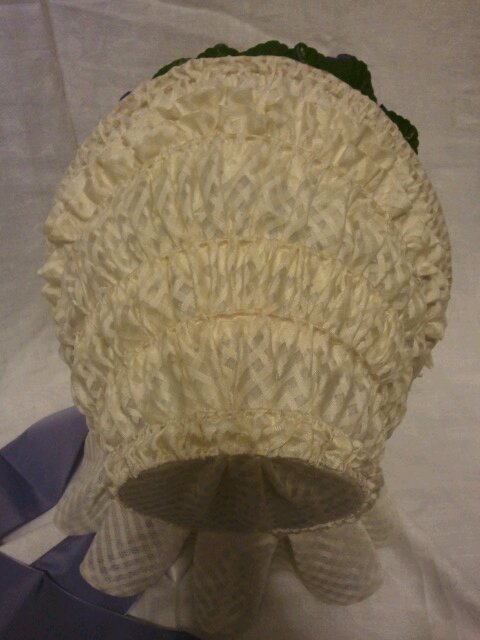
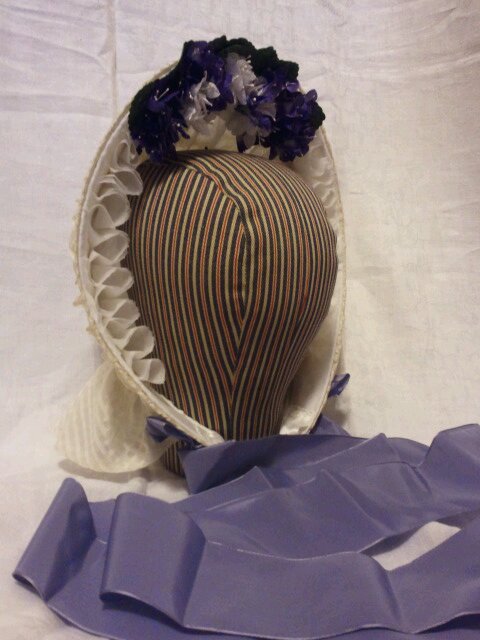
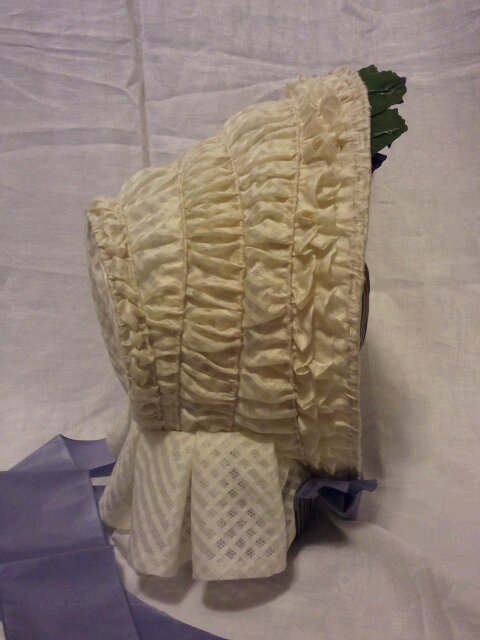
This bonnet is one I have slowly been working on for a while. It really does remind me of those tiny violets that peek up in the early spring. Sometimes they are a speckle of color in the grass; sometimes a speckle in the lingering spring snow. (Btw – I’m amazed by the abundance of white violets in our yard. So, I was glad I had white violets to mimic that too.)
image

This bonnet is a white and ivory organza silk organza woven in a windowpane check design, drawn on cane over light weight buckram. The brim also has some fluffy flounces.
image

The lilac purple silk ribbon comes from Italy. It is a beautiful ribbon both in looks and feel. The edge is particularly lovely. (I need a photo of that edge.)
image

image

You can find this bonnet on Etsy this morning with sideways photos. (Phone issues.)
image

image

I have a few other millinery pieces I am anxious to share with all of you. As soon as their new owners have them in hand, I can share.

Published in: on May 25, 2014 at 9:57 am  Comments (1)  
Tags:

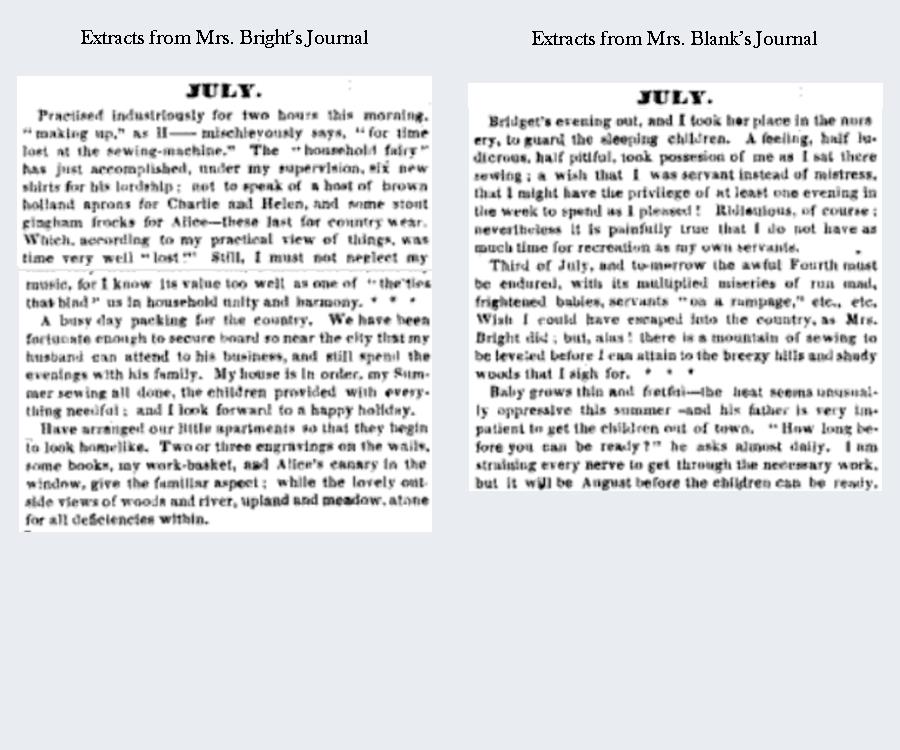
Mrs. Bright’s and Mrs. Blank’s Journals – July

I stumbled across something I found to be a fun read in the 1866 American Agriculturalist. The Ladies Column included a full year through the eyes of two women. I’ll share each month for the next two weeks (ish) side-by-side. (The excerpts are a bit challenging to read.)

July

Mrs. Bright’s and Mrs. Blank’s Journals – June

I stumbled across something I found to be a fun read in the 1866 American Agriculturalist. The Ladies Column included a full year through the eyes of two women. I’ll share each month for the next two weeks (ish) side-by-side. (The excerpts are a bit challenging to read.)

June

Why Green?

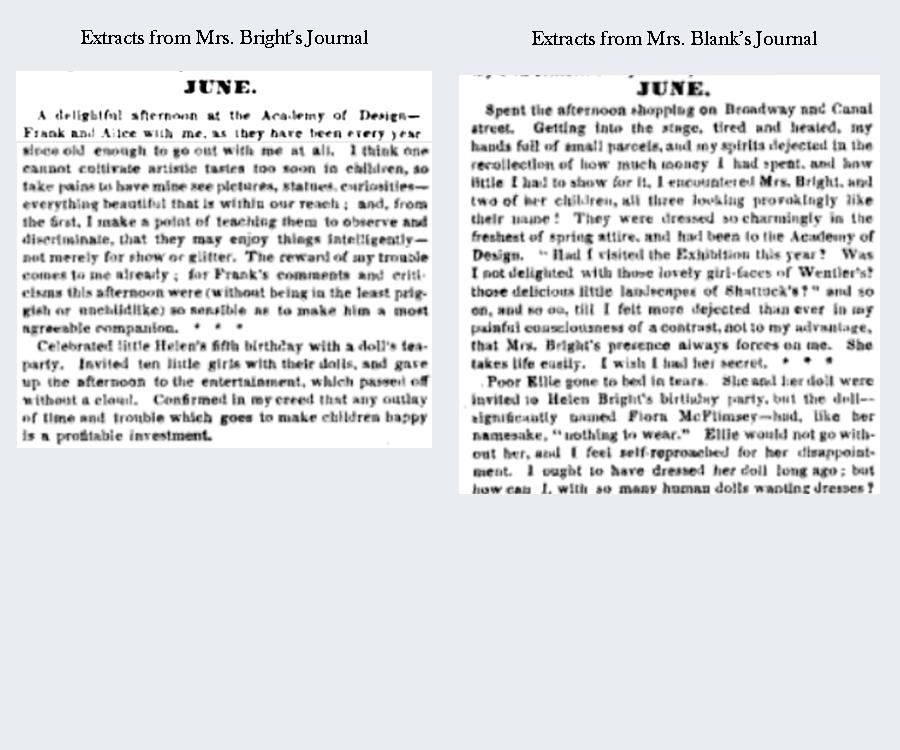
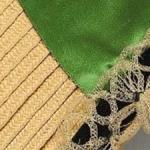
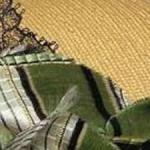
This week I had the pleasure, rather joy, of truly seeing why green was used as often as it was with straw. I was applying this vintage satin back velvet ribbon in an olivey-green shade to a straw hat that is being mailed today. (I’ll share those photos once the recipient receives it.) As I stitched, I was caught by how the green brought out the golden richness of the straw. The hat was pretty before. But, the green ribbon made it almost glow.

After seeing numerous green ribbons on straw bonnets over the years, I finally saw what they saw. I saw how the green worked with the natural straw. It just works and work really well.

What does the original cast say of green for millinery?

For fair-haired women “A green bonnet is advantageous to fair or rosy complexions. It may be trimmed with white flowers, but preferably with rose. A rose-colored bonnet must not be too close to the skin; and if it is found that the hair does not produce sufficient separation, the distance from the rose-color may be increased by means of white, or green, which is preferable. A wreath of white flowers in the midst of their leaves, has a good effect.” (“Color and Ornament”, Home Circle. Nashville, Tenn, 1856)

The main relations of color to be borne in mind are these: Green is the opposite, and the complement, to red; green, therefore, reddens adjacent hues, and red adds a green tinge to them; but green and red set off each other to the best advantage when placed side by side – the green looking greener, the red redder – and this is, of course, most thoroughly the effect when the two colors are alike in depth of tone. What green is to red, yellow is to violet, and blue to orange. In the same way it may be said that the yellow tints of green suggest their compliments and opposites, the violet-reds; the yellow-oranges contrast with violet-blues, and the orange-reds with blue-greens.

Thus the pink of the complexion is brought out by a green setting in dress or bonnet; and any lady who has a fair complexion, that admits of having its rose tint a little heightened, may make effective use of the green color, but it should be a delicate green, since it is of importance to preserve harmony of tone. When there is in the face a tint of orange mixed with brown, a brick-red hue will result from the use of green; if any green at all used in such a case it should be dark.  (“Something for the Ladies About Color“, Harper’s New Monthly Magazine, November, 1854)

A green bonnet is advantageous to fair or rosey complexions. It may be trimmed with white flowers, but preferably with rose….. A green bonnet is suitable to fair and light rosey complexions; rose, red, or white flowers are preferable to all others. (“How to Choose Colors in Dress“, Peterson’s Magazine, 1855)

Worded another way in the London Quarterly Review: A delicate green is favourable to all fair complexions which are deficient in rose, and which may have more imparted to them without inconvenience. But it is not favourable to complexions that are more red than rosy, nor to those that have a tint of orange mixed with brown, because the red they add to this tint will be of a brick-red hue. In the latter case a dark-green will be less objectionable than a delicate green. (1855) (you can tell there was plenty of quoting and paraphrasing going on.)

thumb 6 thumb 5 thumb 4 thumb 3 thumb 2 thumb 1


Published in: on May 23, 2014 at 12:25 pm  Comments (1)  
Tags:

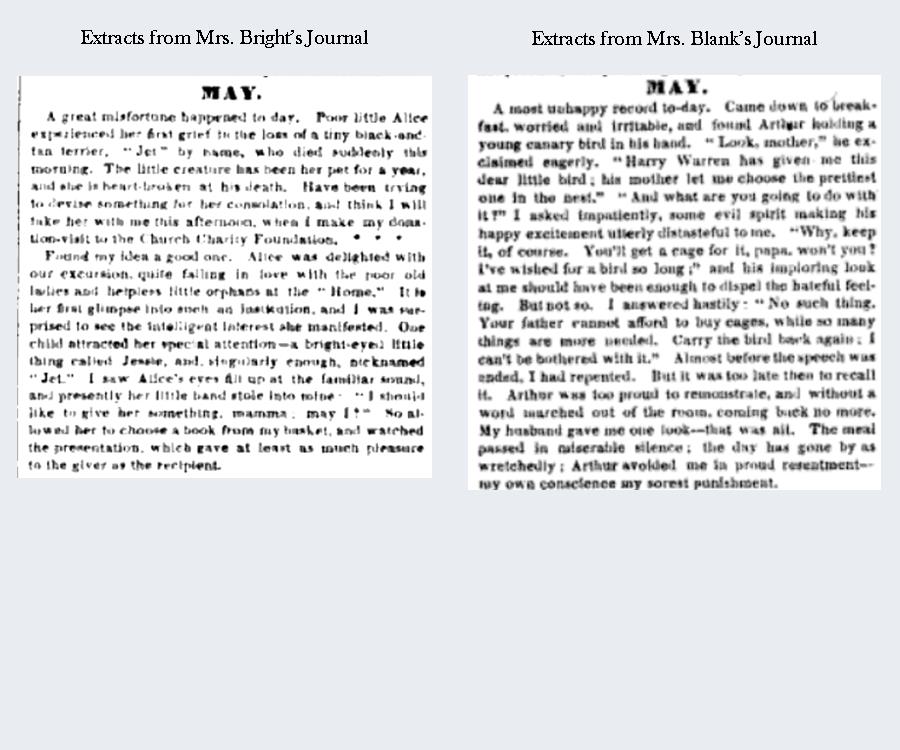
Mrs. Bright’s and Mrs. Blank’s Journals – May

I stumbled across something I found to be a fun read in the 1866 American Agriculturalist. The Ladies Column included a full year through the eyes of two women. I’ll share each month for the next two weeks (ish) side-by-side. (The excerpts are a bit challenging to read.)

May

Mrs. Bright’s and Mrs. Blank’s Journals – April

I stumbled across something I found to be a fun read in the 1866 American Agriculturalist. The Ladies Column included a full year through the eyes of two women. I’ll share each month for the next two weeks (ish) side-by-side. (The excerpts are a bit challenging to read.)

April


Mrs. Bright’s and Mrs. Blank’s Journals – March

I stumbled across something I found to be a fun read in the 1866 American Agriculturalist. The Ladies Column included a full year through the eyes of two women. I’ll share each month for the next two weeks (ish) side-by-side. (The excerpts are a bit challenging to read.)

March