A Winter Hood Story

Except from “The Romance of a Tassel” (The Christmas Annual, 1860)

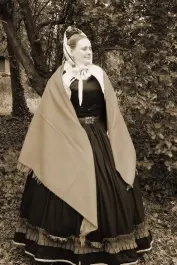
We were to have a sleigh-ride, and the principal topic of conversation was, the delightful morning and the promise of pleasure; I was olde enough to feel all the enthusiasm of the occasion, and yet to temper my feelings with quietness. My Cousin Kate and I had been knitting some new hoods, beautiful we thought them, and of a new pattern. As my fingers had toiled through the countless loops, I had only thought what a delight it would be to wear it, and a little vanity was mingled with my feeling, for truly I looked like another person in its scarlet and white border than in the faded silk of my old hood.

All the young girls and boys of the village were to go to this ride, and I knew very well that Kate and I would have the most dashing head-gear of the party and I remembered with pleasure, that Esquire Thomas’s son Chester had come from the city and was to be one of the party.

I presume I tried my hood on twenty times the day before, because, I said, it felt so comfortable, but I had to look in the glass each time to see just how comfortable it felt.

After our breakfast was over, my Uncle Oliver rode up with his daughter Nancy, who had been sent to join in the day’s pleasure. She lived several miles back in the country, and I must acknowledge that I felt too little interest in her pale face and quiet manners, because I thought she was not quite so smart in her ways and dress as we village girls; but I had not an unkind heart, and so I ran to meet her with a hearty welcome, saying “Why, how cold you are; your cheeks at least are red as roses; come to the fire.” My mother with gentle manner took off her straw bonnet, trimmed with its light faded ribbon, and gave her some coffee, and I ran to get ready for the ride. It took me an hour. I twisted my curls over and over again. I asked Kate if I looked well enough. Then I put on my hood – too it off – re-arranged my curls. “There,” said Kate at last, “you look like father’s beautiful scarlet and white carnation pinks, and if Chester does not say so, I will box his ears.” – And what will Chester say of you?” I asked “Oh what he always does. “you most beauchiful butcherfly.” “But is not Chester handsome, Susy? And he is really so good, so manly, so noble, father says, none of your fops – but come, let’s go down.”

Just then my mother with her gentle touch opened the door. I remembered the look she cast on me – it was one of mingled pride and trust – her eye was bright and cheerful, but there was a look so ful of hope for me and trust in me, that I ran up to her with a kiss as hearty as when I was five instead of fifteen.

“Susy,” said she, in her animated but gentle manner, “Nancy has nothing to wear but her straw bonnet. She will be ill if she thus exposes herself to the cold wind. She says sh will stay with me rather than suffer as she did coming here this morning.” “Well I think it’s queer how some people live,” said I, “Never having anything to wear that is appropriate.” But Susy, she says her mother has been so sick, and you know her father is rather afraid of pennies.” “Afraid! I should should think he was anything but afraid the way he hugs them. Well, Nancy can have my old hood, thought it don’t look very well, but it is better than that old straw bonnet.”

My mother’s look changed instantaneously; there was a sad, half reproachful, half hopeful look on her face as she opened the door, saying, “Would you like to have her wear the old one?” She shut the door and went out. What a commotion was in my heart. I knew my mother had expected me to offer my new hood to Nancy, and wear the old one myself; but what visions were before me of Chester and the effect of my hood on him; of the general look of the whole party as they saw me again in that old Silk. Then came to my ear the sweet tones of my Mother’s voice. I heard all she felt, but more powerful was the thought of what would they say to see me looking like an “old dud.”

I believe I should yielded to the selfishness of my heart if Kate had not spoken.

“I think it is absurd for your mother to ask it; of course you will wear your own things.” Her tone and manner brought to me my Mother’s hopeful trust in me, for she had called her absurd and I knew she was anything but that.

“Of course I shall,” said I, and I ran from the room with swift step. I tore my hood from my head on the way. “Here Nancy,” said I, “You must wear my hood this once, it is so warm and perhaps your father will get you worsted to knit one – Wont you Uncle Oliver? It only costs a dollar., and just see how fine it looks.”

Continue reading on page 100…

Published in: on October 5, 2016 at 6:00 am  Comments (1)  

A Closer Look at My Winter Bonnets

IMG_7764I have been meaning to write about how I make my winter bonnets for a while now, a while being over a year. I really want to share with you what goes into each of the bonnets I make.

Why do I love working on winter bonnets?

As you know, with my straw bonnets it is all about the art, the lines and curves that make up each style. For the winter bonnets, it is equally as much about the why and how of the construction, they layers and the materials. I love figuring out why a bonnet was constructed in a specific way, what the material choices were for, why this little area was done this way, etc. There is also something about the visual texture the quilting or wadding creates. I find it pleasant.

I also get very, very cold in the winter. The soft, snuggly warmth of a wadded or quilted bonnet is comforting. I often want one of my 19th century bonnets for everyday wear during my frigid, pre-dawn morning commute.

Where do the patterns come from?
Each of the bonnets I am now making come directly from original bonnets in my collection. I have slowly been collecting winter bonnets with a variety of shapes and construction techniques. Each piece goes through my version of a conservation process (how I wish I had the resources to do everything I would like), ensuring there are no buggy nasties, helping the all too often crushed, scrunched, flattened fibers back into shape and stabilizing. Once I think a piece is ready and I am ready to focus on a piece, I have a note taking process that I am sure would make some people’s heads turn sideways in puzzlement. Hey, it works for me. From my notes, I draft a pattern. These patterns are what I use for creating my winter bonnets.

What materials do I use?

I try to use the same types of materials I find in original winter bonnets. Sadly, as with many things, we simply do not have the same silks they did in the 19th century. Of the fabrics we do have, I use silk taffeta, tight weave silk twill, silk faille, some special weave silks and tight weave smooth wool. For linings, again, I use what originals bonnets show – polished cotton, cotton prints, cotton weaves, silk and tropical wools.

For the batting and wadding, I use 100% wool batting. Occasionally, I will layer 100% wool batting with 100% cotton batting to get the right loft and firmness. Depending on the bonnet, I use a variety of lofts and layering. I refuse to use polyester batting. I do not think it is warm enough or gives the look of original bonnets. Due to allergy issues, I will consider using just 100% cotton or alpaca/cotton batting.

How do you know which bonnet will be right for you?

When choosing the right winter bonnet for you, I suggest thinking about the type of weather you have in your area and/or where you will attend events. Picture when you were out in the snow last winter, did the snow stick to your coat and hat? Was the snow wet? If you are in an area with sticky snow, I suggest a very smooth fabric like a silk taffeta. If you have wet snow, the tighter weaver the better. For wet snow, you really want a wool batting, I’d even consider silk interlined with a light wool fabric.

How do you trim your bonnets?

I look to originals to determine what kinds of trim I will use. While period fashion columns do suggest some additional trims, I have yet to determine to what extent these trims were actually used. So far, I have stuck to ribbon and silk trim. I may venture into tassels and beading. Maybe.

For the functional ties, I have found I love cotton sateen. This is entirely Eileen Hook’s fault since she showed me the cotton sateen she picked up at Needle and Thread. Cotton sateen is durable and ties nicely. I anticipate it doing very well in the wet of winter. For decoration, I do prefer silk ribbon, but will also use high quality modern ribbons such as Hyman Hendler’s. 

How do you quilt your bonnets?

Far prefer doing quilting by hand. I like the look of hand quilting more than that of machine quilting. That said, hand quilting can take a long time, a very long time in some cases. Yes, this has to be reflected in the price.  I understand machine can be faster, making a bonnet more affordable. In addition to the time/cost factor of machine quilting, there are occasions when a piece wants a tighter quilting than I can currently get with my hand quilting. I often end up arguing with myself over which approach to take, that of the tighter machine quilting and that of hand quilting.

How long g does it take to make one?

It takes about an hour to cut and mark/chalk most winter bonnets. It takes from as little as 8 hours to quilt and sew an easy bonnet to 16 hours for a more complex quilt design or a wadded bonnet with cording or a unique construction. 

What is the deal with wired and unwired?

From an interpretive perspective, this often comes down to two factors: Do you need to pack your bonnet flat? and How do you want it to frame your face? But, in terms of historical construction techniques, wiring is just one of several structural materials found in originals. (I’m going to hold on to the list of those materials for a certain something special.)

Why do I show photos of the insides?

I want to show you how I finished the insides because I know some people like pretty finished seams. As with originals, sometimes I make the seams pretty and sometimes I leave them.

Do I have an Etsy shop?

Yes! A Milliner’s Whimsy by Anna Worden Bauersmith

Published in: on October 4, 2016 at 6:00 am  Comments (1)  

The First of This Season’s Winter Millinery 

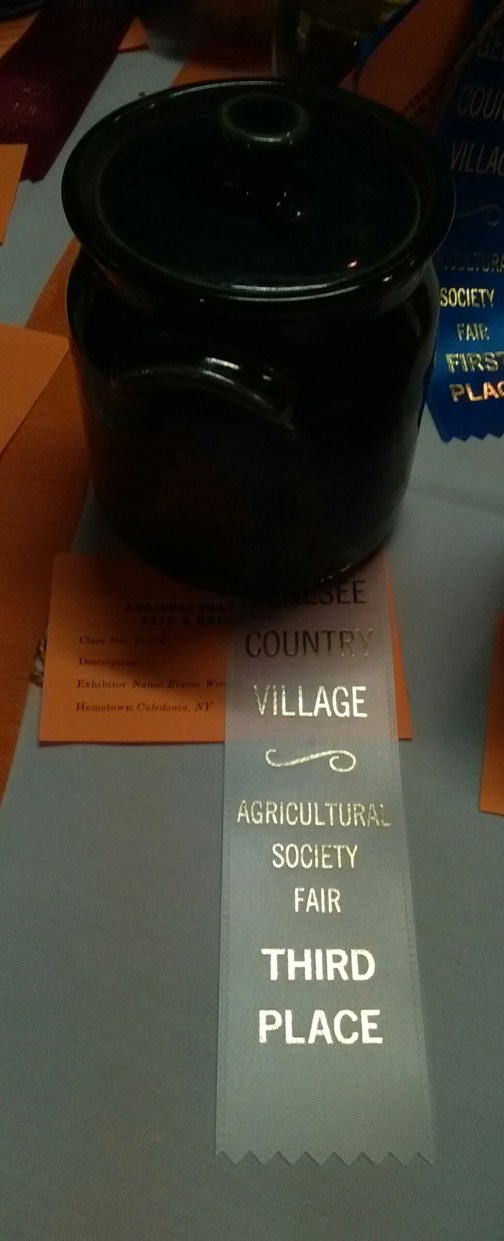
Both of this weekend’s blue ribbon winning winter bonnets are available. Find them in my shop – pumpkin and quilted.


Published in: on October 2, 2016 at 6:44 pm  Comments (1)  

Ag Fair 2016

We just got back from the year’s Agricultural Society Fair. I am rather cold and tired. So, this will be brief. Be sure to see my post on Velvet Vegetables, my whimsical entry that I find of. 

Several of my entries did not fit in categories. 

My play on a horticulture category.

My beaded crochet purse.

A sampling of millinery in miniature.

I also entered a couple millinery pieces. Here is a simple quilted bonnet made with a brightly colored silk. 

My batwing soft crown bonnet, which bows to Anneliese’s incredible cap.

A corded pumpkin bonnet in a mini check silk. 

I made lavender wands for the first time since Grandma died.

Mom entered an assortment, again not as many. 

I took a couple videos this year. (I added a YouTube channel.)

Horticulture tent part 1: https://youtu.be/40wVaKxB33g

Horticulture tent part 2:https://www.youtube.com/watch?v=In0JBLqWn3g

Domestic Skills entries: https://www.youtube.com/watch?v=X8iA56fIu3U

Published in: on October 1, 2016 at 5:31 pm  Comments (1)  

Vegetables in Velvet

When I first thought about making my “Basket of Vegetables Artfully Arranged” it was a quirky amusement. As I started making them, I felt a little silly. When I really got into it, they became just too much fun to make.

There are two kinds of vegetables in my basket, those made with already dyed cotton velvet and those made with white silk velvet colored with chalk pastels. Each are topped with wool leaves and stems. In a couple pieces, I used the pastels over the cotton velvet.  As with original Victorian velvet pin cushions, I did not keep scale as a rule, though I did adhere a little better to real life. This trio from Christie’s shows scale was not a hard fast rule, with the strawberry that is larger than the carrot and apple.


While tomatoes and strawberries are the velvet pin cushions we most commonly think of, I found as I worked, I was most smitten with the carrots and the eggplant.

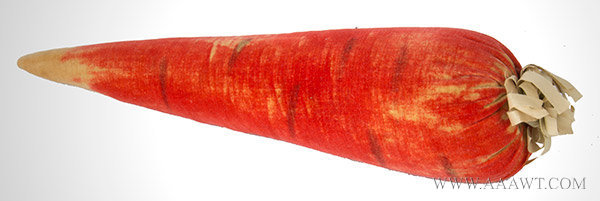
 The carrots captured my attention because it was such a simple shape, yet a complex coloring. The shape is simply a triangle, sewn up the side and gathered in on the top. The coloring though is layers of yellows and oranges accented with stripes. Original velvet carrots show beautiful coloring recalling the carrots of many colors. This original carrot shows a variegation of orange with short brown stripes and a small crown of greens.

The eggplant on the other hand is all about the shape with the green leaves wrapping around the top. There is just something about that combination that I love. This is true for each of the varieties I made. I also quite like the combination of the deep purple velvet and the green wool. (I think I will make a couple all wool eggplants too.) The original velvet eggplants have a beautiful depth of color, a level I have yet to be able to achieve with the colors I used.

Anther favorite is the assortment of chili peppers. This may be that they are already a favorite, or it may be that beautiful red color, or it may be that I can see them dangling together in a group. This is the one vegetable I do not have a solid original example of (yet.)

The squashes and gourds allowed for a great variety of heirlooms to choose from. These are each smaller than life, with the pumpkin being the most so. I want to look into whether or not actual stems were or were not used in nineteenth century examples. There is a fun modern trend of making decorative velvet pumpkins in a variety of fun colors with real stems. This auction example with an original stem is said to be from the early 19th century.

Returning to the popular tomatoes, I wanted an assortment of varieties from deep red, to orange red and green. Luckily, I was able to find several shades of red scraps to work with. I did a little coloring to play with how the colors change as they ripen.

I almost forgot my cucumbers. They are a little under ripe or were in too moist of a garden based on their rather light green tone.

Published in: on October 1, 2016 at 4:25 pm  Comments (2)