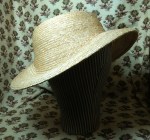
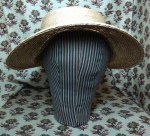
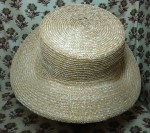
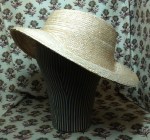
Hop over to Beth’s Bobbins to read her Review of From Field to Fashion.
Thank you, Beth, for the review.
From Field to Fashion is available in my Etsy Shop.
Hop over to Beth’s Bobbins to read her Review of From Field to Fashion.
Thank you, Beth, for the review.
From Field to Fashion is available in my Etsy Shop.
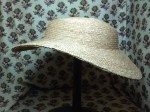
This fashionable Civil War era straw hat is ideal for a promenade about town.
The shallow, oval crown is favored by this with average to small head. The three inch wide brim dips forward and back.
I was asked about a few millinery related things in the past migraine infused week. Here is one quick look at symmetry and asymmetry in straw hats of the Civil War era. (Please note: This does not break down the location of trim by yearly or seasonal fashion.)

Image Sources:
MET, MFA, Peterson’s Magazine, assorted pins on Pinterest.
This Civil War era bonnet is ideal for a working class impression.
This bonnet will best fit an average to small head. The cheek tabs turns in slightly, and will hold the bonnet to your head at your neck like originals.
As with my other straw millinery, this bonnet is entirely hand sewn.
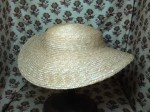
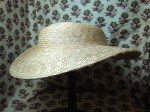
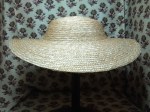
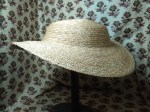
Tonight I finished a Civil War era straw hat. This hat has just a hint of curve to the brim. It is blocked with an antique crown and brim block.
I’ve decided this crown block needs a name to make it easier for patrons to find their favorites. This one will be called Delia, as I happen to be watching Angel and think this shape would fit Cordelia nicely. The Delia crown is 21.5″ in circumference, 6.5″ wide and 7.5″ front to back. This will nicely fit those with an average to large head or those who prefer the feel of a rounder crown. *Remember, this era hat is worn higher on the head compared to where we are accustom to for modern wear.
A band of black velvet highlights the curve of this chapeaux’s brim. Inside, the brim is lined with silk taffeta in a blue and black check. Lush blue satin ribbon ties this bonnet and wraps around the crown, gathered with loops of black velvet.
Note: This post has been updated from its original form thanks to something Beth Chamberlain pointed out.
Among the bandeau and coronet style headdresses speckling museum collections is this black velvet bandeau with black beads from the MET’s collection. Well, numerous pins on Pinterest attribute it to the MET, yet link only to the search page with the connection to the items page broken. I’ve spent hours digging through the collection for it, searching headdress, cap,velvet, coronet, without success.After initially posting about this piece, Beth pointed out that what I thought was two different examples were indeed the same piece – The one attributed to the MET with a broken link was the same as the one from the 2014 Ebay listing when the piece was deaccessioned. I was skeptical at first, then finally convinced when she showed me this photo that allowed the back proportion to be seen clearly.

This bandeau has a very full bow with numerous loops made with inch to maybe and inch and a quarter ribbon. Clusters of round and seed beads alternate – one design has loops of seed beads that are sorta petal like, the other has narrower loops. The loops among the bow combine two size seed beads, the smaller of which may be silver, with tube beads. The foundation is a wire band covered and a black net or buckram like pad at the base of the bow loops.
My example uses inch and a half wide black satin black back velvet wrapped around a wire and batting base. I alternated antique black faceted glass beads with a row of antique black cut steel beads around the crown and in the bow’s loops. This piece used shy of 5 yards of 1 1/2″ satin back velvet ribbon by Hyman Hendler, a strand of antique black cut steel beads, a short strand of antique black glass beads, millinery wire and cotton batting. (I found my single order of beads was enough for only one piece rather than the three I had thought. This makes the beads a rather pricey component.)
I almost forgot: Yes, this is available in my Etsy shop.
(I really wish the bright light did not show every bit of batting fibers coming through the velvet)

When I wrote about headdresses in “A Band of Millinette” a few weeks ago I thought maybe I would make a headdress or cap here and there throughout the season. Well, I sorta got carried away.
Looking at original examples and those in period publications, I find I am drawn to those with structure and form, combined with texture. I love the feel of a good velvet, both visual and tactile. I enjoy the shapes and movement layers of ribbon or feathers can make. I am caught by what beads can do with light.
I am also finding I prefer refined headdresses that are enhance the wearer rather than overwhelm. I like a headdress that can be put on for dinner and not thought of again until bed time, no fussing or adjusting.
These last few weeks, I’ve played primarily with velvet and just a bit of lace and beads. With so many ideas dancing around and around in my head and the many materials options, I’ve not only been learning about period techniques, I’ve learned something about myself. With a whole world of materials options at my fingertips via the internet, I can not focus. There are simply too many options which become too many ideas. I enjoy taking the materials in front of me and making them into something more than searching for the materials. But, you are not interested I that. You want to heat about the headdresses.
These first two stem from an original at the Museum of Fine Arts and a couple illustrations. The original is red velvet with three bands, two with lace and a bow on the side. Each of my pieces today have two bands covered in silk/rayon velvet. (The triple is waiting for its beads) While the black one’s bands are even, the red one is graduated, wider at center front. They can easily be worn alone or with a sprig of fresh flowers to one side.
Now, I have to decide which ones to let go in the Etsy shop.…

In the past year there have been multiple posts and memes talking about the history of tomato pin cushions originating from tomatoes being a good luck symbol places upon the mantle. Now, there is even a video.
In each case, these are perpetuating a Myth.
Let’s look at the components of the story. The claim includes these points:
Let’s start with #3 – To me, this point alone should make someone skeptical of the story. Tomatoes being placed on the mantle or windowsill. Looking at this rationally, a tomato picked from the garden may not yet be ripe. It can be ripened a bit by being placed on the windowsill. At a point a tomato goes from ripe to past ripe to rotting. In some climates or weather combinations this can happen quite quickly. What logical person in any century is going to put a piece of food out to rot? Red flag.
Going back to #1 -Yup. This part is true. But, it is missing a big chunk of the real story. A number of fruits and vegetables were made into pin cushions and/or velvet decorations during the Victorian era (1837-1901), not just tomatoes. We can see tomatoes, pears, apples, carrots, eggplant, nuts, grapes, berries, etc. made from velvet in the nineteenth century.
Now, with all those other vegetables and fruits being made in velvet form and for pin cushions, why are we looking at the tomato as a symbol of good luck? It simply held popularity longer because it was easier to make, and easier to mass produce.
That brings us to #2 – If you were to do a search in Google Books looking for references to tomatoes along with good luck or good fortune, narrowed to the 19th century, you will find that this connection simply does not exist.