Clips of Domestic Economy – pt 7

 An Encyclopedia of Domestic Economy by Thomas Webster has an indepth section on servants from the perspective on one employing them. Within the section is this passage and chart I know some will find interesting. Please remember this applies to an English servant.

“In servants’ dress two thirds of the wages only should be spent. The remainder, left in the hands of their principal, or placed in saving’s banks to accumulate, may prove a means of comfort to them beyond comparison greater than the translent pleasure which a more expensive dress might give them. In the following tables will be found estimates sufficiently accurate to show, that with judgment in the choice of the materials, and a proper subordination of the inclination for dress to the means for obtaining it, a third part, or even more, of wages, may in most cases, be untouched, and yet the personal appearance of the servant not neglected thereby, but rather improved, inasmuch as consistency in dress is always one of the its most becoming attributes.

Table I – Wages 7l.7s

                                                                                      L              s              d
1 good cotton dress, at 8d                               0              7              8
2 common working gowns, at 6d           0              7              0
Linings for the dresses                                 0              2              0
4 petticoats                                                          0              8              0
Body linen                                                          0              4              6
Stockings (3 pairs)                                             0              6              0
Muslin for caps and handkerchiefs        0              6              0
Bonnet and trimmings                                 0              10            0
4 chequered aprons, 2 white ditto         0              6              0
A shawl                                                              0              12            0
3 pairs of shoes                                             0              12            0
2 pairs of gloves                                          0              1              0
Sundries                                                         0              10            0
                                                                            4              13            2

Table II Wages from 12L 12s upwards

3 gowns (making, &c)                            1              10            0
Petticoats                                                     0              12            0
Body linen                                                   0              6              0
4 pairs stockings                                     0              6              0
Aprons                                                           0              7              0
Caps, habit shirt, ribands, and gloves    1              0              0
2 bonnets and trimmings                       1              0              0
Shawl                                                           0              15            0
3 pairs of shoes                                      0              12            0
Sundries                                                       1              0              0
                                                                   L7            8              0
Published in: on November 9, 2011 at 1:31 am  Leave a Comment  

Clips of Domestic Economy – pt 6

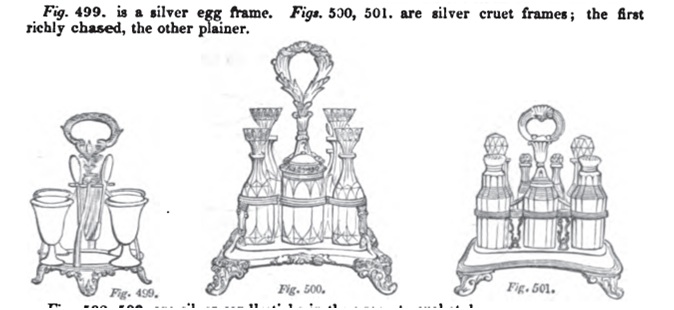
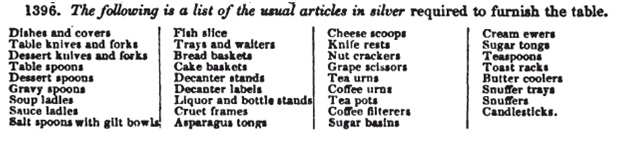
The author discusses silverware, flatware and cutlery extensively with occasional illustration. Those areas are so very detailed, I will not attempt to choose what to clip out. Here is a list of the “Usualy articles in silver required to furnish the table”:


Cruets are just something I want to learn more about. So, I pulled this image of silver-plate to share:

Published in: on November 8, 2011 at 1:16 am  Leave a Comment  

Clips of Domestic Economy – pt 5

I had to switch to the 1852 version of An Encyclopedia of Domestic Economy by Thomas Webster because the 1845 version I downloaded was only half there. This edition was published in London instead of New York.

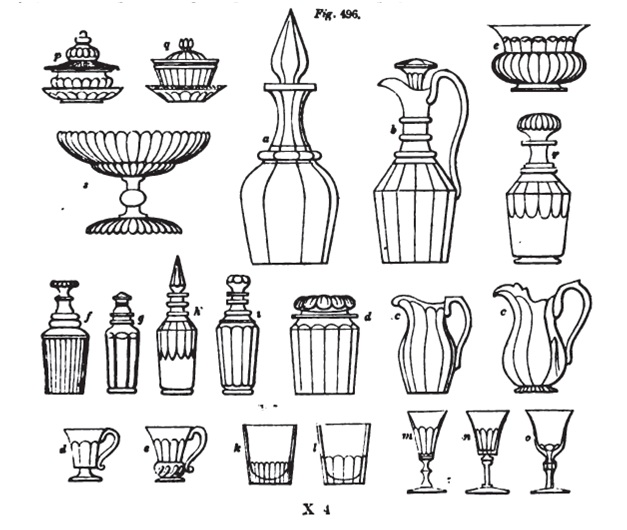
I know there has been recent discussion of glassware for the table. In that light, this illustration and description is quite handy:

“Glass Used as Table Furniture – The use of glass in furniture is too well known to require much illustration. We shall confine ourselves, therefore, to an enumeration of the  various articles in common use. Mirrors have already been mentioned for chandeliers and other holders for lights in Section on Lamps. Glass for the table consists of, decanters for the usual wines, a, fig. 496; ditto for claret, b; liquor bottles, r; water jugs, c, c; pickle glasses, d; finger cups, e; custard cups, d; cruet glasses, f, g, h, I; tumblers, k, l; wine-glasses of various kinds, m, n, o, including those of green glass; butter basins, p, q, s, salad basins, &c.

Published in: on November 7, 2011 at 1:11 am  Leave a Comment  

Clips of Domestic Economy – pt 4


Today from An Encyclopedia of Domestic Economy by Thomas Webster, published in 1845 in New York, we have some bed and bedding items.

One note –  Being written about 15 years prior, these pieces would not have been new in 1860 and in some areas could be seen as out-of-date.

There are quite a few beds shared in the book ranging from simple to draped or canopied to iron and fold-out beds.


I’m sure one of the most of interest will be this folding bed:

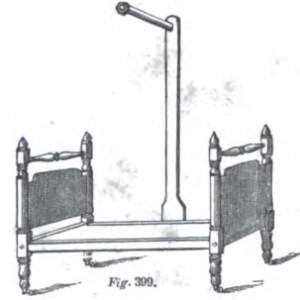
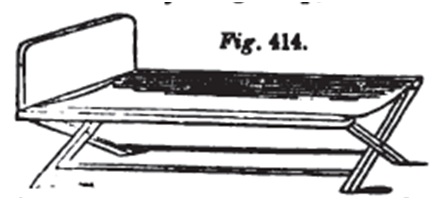
“The folding camp, or tressel bedstead, fig 414, is one of the cheapest made, and has the great convenience of being easily put aside to make room when folded, consisting merely of two frames connected by the sacking. When extended, it is kept open by the head-board, which has two pins that drop into holes in the side rails, with the addition of a foot-board, made in the same manner as the head-board; there is no better bedstead for men servants or young people; and being so moveable, they are easily kept clean, not requiring taking to pieces. They may be had complete for less than [ 1 pound]. If required, nothing would be easier than to add curtains, in the manner of the French bedstead. They are also made sometimes of iron.

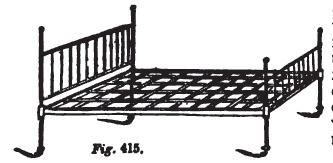
Camp bedsteads, to fold in little room, are made sometimes of iron; but the best and most elegant are of hollow brass rods, which are particularly convenient for travelling by land or sea, and are occasionally useful in the house from being easily put away. Those of brass are about twice the price of iron ones. Couches are made on the same principle.”


In the bedroom section, this book details on several pages the types of materials used for bedding or mattresses. Starting on page 296, these include:

Feather beds stuffed with feathers – The author notes some people rub the inside of the ticking with bees wax or a combination of bees wax and soap to help decrease the dust connected with feather beds. He also says the ticking must be as close, thick and stout as possible. Feather beds are softer than the mattresses they often sit on, which follow.

Mattresses “are firmer kids of beds, usually placed under the feather beds, but sometimes preferred to the latter for sleeping upon, as being less soft, and not so relaxing. They consist of a bag of canvass or ticking stuffed with various materials; but as these are not intended to be moved or shaken, they are fixed in their places by packthread put through, and tufts fixed at equal distances: the edge or border of the mattress is formed square. The materials with which mattresses are filled are usually horsehair, wool, flock, millpuff (a kind of coarse wool), chaff, straw, ulva-marina, cocoanut fibre, or coils of elastic wire. Hay and chaff are occasionally employed.”

Descriptions of each are detailed by the author. He also discusses alternate beds being introduced – the French paillasse “a very thick mattress stuffed hard with drawn wheat straw”, an air bed of India rubber invented in 1813 and a “Dr. Arnott’s water bed” intended as invalid furniture.

Published in: on November 6, 2011 at 1:53 am  Leave a Comment  

Clips of Domestic Economy – pt 3

I am greatly enjoying An Encyclopedia of Domestic Economy by Thomas Webster, published in 1845 in New York. I hope you are enjoying the pieces I am sharing.

One note –  Being written about 15 years prior, these pieces would not have been new in 1860 and in some areas could be seen as out-of-date.

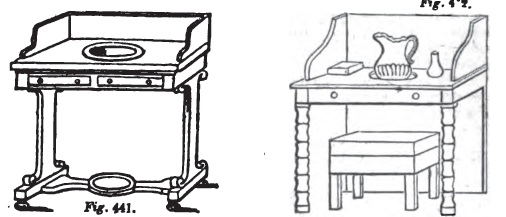
The book has several dressing tables and wash stands, some of which I really like.

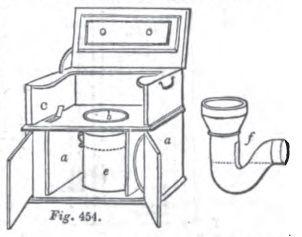
 This portable water-closet is one I thought especially worth sharing:

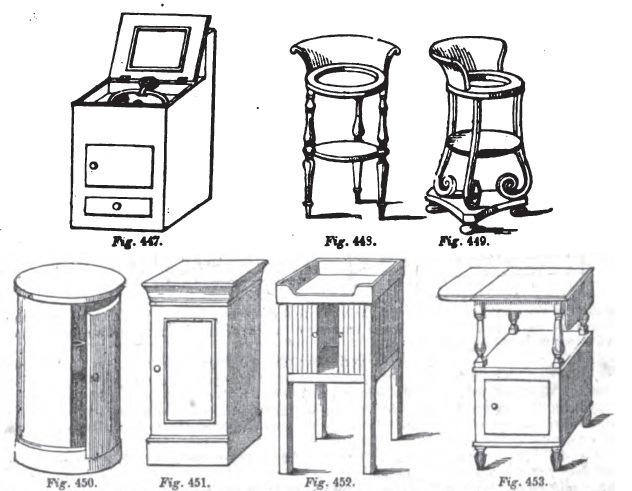
“Portable water-closets are useful where fixed ones cannot be had, and in case of sickness; as they may be placed in a dressing-room, or even a bedroom. If ill constructed, they are a nuisance; butt we can recommend the following , patented by Wiss, near Charing Cross, London. Fig 454, a, a, is the cistern for water, surrounding the three sides of a box which holds the pan, b; the cistern is filled by lifting up a small lid, c, and pulling the handle of an engine, by which the water is forced into the pan through the washer. This water, by its weight, opens the hinged valve at the bottom of the pan, and carries the contents into a pail, e, placed beneath. This pail has a cover with a projection that dips into a groove containing a little water, that effectually prevents any effluvia from coming out. The pail can be removed to empty it. This apparatus many be made in a variety   of forms; as a seat, an arm-chair, a commode, settee, &c. The   same moveable box, with the cistern and pan, may be used without a pail, and be more complete, where there is the convenience of connecting it with a pipe to go into a drain or cesspool. In this case there is a curved tube, f, to be joined to the pipe, which, being always full of water up to the dotted line, stops any smell from ascending.

Published in: on November 5, 2011 at 1:49 am  Leave a Comment  

Clips of Domestic Economy – pt 2

 Today I have more items from An Encyclopedia of Domestic Economy by Thomas Webster, published in 1845 in New York.

One note –  Being written about 15 years prior, these pieces would not have been new in 1860 and in some areas could be seen as out-of-date.

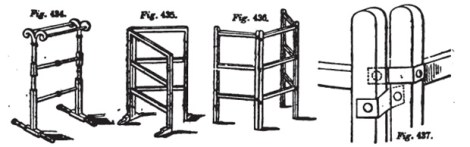
When I first looked at these towel and wash stands in the bedroom section, I noticed fig 434 looked like what I had always thought of as a quilt stand. This is something I will need to look into better. My next thought was about how useful one of these would be at an event. I prefer to drape the clothing I’ve taken off to air out or in some cases dry out due to the weather being hot and humid or wet. I often end up draping my cloths over a chair. One of these would be so much more useful. After all that is what these are for.

“Towel and wash stands. 1234 – Towel and cloth airers. Fig 434 is the form at present most in fashion for towels. Fig. 435 is more convenient for airing clothes; from the mode in which the feet are fixed on, it will stand whether open or shut. Fig. 436 is still more convenient, as by means of a very simple hinge I may be made to fold backward, and in several different positions. Fig. 437 represents the hinge, which consists of only two strips of leather nailed on as in the woodcut: it may be made by any carpenter: there are four such hinges.”

Published in: on November 4, 2011 at 1:46 am  Leave a Comment  

Clips of Domestic Economy – pt 1

I’ve been reading through An Encyclopedia of Domestic Economy by Thomas Webster lately. Published in 1845 in New York this book is packed full of useful and interesting pieces of information. I thought I would share some of those I find either particularly interesting or potentially useful.

One note –  Being written about 15 years prior, these pieces would not have been new in 1860 and in some areas could be seen as out-of-date.

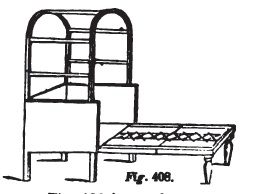
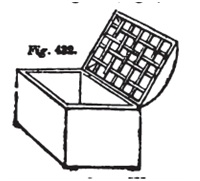
This box-stool is something I would love to duplicate either for use at home or an event. It is a box with the top padded for sitting. The inside has a grid pattern used for hanging caps from. The text says “Fig. 432 is a box-stool, having the top stuffed to sit on, while the inside may hold caps, or other articles of dress, pinned to the girt in the lid.”


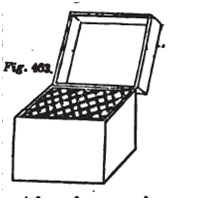
Quite similar is this traveling box meant for caps or bonnets. “Traveling boxes, for caps or bonnets, have a frame with a narrow girth crossed within, as fig. 463, to the underside of the which the caps are pinned, so as not to touch the sides, or each other. Frills, laces, and light articles of that kind are fixed upon the upper side of this network. Care should be taken to carry the boxes always top uppermost, and the caps will arrive at their destination without the slightest injury. The outside of the box is covered with some water-proof substance, as painted canvas.”


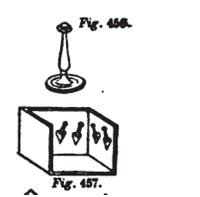
While looking at pieces which store caps and bonnets, I want to share these parts of a wardrobe meant for storing bonnets and caps. “Fig. 455 represents one of the simplest and cheapest wardrobes, being a press with folding doors and sliding shelves. At the bottoms is a deep drawer for holding bonnets and caps; these are best placed upon bonnet-holders within the drawer, fig. 456, or hung on hooks fixed in the inside of the drawers, as in fig. 457.”


Published in: on November 3, 2011 at 1:41 am  Leave a Comment  

Are You Ready for Your Cold Weather Events?

For those of us in the northern states of the country we usually see the onset of fall as the ‘end of the season’. But, many of us have cold weather activities ahead of us. This could be ceremonies for Veteran’s Day and Rememberance Day, Yuletide and Christmas events for our living history sites or even festive caroling in our communities.

For each of these events, the weather can get down-right Cold!

Keep in mind – Layers are the Key to Warmth. This means your 1) Underpinnings 2) Dress 3) Outerwear and 4) Accessories.

Here is a list of items that can help you keep warm:

For your dress, consider:

For outerwear, think beyond the cape that will let cold air in and encumber you arms. Consider:

Accessories help keep your hands and head warm. Consider these:

Published in: on November 2, 2011 at 1:23 am  Leave a Comment  
Tags:

12 Homemade Gifts of Christmas – Day 12

The twelfth and final homemade gift is my husband’s pic – A quilt. Last year I assembled and quilted my husband’s quilt right in the living room while he slept on the couch. (He was working 12 hour nights and was impossible to wake up otherwise.) 

Okay, I know some of you are screaming “there is no way I can make a quilt in time for Christmas.” Sure you can!

The type of quilt I’m talking about is a stripy-quilt common during the first half of the century. These quilts are simple strips of fabric sewn side by side. You can use plain strips or pieces strips. You can even alternate. A quilt size good for a bedroll can be 45″ by 7 or 8 feet. Convienantly, you can cut a fat quarter (22″x22″) into four strips when sewn end to end gives you a 5.5″ wide strip 7 feet long. This strip will become 5″ wide if you use a 1/4″ seam allowance on each side when attaching the strips. So… this means you can use as little as 9 fat quarters of period correct fabric to make a simple stripy-quilt. To make piece stripes you will need more of course. I like to alternate pieced stripes with a solid color stripe. For the back, 3 yards of muslin will work. Choose a cotton or wool batting for the inside.  You will also need a fabric to bind the sides with. A half yard cut into 2.5″ strips should work nicely. Now how to get your quilt together.

Day 1 – Cut each of your fat quarters into their 5.5″ wide pieces. Sew each long strip together. Cut you binding strips. Sew them together in one long strip and set aside.

Day 2 – Lay your strips out next to each other and arrange how you want them to go together. Label them if you like. Stack them nicely. Take them to the machine and sew the strips in order. (You can do this by hand of course.)

Day 3 – Double check the length of your quilt front. Cut the muslin and batting to size. On a large flat surface, lay the muslin, batting and quilt top. (if there isn’t enough floor space, the bed works nicely.) Pin your layers together from the center out. When it is all pinned together, roll from the left in to center and the right into center, clipping with the large plastic hair clips.

Day 4 till? – Starting in the center and working out, quilt in the seams of the strips. This is called “stitching in the ditch”. Stitch the very center ditch. Then unroll one side just enough to see the next seam. Continue quilting in the seams and unrolling until the quilt is quilted. This is quite relaxing while watching your end of day tv, a favorite movie or even the kids doing their homework.

Day x – Pin the binding to the front of the quilt all the way around. (You may want to look up mitering corners.) Sew around the whole quilt. Fold the binding over to the back. Fold the raw edge under and whip to the muslin.

Ta-da…. You are done.

Need a recap?

  • 9 fat quarters
  • 1/2 yard binding fabric
  • 3 yards muslin
  • 45″x90″ cotton or wool batting (to be trimmed down)
  • Pins
  • Hair Clips (The kind that look like claws)
  • Some of your favorite videos or audio books. Possibly an activity for the kids as well.
  • Thread and needles
Published in: on November 1, 2011 at 1:11 am  Leave a Comment  
Tags:

12 Homemade Gifts of Christmas – Day 11

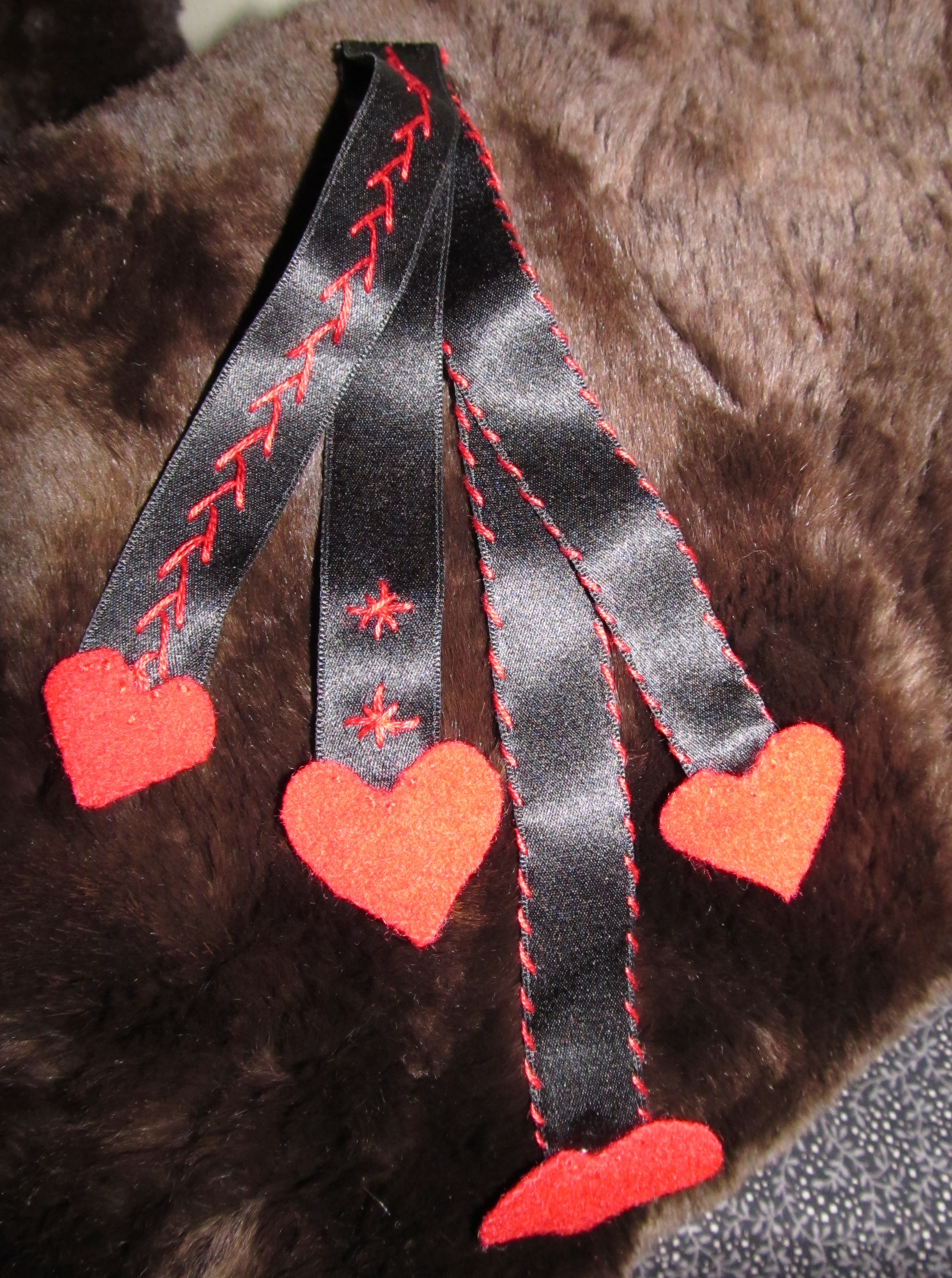
For the eleventh day of homemade gifts we have something for book lovers – A book marker.

This fun book marker comes from Peterson’s Magazine. It is made of two lengths of ribbons decorated to taste.

Take a length of ribbon, approx 2 feet, and cut it into two pieces one slightly shorter than the other. Fold each ribbon in ‘half’ so you have four different lengths at the ends. Lay the folded ribbons on top of each other with the folds together. Tightly whip the folds together with tiny stitches. Embroider the ribbons to taste. Use pieces of fabric to make the crosses (in Peterson’s or hearts in the case of mine) at the ends of the ribbon.

Published in: on October 31, 2011 at 1:40 am  Leave a Comment  
Tags: