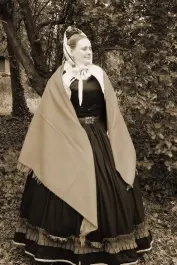
Aunt Betsy on Woman’s Rights

Moore’s Rural New-Yorker
March 23rd, 1861
Aunt Betsy on Woman’s Rights
We had been talking of “Woman’s Rights,” one winter evening in Aunt Betsy’s room- talking girl fashion, but none the less ‘decidedly’ or enthusiastically, from the fact that it was a subject we knew little but fancied much about.
At last Alice said, looking around to where she sat, – her specs pushed up, and her eyes fixed rather quizzically on us, – “What do you think about ‘Women’s Rights,’ Aunt Betsy?”
“Well, girls,” she said, after a moment’s pause, “I can tell you just what I think, and I’ve a sort of an idea that it won’t do you any hurt either, seeing that I’ve seen more of the world than you have.”
“Why, Aunt,” broke in Alice, “you’ve never been out of Saddlersville in your life, and we’ve been to the Falls, and the Springs, and ever so many other places.”
“That may all be, child; but talking about “Woman’s Rights, – her rights are in her world, aint they? And her home is her world, isn’t it? I think, may be, my dear, that I know full as much about the falls and springs of that sort of world as any body, – falls and springs of feeling, and love, and temper, too.”
It was quite a sentimental speech for the old lady and she sat thinking for a moment, till we began to fidget in our chairs.
“I suppose you all think,” she began at last “that when you’re once launched on the “Sea of Matrimony,” as some of them big writers tell about, you’ll ‘become possessed of your own inalienable and individual rights,’ and so on, but, girls, there’s a heap of knowledge, that isn’t to be found in your boardin’-schools and ‘cademys, got to be drilled into your innocent heads yet.
“When you get married, and leave your mother, and sisters, and aunts, to go tagging after a man, that you never see in his own home, – whose shirt-bosoms and sock-heels you never even thought of, – you’re just jumpin’ off a precipice with your eyes blinded, and the land you pitch your tent in, after you’ve jumped, will have to have a blessed lot of sunshine to keep your mind off the little briars and sticks that catch hold of your dresses and tear your ankles.
“It’ll be all butter and honey at first, to be sure, till just then, your weddin’-tour will be over, and the next thing will be to get to house-keeping. You, who never scratched your finger without crying, will tug up and down stairs, and scrub, and wash and sweep, to get things in order, and maybe you’ll think about them that it’s one of your ‘inalienable rights’ to have a little help; but pretty soon in he’ll come- out of the air and sunshine, wide-awake as can be – and laugh at you about the hooks burst off the back of your dress, looking round at the things approvingly, and finally throwing himself into the rocking-chair, and with the remark that he ‘thinks he’ll have a clean shirt!’
“’Where is it, my-dear!’ says he, and you’ll take your hands out of your dish-water, as meekly as though you hadn’t an individual right in the world, – go a trudgin’ off up-stairs, or somewhere, after it, shut the drawers ruefully on a dozen that need patching, and hunt half an hour for a needle to sew on a button-with.
“That’s the beginning of your rights, and though you may get what folks call ‘one of the best men that ever was,’ and you ‘love him like a pisen,’ as some one says, there’ll be a dozen times every day that he’ll tread one of your mights under his heel, and another under his toe; and you’ll look the other way, – like enough grease the boots he does it with.
“Just you take my advice, girls, and don’t say any more about your rights, for you’ll
be pretty likely to ‘haul on your colors,’ when the time comes, and woman’s fate with it.
“I’m sure I don’t know whether we’re born so or now, but sensible women, that have got to be as old as I am, are pretty apt to think it’s better to put up with a few less rights for the sake of a little more peace.”
E.C.L.K. Charlotte Center, N.Y., 1861

Read more “Their Life; Their Words”


Published in: on April 29, 2014 at 4:00 pm  Leave a Comment  
Tags:

A Year in Millinery Fashion – 1864

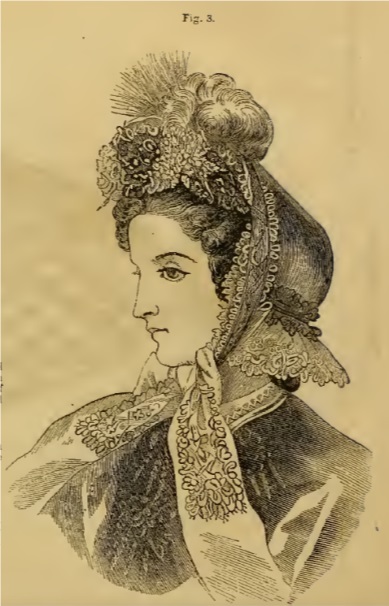
White crepe bonnet, made over white silk. A straw guipure lace falls over the face, and trims the outside of the bonnet. A straw colored feather is laid gracefully over the front. (Godey’s, May 1864)

4


Vulgarity is often clothed in a silken garb

Moore’s Rural New-Yorker

February 2nd 1861

Over-Dressing, Again

It is well that the Rural has opened its pages to discussion upon this subject, for extravagance in dress has become the national sin of American women, and notwithstanding Linda’s spirited defense, they are without excuse.

The fact that husbands are often bought by an expensive toilet, is the very reason that over-dressing should be avoided, for what true women would wish to marry a man who wedded only for wealth. However, that class is small which, in seeking a bride, places of wealth before personal attractions, and when introductions are solicited to “that little butterfly of a coquette, made radiantly beautiful by silks and laces,” in nine cases out of ten it is something in the look, word, manner, or in the taste displayed that is the chief feature of attraction; and, generally speaking, an elaborate and showy wardrobe does little to assist in gaining admiration. On the contrary, (if we dress to please the gentlemen,) they must often be displeased, if not disgusted at the low standard by which we judge their taste in our extravagant attire. I am sure they would be better pleased, if the fair ones used a little more common sense, becoming women of America in the nineteenth century.

Linda says that “personal beauty is rarely appreciated, except it be assisted with the elegance of dress.” In good society at present, personal beauty in simple but tasteful array in appreciated more highly than plainer features associated with rich apparel. But few things have a great bearing upon our success in society than dress, which depends not so much upon its elegance, as its grace and fitness. Expensive attire may usually be dispense with, but taste and neatness can never be omitted. I know a beautiful lassie who was woed and won in a corn-colored print, and whose suitor was highly educated and refined, moving in the first circles in our great metropolis. Her beauty was none the less appreciated because of her simple dress. Vulgarity is often clothed in a silken garb, but refinement cannot be mistaken in tasteful though unassuming garments.

“And often the chief attraction of the handsome face is dependent on some peculiarity of style, or shade of color in dress, which is made the subject of study by those who know the secret of their power in society.” It is the duty and privilege of woman to make her dress a subject of study, and adopt that which is most becoming. Every delineation of form and feature should be taken into consideration, and from among the great variety of styles in fashion, that one selected which will enable her to appear to the best advantage. Expensive and superfluous dress is not necessary to produce a pleasing effect. It is good judgement and skill in every department of the toilet, however minute. If I were to appear an evening in company with a view to charm an ideal admirer, I should certainly choose the dress which would give the best effect, though it were of plain material, rather than the most elegant, if it were deficient in any particular. Let the clothing be fashionable and faultless, but it need not be superfluous to be admired.

Certainly, American gentlemen do not prefer the stolid English, the phlegmatic German, or the plain features of the French, to our fair and spirited women, with all their sin of dress; but if the dear little wife who presides in the sweet vine-wreathed the sober colors of the English, would study more perfectly the true science and art of dress, in which the French excel, she could, with less inconvenience, be arrayed becomingly in the style her husband most dearly loves to see, which is oftener the tidy print, or the robe of plain material. Is it not, gentlemen? As we like to please the fastidious of the other sex, let us hear their views upon this important subject.

Jane E. Higby. Piffard, N.Y., Jan., 1861

For the continued disucssion of dress and over-dress, please click: Following the question

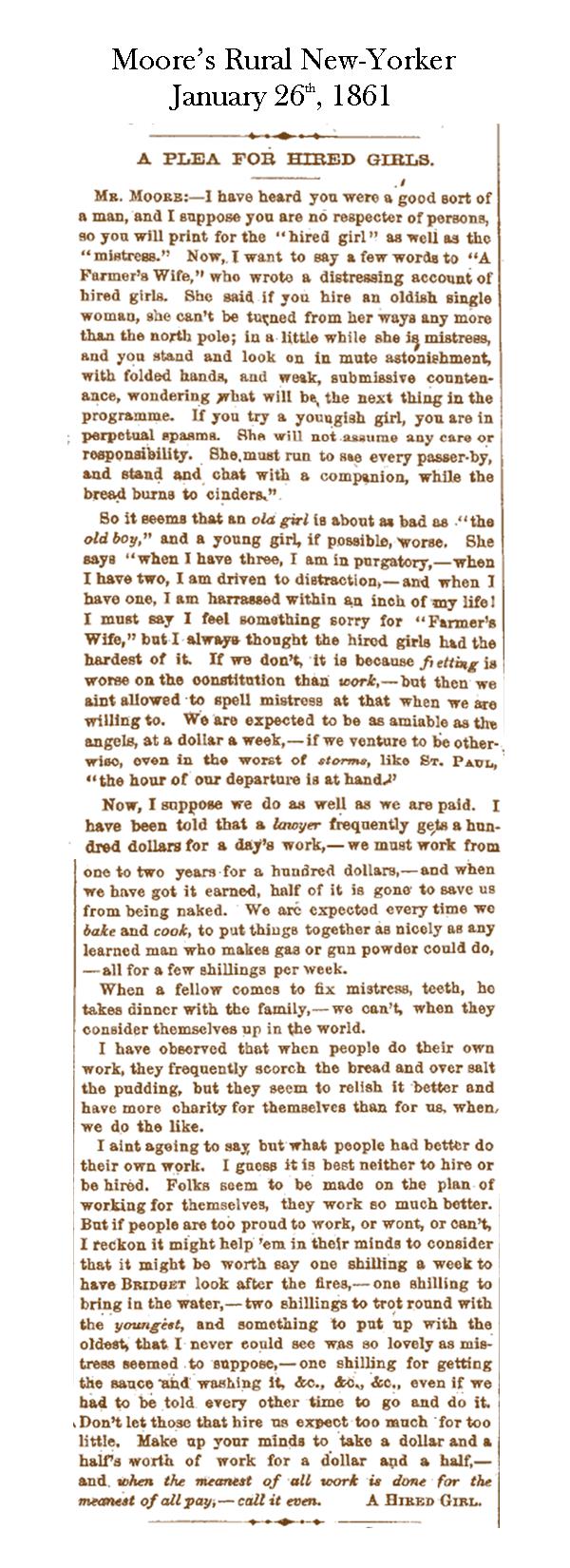
Hired Girl – Looking for Previous Article

If anyone happens to know where I can find the 1860 Moore’s Rural, please let me know. I want to find the article previous to this one:

Hired Girl 61

Published in: on April 25, 2014 at 6:00 pm  Leave a Comment  
Tags: ,

Over-Dressing (From the Rural)

Moore’s Rural New-Yorker
January 5th, 1861
Over-dressing
“The over-dressing of American ladies in the streets, at hotels, and in the churches, is a subject remark among travelers from abroad, as well as sensible people at home.” Rural New Yorker
There is a foreign savor about your discourse, Mr. Celebs. The true sons of “Uncle Sam” do not sit in judgment against the wives and daughters of their own country. Hav’nt [sic] you been taking a jaunt in the Queen’s dominions, and been accustomed to the sight of those somber-colored satin dresses that last from one generation to another, and from thence drawn your conclusions? Doubtless you have encased yourself in an armor of impenetrable reserve while the “conflict of” charms is viewed afar off, and while good care is taken that your position is beyond the reach of “Cupid’s darts.” Who are the sensible people you speak or? Are there any who do not make obeisance to keeping up appearances , especially in dress? A few prodigies of excellence and economy may exist; but the torch of Diogenes would evidently be required to find them. Suppose the American Ladies are somewhat in advance of those on the other side of the “big pond,” is there any rule by which they can be judged? Is there any judging in matters of dress? Surely nothing is more capricious than taste.
But if fault exists in matters of dress, where does it originate? For what purpose do they array their dear little selves in the most becoming style? Is it for their own gratification alone? On whom do gentlemen lavish their unceasing attention at “the Springs,” at Newport, at the ball, and, if you please, at the little private party in your own circle? To whom do gentlemen solicit introductions? Is it the plainly-dressed, unpretentious young lady? Or is it that little butterfly of a coquette, made radiantly beautiful by silks and laces? If I am not mistaken, men seldom value a jewel unless it be handsomely set. Dress, or over-dress, has a semblance of wealth, and husbands are not unfrequently bought with the lustre of money alone, and the conclusion of the matter sometimes is, that they find themselves beautifully “sold.”
Personal beauty is worshiped next to mammon, but is rarely appreciated except it be assisted with elegance of dress, and often the chief attraction of the handsome face is dependent on some peculiarity of style, or shade of color in dress, which is made the subject of study by those who know the secret of their power in society. Indeed, the great wonder is that so much attention is paid to mental culture and general intelligence. Goodness and intelligence must receive the homage that is due for their sakes alone, before a reform in dress can be expected. Newspaperdom is not the path to this field of reform. Honestly, Mr. Celebs, does not an American woman possess more attractions for a better-half with her great fault of over-dressing, or, rather, her fault of trying to please, than any of those English ladies who possess such a keen relish for roast beef and porter? Would you like to be taken captive by any of those German beauties whose liking for lager bear is equal to that exhibited by Artemas Ward’s musician – or would you prefer a French lass to serve up frogs in your dish of fricassee, and keep you spending half your life at a “café?” – instead of a neat little American home, where the vine and shrubbery grow undisturbed, and where the sunshine can play hide and seek, and the dear wife, arrayed in the becoming dress you so dearly love to see, is ever ready to welcome you. Linda Bennett. Hammondsport, N.Y., 1860
We wonder if Linda is not indulging in a sly hit at the occupants of the Rural sanctum, – administering her castigation over the shoulders of the devoted “Celebe?” At all events, she comes to the defense of American ladies with true spirit and courage, – genuine feminine grit, – and while we must, with the most profound respect, acknowledge the ardor displayed, we beg leave to enter our protest at being thus summarily read out of either the Union Federal, or Union Matrimonial, For the first, – and we include that naughty little sister, Miss S. Carolina, – we cherish a devotion that will last while pulse beats or heart throbs, and latter, bless your dear heart, Linda, we love with all our powers of body and soul. We speak knowingly, too; for instead of “keeping beyond the reach of Cupid’s arrows,” one of the aforesaid weapons touched us delicious years agone, as those who compose “our own circle” at home, – the little ones who clamber upon our knees and dally with locks where the frosts of winter are somewhat thickly sown, – could testify. In Linda’s remarks relative to the male race, there is unfortunately, too much of truth; we think, however, that the cause of this moral delinquency is not rightly judged. As to the question of dress, and the modes of styles thereof, we do not consider ourselves competent critics, and will take the advice of witty writer she mentions: – “Never don’t do nothin’ which it isn’t your Fort.” Our correspondent has broached the subject, – the ladies have the matter in charge, – and we will be glad to have them discuss its influence upon their sex, in a philosophical and hygienic point of view, through the columns of the Rural.


For the continued disucssion of dress and over-dress, please click: Following the question

Readings for Rural Life – The Amiable Woman Photographed

From Moore’s Rural New-Yorker in Rochester, NY

April 23rd, 1864

The Amiable Woman Photographed

Mrs. Bland is an exceedingly popular personage, indeed, esteemed quite a model by herself; and also by that class of highly respectable and incomparable individuals who congratulate themselves upon having the ability to please the whole world in consequence of possessing that wonderfully desirable trait of character – amiability.

We do not mean amiability as defined by Webster, but as understood by the class referred to; who should certainly be appreciated in “these degenerate days.” They are so excessively punctilious. And how entertaining and instructive! In their society one fears no wounds from keen, sparkling repartee, from scorching, dazzling wit, of meteor- like brilliancy. Nor is there danger of experiencing that uncomfortable feeling – envy. Nor do their genius, talents, individuality, or intellectual attainments, tempt to a violation of the seventeenth commandment; neither are they so deplorably ignorant as to call things by their proper names, unpleasant morals being known in their vocabulary; nor do they adhere to an opinion longer than is perfectly convenient. Neither have they the bad taste to insist upon the possession of their own souls! (granting they have any, which some uncharitable people doubt,) but seem quite ready to humbly beg pardon for committing the impropriety of entering the world at all.

True, they cannot understand lofty principle, nobility of soul, immutablility of opinion, speaking for the oppressed, and, if need be, battling for the right. But do they not veer round to all points of the compass to please? With consciences India-rubber-like, avowing loyal sentiments to the loyal union man loving his contry next to God, and the next moment agreeing with a vile, slimy, creeping copperhead, a rank secessionist, hissing forth treason and venom.

Their motto is, – be always popular; for if a man, there is the hope of office; if a woman, the prospect of matrimony. For do not many of the generous, liberal-minded, and discerning “Lords of Creation,” prefer a gentle, plastic, creature, an artificial nonentity, to a noble, whole-souled, high-minded woman, lest the contrast between them be too suggestive? One with intellect of Lilliputian order, seldom fancies have a wife’s colossal.

So anxious mamas desire their daughters to copy Mrs. Bland, who never offends Mrs. Grundy, and is too amiable to possess strong feelings, but whose limited stock is invariably called into exercise if a woman ventures to have an opinion, or, far worse, has the audacity to express one at variance with old, pre-conceived notions. And, if so “unwomanly” as to differ from a “gentleman,” she witheringly exclaims, “I had before supposed Miss Lawton was an amiable young lady!”

And did not this pattern for imitation, – this woman, par example, when her parents wished, break the engagement existing between herself and a poor young man, though with all her capacity loving him, when a merchant (who had failed, and was therefore rich) solicited her hand, and she married him, while attached to the other. For, as she remarked, “there is nothing like having all one’s friends satisfied.”

True, the poor young man soon after attained high eminence, and, in a pecuniary point of view, (as well as every other,) was a more desirable match than Mr. Bland; but that could not be forseen, and Mrs. Bland is far too amiable, if she feels any regrets at the irrevocable step, to express them. Lancilotte. Southold, Suffolk Co., N.Y. 1864.


Published in: on April 23, 2014 at 6:06 am  Leave a Comment  
Tags:

FanU Patriotic Fabric Swap!!

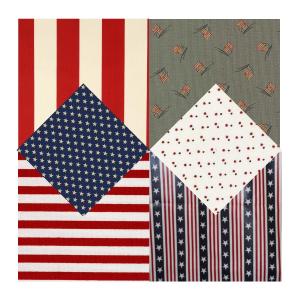
Today is the day to sign-up for the FanU Patriotic Swap! New ideas Patriotic

For the Patriotic Swap, Swappers will exchange nineteenth century appropriate cotton fabrics in red, white and blue or reproduced patriotic prints.  We will mail our fabrics on April 30th.

Please read all the details below. 

To Sign-up, simply comment below with your email and mailing address. (I’ll erase those before approving your comment, so the whole world doesn’t have that info.)

What is a Swap?

This is a chance for to exchange fabric with a small group of people. Each group will have 8 people exchanging pieces of fabric. All you need is a half yard of fabric and envelopes along with your copy of Fanciful Utility.

To Participate:

1: Sign Up Day!
On sign-up day, groups will be assigned on a first-in basis; the first eight will be the first swap group, second eight in the second group, etc. **Please be certain you will be able to fully participate by mailing your fabrics on the Mail-Out Date.**

Romantic Swap Sign-Up Day: January 13th
Paisley Swap Sign-Up Day: February 10th
Mini-Print Sign-Up Day: March 10th

Bonus Patriotic Swap Sign-Up Day: April 14th

2: Mail-Out Day:
Place a 9×9″ piece of fabric suited to the mid-19th century in envelopes for each of the 7 other people in your swap group, stamp them (be sure to double check at the post office, but the small 9×9″ pieces should mail in a regular envelope with a normal stamp), and send them off no later than the Mail-Out Day.

Romantic Swap Sign-Up Day: January 31st
Paisley Swap Sign-Up Day: February 28th
Mini-Print Sign-Up Day: March 31st

Bonus Patriotic Swap Sign-Up Day: April 30th

3: Get Fanciful!
Use your Fanciful Utility templates and techniques to make a project from the book, or copy your own from 19th century sources. We’ll all look forward to seeing your projects! You don’t have to sew right away, but don’t keep us waiting forever to see all the fun things!

(If you need a copy of Fanciful Utility, you can purchase them from the publisher at www.thesewingacademy.com

Fabric Guidelines:

  1. For the cotton and silk categories, your fabric should be early to mid-nineteenth century appropriate. (If there is a want for an earlier or later group, we can do that.) Prints and motifs should reflect those available in the 1840s, 50s and 60s. Cotton should be 100% cotton. Silk should be 100% silk.
  2. To keep the swap and sewing possibilities interesting, please avoid solids as best we can.
  3. Fabrics that do not work well for sewing cases should not be swapped. These include sheers, gauzes, heavy, thick, easy-to-fray, slippery and stretch fabrics.
  4. For the “crazy swap” category, think crazy quilt in a sewing case. This could include satins, velvets, textured fabrics. Quality synthetic fabrics are invited.  

Swapper Guidelines:

  1. Please be certain you can fully participate in the swap before you sign-up.
  2. If something arises after you sign-up that will effect the date you are mailing your fabrics, please email your group so everyone is aware.
  3. If you fail to fully participate in a swap, you will not be able to sign-up for future swaps. (We do understand medical and family emergencies. I need to be able to ensure swappers will receive fabrics when they send fabrics out.)

Q&A

Yes, you can participate in 1, 2 or 3 of the swaps.

Yes, if we end up with multiple groups, you can participate in more than one group to swap more fabric. If you participate in 2 groups, you should swap 2 fabrics.

Yes, you can swap large and small scale prints.

Yes, you can swap now and sew later.

Yes, we would love to see what you’ve made with the swapped fabric.

Yes, you can use your own fabric in your swapped project.

Published in: on April 21, 2014 at 6:00 am  Comments (4)  
Tags:

A Year in Millinery Fashion – 1864

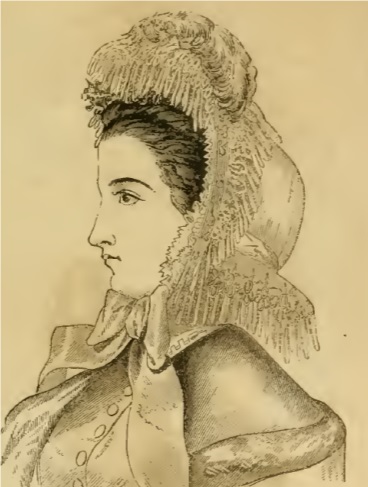
Violet crepe bonnet, trimmed on the front with a black lace insertion. The cape is covered by a rich white blonde, headed by a black lace. On top of the bonnet is a light violet
feather, and a pompon of spun glass. The inside trimming is of black and white lace, mixed with scarlet-berries and fancy grasses. A black lace barbe is tied in with the violet strings. (Godey’s, May 1864)

3

Readings for Rural Life

From Moore’s Rural New-Yorker in Rochester, NY

April 16th, 1864

High Dresses

We are thankful for at least one of the dame Fashion’s freaks: she has turned her back upon low-necked dresses, and rather insists that collar-bones and shoulder-blades shall be covered. It is certainly a great improvement – not only because the study of anatomy in private parlors is not desirable, and that American damsels are apt to run to bone as some tall flowers do to seed., and because spinsters of uncertain age, fearful of being outdone by the nieces, presented such vast expanse of yellow neck and shoulder to the view at evening parties as were calculated to alarm nervous people seriously; but because since custom obliges us to wear garments, there can certainly be no reason why we should leave the most delicate portion of our frame without protection. Plumb shoulders and arms are pretty. But so (let us whisper) are plump legs. The mother who should fail to provide her daughter with stockings would be considered a cruel wretch, yet a year ago she might neglect to cover her chest and arms with impunity. We trust this state of things is over. We hope that the wisdom which causes every prudent parent to protect the pretty shoulders of her little girls with comfortable woolen sacques or capes will be appreciated; that sense will conquer vanity, and that in a little while it will be as absurd to say a woman in a low-necked dress as it would to-day to see a man in low-necked coat. – Sunday Times.


A Closer look at Straw Plait

I’m trying really hard to take a tech/internet vacation. But, I got a message that there is a plait discussion going on. This is an older blog post. I am in the midst of something far more indepth. (That’s all I can say right now.)

If I Had My Own Blue Box:

One of the most common mistakes in making a straw bonnet for living history or reenactment, is choosing a plait that is to wide and coarse. I will admit, I too made that mistake in the begining. We are often tempted and occasionally encouraged to use the straw from a craft bonnet for making a straw bonnet. Again, yes in the begining I did this. But, I’ve since learned and would like to advise you learn from my mistakes rather than wasting your time.

So, what is wrong with the straw from a craft hat from the craft shop? Most of them are to wide and to coarse. Occasionally, you can find narrower craft straw. But, not always. Take a look at the image below. A is a craft straw. It is 3/4″ wide. Some comes as wide as 1″. While there were wide straw strips used during the era…

View original post 275 more words

Published in: on April 15, 2014 at 8:42 pm  Leave a Comment