A Year in Millinery Fashion – 1864

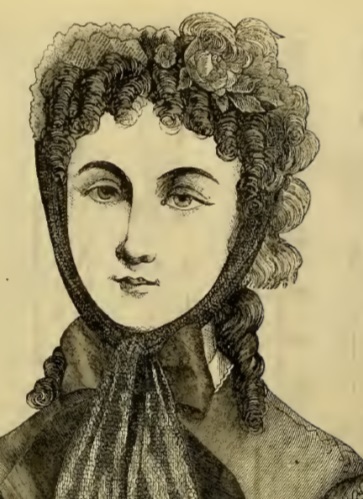
Left – The bonnet is trimmed with a row of daisies around the edge. The crown is formed of loops of ribbon and flowers, and a fall of white lace takes the place of a curtain.

Center – A fall bonnet of blonde lace constitutes the curtain. The inside trimming is of blonde lace and a small scarlet feather.

Right – White bonnet, trimmed with black lace. A black feather is laid over the front, an on the right side where the black feather is fastened is a large tuft of pink roses. 1

Published in: on November 21, 2014 at 1:01 am  Leave a Comment  
Tags:

Readings for Rural Life

From Moore’s Rural New-Yorker in Rochester, NY

November 26th, 1864

Baby-ology

If there is anything of which I am positively afraid, it is a baby – a real, live, genuine, long-white-gowned baby. I like little ducks, chickens, turkeys, and pigs are quite admissible. But a little, bald-headed, red-faced, tender-eyed, mouth-puckered baby is inadmissible. I am a very courageous youth; I hardly know the feeling of fear, but deliver me from entering a room where I am liable to be asked to hold some body’s “dear baby!” I rather hold a bag of cats. I am afraid to hold the thing with any degree of tenacity, for fear of squeezing it to death, and if I do not hold it fast, I am afraid it will fall to pieces. If I look at it, it sets up a squall, and if I do not look at it, it upsets itself.

Besides making me tremble with fear and horrible apprehensions, a baby nonpluses me. I neither know how to act, what to say, which way to look, or what to do with myself. So with a species of desperation unknown under any other circumstances, I grab a portion of the garments on either side of the bundle of flesh, and hang on! To keep my stomach from turning treasonable, I call up all the prose and poetry I ever read, to help me to believe that they are sweet, angelic, and the other pretty things that some women and a few men have written about, but I never could see where the dear adjectives applied. I never could understand why some persons will go a long distance just to see a baby, when I would go as far the other way to avoid it. When you have seen one you have seen the whole craft, for they all look alike. Some one, in the Rural, some time ago, says he “would recommend no many to marry a woman who says ‘I hate babies!’” and adds that such a one “is not fit to be a wife,” &c. So I infer if a baby is brought into a room full of young women, the one who makes the greatest pow-wow over it, and thinks Heaven has one in every niche and corner, and Earth is rendered a Paradise by their presence, she is the one who would make a model married woman. I do not deny his statement. I rarely indulge in newspaper conflicts – I have too much regard for the editors. On the contrary, I think “Lead Pencil” is correct, for I most thoroughly dislike babies! Even when a five-year-old girl, if one came toward me with a baby, I would run as if a thousand snakes were after me. But being considerably older now, I kill the snakes and run from the babies. S I suppose, according to “Lead Pencil’s” phraseology, when a marriageable man meets me, he ought to turn his head away, and run for his dear life. That would hardly be advisable, for having a profound passion for imitating broadcloth, I might “put” after him, and bless him! (just imagine how that would look!) he would think is time had come, surely.


Published in: on November 20, 2014 at 6:00 am  Leave a Comment  
Tags:

Readings for Rural Life

From Moore’s Rural New-Yorker in Rochester, NY

November 19th, 1864

Girls and Their Treatment

From intelligent physicians, having extensive practice in this city, we learn that, of the women of New York embraced in that class whose circumstances raise them above the necessity of labor, nineteen-twentieths who have reached the age of thirty are seriously diseased, and of their daughters nine-tenths have impaired health at the age of eighteen. In this class of society, for the last ten years the deaths have exceeded the births, so that, if it were not recruited by accessions from the country  or from the lower class, it would disappear in a single generation. This may be an exaggerated statement, and we care not to insist upon the figures, but there is ground for alarm. The diseases are chiefly dyspepsia, nervous affections, spinal curvature, etc. The causes are easily found. Our artificial life, want of proper exercise, stimulating diet, emotional excitement. Our young ladies feast at the same table as their parents, using the same luxuries and stimulants. They enter into society before they enter their teens; they take but little exercise, and that spasmodically and the most injudicious kind – the exercise of the lower limbs. What is the remedy? Exercise in the open air, the use of the broom, spinning-wheel, the washtub, which would develop the muscles of the arms and chest, expand the lungs, and pump the blood vigorously through the veins. But, next to a properly regulated exercise, girls need a properly selected food, both physical and intellectual. It would be well also to let them know that there is a distinction between girls and women, and that the social enjoyments, the late hours and the emotional excitement which can be endured by the one cannot be so well endured by the other. All this may be little heeded no, but the time may come when young men in search of wives will deem a broom in the hand of a lady more ornamental than a curve on her back; a knowledge of mathematics better than an acquaintance with romances; and a group of healthy children more acceptable in a nursery than a council of eminent and distressed doctors.


Published in: on November 19, 2014 at 6:00 am  Leave a Comment  
Tags:

Read this

You know how I occasionally blabber on about setting the scene and placement of prompts, articles of inquiry? This is how Kitty Calash sees it: http://kittycalash.com/2014/11/18/pushing-interpretation-forward/

Published in: on November 18, 2014 at 8:49 am  Comments (1)  

A Year in Millinery Fashion – 1864

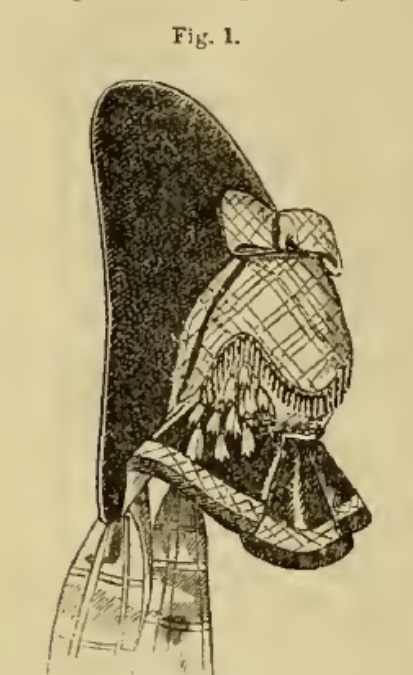
Bonnet for light mourning. The front is black velvet. The crown is soft and formed of white tulle, which is covered with a fanchon of black and white plaid silk, edged with bugle fringe. On the left side of the crown is a spray of white flowers. The cape is of black velvet, trimmed with a bias band of plaid silk. The inside trimming is of pearl color, and white flowers, and white. (Godey’s, November, 1864)

1

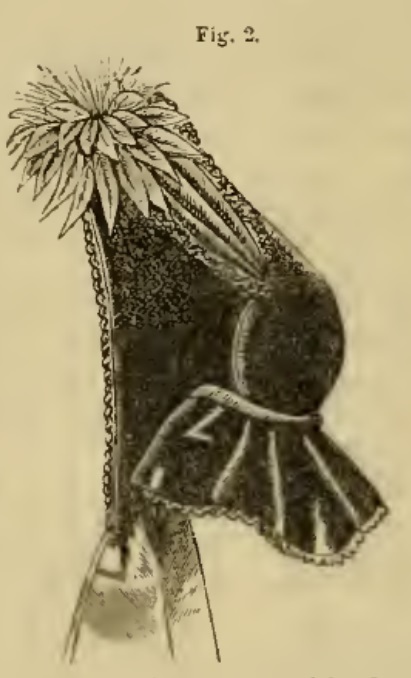
  Black velvet bonnet, timed with white silk edged with black lace. On the front is a large white flower, surrounded with scarlet velvet leaves. The inside trimming is of scarlet velvet and black lace. (Godey’s, November, 1864)

2

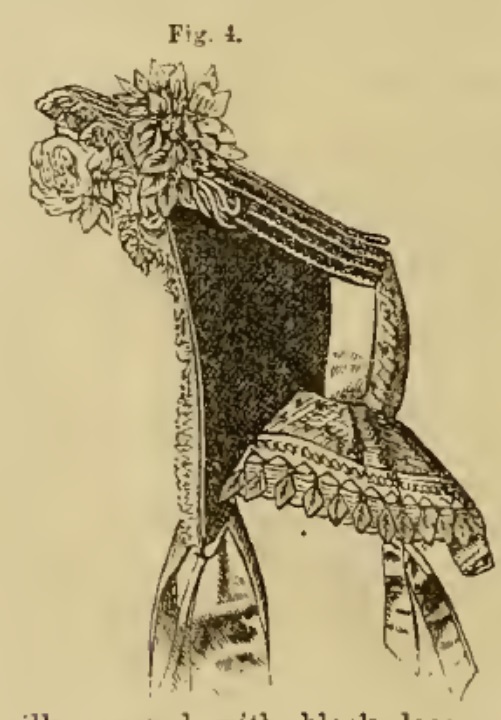
 Bonnet for light mourning. The front is of black silk. The crown and cape of white silk covered with black lace. The flowers, both outside and in, are of violet velvet. (Godey’s, November, 1864)

3

Published in: on November 17, 2014 at 1:01 am  Leave a Comment  
Tags:

A Year in Millinery Fashion – 1864

White silk curtainless bonnet, timed with black velvet, black lace, large black beads, and sprays of orange-colored velvet flowers.

1

Evening bonnet of white crepe, trimmed with mauve feathers. A fall of blonde lace loops of mauve velvet take the place of a cape. A tulle veil ties under the chin, and is a substitute for the side caps. Over the forehead is a pink rose, with buds and leaves. (Godey’s, December, 1864)

2

Published in: on November 15, 2014 at 1:01 am  Leave a Comment  
Tags:

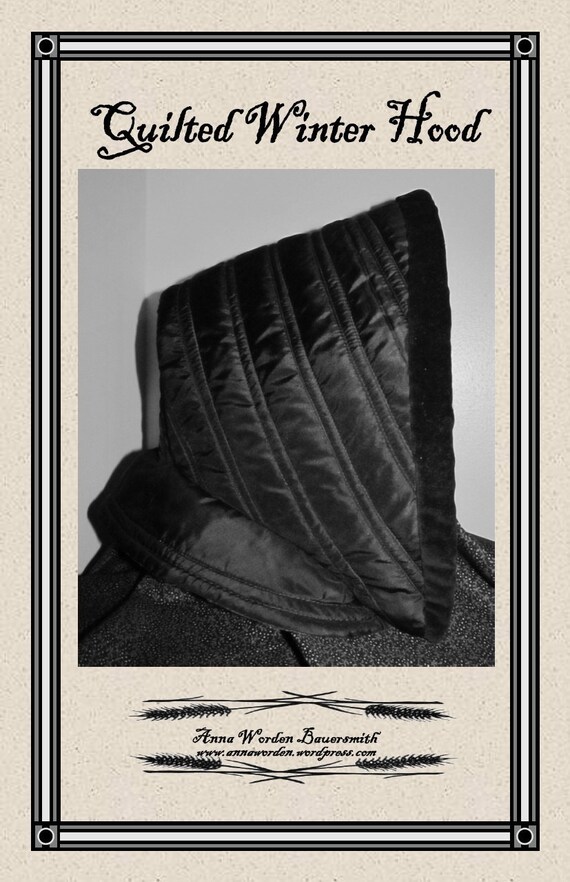
Quilted Hood Pattern – TBD

Quilted Hood Pattern -  By Anna Worden BauersmithAs the weather turns cold, very cold for some of us, I have had more and more people asking for my Quilted Hood Pattern. I have mixed news.


Currently, the pattern is out of print.

I do plan to reprint it.

I’ve been trying to get a new printing for a month. My printer merged with another printer who has failed to return my calls or emails. So, I am on a quest for a new local printer.

Sadly, since we are so close to Thanksgiving, I am not sure I will have the pattern early enough for Christmas or Hanukkah gifts (either made from the pattern or the pattern itself.

Published in: on November 13, 2014 at 5:38 pm  Comments (2)  

Where do I find Fanciful Utility?

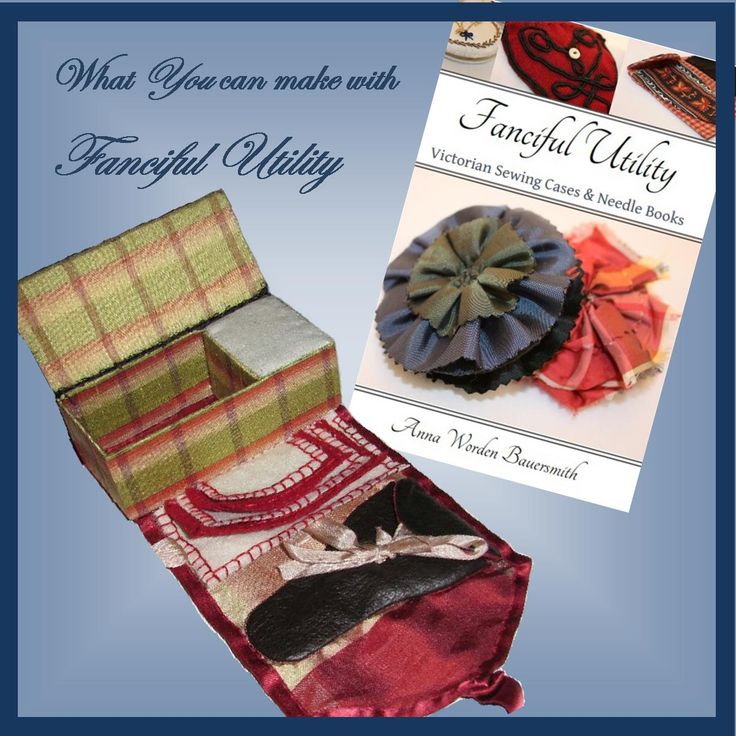
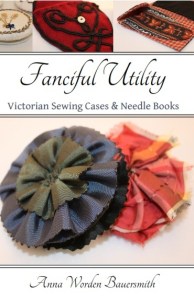
FanU-Cover-SnapThis is a question I love to hear and I love to answer.

You can find and purchase my book, Fanciful Utility: Victorian Sewing Cases and Needle-books, at The Sewing Academy.

Fanciful Utility makes an excellent gift for reenactors, museum friends, seamstresses, quilters, and anyone crafty with a needle and thread.

Fanciful Utility is packed full of projects, complete with directions and templates, for rolled sewing cases, sewing boxes and needle-books.

d c b a

Published in: on November 13, 2014 at 4:02 pm  Leave a Comment  
Tags:

That Which Makes Me Squeek

Every now and then we come across an image or a passage that makes a so very, very excited. This is one of those images. When doing my initial research on straw bonnets, I found the passages in fiction of incarcerated, institutionalized or recently either women and their straw bonnets rather fascinating. Now, this… an illustration of their pre-incarceration hear wear and an original caption. Untitled

The image will take you to the original page. Be sure to enlarge the image for the details.

Published in: on November 12, 2014 at 4:22 pm  Leave a Comment  

Fichu Pattern – Not being reprinted

 My Fichu Pattern is officially out of print and sold out (the last copy left the Genesee Country Village earlier this month).

I plan Not to reprint this pattern due to the cost of doing so. 

Published in: on November 12, 2014 at 4:04 pm  Leave a Comment