Tidbits for Servants….. (these are mostly published in London)
WAITING AT TABLE.
In giving directions for waiting at table, I shall describe the kind of dinner at which you are likely to assist. It will be of no use to tell you how to wait at a stately dinner, where all the dishes are cut up at a side-table, and wine is handed round, for at such dinners only men wait; nor will I speak of dinners a little less formal, but still large and costly, at which two or three thorough house and parlour-maids wait; for before you are admitted to such service, you will be expected to have gone through some practice in waiting, and it is for a small dinner at which you would acquire such practice that I will give my rules,—such a dinner as we may suppose to be served in the house of a gentleman keeping only two or three servants.
In dressing yourself to wait at table, see that your hands and nails are scrupulously clean. Use a nail-brush, warm water, and plenty of soap. If your mistress likes it, and you can manage it, wear clean white under-sleeves ; for your hand and arm will be often put close to the guests and their food, and should, therefore, look clean and pleasant.
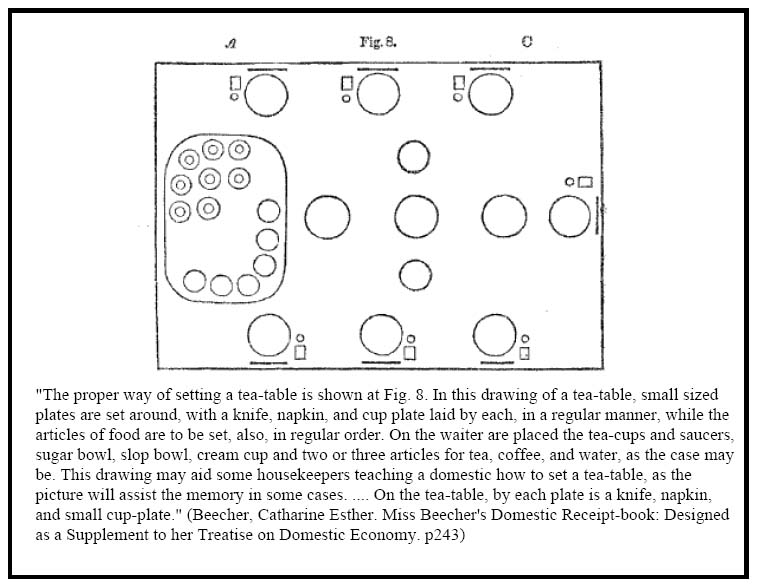
It may be useful to some of you to have a few hints about laying the cloth. It is a thing I have always had to teach my young servants to do, and many of you who can do it for an every-day dinner, of two or three persons, may still be puzzled by having to place a few extra things on the table.
First, see that the cloth is laid even on the table, the middle crease being straight down the centre; then put to each person a table-napkin folded, with a thick piece of bread in it: for this purpose a thick round of bread should be cut into six pieces. I cannot describe to you how to fold the napkin for this; but should you not be able to get your mistress or any one else to show you, let the napkin lie in a neat small square, and place the bread at the left side of each person; next, put as many knives and forks as will be wanted to each person; and if there is to be soup, a table or dessert-spoon, as your mistress may provide. If there is to be fish, meat, and poultry, each person will want two knives and three forks, for no knife is used for fish; they must be laid side by side, the knives on the right hand of’the napkin, and the forks on the left; the people sitting at the top and bottom of the table must also have a carving-knife and fork. Now put a dessert-spoon and fork, across, at the top of each napkin, laying the prongs of the fork close to the handle of the spoon, and the bowl of the spoon by the handle of the fork ; they are to lie side by side, but the crossway of the table. The salt-cellars, previously well filled and stamped, should be put at each corner of the table, with two table-spoons crossed, and laid so that each salt-cellar stands between the two bowls of the spoons. Put the cruets in the middle of the table, with mats on each of the four sides, ready for the meat and vegetables. Unless the table is very small, there will be room for the lamp between the cruets and meat- mat. There should be knife-rests top and bottom, on which you should rest the tips of the carving-knives and forks. Horseradish, jam, or anything else in a small glass dish, can be placed at the corners, or along the sides, according to the size of the table, and shapes of the dishes. A tumbler, and one or two wine-glasses, as your mistress may direct, should be put at the right hand of each person, and water-bottles, with tumblers over them, at each corner of the table.
When the dinner is ready to be served up, you will put fish at the top of the table and soup at the bottom, a pile of soup-plates, with a napkin on the top, before the soup, and meat- plates, with a napkin on the top, before the fish. The fish-slice should be put in front of the dish; and if wine is to be on the table, let it be at the corners.
Before we proceed to the announcement of the dinner, let us talk a little of the arrangement of the sideboard.
When you are arranging the dinner-table, put a cloth also on the sideboard, and think of all you will want for the different courses. Every thing that can be kept in the room should be placed there in readiness, to prevent the neces-1 sity of going in and out while you are waiting.
You should have pudding-plates in a pile, two to each person, as some may take more than one kind of pudding or tart, and these are put on the table cold; the meat-plates must be kept down-stairs at the fire, as they should be hot.
Sometimes, where a fire-screen hides the fireplace, I have seen meat-plates kept hot in the ‘fender of the dining-room; but, as they are not put on the table one by one, as the pudding- plates are, it is but little trouble to fetch the pile up from the kitchen when it is needed. You should also have on your sideboard a knife-tray, with knives, forks, and spoons of all sizes, as you can never tell exactly what number may be called for. It is safe to have half-a-dozen more of each than you see use for; if they are not needed, they are clean to put away, and no time has been lost by having them at hand ; if they are needed, and are not ready, much time and credit are lost in running to look them up in the middle of dinner. You will probably want pounded white sugar for the tarts, and there will be beer in a jug or bottles, and a jug of cold water in case the water-bottles should be emptied.
You should have also a loaf of bread, or a bread-basket with some small thick pieces ready cut, a corkscrew, cheese-plates in a pile ; the cheese on a dish covered by a crochet or other cheese-mat; perhaps celery in a dish, or mixed salad in a salad-bowl; butter and butter-knife ; all of which should be put close together, because belonging to one course. I have not mentioned small knives for the cheese, because we may suppose they are in the knife-tray, though it will save time and noise to have the right number by the cheese-plates.
Now comes the dessert course. All the dishes nicely arranged, the fruit perhaps decked with leaves, and the table-spoons laid on such dishes as require spoons for helping; the dessert-plates in a pile ; two wine-glasses for each person ; doyleys in a pile; and wine in the decanters. Remember, if there are nuts of any kind, to keep up one or two of the salt-cellars, and to have nutcrackers laid on the dish.
I think you will now have all that can be properly put on a sideboard, and you will find the convenience very great of having so many things within reach, as it is indispensable that you stay in the room as much -as possible while waiting. I may add that any cold tart or pudding, jelly, blanc-mange, custards, and the like, can also be on the sideboard.
All being ready on the sideboard and table, see to the fire and candles (should there be any), and then walk across to the drawing-room, where the company are, and go in; shut and hold the door in your hand, and say in a clear voice, ” Dinner is on the table, ma’am.” Go out again, shut the door, and walk to the further side of the dining-room door, which you should throw open, and stand there till the ladies and gentlemen are all gone in, when you should follow, shut the door, and walk to your master’s side and stand there while grace is said; immediately after which remove the covers, first from the soup and fish, and then from the potatoes. The covers should be put on the dinner-tray, which should be on its own stand, as near as convenient to the door. After this, take the plates from the carvers and hand them round as quickly and quietly as you can. You will probably be told for whom each plate is intended, or you will have heard who was first asked to take soup or fish ; but should this not be the case, you must take the first plate to the first lady, and ask, ” Will you take soup, ma’am ?” If she says ” No,” go to the next, and so on, taking fish to those who refused soup. You cannot do very wrong if you begin with the lady whom your master led in to dinner; and, after going to all the ladies, begin with the gentleman who led your mistress in—leaving your mistress to the last of the ladies, and your master of the gentlemen. Potato is eaten with fish, and if you can get time, between taking each plate from the carver, to give the potatoes to the person to whom you give the plate, it will be best to do so ; but this will not do if you are not ready to take the next plate. It is very likely that some one at the table will offer to help the vegetables, seeing you busy with handing the plates ; if so, as soon as you have set all the plates round, relieve this person by taking the potatoes round to those who may not yet be served ; you may then see that each person has melted butter, or sauce, and anchovy. In handing potatoes, take the vegetable dish to the left side of the person, and say, if you are not noticed, ” Will you take potato, sir?” but always in a low voice. In handing anchovy you may take the cruets, or the anchovy-bottle only, on a small tray, saying, in the same way, “Anchovy, sir,” or whatever else it may be, as the people will like to know what sauce it is before taking it.
Watch the plates, and as soon as any one lays down his fork or spoon, take the plate away, saying in a low voice, ” Will you take more fish, sir?” Tf no more is taken, put the plate and fork which have been used in the dinner-tray or basket provided for the purpose, and do the same till all the plates are removed. You will then take away the soup and fish, and carry all on the tray out of the room. I am supposing now that there is another servant below. She will by this time have the meat and fowls ready dished-up. You will empty the tray as quickly as possible, and bring up the fresh course. Put the poultry to your mistress at the top of the table, and the meat to your master at the bottom; the vegetables on the middle at each side of the cruets; plates before both dishes, and then remove all covers, hand plates as before, and then see that every one has vegetables, always putting the. vegetable dish back to its place on the table, also mustard, and any sauce, jam, &c., that may be eaten with each dish. Having seen to all this, it will be time to take round the beer, should it not have been asked for before. Take the jug or bottle in one hand, and a small tray in the other, and go all round the table, saying to each person who does not see you and at once give the tumbler, “Do you take beer, sir ?” holding the tray at the person’s left side for the tumbler. Those who take it will put the tumbler on your tray, where you will fill it, and hold it to be taken off again. Should any one chance to say “Yes,” and yet go on talking without giving you his tumbler, you must of course take it up and put it down again your-(The servant’s behaviour book)
self; but this is not likely to happen often, as the tray in your hand reminds the visitor that he is to put his glass there. In pouring out bottled beer, be careful of two things: first, having once turned the bottle over to fill one 4*lass, to carry it leaning down in the same position to the next person, as by turning it upright again you spoil the beer; secondly, not to make “a head” with bottled beer, but pour it very gently close to the side of the glass, or it will froth over and fill your tray.
Having taken beer all round, stand again near the sideboard, but in such a way that you may watch the plates, and supply vegetables, sauce, and mustard, &c., to any one who may be without, and take away the plates of those who lay down their knives and forks. In taking each plate, ask, as before, if more will be taken; if so, take the plate for more, first removing any bones or fat left on the side ; but any one taking meat after fowl, or fowl after meat, must of course have a clean plate, for which purpose you must always have hot plates ready. If they can stand in the fender, they will be hotter than on the sideboard; but should it not be possible to put them in the fender, they should be made very hot before coming up. When any one has finished altogether, put a cold pudding-plate in place of the plate you remove, and leave it there ready for pudding, so that by the time all have done, there will be pudding-plates ready all round.
You will now remove the meat, poultry, and vegetables, and carry them down with the plates which have been used as before, bringing any hot pudding or sauce up with you. The pudding must now be put to your mistress, and tart to your master. You will then hand the plates again. Each person will give you an empty plate in exchange for the plate of pudding or tart you take, and you will carry this to be filled, and again exchange it till all are served; you will then take round sauce or sugar. Though, in handing things that people take from you, you should go on the left side, that the visitor may use his right hand, yet in putting down a plate, or anything that is not taken from you it is more convenient for you to go on the right side. This you will soon find out by practice.
As the pudding-plates are done with, take each one away and put down a cheese-plate, with a small knife, in its place. If there should be game you will put no plate, as a pile of hot plates will come up with the game. I need give no directions concerning game, because they are served in the same way as meat or poultry, with hot plates, potatoes, bread-sauce, gravy, &c., all of which you will know how to manage, having gone through the meat course. So we will suppose there is no game, but cheese after the pudding.
When all have finished with the pudding and tart, and you have removed the plates and put down cheese-plates, you will place the cheese on the table to your master, and celery or salad to your mistress, putting the butter near the cruets in the centre.
Your master will now cut several pieces of cheese and put them into his own plate, which he will give to you. .You must hand this plate all round; each person, who wishes it, will take a small piece with his knife, (here you should go on the left side), and having gone all round, you should take the plate back and put it down before your master. It will now be right to take beer round again ; also bread, to those who may have none. Bottled beer should have the corks drawn in the room, at the sideboard.
In removing the cheese-plates, you must not put down dessert-plates, as the whole table will now have to be cleared. As soon as all have
finished cheese, take away cheese-dish and celery- dish, cruets, salt-cellars, and everything. This should be done by taking round a small tray and filling it, and then emptying it into the large tray, till the whole table is cleared; and should be done as quickly and quietly as possible. Some ladies like the table-cloth removed for the dessert, but it is usually left on; sometimes two clean table-cloths are put on, one over the other, so that the top one may be removed, and yet a white cloth remain. In any case, the crumbs are usually brushed off into a tray, with a brush made for the purpose, and the cloth made perfectly clean; but in some houses the crumbs are left and folded in the cloth, which is shaken afterwards down stairs. All pieces of bread left should be taken up with a fork, not with the hand, and put on the small tray into which the crumbs are swept, unless removed by a fork, with the glasses, &c. If wine or beer is left in a glass, do not hurry it away too quickly, but should it not be emptied when you are going to sweep the cloth, you must remove it with your last tray full.
When the cloth is removed, or ready swept for dessert, put the fruit-dishes on the table. It will be well to have asked your mistress how she will like them placed ; but there is not much difficulty about it. If only two, they must be put top and bottom; if four, the principal ones top and bottom, and the others on each side ; if six, there will be two at each side. A large round raised dish, if there be any, should stand in the centre. The wine decanters must all be placed in the front of your master.
Having placed the dishes, give to each person a plate with a doyley in it, and a finger-glass, should there be any, or two wine-glasses standing on the doyley. Should there be fruit-knives and forks, they must also be put round with the plates. The table being arranged for dessert, you should make up the fire and leave the room, your work of waiting is ended. While dinner is going on, you should manage to run in once to the drawing-room fire, or else ask the other servant to do so, for should you forget it till dessert is on the table, the probability is that it will then be out, and you will not only have the trouble of lighting it, but will be thought neglectful by the ladies, who generally leave the dessert^table very soon, and go to the drawing-room.
When there is only one servant kept, and no extra help procured for dinner, the servant can-
not, of course, be in the room the whole time of dinner; she may, however, lay the cloth and arrange the sideboard as directed—her mistress probably helping her—and she may, just before she dishes up the dinner, put on a white apron, wash her hands, and smooth her hair; then having put the dinner on the table, announce it, walk to the dining-room door, follow the company in, remove the covers, hand the plates, pour out beer, and go down to prepare the next course. In such a case, people help each other to vegetables, and when one course is over, the master will ring the bell; but if the servant can manage to run up (having put the next course ready for the tray), and take away the plates, &c. before her master rings, it will be much better, and will save his rising from the table, which is always awkward. Every girl should study the foregoing directions for waiting, and, according to her quickness and method, she will be able to carry them out more or less, when she has the cooking also on her hands. When the puddings are once up, there is no occasion to leave the room again, as all that is wanted for cheese and dessert will be ready on the sideboard. In all probability, the dinner will be very simple when one servant manages all. There will be no game, and perhaps no fish or soup ; so that the difficulty will be much less than in the dinner we have described above. A single servant, still more than one who has a cook down-stairs to help, will find the advantage of having plenty of hot plates, knives, forks, spoons, &c., ready for use, as there is no hindrance so great as having to search for, or clean up these things in the middle of waiting.
Let every girl remember that a simple dinner, with good waiting, will always appear more hospitable, and be more comfortable, than a costly one, with bad waiting : every mistress is sensible of this, yet few who do not keep a regular housemaid, expect to get good waiting. The girl, then, who chooses to study and practise these directions, will be valued accordingly. It will generally be a surprise to the mistress of a young and inexperienced servant, to find her able to do what is looked upon as the work of a higher servant, and yet any girl of common sense will find it perfectly practicable to do all that I have directed, though it may require the practice of three or four dinners to make every thing come quite easily.
Before leaving this subject, I must not forget to warn you against smiling at droll stories told E 2
at table, or seeming in any way to notice or enter into the conversation. Should it even happen that all at table are wishing to know something which you could tell them in a word or two—as, whether it was the baker or the butcher who was run over; whether the clergyman had found his stray cow or not;—you must still be silent, unless you are appealed to, and then answer modestly, in as few words as possible. If the question you are able to answer should chance to be of consequence,—as whether the coach a gentleman wished to return in had passed or not, you might go up to your mistress, and say, in a low voice, ” The coach is not gone, ma’am; it does not pass now till nine o’clock,”—supposing you were certain of being well informed; but even then, speak in a voice that only your mistress may hear; for you may have misunderstood the conversation, and it is possible that the question may be best left unanswered.
I advise you to read this chapter through several times, as it contains many directions; and you will find that even after having studied them carefully, the bustle of a dinner-table will be very likely to drive many of them from your head, till practice has made them familiar to you. When you know all these rules, the difficulty of waiting at table consists in the necessity of being quick, and, at the same time, expert and noiseless. It is better to be slow, than to spill gravy, overturn glasses, catch your foot in chair legs, let things fall, or make noises with knocking china and glass; and yet a slow waiter is very tiresome. Every time you wait, you will do better than the last, and it should be your constant aim to become less noisy, and more quick.







 If I Had My Own Blue Box: