This is the second of two mirrors I’ve come across like this. If anyone knows anything about when, where these would have been made, I would like to know.


This is the first one, which I don’t have anymore:


This is the second of two mirrors I’ve come across like this. If anyone knows anything about when, where these would have been made, I would like to know.
This is the first one, which I don’t have anymore:

Burgess, Fred W. Antique Furniture. New York: Putnam, 1915.
Comstock, Helen. The Looking Glass in America, 1700-1825. New York; The Viking Press: 1968.
Fitz-Gibbon, Costen. “Mirrors and Mirror Frames in Three Centuries” House and Garden. Conde Nast, Nov. 1918.
Greenly, Horace, Et El.. The Great Industries of the United States. Hartford: Burr & Hyde, 1872.
Hinckley, F. Lewis. Queen Anne and Georgian Looking Glasses: With Supplement on the Distributors of Colonial and Early Federal Looking Glasses. Washington: Mews Books, 1988
“Ladies’ Department: The Looking Glass.” The American Farmer. Baltimore: Toy, 1829.
Lockwood, Luke Vincent. Colonial Furniture in America. New York: Scribers, 1921.
Moore, N. Hudson. The Collector’s Manual. Stokes, 1906.
Morse, Frances Clary. Furniture of the Olden Time. New York: MacMillan, 1902.
Patent Office, Great Britain. Patents for Inventions: Abridgements of Specifications. Patent Office, 1869.
Perrett, Anionette Rebmann. “The Stories of the Looking-Glasses” Good Housekeeping. Hearst, 1908. V.46 Jan-Jun 1908.
Robetson, J. C. Ed.. The Mechanics’ Magazine, Museum Register, Journal, and Gazette. London: Bousnall, 1845.
Singleton, Esther. Furniture. New York: Duffield, 1911.
Woodhead, Henry. Echoes of Glory: Arms and Equipment of the Union. Alexandria, Virginia: Time Life, 1998.
Woodhead, Henry. Echoes of Glory: Arms and Equipment of the Confederacy. Alexandria, Virginia: Time Life, 1998.
Wooster, Steven and Judith Miller, Mitchell Beazley. Miller’s Antiques Encyclopedia. Sterling, 2005
Images, Paintings and Looking Glasses from
Smith, George. The Cabinet-Maker and Upholsterer’s Guide” 1826 (available NYPL.org.)
The Practical Cabinet-Maker, Upholsterer and Complete Decorator. 1826 (available NYPL.org.)
Metropolitan Museum of Art online Digital Collection
Boston Museum of Fine Arts online Digital Collection
Big Spring Museum
Genesee Country Village and Museum
Athenaeum online database
US Patent Office (7,080, 15,950, 27,965, 35,344, 39,277, 46,062, 46,767, 50,659, 50,874)
Recently Connie and I were having a email discussion that included how the original cast may have carried gloves and fans when they were not in use. It seems like a very simple question…. but I just can’t let it go. I’ve been pulling passages from fiction to see what these characters did. (results to follow)
My question for those who would like to post a comment or send me an email…..
Where do you put/carry your …. gloves, fan, purse, etc.
I am curious what other reenactors do. I can say for years I hung my fan from my waist/belt. Now it goes in my pocket. Most everything goes in my pocket. Prior to my implementation of pockets, I had a couple purses. I like purses as long as I don’t make them to full.
UPDATE APRIL 13: Thanks for the responses so far. There seems to be a variety of places people keep things. More comments/emails about where you keep gloves and fans specifically would be great.
In collecting references from period fiction regarding where women place their gloves and fans, I see the vast majority of the passages refer to putting the items in or taking them from pockets. This seems to span all age groups including children. I have also found mention of putting gloves in a bag. I hope to find additional passages suggesting other possiblities.
Tidbits for Servants….. (these are mostly published in London)
DIRECTIONS FOE SERVANTS. SERVING AND WAITING AT TABLE. Whether the duties of serving and waiting at table be performed by a- male or female attendant, the routine is the same. I shall suppose that I am addressing a maid-servant. Before the dinner is to be served, you should have yourself neatly dressed, and your hands perfectly clean. After spreading the cloth evenly upon the table, proceed to place for each person a knife, fork, and spoon, also a finger napkin with a roll in it, or a piece of bread laid upon it, and a tumbler and wine-glass. Place likewise salt-cellars, four, six, or eight, according to the size of the table; one is placed at each corner, and the others opposite each other clown the table. Then place upon the table a mat for each dish, and a carving- knife and fork at every dish that requires carving, also gravy-spoons and sauce-ladles where required. If there be an epergne, place it in the centre of the table, and the castor-stand near it; if there be not an epergne or ornament, place the castor-stand in the centre. With other additions, according to circumstances, the table is now dressed. Next, proceed to arrange the side-table or sideboard. Spread a small cloth upon it, and arrange the knives, forks, spoons, glasses, water jug or bottle, beer, and all the tart and cheese plates that may be required in course of the dinner. Much trouble may be saved by collecting these various articles beforehand on the sideboard; for a servant should never have to run out of the room during dinner to bring what she wants. Have also on the sideboard a small tray or waiter, on which to hand anything that may be asked for during dinner; likewise a small knife-tray, with a cloth in the bottom of it to prevent noise, and into which the knives, forks, and spoons from the dishes are to be placed, previous to removing the dishes from the table. All the dishes are to be carried to table with covers over them. Allow these covers to remain till the company is seated, and the different dishes are required to be carved. Lift off the covers in such a manner that the drops of moisture from them will not fall on the guests or on the tablecloth. All the plates taken to table must be hot, therefore they should be brought directly from the heating-place in the kitchen to table. They should not be so hot that they cannot be handled. When all the dishes and plates are on the table, place chairs around, and announce that ‘ Dinner is on the Table.’ While the guests are coming in, you stand by the sideboard, and when they are seated, you stand ready at the top of the table to hand the plates. In handing plates or anything else, such as bread in a tray, go to the left-hand side of the person. Never stretch across in front of any person. Be ready, when a person has done eating, to remove his plate, knife, and fork ; and at the same time lay down a clean knife and fork, or spoon, according to what is to be served next. After the meat courses are over, and the dishes and plates are removed, still leave upon the table the wine, the glasses, salts, castors, and any ornaments. Then brush the cloth, drawing the crumbs upon a plate or waiter. In some cases two cloths are laid, one upon the other, and the uppermost is removed after the meat courses; when this is the case, all the articles whatsoever must be removed from the table, and replaced on the clean cloth. You now set down the course of tarts and confectionery. When this course has been removed, still leave the glasses and other articles upon the table. It is improper to remove the salts, as many persons take salt with their cheese. When laying for the cheese course, place a plate and knife for each person. After clearing the table, take off any bits of bread left upon it with a fork into a server; then remove the cloth, by throwing it loosely together on the table, and lifting it carefully away. The cloth should soon after be shaken and laid aside flat in its proper place. Immediately on taking away the cloth, place the wine on the table, and give to each person a doily and two wine glasses. Then place the dessert on the table, and give to each person a dessert plate, knife, fork, and spoon. By the time that the dessert is placed on the table, an assistant must have helped you to remove all the things out of the room and from the sideboard. Immediately that the dessert is placed, you retire. In the course of the above serving at table, from first to last you must avoid making any unnecessary noise, or speaking loud. There are two rules which you must attend to—never speak except when answering a question, and never seem to heed anything that is said, unless it be addressed to yourself. Be active bnt quiet, and never appear flurried or in a bustle. Becollect that the attention of the servant is an additional comfort to the visitor, and reflects credit on the mistress. (Cookery and domestic economy for young housewives )WAITING AT TABLE.
In giving directions for waiting at table, I shall describe the kind of dinner at which you are likely to assist. It will be of no use to tell you how to wait at a stately dinner, where all the dishes are cut up at a side-table, and wine is handed round, for at such dinners only men wait; nor will I speak of dinners a little less formal, but still large and costly, at which two or three thorough house and parlour-maids wait; for before you are admitted to such service, you will be expected to have gone through some practice in waiting, and it is for a small dinner at which you would acquire such practice that I will give my rules,—such a dinner as we may suppose to be served in the house of a gentleman keeping only two or three servants.
In dressing yourself to wait at table, see that your hands and nails are scrupulously clean. Use a nail-brush, warm water, and plenty of soap. If your mistress likes it, and you can manage it, wear clean white under-sleeves ; for your hand and arm will be often put close to the guests and their food, and should, therefore, look clean and pleasant.
It may be useful to some of you to have a few hints about laying the cloth. It is a thing I have always had to teach my young servants to do, and many of you who can do it for an every-day dinner, of two or three persons, may still be puzzled by having to place a few extra things on the table.
First, see that the cloth is laid even on the table, the middle crease being straight down the centre; then put to each person a table-napkin folded, with a thick piece of bread in it: for this purpose a thick round of bread should be cut into six pieces. I cannot describe to you how to fold the napkin for this; but should you not be able to get your mistress or any one else to show you, let the napkin lie in a neat small square, and place the bread at the left side of each person; next, put as many knives and forks as will be wanted to each person; and if there is to be soup, a table or dessert-spoon, as your mistress may provide. If there is to be fish, meat, and poultry, each person will want two knives and three forks, for no knife is used for fish; they must be laid side by side, the knives on the right hand of’the napkin, and the forks on the left; the people sitting at the top and bottom of the table must also have a carving-knife and fork. Now put a dessert-spoon and fork, across, at the top of each napkin, laying the prongs of the fork close to the handle of the spoon, and the bowl of the spoon by the handle of the fork ; they are to lie side by side, but the crossway of the table. The salt-cellars, previously well filled and stamped, should be put at each corner of the table, with two table-spoons crossed, and laid so that each salt-cellar stands between the two bowls of the spoons. Put the cruets in the middle of the table, with mats on each of the four sides, ready for the meat and vegetables. Unless the table is very small, there will be room for the lamp between the cruets and meat- mat. There should be knife-rests top and bottom, on which you should rest the tips of the carving-knives and forks. Horseradish, jam, or anything else in a small glass dish, can be placed at the corners, or along the sides, according to the size of the table, and shapes of the dishes. A tumbler, and one or two wine-glasses, as your mistress may direct, should be put at the right hand of each person, and water-bottles, with tumblers over them, at each corner of the table.
When the dinner is ready to be served up, you will put fish at the top of the table and soup at the bottom, a pile of soup-plates, with a napkin on the top, before the soup, and meat- plates, with a napkin on the top, before the fish. The fish-slice should be put in front of the dish; and if wine is to be on the table, let it be at the corners.
Before we proceed to the announcement of the dinner, let us talk a little of the arrangement of the sideboard.
When you are arranging the dinner-table, put a cloth also on the sideboard, and think of all you will want for the different courses. Every thing that can be kept in the room should be placed there in readiness, to prevent the neces-1 sity of going in and out while you are waiting.
You should have pudding-plates in a pile, two to each person, as some may take more than one kind of pudding or tart, and these are put on the table cold; the meat-plates must be kept down-stairs at the fire, as they should be hot.
Sometimes, where a fire-screen hides the fireplace, I have seen meat-plates kept hot in the ‘fender of the dining-room; but, as they are not put on the table one by one, as the pudding- plates are, it is but little trouble to fetch the pile up from the kitchen when it is needed. You should also have on your sideboard a knife-tray, with knives, forks, and spoons of all sizes, as you can never tell exactly what number may be called for. It is safe to have half-a-dozen more of each than you see use for; if they are not needed, they are clean to put away, and no time has been lost by having them at hand ; if they are needed, and are not ready, much time and credit are lost in running to look them up in the middle of dinner. You will probably want pounded white sugar for the tarts, and there will be beer in a jug or bottles, and a jug of cold water in case the water-bottles should be emptied.
You should have also a loaf of bread, or a bread-basket with some small thick pieces ready cut, a corkscrew, cheese-plates in a pile ; the cheese on a dish covered by a crochet or other cheese-mat; perhaps celery in a dish, or mixed salad in a salad-bowl; butter and butter-knife ; all of which should be put close together, because belonging to one course. I have not mentioned small knives for the cheese, because we may suppose they are in the knife-tray, though it will save time and noise to have the right number by the cheese-plates.
Now comes the dessert course. All the dishes nicely arranged, the fruit perhaps decked with leaves, and the table-spoons laid on such dishes as require spoons for helping; the dessert-plates in a pile ; two wine-glasses for each person ; doyleys in a pile; and wine in the decanters. Remember, if there are nuts of any kind, to keep up one or two of the salt-cellars, and to have nutcrackers laid on the dish.
I think you will now have all that can be properly put on a sideboard, and you will find the convenience very great of having so many things within reach, as it is indispensable that you stay in the room as much -as possible while waiting. I may add that any cold tart or pudding, jelly, blanc-mange, custards, and the like, can also be on the sideboard.
All being ready on the sideboard and table, see to the fire and candles (should there be any), and then walk across to the drawing-room, where the company are, and go in; shut and hold the door in your hand, and say in a clear voice, ” Dinner is on the table, ma’am.” Go out again, shut the door, and walk to the further side of the dining-room door, which you should throw open, and stand there till the ladies and gentlemen are all gone in, when you should follow, shut the door, and walk to your master’s side and stand there while grace is said; immediately after which remove the covers, first from the soup and fish, and then from the potatoes. The covers should be put on the dinner-tray, which should be on its own stand, as near as convenient to the door. After this, take the plates from the carvers and hand them round as quickly and quietly as you can. You will probably be told for whom each plate is intended, or you will have heard who was first asked to take soup or fish ; but should this not be the case, you must take the first plate to the first lady, and ask, ” Will you take soup, ma’am ?” If she says ” No,” go to the next, and so on, taking fish to those who refused soup. You cannot do very wrong if you begin with the lady whom your master led in to dinner; and, after going to all the ladies, begin with the gentleman who led your mistress in—leaving your mistress to the last of the ladies, and your master of the gentlemen. Potato is eaten with fish, and if you can get time, between taking each plate from the carver, to give the potatoes to the person to whom you give the plate, it will be best to do so ; but this will not do if you are not ready to take the next plate. It is very likely that some one at the table will offer to help the vegetables, seeing you busy with handing the plates ; if so, as soon as you have set all the plates round, relieve this person by taking the potatoes round to those who may not yet be served ; you may then see that each person has melted butter, or sauce, and anchovy. In handing potatoes, take the vegetable dish to the left side of the person, and say, if you are not noticed, ” Will you take potato, sir?” but always in a low voice. In handing anchovy you may take the cruets, or the anchovy-bottle only, on a small tray, saying, in the same way, “Anchovy, sir,” or whatever else it may be, as the people will like to know what sauce it is before taking it.
Watch the plates, and as soon as any one lays down his fork or spoon, take the plate away, saying in a low voice, ” Will you take more fish, sir?” Tf no more is taken, put the plate and fork which have been used in the dinner-tray or basket provided for the purpose, and do the same till all the plates are removed. You will then take away the soup and fish, and carry all on the tray out of the room. I am supposing now that there is another servant below. She will by this time have the meat and fowls ready dished-up. You will empty the tray as quickly as possible, and bring up the fresh course. Put the poultry to your mistress at the top of the table, and the meat to your master at the bottom; the vegetables on the middle at each side of the cruets; plates before both dishes, and then remove all covers, hand plates as before, and then see that every one has vegetables, always putting the. vegetable dish back to its place on the table, also mustard, and any sauce, jam, &c., that may be eaten with each dish. Having seen to all this, it will be time to take round the beer, should it not have been asked for before. Take the jug or bottle in one hand, and a small tray in the other, and go all round the table, saying to each person who does not see you and at once give the tumbler, “Do you take beer, sir ?” holding the tray at the person’s left side for the tumbler. Those who take it will put the tumbler on your tray, where you will fill it, and hold it to be taken off again. Should any one chance to say “Yes,” and yet go on talking without giving you his tumbler, you must of course take it up and put it down again your-(The servant’s behaviour book)
self; but this is not likely to happen often, as the tray in your hand reminds the visitor that he is to put his glass there. In pouring out bottled beer, be careful of two things: first, having once turned the bottle over to fill one 4*lass, to carry it leaning down in the same position to the next person, as by turning it upright again you spoil the beer; secondly, not to make “a head” with bottled beer, but pour it very gently close to the side of the glass, or it will froth over and fill your tray.
Having taken beer all round, stand again near the sideboard, but in such a way that you may watch the plates, and supply vegetables, sauce, and mustard, &c., to any one who may be without, and take away the plates of those who lay down their knives and forks. In taking each plate, ask, as before, if more will be taken; if so, take the plate for more, first removing any bones or fat left on the side ; but any one taking meat after fowl, or fowl after meat, must of course have a clean plate, for which purpose you must always have hot plates ready. If they can stand in the fender, they will be hotter than on the sideboard; but should it not be possible to put them in the fender, they should be made very hot before coming up. When any one has finished altogether, put a cold pudding-plate in place of the plate you remove, and leave it there ready for pudding, so that by the time all have done, there will be pudding-plates ready all round.
You will now remove the meat, poultry, and vegetables, and carry them down with the plates which have been used as before, bringing any hot pudding or sauce up with you. The pudding must now be put to your mistress, and tart to your master. You will then hand the plates again. Each person will give you an empty plate in exchange for the plate of pudding or tart you take, and you will carry this to be filled, and again exchange it till all are served; you will then take round sauce or sugar. Though, in handing things that people take from you, you should go on the left side, that the visitor may use his right hand, yet in putting down a plate, or anything that is not taken from you it is more convenient for you to go on the right side. This you will soon find out by practice.
As the pudding-plates are done with, take each one away and put down a cheese-plate, with a small knife, in its place. If there should be game you will put no plate, as a pile of hot plates will come up with the game. I need give no directions concerning game, because they are served in the same way as meat or poultry, with hot plates, potatoes, bread-sauce, gravy, &c., all of which you will know how to manage, having gone through the meat course. So we will suppose there is no game, but cheese after the pudding.
When all have finished with the pudding and tart, and you have removed the plates and put down cheese-plates, you will place the cheese on the table to your master, and celery or salad to your mistress, putting the butter near the cruets in the centre.
Your master will now cut several pieces of cheese and put them into his own plate, which he will give to you. .You must hand this plate all round; each person, who wishes it, will take a small piece with his knife, (here you should go on the left side), and having gone all round, you should take the plate back and put it down before your master. It will now be right to take beer round again ; also bread, to those who may have none. Bottled beer should have the corks drawn in the room, at the sideboard.
In removing the cheese-plates, you must not put down dessert-plates, as the whole table will now have to be cleared. As soon as all have
finished cheese, take away cheese-dish and celery- dish, cruets, salt-cellars, and everything. This should be done by taking round a small tray and filling it, and then emptying it into the large tray, till the whole table is cleared; and should be done as quickly and quietly as possible. Some ladies like the table-cloth removed for the dessert, but it is usually left on; sometimes two clean table-cloths are put on, one over the other, so that the top one may be removed, and yet a white cloth remain. In any case, the crumbs are usually brushed off into a tray, with a brush made for the purpose, and the cloth made perfectly clean; but in some houses the crumbs are left and folded in the cloth, which is shaken afterwards down stairs. All pieces of bread left should be taken up with a fork, not with the hand, and put on the small tray into which the crumbs are swept, unless removed by a fork, with the glasses, &c. If wine or beer is left in a glass, do not hurry it away too quickly, but should it not be emptied when you are going to sweep the cloth, you must remove it with your last tray full.
When the cloth is removed, or ready swept for dessert, put the fruit-dishes on the table. It will be well to have asked your mistress how she will like them placed ; but there is not much difficulty about it. If only two, they must be put top and bottom; if four, the principal ones top and bottom, and the others on each side ; if six, there will be two at each side. A large round raised dish, if there be any, should stand in the centre. The wine decanters must all be placed in the front of your master.
Having placed the dishes, give to each person a plate with a doyley in it, and a finger-glass, should there be any, or two wine-glasses standing on the doyley. Should there be fruit-knives and forks, they must also be put round with the plates. The table being arranged for dessert, you should make up the fire and leave the room, your work of waiting is ended. While dinner is going on, you should manage to run in once to the drawing-room fire, or else ask the other servant to do so, for should you forget it till dessert is on the table, the probability is that it will then be out, and you will not only have the trouble of lighting it, but will be thought neglectful by the ladies, who generally leave the dessert^table very soon, and go to the drawing-room.
When there is only one servant kept, and no extra help procured for dinner, the servant can-
not, of course, be in the room the whole time of dinner; she may, however, lay the cloth and arrange the sideboard as directed—her mistress probably helping her—and she may, just before she dishes up the dinner, put on a white apron, wash her hands, and smooth her hair; then having put the dinner on the table, announce it, walk to the dining-room door, follow the company in, remove the covers, hand the plates, pour out beer, and go down to prepare the next course. In such a case, people help each other to vegetables, and when one course is over, the master will ring the bell; but if the servant can manage to run up (having put the next course ready for the tray), and take away the plates, &c. before her master rings, it will be much better, and will save his rising from the table, which is always awkward. Every girl should study the foregoing directions for waiting, and, according to her quickness and method, she will be able to carry them out more or less, when she has the cooking also on her hands. When the puddings are once up, there is no occasion to leave the room again, as all that is wanted for cheese and dessert will be ready on the sideboard. In all probability, the dinner will be very simple when one servant manages all. There will be no game, and perhaps no fish or soup ; so that the difficulty will be much less than in the dinner we have described above. A single servant, still more than one who has a cook down-stairs to help, will find the advantage of having plenty of hot plates, knives, forks, spoons, &c., ready for use, as there is no hindrance so great as having to search for, or clean up these things in the middle of waiting.
Let every girl remember that a simple dinner, with good waiting, will always appear more hospitable, and be more comfortable, than a costly one, with bad waiting : every mistress is sensible of this, yet few who do not keep a regular housemaid, expect to get good waiting. The girl, then, who chooses to study and practise these directions, will be valued accordingly. It will generally be a surprise to the mistress of a young and inexperienced servant, to find her able to do what is looked upon as the work of a higher servant, and yet any girl of common sense will find it perfectly practicable to do all that I have directed, though it may require the practice of three or four dinners to make every thing come quite easily.
Before leaving this subject, I must not forget to warn you against smiling at droll stories told E 2
at table, or seeming in any way to notice or enter into the conversation. Should it even happen that all at table are wishing to know something which you could tell them in a word or two—as, whether it was the baker or the butcher who was run over; whether the clergyman had found his stray cow or not;—you must still be silent, unless you are appealed to, and then answer modestly, in as few words as possible. If the question you are able to answer should chance to be of consequence,—as whether the coach a gentleman wished to return in had passed or not, you might go up to your mistress, and say, in a low voice, ” The coach is not gone, ma’am; it does not pass now till nine o’clock,”—supposing you were certain of being well informed; but even then, speak in a voice that only your mistress may hear; for you may have misunderstood the conversation, and it is possible that the question may be best left unanswered.
I advise you to read this chapter through several times, as it contains many directions; and you will find that even after having studied them carefully, the bustle of a dinner-table will be very likely to drive many of them from your head, till practice has made them familiar to you. When you know all these rules, the difficulty of waiting at table consists in the necessity of being quick, and, at the same time, expert and noiseless. It is better to be slow, than to spill gravy, overturn glasses, catch your foot in chair legs, let things fall, or make noises with knocking china and glass; and yet a slow waiter is very tiresome. Every time you wait, you will do better than the last, and it should be your constant aim to become less noisy, and more quick.
Tidbits for Dinner Parties…
Mrs. L. — Will you give me some idea of the best method of setting out and arranging a dinner table, for a party of sixteen, or twenty. Mrs. B. — Fashion, the great arbiter of every thing connected with social life, varies the nature of the courses, and the quantity of viands which must be placed at one time upon the table; so that the dinner which might be considered as elegant at one time would have an air of vulgarity at another; particular directions, therefore, on this part of your inquiry, can scarcely be given, though by describing a dinner of three courses, for the present time, some idea may be given, which may be modified to any future change of fashion. Thus, in the middle of the table is generally an epergne, filled with either real or artificial flowers, or it may contain a salad ornamented. A dish offish is placed at each end of the table, one boiled and the other either fried or stewed : the requisite sauces being placed between these dishes and the epergne. Two tureens of soup, one white and the other brown, may be placed on a line with the fish, or on each side of the epergne. This is the usual plan of the first course. The second may consist of roasted and stewed meat, at the top and bottom of the table: —the choice of these must depend upon what happens to be in season. On each side of the epergne, where the soup was placed in the first course, may now be boiled chickens and a tongue, or a small ham, varnished and decorated. Between the top dishes and the epergne two small made dishes, or tureens with sauce, may fill up that space. The four corners must have covered dishes, which may contain either curry, patties, palates, riseaux, fricassee of mutton-chops, stewed rump-steaks, stewed mushrooms, stewed cucumbers, or any similar viands. Other vegetables are on a side-table, to be handed round by the servants. On removing this course, the epergne may be taken away; and, at some fashionable parties, a small table-cloth or napkin, which covers part of the table only, is also withdrawn. A third course generally consists either of two dishes of game, or of some kind of poultry, at each end of the table ; or there may be but one dish of game at the bottom of the table and at the top a large dish of asparagus, sea-kale, or peas; in the centre may be a trifle, or some kind of fancy confectionary. The intermediate spaces, in the length of the table, may be occupied with a dish of prawns, at one end, neatly set up, and at the other by lobster-salad or a prepared crab. On one side of the centre dish may be a light pudding, on the other a tart or macaroni. At the corners, jellies, blancmange, tartlets, creams, or any other fancy confectionary. The wines are placed upon the table at first, in six decanters, one of each being placed at each corner of the table, and one on each side of the epergne, whilst two bottles of some light French or Rhenish wine, undecanted and corked, and placed in silver or plated vases, fill up a space between the epergne and each end of the table. Small decanters of water, covered with an inverted tumbler, should be placed by every second guest, but malt liquors, cider, soda-water, ginger-beer, or similar beverages, are handed by the attendants when called for. In the interval of each course, champaign, hock, burgundy, or barsac, are handed round to each guest.. Cheese, with a fresh salad, follows the third course, and a glass of port wine is generally offered by the servants to each of the gentlemen. When, according to the continental fashion, the cloth is allowed to remain on the table; or, according to the more general custom of this country, before it is removed, a silver, or a china or glass dish, containing rose-water, is passed round the table, into which each guest dips the corner of his table- napkin, for the purpose of refreshing his mouth and fingers, prior to the appearance of the dessert. The dessert necessarily varies with the season: when that will admit of ripe fruits, the most important, such as grapes, pine-apples, peaches, or apricots, must of course occupy the ends of the table; while the inferior fruits, such as strawberries and raspberries, with preserves and dried fruits, fill the corners and sides of the table. A Savoy cake, on an elevated dish, is very proper for the centre; wafers, and any other cakes, may fill up any spaces in the length of the table. In the summer a China pail of ice is generally placed at each end of the table, and served out on glass plates before the wine is circulated. Sometimes Noyeau, Curacoa, Dantzic, Constantia, or some other liquor, is handed to the guests in small glasses, immediately after the ice has been served; the pails and glass plates are removed before the servants leave the room. The decanted wines placed on the table during dinner are white wines; either madeira, sherry, or bu9ellus; those circulated after dinner are port, madeira, and claret. Claret is generally contained in a decanter with a handle, and of a peculiar form. Directions to the cook should always be closed with strict injunctions to be punctual to time, and to send everything, which is intended to be eaten hot, to table in proper season. Carelessness in these two particulars should not oe passed over without reprimand ; and if the fault be repeated, it might be as well to part with a servant, who has either undertaken a place without possessing for it sufficient qualifications, or who is indifferent to the comfort of her master and mistress, to whom it is a most disagreeable circumstance to be anticipating for a length of time the announcement of dinner, and when announced, to find every thing either chilled or overdone. The butler, or footman, should be furnished with a plan of the dinner, drawn out in an intelligible manner, so that he may know how to arrange the dishes on the table: for as much of the elegance of effect, which is always desirable on a dinner-table, is produced by this arrangement, it ought not to be trusted to the taste or judgment of a servant. The diagrams I now show you are specimens of the usual manner in which this is done: (SEE PAGE 60 -62 FOR TABLE LAYOUTS) The butler and footman should have every thing in the neatest order, at the side-board and on the table; with a sufficient quantity of glasses, knives, forks, spoons, &c. in the room. They should be quiet and rapid in their movements; observant in supplying changes of plates, and in attending to the demands of each guest. The courses should be quickly removed, but without bustle. It is always proper, if no housekeeper or butler be kept, that the mistress of her family should give very minute directions to the footman, to prepare the plate the day before a dinner-party is to be given. Wax lights should be in readiness, and the lamps, particularly those not in common use, should be cleaned, and trimmed. The table, which is to be used, must be so proportioned to the size of the party, as neither to inconvenience the guests, by over-crowding them, nor yet to admit of too much space, which has always an uncomfortable appearance. The glasses of every description should look clean and bright; and the water in the decanters should be clear, and without sediment. The wines, when not in charge of a butler, should be given out in good time, to be properly decanted and cooled.
COMPANY SUPPERS.
The ingenuity of the genteel economist is as often taxed to contrive supper things as in arranging dinners, which admit of less temporizing. Economy, good taste, and neatness, can however do much, even with slender means, where the chief organ to be propitiated is the eye ; for the lateness of modern dinner-hours has now, almost universally, changed suppers from a solid meal into a light showy refreshment.
It is said that ladies are the best critics in suppers, while gentlemen are better qualified to decide on the more substantial business of the dinner-table. Ladies are unquestionably more conversant with the things on which the elegance of a supper depends, — namely, the beautiful shapes and arrangement of china, glass, linen, fruits, foliage, flowers, colours, lights, ornamental confectionary, and all the other natural and artificial embellishments of the table. Articles, so beautiful in themselves, cannot fail, if tastefully disposed, to gratify the eye, however slender the repast with which they are intermixed.
When a formal substantial supper is set out, the principal dishes are understood to be roasted game or poultry, cold meats sliced, ham, tongue, collared and potted things, grated beef, Bologna sausage, Dutch herring, kipper, highly- seasoned pies of game, &c. &c. with occasionally soup — an addition to modern suppers which, after the heat and fatigue of a ball-room, or large party, is found peculiarly grateful and restorative. Minced white meats, lobsters, oysters, collared eels, and crawfish dressed in various forms ; sago, rice, the more delicate vegetables, poached eggs, scalloped potatoes, are all suitable articles of the solid kind. To these are added, ices, cakes, tarts, possets, creams, jellies in glasses or shapes, custards, preserved or dried fruits, pancakes, fritters, puffs, tartlets, grated cheese, butter in little shapes, sandwiches ; and the catalogue of the more stimulating dishes, as anchovy toasts, grilled bones, Welsh, English, and Scotch rabbits, roasted onions, salmagundi, smoked sausages sliced, many of the things the French nani£ hors d’oeuvres, and those other preparations which are best adapted to what among ancient bon-viwmts was called the rere-supper, or ” supper next morning.”
A supper table should neither be too much crowded nor too much scattered and broken with minute dishes. Any larder moderately stored will furnish a few substantial articles for supper on an emergency; and a few sweet things readily prepared, or purchased, with patties, shellfish, and fruits, will do the rest, if the effect of contrasted colours, flavours, and forms, be understood ; and that light and graceful disposition of trifles which is the chief art in setting off such entertainments. Where small apartments, and crowded parties introduce the custom of standing suppers, the same cold dishes are suitable, served on high tables, and eaten on one’s knee, or standing.
French wines have become an article of ambitious display at fashionable suppers, even in families of the middle rank. Where they can be afforded in excellence ‘ and variety, nothing can be more appropriate to a light, showy, exhilarating repast (The Cook and Housewife’s Manual By Christian Isobel Johnstone)
I’ve noticed some people have been trying to find the index I am keeping of mid-nineteenth century civilian related article index. The index included articles from the Citizen’s Companion, The Watchdog, and The Civil War Lady. Some articles from the Civil War Historian are also included while I wait to fill that in fully. There is a seperate list of online articles as well.
Sadly, I can not upload Excel files to the blog. I can however post a PDF version of the printed article index. Downside is this is just an alphabetical list that isn’t sortable like the Excel file. If you are interested in the Excel file, email me or leave a comment. (Right now the index is current through January 2009. Updates will follow.)
Tid-bits for serving tea….
“Green or black tea, to be drunk in perfection,
must be made with boiling water,–boiling at the time of being poured on the tea; and black tea is the better for boiling some ten minutes.
“Do not trust this operation to servants, as it is very common, with most of them, to believe that water once boiled is boiling water. Although the kettle, on boiling, is removed from the fire so far as entirely to stop the ebullition of the water, it is thought nevertheless boiling water, and tea is made of such, in most cases, if the eye of the mistress is not upon it. “Of best green tea three teaspoonfuls will be sufficient for six persons, though if you wish tea for one, a spoonful will be needed. For black tea a larger proportion will be necessary, perhaps double. “If a silver teapot is used, the tea should first be made in an earthen pot, and kept at boiling heat near the fire till about to be served; then the silver pot should be scalded with boiling water, and the tea immediately transferred into it and served.“Three things it would be well to avoid in tea,–tea of inferior quality, weak tea, and cold tea: unless persons desire iced tea,–then it should be
well iced. Tepid tea is nauseous, especially if weak. (Mason, Mary. The Young Housewife’s Counselor and Friend: Containing Directions in Every Department of Housekeeping, Including the Duties of Wife and Mother. New York: E.J.Hale & Son, 1875. p126. )
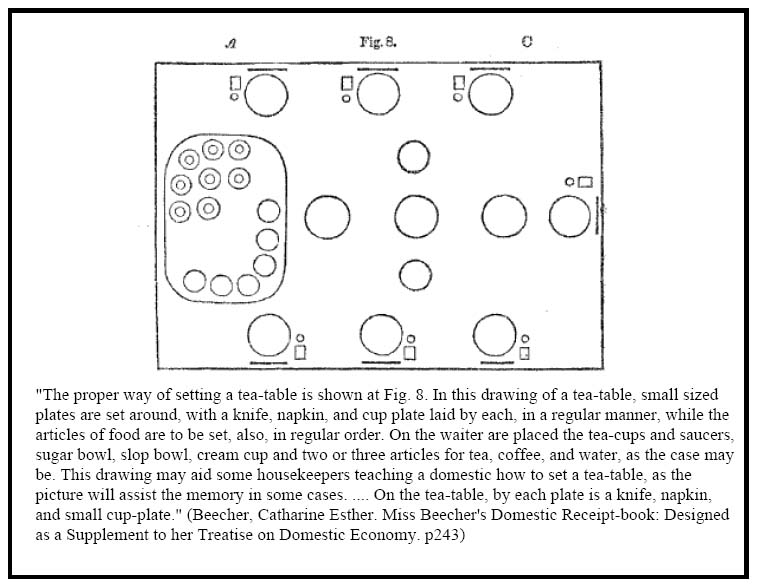
“Tea Parties and Evening Company” “In one respect, fashion has aided to relieve a house-keeper of much care in providing evening entertainments. It is now fashionable to spread a table for evening parties, and not to serve tea and coffee, as was formerly done. As this is the easiest, and most rational way of entertaining evening company, no other method will be so minutely described. “If a lady designs to invite from forty to sixty friends to pass the evening, of even to have a much larger company invited, the following would be called a plain but genteel arrangement, for company in New York, Philadelphia, or any of our large cities. “Set a long table in the dining-room, and cover it with a handsome damask cloth. Set some high article containing flowers, or some ornamental article, in the centre. Set Champagne glasses with flowers at each corner. Set loaves of cake at regular distances, and dispose in some regular order about the table, preserves, jellies, lemonade, and any other articles that may be selected from the abundant variety offered in the collection of Receipts for Evening Parties in this book. “Where a very large company is to be collected, and a larger treat is thought to be required, then a long table is set in the center of the room, as above, and on it are placed cakes, pastry, jellies, and confectionary. Then smaller tables are set each side of a mantle, or in corners, one of which is furnished with sandwiches, oysters, salad, celery, and wine, and the other with coffee, chocolate, and lemonade. Sometimes all are placed on one long table, and in this case, cakes, jellies, and confectionary are put in the centre, coffee and lemonade ate one end, and oysters, sandwiches, celery, and wines at the other. A great deal of taste may be displayed in preparing and arranging such a table. “As it is often the case, that the old mode of serving tea and coffee will be resorted to, on modification is proposed, which decreases the labour and anxiety to the housekeeper, and increases the enjoyment of the company. It is this. Set a table in one of the parlors, and cover it with a damask cloth. Let the tea and coffee be served at this table, the lady of the house presiding. Then let the gentlemen wait upon the ladies around the room, and then help themselves. This is particularly convenient when it is difficult to get good waiters. “Most of the articles used for evening parties (with the exception of rich cakes, wine, and highseasoned chicken salad are not unhealthful, if taken moderately. “When these parties break up at seasonable hours, then may prove one of the most rational and harmless modes of securing social enjoyment; but when connected with highly exciting amusements, and late hours, they are sure to wear upon the constitution and health and rational and conscientious persons, for these and other reasons, will avoid them.” (Beecher, Catharine Esther. Miss Beecher’s Domestic Receipt-book: Designed as a Supplement to her Treatise on Domestic Economy. p241-242)
TEAnotes – These are plain notes, no formating, not cross checking.
While the “Serving 19th C. Style” article looks at serving trays, slavers and waiters, there were many other serving dishes and utensils used in the mid-century. This is a partial list of the many dishes used to serve during meals and in the parlor including:
Many of us will find a use for some or many of these items at some point in our reencating. There are a few factors to keep in mind when choosing which pieces to use for a particular occasion. You will want to ask yourself what type of serving pieces the person you are portraying would have chosen. Or in servant’s cases, what types of pieces would the person you work for would have chosen. You will find when looking into the details of some pieces the early and mid-Victorian years were a transition from simpler lines of the early century to ostentatious ornamentation of the last quarter of the century. You will also want to consider your comfortable investment point. Likely, these pieces are ones you will be transporting from site to site for events rather then just from kitchen to dinning room or parlor as originally intended. The regular packing, transporting, and varied use of reenacting could be detrimental to an original piece or a significant investment piece. Besides physical damage, a piece could be misplaced or accidentally left behind. I have managed to loose the lid to a serving dish, one of a pair of large monogrammed silver trays, and two smaller silver trays belonging to a set over the years. Luckily, with this possibility in mind I have limited my purchases to a price I could afford to loose.
I will add to the following list any notes or tid-bits of information that may be helpful in selecting pieces.
Soup Tureen
Fish and Meat Platters
Vegetable Dishes
Two vegetable dishes should fit on the waiters serving tray.
Sauce Boats
Castors, Salt Cellars, Sugars, and Cream Jugs
[Leslie p 252 “257” Leslie discusses two different castors or cruets, one for dry and one for vinegar. She discusses pepper, cayenne, mustard, vinegar, pickles, salad oil, salt (in cellars), and powdered loaf-sugar (found in some castors) in her section on castors. She also covers separate castors for anchovy, soy, catchup and fish-sauces.
“We see no very reasonable objection to having the castors on the dining table. If there are two sets of castors, place in the middle of the table the salad bowl or the celery glass; unless there is company to dinner, and the centre, perhaps, is occupied by a plateau, an epergne, a vase of flowers, or some other ornament.” (Leslie)
Tea and Coffee pots
Another tea related piece is the hot-water urn. While frequently written about and illustrated in period literature and art, I am not certain how extensively urns are practically used in a living history interpretation setting. Originals, should not be used, while reproductions may or may not exist at an affordable price. Urns kept water hot with a cylinder heated in the fire and placed inside the urn. A more affordable option used in the era was a tea kettle kept hot on top of a chafing-dish. The chafing dish holds hot coals to keep the water hot.
Cold Drink Containers – Decanters, pitchers, etc.
“The decanters are to stand neat the corners. It is now usual at many tables to have a smaller water bottle (holding about a pint) placed by the side of every place that each person may pour out water for himself. Nevertheless, there should always be water-pitchers on the side-table, to replenish the bottles when necessary, whether large or small ones are used on the table. In summer, when filling the pitchers, put two or three lumps of ice into each.” (Leslie)
Fruit Dishes
Fruit dishes and sweetmeat dishes can be covered prior to dinner with fine black wire net covers.
Dessert Dishes
For the past couple years, I’ve done part of the CW unit for the HS I work at. Here are the class outline and the basic handout files in Word format.






 If I Had My Own Blue Box: