Little Things That Can Mean A lot

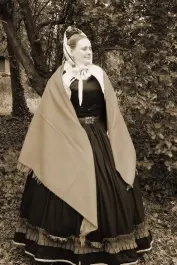
As we observe our cohorts at events or in photographs, there are those little things that can make or break what we see. These are those visual ques that make us think “yes” or “eaguha”. While we are observing others, others are observing us as well. So, lets honestly ask ourselves, what are those little things that stand out as not so little things? And in the case of those break it things that make us squirm, what can we do to fix them?

Make It

Fit – Fit, corset and skirt support go hand-in hand as they each compliment the other. Even with great silhouette support, a dress can still hit or miss when it comes to fit. Each of us has different body types with different proportions. Some of us are curvy, some slim, some short waisted, some wide shouldered. Combine this endless variety of body shapes with the fashion characteristics of the 1850s and 60s (or really almost any era) and there are bound to be some dresses that just do not go with some body variations. While we are looking for a dropped shoulder seam and armscye, these attention points will fall differently on women of the same size if one woman is narrow shouldered and the other wide shouldered. The same comparison can be said of women who have variations in torso length such as being long vs short waisted or long vs short shouldered. If the same dress is tried on by a woman who is long waisted and by a woman who is short waisted we will see a difference in where the waist falls. Ideally, the waist would fall just above the natural waist. But, on the short waisted woman it may fall at or below the natural waist, while on the long waisted woman it may fall well above the natural waist. There are some instances of impression where variation of fit is necessary. Suggested Reading:

Corset – A properly fitting corset not only effects the entire silhouette of a dress, it also effects how a woman carries herself and her comfortablity. The reality is we can all tell who is or isn’t wearing a corset. The position and shape of our chest is different. I’ll admit my bust height is easily a difference of 4 inches with vs with out a corset. That make a drastic difference in the silhouette of a dress. Beyond the look of the dress is how we stand and sit while wearing a corset. Most of us are much more aware of our posture while wearing a corset. In this modern world where we spend hours working at a desk and computer we tend to slump and roll our shoulders. In the 19th century, women worked at kitchen tables preparing food, in gardens or fields and in chairs sewing. Their corsets helped relieve some of the back strain they experienced while working. This is only part of the comfortablity. A corset helps support the weigh of our skirts and skirt supports. The corset holds the waistbands rather than our skin. Suggested Reading:

Skirt Support – Good skirt support creates a beautiful skirt silhouette. This is a combination of volume, poof off of the waist, curve of the skirts and drop to the ground. The only way to decide if you have good skirt support is to compare your look with the look of women from the years you are portraying. Take photos of yourself in full dress from the front, back and sides. Compare them side by side to CDV images. Suggested Reading:

Collar – A collar is an essential item for keeping the collar of your dress clean. It also finishes the look of a dress nicely. A nice, simple white cotton collar can say allot. The great thing is, personal linens such as a collar and cuffs, cost very little to make. Keep in mind, they should be an inch to an inch and a half wide made of light weight cotton. Some variation in width and angle of the front does exist from year to year. If you are wearing a wash dress, consider a kerchief of other personal linen for the neck of that dress.  Suggested Reading:

Cuffs or Undersleeves – Just like a collar, cuffs or undersleeves protect your dress and finishes the look. These can each be very simple or very elaborate depending on the over-all look of your dress. Suggested Reading:

Hair – We all struggle with our hair in both centuries from time-to time, or all the time. But, we all know when someone really “got it”. Their hair looks not only great but just like they stepped out of a CDV. Suggested Reading: “False Hair” by Elizabeth Topping, May 2010 CC

Jewelry – I’ll admit I am not a jewelry follower. But, I know when a woman’s jewelry completes a look. Well chosen jewelry not only encompasses research and taste, it shows completeness in thought. It shows just how much a woman has thought about who she is portraying and what she would have worn. Suggested Reading: “Hands, Hearts and Hair: Motifs and Symbolism of Victorian Jewelry” May 2010 CC

Break It

The “S” word – Nothing can ruin a look like a saggy, baggy, nylon snood. Whether it hangs there like a laundry sack holding piles of loose hair or droops off of what might actually be a nicely fixed chignon, it just screams. This item did not exist in this heavy form in the mid-19th century. This is one area where there is very good news… If you must have a net, the simplest way to go is also a very cost effect way to go. Yes, cheaper then that snood. I know, in this expensive hobby, cheaper can always be appreciated.  A simple faux hair net can be purchase at beauty supply stores. This can be worn plain. Or, you can add a simple silk ribbon. Suggested Reading: “To Net or Not To Net”

Pony-tail cameo – This is one of those little things we notice when we are having a conversation with someone. After all, we do have to stand fairly close to see the detail of a cameo. But, for some reason, that long dangly pony-tail on the silhouetted woman just stands out. These cameos from the second quarter of the 20th century are everywhere and easy to pick up. It is even possible that a woman is wearing a well-loved keepsake from a grandmother. The fix for this is simply self-control while shopping. No matter how pretty or how great the price, if the woman in the cameo has a pony-tail save her for someone else or for modern wear. Suggested Reading: “Victorian Cameos” (I’m trying to find the title of this amazing time-line cameo book I had from the library once. It amazed me.)

Flop – This goes along with the skirt support suggestion above. An absolutely beautiful dress can lose all it self-esteem when left drooping over poor skirt supports. Flopping and drooping just kills a look. This goes for any dress worn day or evening, for work or visiting. Skirts were not meant to fall from the waist in the mid-century. They want life and body. The answer is properly full and starched petticoats.

Bones – Along with the above flop comes bones, when we can see the bones of a cage showing through a skirt. This happens when a skirt lays directly over a cage rather then being softened and shaped by layers of petticoats. The solution is the same as above, properly full and starched petticoats.  

Leather belts – Many of us have a heightened awareness of our waist and want to wear a belt. While women did wear belts, it was infrequent and far from fashionable to wear a leather belt. Depending on the dress, a self fabric or silk ribbon belt is preferable.

I’ll admit, I faded as I put this together tonight. There will likely be additions, expansions and more reading suggestions. If you have a suggestion for one of those “little things” please let us know in the comment section.

Published in: on May 24, 2010 at 9:28 pm  Leave a Comment  

I’m more than just a bit of a fan of Flow Blue

Article link:

Flow Blue Ceramics

Published in: on May 24, 2010 at 7:50 pm  Leave a Comment  

Updated Civilian Article Index is Available

I finally got around to updating the Civilian Article Index entries for the Citizen’s Companion through the March/April edition.

It can be found on my Yahoo Group’s files as I am not yet able to upload an Excel file here (just about everything but Excel). The published articles’ worksheet is now 48 pages long. A version with just the published articles is available in Word. Keep in mind this is not sortable. Civilian article index just published articles

There are still gaps in the published and web-based articles. I know I’m missing some recent needlework and knitting articles in other publications which should be include. If you know of an article please let me know so I can add it.

Working Attire Survey Results

I had planned on developing a full article on working support garments. But, I have been utterly swamped (yes after being bored) with a new home style, two major projects, and a new job. So, rather than have the information from the survey just sit around, I am posting it. I ended up with exactly 100 respondants. I had hoped for double that to get a good sample. 100 isn’t bad though. I need to figure out how to properly post the 123 comments people took the time to make in the survey. There are a variety of different views and reasonings in them. This was just the look at how this is interpreted by the living history community. The other, and larger, componant of the original article plan was a look at what literature and photographic evidence tells us about what women worn in different work situations. I will try to get some of that information up over the next several weeks as well.

Question 1. What undergarment do you wear while doing light domestic work such as preparing food, washing dishes or sweeping?

Corset wtih full boning – 83.8%
Corset with light boning – 10.1%        
                          10.3% (excluding those who do not do this activity)
Stays with soft or light boning – 4%      
                                   4.1% (excluding those who do not do this activity)
Nothing 0%   
Modern Bra – 4%   

                                   4.1% (excluding those who do not do this activity)
Do not do this activity – 2%
1 skipped this question

Question 2. What undergarment do you wear while doing heavy domestic work such as cooking in a hearth, on a stove or over a fire or doing laundry?

Corset wtih full boning –  61.6%     

                                   79.2% (excluding those who do not do this activity)
Corset with light boning –  11.1%          
                       14.3 % (excluding those who do not do this activity)
Stays with soft or light boning – 7.1%         
                          9.1% (excluding those who do not do this activity)
Nothing – 0%          
Modern Bra – 4%            
                            5.2% (excluding those who do not do this activity)
Do not do this activity – 22.2%
1 skipped this question
 

Question 3. What undergarments do you wear while doing moderate outside work such as collecting firewood or gardening?

Corset wtih full boning –  66.3%   
                                                     79.3% (excluding those who do not do this activity)
Corset with light boning –  10.2%  
                                                    8.5% (excluding those who do not do this activity)
Stays with soft or light boning 6.1- %           
                                                       7.3% (excluding those who do not do this activity)
Nothing – 0%
Modern Bra – 6.1%           
                              7.3% (excluding those who do not do this activity)
Do not do this activity – 16.3%
2 skipped this question
 

 Question 4. What undergarment do you wear while doing heavier agricultural work such as farming or building?

Corset wtih full boning –  25.3%           
                                64.1% (excluding those who do not do this activity)
Corset with light boning –  8.1%             
                                    20.5% (excluding those who do not do this activity)
Stays with soft or light boning – 5.1%            
                                      12.8% (excluding those who do not do this activity)
Nothing – 1%            
                                             2.6% (excluding those who do not do this activity)
Modern Bra – 4%           
                            10.3% (excluding those who do not do this activity)
Do not do this activity – 60.6%
1 skipped this question

Question 5. Is your corset

Custom made in person or by yourself – 58.3%
Custom made by measurements – 31.3%
Authentically made off the rack – 12.5%
Acceptably made off the rack – 1%
Something that gets by – 1%
4 skipped this question
Question 6. How would you describe the fit of your corset?
Comfortable fit with no complaints – 68.0%
Right shape for me but a little loose – 4.1%
Right shape for me but a little tight – 5.2%
Roughly a good fit with some issues to fix – 21.6%
Will do now until I replace it – 7.2%
3 people skipped this question
Question 7. Does the fit of your corset affect when/if you wear it?
Yes – 28.9%
No – 73.2%
3 skipped this question
Question 8. Does your body type, bust size and/or figure affect when/if you wear a corset?
Yes – 24.7%
No – 75.3%
3 skipped this question
Question 9. Does the weather (heat, humidity, rain) affect when/if you wear a corset?
Yes –  15.5%
No – 84.5%
3 skipped this question
Question 10. Do you think mid-19th century women wore a support garment (corset or stays) while doing work?
Yes – 92.9%
No – 3.1%
Don’t know 5.1%
2 skipped this question


Published in: on August 28, 2009 at 7:36 pm  Leave a Comment  

Sewing Cases Publication

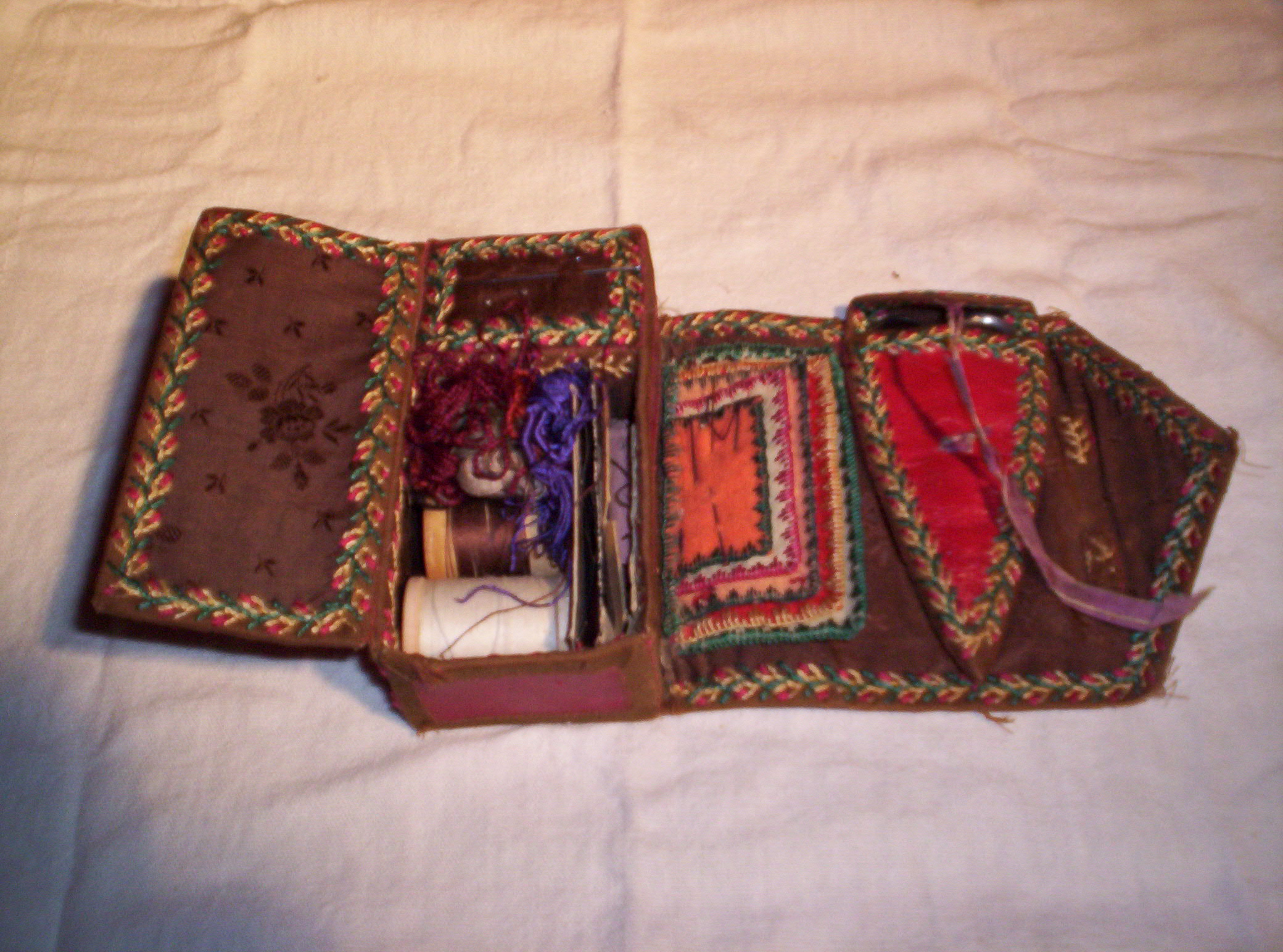
I’ve decided to go forward with the Sewing Cases Publication. Thank you for your encouragement. I am working on an outline and list of each sewing case, needle-book and accessory I want to include. Right now the list keeps getting longer. It will take me a while to make each sample, thoroughly photographed along the way, and get the directions written. Then comes the book formatting. All-in-all I am pretty excited to work on this. I have a notes started for additional booklet ideas as well. Stay tuned.

Published in: on July 30, 2009 at 4:15 pm  Leave a Comment  

Sewing Cases Publication

A few years back the patterns I made from some 19th century sewing cases were a huge hit. I am considering a how-to publication about sewing cases including patterns and step-by-step directions including pictures. I will include each of the sewing cases you have already seen and those I haven’t offered before. I am picturing a booklet about the size of From Field to Fashion with the patterns folded inside. I would like to know if this is something people would be interested in. If you would like to comment below or email me, please do.sewing case original

If this type of publication is a success, it could be followed up with other how-to booklets on other period accessories.

Published in: on July 24, 2009 at 12:48 pm  Comments (3)  

How To Wear A Shawl


The What-not; or Ladies’ Handy-book “How to Wear a Shawl”
On the subject of wearing shawls, both long and square, much may be said, on some of our fair readers having  expressed to us their desire that we should publish some details upon the best system to be adopted in wearing shawls gracefully, we purpose doing so to the best of our ability.
In the first place we must premise that, as there does not and cannot exist a universal panacea for effacing wrinkles or making the hair to grow on bald places, there cannot be an absolute system for draping shawls. One substance suitable, or rather inoffensive for some ladies, may be essentially prejudicial to the appearance of others. One fashion of wearing a shawl may appear very graceful on a slender figure, but will transform into a bundle a woman of rounder and fuller proportions.
If the so called long shawl be somewhat shorter than usual it should not be evenly folded, that is to say one end should be left longer than the other, in order that it may fall lower. This is indispensable in the striped shawls, which are now so fashionable for morning toilettes, as they are much shorter than bordered shawls. They should be folded so that one end may not appear exactly over the other. If these two points in fact, were to be placed on the same line, the longer end of the shawl would then be too short. Round the neck, two or three folds should be made, which are fixed in their proper position by a long pin; this is done in order to disengage the head which would otherwise be confined by the folds of the shawl. Nothing looks so ungraceful as to see the curtain of the bonnet in constant and ungraceful contact with the awkward wraps of a badly folded shawl. It is then necessary to be careful that the neck be perfectly free, while, at the same time, it is protected by the folds.
But these rules do not suffice for the graceful wearing of a shawl. To succeed we must have not only the experience that is acquired, but the instinct which is innate. A woman must then know her own figure, and not be led away by illusions in this respect.
Drooping shoulders are those which bear most becomingly the long or square shawl. High and pointed, and consequently narrow shoulders are less adapted for the square shawl. For ladies so circumstanced by nature in the latter respect, we would recommend the long shawl, which being quadrupled over the shoulders, takes off the angular appearance which would otherwise disagreeably prominent.
A thin woman should fold her shawl in such a manner that the upper point may fall in the centre of the back. A woman of a stouter figure should so arrange her shawl that this point may be larger and descend lower, about to the waist. It may be easily understood that this quadrupled shawl augments considerably the volume of the bust. And when the bust is sufficiently full, it is necessary that the upper point should fall lower, so as to envelope the body without increasing the size.
The longer side of the shawl is ordinarily placed to the left, the right arm raising the shorter end; but this depends entirely on acquired habits, and there is no reason why the shawl should not be worn in an inverse way.
Square shawls should be raised on both arms, and a very tall, or very stout woman, ought carefully to avoid folding a square shawl exactly double. One side should be longer than the other, in order to augment the proportions ¡of the shawl, which would otherwise be too short, and consequently ungraceful, if she neglected this precaution.
We may add that all shawls should be as much as possible draped upon the woman who wears them, and sustained by the arms being pressed upon the bust ; but we must also add that we hare displayed to our readers but the material part of this difficult art, and unfortunately it is the only one we can analyze, for grace is not demonstrated, and taste is a natural gift which escapes every definition and all commentary. Wealth cannot replace it, nor can experience supply its want.
Literary Gem 1854 “How to Wear a Shawl”
If a lady sports a shawl at all, and only very falling shoulders should venture to do so, we should recommend it to be always either falling off or putting on, which produces pretty action. Or she should wear it upon one shoulder, and down the other, or in some way drawn irregularly, so as to break the uniformity. One of the faults of the present costume, as every real artist knows, is that it offers too few diagonal lines. Nothing is more picturesque than a line across the bust, like the broad rilibon of the order of the garter, as worn by Queen Victoria, or the loose girdle, sloping across the hips, in the costume of the early Plantagenets. On this very account, the long scarf shawl is as picturesque a thing as a lady can wear. With the broad pattern sweeping over one shoulder, and a narrow one, or none at all, on the other, it supplies the eye with that irregularity which drapery requires; while the slanting form and colors of the border, lying carelessly round the figure, gives that eastern idea which every shawl more or less implies. What Oriental would ever wear one straight up and down, and uniform on both sides, as our ladies often do?—Quarterly Review.
Hurry-Graphs by Nathaniel Parker Willis “Shawl Aristocracy”

The degree to which ladies care more for each other’s opinion of their gentility of appearance, than for the opinion of gentlemen, on the same point, is, at least, equal to the difference between a French shawl and a Cashmere—one worth fifty dollars and the other worth from five hundred to a thousand—for, though no man knows the imitation from the real shawl, as he sees it worn, a fashionable woman without a Cashmere, feels like a recruit unarmed and unequipped. The pilgrimage to Mecca, which entitles to the privilege of wearing the green turban, would not, by the majority of women, be considered too much to undergo for this distinction—recognizable, though it be, by female eyes only. “She had on a real Cashmere” would be sweeter, to numbers of ladies, as a mention when absent, than ” she had a beautiful expression about her mouth,” or  “she had such loveable manners,” or “she is always trying to make somebody happier,” or “she is too contented at home to care much about society.” It is, moreover, a portable certificate of character and position. A lady “with a real Cashmere on,” would be made way for, at a counter of Stewart’s—differently received when introducing herself at a first call—sooner offered the head seat in a pew criticized, as to manners, and very differently estimated in a guesst as to who she might be, in any new city or place of public resort where she chanced to be a stranger. The prices of the best Cashmeres vary from four hundred to fifteen hundred dollars.* There are two plausible arguments in their favor, usually pleaded by ladies—first, that they fall in more graceful folds than any other shawl, and have an “indefinable air of elegance,” and, second, that, as they never wear out, they are heir-looms which can be bequeathed to daughters. The difference between a thousand dollar shawl given to a daughter after twenty years’ wear, and the same thousand dollars invested for a daughter and given to her with twenty years’ interest, puts this latter argument upon its truest ground; but one word as to the superior becomingness of Cashmeres.

There are very few women, out of Prance, who wear any shawl becomingly—for it requires either the taste of an artistic mind, or a special education, to know its effects and arrange it to show the figure to advantage—but a Cashmere, by the very pliability which is subservient to grace, betrays awkwardness or a bad figure just as readily. For a round back, flat chest, or arms held at inelegant angles, there is more concealment in the French shawl, than in the slighter tissue of an India one; but, either way, we fancy, the difference is too trifling to be recognizable by one person in a thousand. As to the beauty of color and texture, we are very sure that, to men’s eyes, the dull complexion of a

Cashmere conveys the impression of a cover-all, grown somewhat shabby, and which the wearer would not have put on if she had “expected to meet anybody.” There is not one lady in a hundred, of those who own Cashmeres, who do not look better dressed, (to most female and all male eyes,) in any other out-of- door covering.

As our city readers know, there has been a three days’ exhibition and auction of Cashmere shawls, in the large hall over the theatre at Niblo’s. The vessel in which this precious cargo was being conveyed to England, was abandoned at sea by the crew, and, an American ship securing the cargo and bringing it to this country, the goods were sold by the British Consul, to arrange salvage and remit the remainder to right owners. The shawls were hung upon lines, up and down the immense hall, and, between these aisles of Cashmere, the fashionable ladies of the city promenaded, with close scrutiny and comparison of opinion— (and with a degree of keen interest .that we should like to see given to a gallery of pictures!) Having, ourself, fortunately secured the company of Mr. Flandin, who was the only importer of Cashmeres to this country for twenty or thirty years, (and whose eye, for better reasons, is familiar with the Parisian grace of a shawl’s wear, and its value in becomingness,) we took the opportunity to enrich our knowledge in the matter. After having all the advantages of the India fabric pointed out to us, however, and hearing, from our well-informed friend, what class were the purchasers, and what made the difference of hundreds of dollars in the cost of shawls which to a common eye would seem of equal value, we came away satisfied that a better present could be made with five hundred dollars, than to bury it in a Cashmere shawl— that things better worth having could be had for a quarter of the money—and that the arbitrary aristocracy, which is based upon the wearing of them, is one of those illusory valuations which this common-sense age is constantly on the look-out to put down.

(* It is a curious foreshadowing of the anticipation of income by which such expensive articles are sometimes obtained, that the finest and costliest of these shawls are made from the down of the lambs taken from the womb before birth.)
 

Published in: on June 23, 2009 at 1:15 am  Leave a Comment  

Tableclothes – White or More?

Jackie called me yesterday asking about tablecloths. She had a couple plaids she was considering for a large table at the Mumford event. My response was to play it safe and stick to white linen. Of course, since she asked, I had to go find out.

Step one, look through the interior paintings I have saved. In the first painting I opened, my play it safe response went out the window. In Francis William Edmonds’ Barking Up the Wrong Tree (c. 1850-55) a red cloth covers a small table. This cloth has either a yellow or golden double stripe border. This is a modest working class or  lower middle class home.

Looking at the more affluent homes, first is Lady in an Elegant Interior by David  de Noter (c. 1852). This round table in what appears to be a parlor is draped in a red patterned cloth which has colors that remind me of paisley shawls (though I doubt this is a shawl.) The cloth is rather tossed or roughly draped. A small table in Christmas Time by Eastman Johnson (c1864) has another red patterned tablecloth. This one is neatly draping the table. A dark green cloth with a decorative border drapes a parlor table in Lilly Martin Spencer’s Patty Cake. Another lovely green cloth is draped over a round parlor table in Reverend Atwood and His Family (page 5). This cloth has what appears to be a woven in border type design. This is a similar cloth as well.

Kitchen tables, used for work, are shown without clothes. Examples would be The Speculator by Francis William Edmonds (c 1852), The Young Wife: First Stew by Lilly Martin Spencer (c1854), Kitchen Interior by Thomas Hicks (c1865),

One table I am not sure about is in the painting The Song of the Shirt by John Thomas Peele (c1847). The woman is working on her sewing. I don’t know if the yellow fabric with holes draped across the table is a table cloth or simply a piece of cloth.

What about that safe white linen tablecloth? One like what I pictured can be seen in Family Life on the Frontier by George Caleb Bingham (c1845) where it drapes a large table. Another drapes a table in home with more means in The Contest for the Bouquet by Seymour Joseph Guy (c1866). Most still lifes I have saved also show a white cloth (or now cloth). Each of these show tables set with food. A few examples: several by John F. Francis, Fruit Still Life with Champagne Bottle by Severin Roesen (c1848),

A surprise to me is the long cloth-less table in the 1821 painting The Dinner Party by Henry Sargent. That cloth free table goes against everything I’ve read about setting a table.

Now, I haven’t noted which table clothes are found in American homes vs European homes because without looking up the art pieces, I can just speculate. There could be some variation between the two.

In the International Exhibition catalogs a variety of tablecloths are listed. Most are listed under flax (linen); some under wool & woolens and silks as tablecloths, table-cloths and table linens. These tablecloths or table-covers would need to be divided into those put on a table for eating (what I think Jackie wants) or over a parlor table. I suspect a tablecloth is the one that goes on the dining table for the meal while the table-cover goes on the parlor tables or the dining table while there is no meal. This is based on this passage: “….and the table-cover thrown over, and the room restored to its usual order.” (The Book of Household Management) Also keep in mind these are the ‘cream of the crop’ type of examples meant to display the art of each manufacture. Here are some of those listed:

“Damask table-cloth” “Damask table-cover”
“Double Damask tablecloth”
“Tablecloth of damask with heraldic designs”
“Table cloth, embroidered with thread on crimson sarsenet.”
“Mohair table-covers”
“Table-covers:- cotton and worsted, and silk and worsted”
“Crimson and green embossed table covers”
“Victoria table-cloth, made from cotton and worsted, dyed previous to weaving, fast colours.”
“Silk and worsted and cotton and worsted Victoria velvet table-cover.” “The manufactures express their opinion that the Victoria velvet damask and table-cover, are in a style that has not been previously made in this country [England].
“Pictoral mosaic cloth-work table-cover or quilt, comprising 32 compartments exclusive of the centre, which is the arms of England; which being an imitation of some well-known picture, made of coloured clothes, fine-draw together so as to imitate paintings, the features being worked with the needle, the whole surrounded with a border. This work has been the labour of leisure hours for a period of nine years and a half.”
“Double damask table-cloth, with border, roses, shamrocks, and thistles, Irish wolf-dog and harp; cornerpiece, shield of oak leaves, flags, anchors, and a dove encircled in palm wreathes with olive branchl side range, tray-scroll, Price of Wale’s feathers, in oak wreath; and centre range, a temple, British royal arms, vase of flowers, &c.”
“Table cloth of new pattern, to be presented to the Earl of Clarendon by the Royal Society for the promotion and improvement of the growth of flax in Ireland. The centre represents the star of the Order of the Garter, in a union garland of rose, shamrock and thistle, interspersed with flax, and surrounded by the jewels of the Order of the Bath and St. Patrick, with Irish harps in shamrock wreaths. At each end is a presentation piece from the Royal Flax Society, Belfast, 18.”>1, on a group of shamrock and flax, surrounded by the Clarendon arms, incorporating the collar and jewel of the Order of St. Patrick, with the motto and jewel of the Order of the Garter. The border exhibits a rich collection of flowers, drawn from nature. The ground consiste of four large amaryllids around each representation of the arms, with email sprigs of shamrock and flag intertwined, &c.”
“Table cloth of new pattern, designed by John Mackenzie, Government School of Design. The centre consista of a rustic stump and basket of rich flowers, resting on a group of flowers at the base, and supported by an Arum and a Strelitzia, surrounded by a light wreath of flowers, chiefly climbers, and a ground harmonizing in same style. The border represents a rich scroll, each compartment terminating with distinct flowers. The corners represent tin1 rhododendron in flower, the end and side the centres of flowers. The margin represents the hearts-ease, on leaves of the same.”
“Table-cloth, extra double damask, with arms of Goldsmiths’ Company of London for centre, flowers with sprigs filling, in a scroll and flower border.”
“Table-cloth, extra double damask, with arms of Baron Bothacliild for centre, surrounded by various sprigs, and border of flowers”.
 “Table-cloth, extra double damask, with anus of Mr. Wheble for centre, surrounded with »prigs, mid encircled by two flowing scroll borders.”
 “Table-cloth, extra double damask, being pattern of a rich table service of various lengths, manufactured for Her Majesty’s 62nd Regiment of Foot, showing the number in a large star, surrounded by a flowing riband containing the names of the buttles in which this regiment obtained honours, with sprigs, the whole enclosed by a bonier of oak and laurel intertwined.”
 

I am rather disappointed by what I am finding in the household advice and guide books. The authors like to write about laying a cloth on a table but they fail to tell us which cloth. In Beeton’s The Book of Household Management, she mentions a “neat white cloth covered the table” in a story she tells.

 Next steps could be to look at sales accounts, paying attention to  the size of the tablecloth or table-cover compared to the size of tables (dining vs parlor). (Not sure if I’ll get to that.)

Published in: on June 8, 2009 at 8:48 am  Leave a Comment  

Increasing Spectator & Civilian Interaction

Inviting Spectators to participate 

It is important to offer an opportunity to try an activity to a spectator or visitor. Inviting them to participate opens the door for a more complete experience. Since live historical interpretation differs significantly from traditional museum and gallery displays, visitors may not know what to expect or what opportunities to make the most of. Often guests will be interested in trying what you are doing but will either be to shy to ask or unsure of what is acceptable. This is why it is important to invite spectators to participate, clarifying the possibilities of the experience for them.


Spectator friendly activities

  • Sewing – Invite spectators to try working on sample sewing and handiwork projects.  If you are working on a treadle or hand-crank sewing machine, invite them to try the machine. If you are quilting, have an extra needle and thread started for them to try. If need be, you can remove the stitches at the end of the event.
  • Spinning and Weaving – If you are working with fibers, have a drop spindle or small loom on hand for them to try. Children will benefit from the tactile experience of feeling the wool, silk or cotton fibers and comparing them to the finished yarns.
  • Knitting – Have an extra ball of yarn and a set of needles for spectators to try.
  • Food – Have them churn butter. (This is one of the few food related activities that are allowable.)
  • Laundry – If doing a partial laundry impression without the hot water and caustic chemicals, spectators can participate. Scrubbing wet clothes and hanging them can be a favorite for children.
  • Games – Almost every child and many adults love to play with period games. If your children are playing, invite a visiting spectator family to play as well. This will give the adults plenty of question and answer time as well. Parlor games are fun and often new to adult spectators. Invite them to join your game of conundrums or tableax vivants.

Potential Spectator Hazards

  • It is generally best not to have spectators handle original items outside of control situations with the proper surface and gloves.
  • Spectators should not be allowed to handle or taste food.
  • Spectators, though very interested, should not be allowed handle sharp or hot objects.
  • Spectators should not be allowed to handle loaded firearms.
  • Spectators should be kept a safe distance from fires.

Working with School Groups & Encouraging Student Interest

  • Younger spectators relate better to the character, personalities, and personal stories of people rather than facts, details and technical concepts.
  • Presenting a concept, event or series of events from the perspective of a character helps a student connect and develops a story-line.
  • Give students the opportunity to think critically and voice their perspectives on issues and events.
  • Link past events with present day experiences kids can relate to. Example – Soldiers’ aide groups gathering supplies for CW soldiers compared to student groups gathering items for care packages for soldiers.
  • Provoke curiosity and creativity.
  • Themes that can work well with students include
    • Choosing between different options, right and wrong
    • Dealing with pressure from peers and superiors
    • Needs, wants and problems solving – ex. How to provide food for your family if there wasn’t any available to purchase? What would a soldier do if he saw a cool stream of water during a hot day of marching?  


Tips for Teaching the Civil War

Mid-19th C or CW Civilian Article Index

I’ve noticed some people have been trying to find the index I am keeping of mid-nineteenth century civilian related article index. The index included articles from the Citizen’s Companion, The Watchdog, and The Civil War Lady. Some articles from the Civil War Historian  are also included while I wait to fill that in fully. There is a seperate list of online articles as well.  

Sadly, I can not upload Excel files to the blog. I can however post a PDF version of the printed article index. Downside is this is just an alphabetical list that isn’t sortable like the Excel file. If you are interested in the Excel file, email me or leave a comment. (Right now the index is current through January 2009. Updates will follow.)