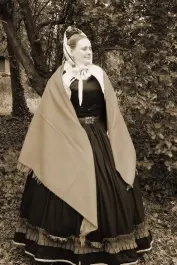
Hats against Bonnets – Peterson’s 1865

My friend, Sue L., found a must share passage regarding the wear of hats in a July, 1865 Peterson’s Magazine.  On page 74 in the Editor’s Table….

Hats against Bonnets.–The attempt to make hats unfashionable has not succeeded. There are, indeed, more bonnets worn: but many ladies still prefer hats: in fact look better in them. The hats are so various that it would be difficult to indicate which form is preferred. Some ladies wear hats more like the high-crowned black hats worn by men: the crown is not quite so high, and the brim is broader–these are the only differences; we have engraved one of these hats. Very little trimming is added; a flower is usually placed at the side, and appears to fasten a scarf, which is twisted round the top of the brim and falls on the shoulders. These hats are made of either black or white sewed-straw, and the color of the veil corresponds with that of the hat. The toquet, with brim turned up at the sides, and forming a point both at the back and front, is very becoming to the generality of faces; a long feather is won round these toquets, and forms the sole ornament to them. The jardinière hats are also worn. These have round brims, which are turned down and bound with velvet, to which is added either a gauze or lace veil. These hats are worn alike by young girls and their mothers, and especially by those who are not sufficiently youthful to adopt any of the faster forms.

The Usefulness of a Jacket – Godey’s 1858

This is a clip from Godey’s, 1858, I had in my “Distracting Odds and End” folder. It simultaneously speaks of the commonness of a shawl and the usefulness of a jacket.

 Hints on Jackets – When to Wear Them by Mrs. Damas Few things that we wear are, in my opinion, more comfortable than a jacket. There are various sorts, morning and evening- jackets, for young and old; but what I would first wish to call attention to is a comfortable jacket, one that can be worn at any time, the first thing in the morning, and the last thing at night. Mothers of families would do well to have such a one. It is a common practice with many to draw on a shawl; and, as this is generally done in a hurry, it rarely covers the chest, and requires one arm to hold it on. The jackets I now speak of are within the reach even of the poor. The skirt of an old gown, washed, will make a very good one; and to a poor woman it would be a very charitable gift, not to mention the great comfort of it. There can be no difficulty in deciding which looks best, an old shawl put on in a hurry, or a tidy-looking loose jacket, even if made of an inferior material. For the bedroom or house, a washing material should be chosen. If colored flannel is too expensive, a thin wadding put in between the lining and outside is warm and comfortable. Brown calico is sufficiently good and warm for lining, should that be preferred to wadding; but, for invalids, wadding is lighter. These jackets are by no means intended to fit the figure, but merely to sit easy and comfortable. To invalids, they are a great comfort to slip on if they have occasion to go into a cold room, or to wear under a shawl. A girdle or ribbon may be tied round the waist where additional warmth is required. Many ladies, as the winter comes on, give presents of warm petticoats, which are certainly a comfort. But still a substitute is wanted for the woman’s thin cotton body at top; and what better substitute could be offered than a warm jacket? For children, nothing can be so good as a jacket. It leaves their arms free, which is of great importance to them. Indeed, to obtain this freedom, they frequently throw off a cape or shawl, and thus expose the chest and neck, both of which require to be kept warm. Many persons have only one fire to sit by, in which case, should there be four or six in a room, it is almost impossible for one or two not to feel cold. Let those that do slip on a jacket, and they will then feel as warm as those near the fire. I by no means advocate wrapping up too much; but, when occasion requires a little extra warmth, I think that all who know the comfort of it would say that nothing can surpass the jacket.

Published in: on March 23, 2011 at 3:19 pm  Comments (2)  

A Conversation on Butter from the New England Farmer

Carrot juice? Specks and Spots? To Scald the cream or the churn? Warm space or Cool?

While looking for something else in the 1860 New England Farmer, this discussion about making good winter butter caught my attention. I couldn’t help but follow it. Yes, I am easily distractible. Just ask my husband.

It turns out this discussion began a full year earlier in the February of 1859 edition.

“To Make Good Winter Butter – At the annual meeting of the Jefferson County Agricultural Society, at Watertown, on the 14th of January, a tub of superior winter-made butter was exhibited by Mr. Daniel Parker, of that town, for which a premium was awarded by the discretionary committee. “The Butter,” says the Northern Journal, “was quite as yellow as much of the fall-made sent to market, and the flavor so fine that we obtained of Mr. Parker the mode of manufacture. He states that as soon as he has finished milking, the pails of milk are set into kettles of boiling water, where they are allowed to remain thirty minutes, then the milk is strained into pans and allowed to stand until the cream is ready to be taken off, which will depend upon the temperature of the room in which it is set. Before churning, the cream must be kept in a warm room at least twelve hours; then it will require churning less than an hour. He washed his butter immediately after taking it out of the churn, and at the same time salts it. His cows had been fed on clover hay, without grain or roots, for six weeks previous to the time of making this sample. Butter made in this way is perfectly sweet, of a good color, and will bring from two to four cents per pound more in market, then that manufactured in the ordinary way. It is worthy of attention of farmers.”

BUTTER IN WINTER I often see directions how to make good butter in your valuable journal. In making butter I find many obstacles; my cow has been fed carrots for several weeks; since that time have churned several hours (with the cream at 62) without making the butter come. Do suppose the carrots have a tendency to it? If so is there any way to avoid it? Can cream be churned again by any process?  Jan 11 1859 A SUSCRIBER

REMARKS We believe the carrots would a tendency to produce good butter, and not retard in any way its coming. If you have churned a day or two on your cream, you had better appropriate it to some other purpose than making of butter. The first thing essential in making good butter in winter, is to get good milk, and then if milk is set in some place, cellar or closet, where the temperature will remain at 60* Fahrenheit, cream will rise abundantly, and the butter come in ten minutes after commencing the cream. Some persons scald the milk it comes to the house – but that is not so essential as an even temperature at 60* for the milk to stand in. We are making 20 Ibs per without the slightest difficulty.” (March, p122)

“MAKING BUTTER IN WINTER. Having noticed an article by a subscriber under date Jan. 11, 1859, in regard to making winter butter, I would say in reply, that the reason why butter does not come quick in winter, is that the milk is set in a cold place where it attains to nearly or quite a freezing point. To remedy this, the only way that I know of is to take the cream when it is found it will not come, and scald it, and set it away till cool, when it will be found that the cream part of it will rise, which skim off and churn in the usual way, and you will find no difficulty in fetching your butter. Middlebury, Vt., Jan., 1859. ” w. D. H. Remarks.—If milk can be set where the temperature is 55° to 60° the cream will rise readily, and if kept in that temperature, may be churned into butter in less than fifteen minutes.(March, p151)

The discussion continues into 1860 (which is where I found it)…. I believe I need to find a missing passage because the 59 passages I have found do not mention Mr. Leonard and a loss of use of his cows.

BUTTER MAKING IN THE WINTER  – Mr. Brown – I will merely mention my experience in making butter in winter, hoping it may be an advantage to Mr. Leonard, for I should like to think it would be a real trouble to lose, or about lose, the use of his cows. I set my milk, after being strained through a cloth strainer into a kettle of hot water, occasionally stirring it in order that the cream or scum shall not rise until it is nearly scalding hot. Then it is set in a cupboard in the room where we live, which proves about the right temperature, and the cream will rise in about thirty-six hours. It is then taken off and set in a cold room, and so repeated until enough is gathered for churning. The cream is then set in a warming room until it is the right temperature to churn. I only churn from five to fifteen minutes, and never have lost but one churning in ten years’ experience. Two years ago I made in the same manner one hundred pounds, which sold in our village at the highest prices. Carron juice is an advantage to both taste and looks.    Reading, Vt, 1859   A Subscriber (February, 1860)

BUTTER IN WINTER – In my reply to “New Bedford correspondent,” I, last week, gave some views on this subject, and promised soon to render other information. This I could not acquire until I saw the result of this morning’s churning.             Here, the churning is done once a week, and from cream obtained by feeding “meadow hay” only. Better feed, sure, ought to give better cream! The milk of night and morning, during winter months, (as before said,) is thoroughly scalded immediately after milking, and straining. The past week, during sudden changes of weather, the pans accidentally became frozen solid. The cream however, (partially at least,) had risen. But it was so solidly frozen it had to be scraped off with a spoon, and in such state, was placed away, thinking it worthless. This morning, however, it was thawed out by putting the cans holding it into hot water. This was the condition of all the cream churned this day. The result was, most excellent butter in thirty minutes churning, and the “butter-milk” remaining could not be distinguished from new milk from the cow. I would also say, the cream from milk that is scalded never has a bitter taste, as is generally the case with cream from milk not scalded. This, sure, is a gain. Let, therefore, no on object to the little “pains-taking” in scalding of milk, as it surely saves so much labor in churning, and ofttimes saves the whole week’s product of cream from being lost.     Now, Messrs, Editors, for all this rendering can any one give me any information as to the churn advertised with you the past summer, that would produce good butter from “butter-milk” in five or ten minutes of churning? As the Scripture says “Come over and help us.”   Oak Hill    Dec. 23, 1859. (February, 1860)

WINTER BUTTER  – In answer to friend Leonard’s inquiry how to make butter in cold weather, I will tell him how I practice. I heat my milk by putting it into a strainer pail, and set it into a kettle of hot water; heat until nearly scalding hot; set it in a cupboard with a cloth hung in front, in a room where there is a fire kept through the day; it will keep from two to three days. I am careful to skim it before it sours; keep the cram in the same room, and as near summer heat as I can. I never heat the cream before churning, but scald the churn before putting cream into it. I add a little carrot juice to the cream when I churn it. It will puzzle the best judges to tell the butter that I am making this winter from that made in September. Dec. 22, 1859    Butter Maker (February, 1860)

MAKING BUTTER IN WINTER – I have found no difficulty in making butter in winter; my process is simply this: keep the butter in a cool place; if it freezes it will not injure it; collect the cream about ten days, then place the pot of cream near a fire, stirring it occasionally, till it becomes nearly milk-warm. Then scald the churn, and the butter will come in about half an hour, a good quality, fit for any man’s table. The great difficulty is in not having the cream of a right temperature before churning. If Mr. Leonard will try this method, I think he will have no difficulty in future.   Please inform me what kind of churn is best.      Derry, N.H. 1860.    Dairywoman

REMARKS – We cannot tell which of all the churns is the best. Out of some five or six kinds which we have tried, we prefer and use the Fyler churn. A correspondent in Auburn, N.H., stats the by setting the milk on the stove as soon as it is strained and bringing it to a scalding hear, and by keeping the cream in the warm kitchen, the butter will come in twenty-five to thirty minutes.    M.P. Knowles, of Rangely, ME., scalds the milk as above, and warms but does not heat the cream. To give the butter a good color, he says, I scrape a carrot and warm it in about three pints of cream, and strain it into the churn. (February, 1860)

BUTTER IN WINTER- This is headed an inquiry in your valued journal, Messrs. Editors, over date of November 27, from a correspondent in New Bedford. Allow me to aid him all in my power. From a most notable housewife in this vicinity, I obtain this teaching. After milking and straining, at once place the milk obtained in a clean kettle, and scald it well over the fire. Do not bring it to a boil, but simple scald it gradually, but well. Place it away for skimming in a room of moderate temperature. When ready to churn, warm it by setting the vessel that holds it, (if earthen,) in hot water. Otherwise, bring the cream to a point that holds not chill. Rinse the churn in boiling water before using. Drain out, and then “up and at it.” In a short time the result will be reached. I must remark this process never has failed me, from milkings not very heavily oppressed with cream, the food of the cows being ordinary meadow hay, with no other change whatsoever. To obtain a bright or golden color (so difficult to be had in winter with any feed,) take a few orange carrots, scrape them fine, immerse and soak in blood-warm water till the color be fully extracted. A portion of this, according to color desired, may be put in the cream when churning. It is wholly harmless in character, and not so repulsive to many, as “annotto,” an article doubtless well known. This process in winter, will secure the coming butter, in less (at least not over) 30 minutes’ churning in a warm room, and if coloring be used as designated, it will give it a pure June tint.   Oak Hill (March, 1860)

COLORING MATTER FOR BUTTER – In your paper of Jan. 14, I perceive that Mr. Everett, of Princeton, Mass., speaks of using the juice of carrots in making butter; I presume this is done to improve the color of the butter. I have known other coloring materials to be used for the same purpose. I cannot believe the use of any such material to be desirable. When the cows are in good condition, generously fed, their butter will be yellow enough, without such coloring ingredients. I am surprised that any one who feels competent enough to instruct others in the making of butter, should think it necessary to use the juice of carrots to color it. My mother, who made as nice butter as I ever saw, some seventy pounds per week through the months of June, July and August, never used such extra material to color the butter.    South Danvers. Jan. 1860 (March, 1860)

WINTER BUTTER -I.R. Havins, Foxboro, scalds the milk, sets it where it will not freeze; sprinkles on a little salt each time cream is added. Gets good sweet butter.  (March, 1860)

WINTER BUTTER AGAIN – Mr. Editor: – To ascertain the best mode of making winter butter is a good deal of importance, for there are many tons made in the State every winter. You must have patience with ups as we correspond with each other to find the best “modus operandi” of its manufacture. In the Farmer of January 28, your “South Danvers” correspondent, in allusion to my article, stating my method of butter-making in winter, expresses surprised that any one who feels competent to instruct others in this matter, should think it necessary to use the juice of carrots to color it. Let “South Danvers” try it, and he will lose his surprise. He is not the only one that has been surprised in lessons of improvement. Worchester county is not behind any other, to say the least, in butter-making, and I know that some of the best dairy-women in this town and county use the carrot in butter some six or eight months in the year. Let me surprise “South Danvers” again by telling him that one of the best dairies in Princeton, and othe that taken more premiums with-in the last fifteen years than any other in Worchester county, and probably in the State, never makes a single pound of butter after September, till the next summer, without carrots. Yes, more high premiums have been given to WILX ROPER, of Princeton (and justly awarded, too, I doubt not,) at county shows in Worchester and Barre, then to any man in the county, and those premiums were awarded by the best judges of butter that could be selected. Further, Mr. Roper took the first premium at the State show (in 1858, I think,) on tub butter, and would have taken the first also on lump butter have the laws of the society permitted both to be given to the same dairy. Mr. Roper has often told me that he never makes butter in fall or winter without carrots. I know it will surprise “South Danvers” greatly to know that the best premium butter in Worchester county, of the old Bay State, is colored with carrot juice. But it is a fact, and facts are stubborn things.   Let “South Danvers,” or any one else that doubts this improvement, try it, and he will be suprised to find that his stock of wisdom, in making winter butter, may still be improved.  Yours still for improvement, J.T. Everett. Princeton, Feb. 13, 1860. (April, 1860)

CARROT JUICE IN BUTTER – Mr. Editor: – In the last Farmer, Mr. Everett states that carrot juice put into butter is an improvement, in proof of which he cites the long time it has been practiced, by nearly all the butter-makers in the Bay State. It reminds me of the woman in New York city whose milkman wishing to be honest, carried her good milk, but the woman denounced it, saying she did not link the dirty yellow scum on it, but preferred the sky-blue article. Now if carrot juice really improves the quality of butter, I am surprised, as well as the South Danvers correspondent. I thought the coloring of butter merely a deception, practiced by those who were preparing the article for the market, the same as stuffing the soles of shoes with wood, galvanizing brass and passing it off for gold, and thousands of other vile deceptions to gull the unsophisticated. But when such a practice is published for an improvement, it is time for us to pause and consider. If there is any improvement in butter by the use of carrot juice, let it be given to the cows. I contend that cows fed on corn meal will color butter sufficiently through the winter, and increase the quantity and quality. I hope some of the farmers of the old Bay State will try it, and give us the result.  Derry, Feb 1860   Dairywoman.


Along with this winter conversation was one regarding specs in butter connected with artichokes:

“EXTRACTS AND ARTICHOKES FOR COWS WHITE SPECKS IN BUTTER Will you be so kind as to inform me through the columns of your paper, whether or not artichokes are useful to give cows.    I have, for years, occasionally noticed white specks in butter, and have made inquiry for the cause, but no one can tell. If you rinse the butter, many of those white particles will float on the top of the water, but it is impossible to get them all out. If you can tell me the cause or preventive, you will favor one who is interested in your journal.[signed] T Felchville, Vt 1859

REMARKS Artichokes are good for cows given in proper quantities. In churning as soon as the butter begins to come, all the particles of cream that have been thrown to the top, or any other part of the churn should be carefully scraped down. If they are left, they will, more or less of them, mingle with the butter and make white spots. Sometimes, however butter will have white streaks through it. This may be occasioned by collecting the cream at many different times, so that in churning some of it is quite fresh and does not “come” go readily as the rest. The cream while being collected should be salted a little and carefully stirred every day.” (March)

WHITE SPECKS IN BUTTER MR EDITOR I noticed in the N.E. Farmer last week, your theory about churning to prevent white specks in butter. Having devoted my whole time, for the last five years in the manufacture and sale of the Fyler churn, and spent much time among the dairies of Vermont and northern New York, I venture to differ with you in theory on that subject. You say as soon as the butter be gins to come, scrape carefully down all the cream is thrown to any part of the churn, and has escaped its share of churning. I say never scrape the cream down into the churn after it begins to come; if scraped at all, scrape it into the cream pot and save it for a new churning, and not into the churn to form those very specks you wish to avoid. Those white specks are usually caused by uneven churning. The true principle of churning is to have the dasher of the churn so adapted to the inside of the cylinder as to act on all the cream alike, if so adapted and the cream has been cared for, and you churn quite slow till it is perfectly mixed, and then faster, till the sacks containing the butter begin to break, and then scrape what is on the lid into the cream pot, will not be troubled about those white specks that spoil one half the butter made in this country. To carry out your theory, suppose you try experiment; churn say nine quarts of cream my principle, and see how much butter then the same quantity and churn till it begins come, or until you have churned one half time required now put in another quart cream and I will be bound you will either plenty of white specks, or your buttermilk be enriched with about the value of one of butter HENRY HOLMES Proprietor of 0. R. Idler’s Butter Working Churn Grafton VT., May 30, 1859

WHITE SPECKS IN BUTTER I would say in answer to T of Felchville Vt that white specks in butter are caused by getting sour milk in with the cream when skimming which becomes hard like cheese to prevent white specks in butter stir the cream thoroughly after skimming and should there be specks then rinse in cold water Ludlow Vt 1859 MRS L. E. H.

For the New England Farmer WHITE SPECKS IN BTJTTEB MR EDITOR Your correspondent “T” asks” What makes the white specks in butter?” I answer they are occasioned by the milk being “set” where there is a current of air, as from an open window, or by the milk room being too warm, so that the surface of the cream in the pans before skimming becomes dry, and in the process of churning does not mingle with the rest of the cream, but remains in the butter and butter-milk in the form of specks.

 In your “Remarks” appended to” T”‘s inquiry, you say that the white streaks in butter may be occasioned by some of the cream being more recently taken off, and not come so readily as that does that has been taken off longer. My theory is that they are caused by the salt being imperfectly worked in at the time of salting the white streaks are not so salt as the rest of the butter.

 Since writing the above I have read the communication of Henry Holmes. He says, “if you scrape what cream there is on the lid of the churn into the cream pot you will not be troubled with those white specks.” The cream on the lid, or in the corners of the churn had nothing to do with the specks or streaks in butter, and had Mr Holmes spent the last five years in person churning, working and putting down butter for market or so much of the time as would have been requisite to taking care of a good dairy, instead of “manufacturing and selling churns” would have learned that fact H BLAKE Hardwick Vt June 1859

[And now, my eyes are tired…. I will see if there is more soon….]

Published in: on July 21, 2010 at 7:59 pm  Leave a Comment  

Updated Civilian Article Index is Available

I finally got around to updating the Civilian Article Index entries for the Citizen’s Companion through the March/April edition.

It can be found on my Yahoo Group’s files as I am not yet able to upload an Excel file here (just about everything but Excel). The published articles’ worksheet is now 48 pages long. A version with just the published articles is available in Word. Keep in mind this is not sortable. Civilian article index just published articles

There are still gaps in the published and web-based articles. I know I’m missing some recent needlework and knitting articles in other publications which should be include. If you know of an article please let me know so I can add it.

Fan Dance

A recent post on the Sewing Academy brought up one of my pet peeves, the Fan Dance. This dance is popular at many of the north-eastern events. I love cotillions (dance games). But, most of the time I see this dance done, it isn’t done the way it is described in mid-century dance manuals. At events I see it danced in long lines rather than in a circle as described. I’ve seen the dance done in a circle. This format makes it far more fun for all involved.

Below are period versions of the fan dance.

From The Prompter by William DeGarmo (New York, Raymond & Caulon, Printers, 1865.)

“L’ÉVENTAIL–(THE FAN.)

“The first couple perform a Tour de Valse or Galop. The gentleman conductor seats his lady upon a chair in the centre of the room, and brings two gentlemen (one by each hand) in front of the lady, who offers to one of the two her fan, and dances with the other. The gentleman who receives the fan must follow the dancing couple round, fanning them at the same time.”


From American Dancing Master, and Ball-room Prompter by Elias Howe (Boston 1862)

The Fan–L’Eventail. (Waltz, Polka, or Mazourka Step.)

“Three chairs are placed in the middle of the room upon the same line. The two at the ends should be turned contrariwise to that in the centre, as in the figure of the Glass of Champagne. The first couple sets out in waltzing. The gentlemen seats his lady upon the centre chair, and seeks two other gentlemen, whom he places in the two other chairs. The lady offers her fan to one of the gentlemen at her side, and waltzes with the other. The gentleman with the fan must follow the waltzing couple, fanning them and hopping about the circle.”


From The Art of Dancing, by Edward Ferrero (New York, 1859)

“The Fan Three chairs are placed in the centre of the room on a line. The two at the extremities must be turned contrariwise to that in the centre. The first couple leads off in a waltz. The gentleman seats his lady on the centre chair, and gives her a fan; he proceeds to select two other gentlemen, whom he seats on the other two chairs. The lady offers the fan to one of the two gentlemen seated at her side, and waltzes with the other. The gentleman who holds the fan must follow the dancing couple, fanning them, while hopping on one leg.”


From The Drawing-Room Dances by Henri Cellarius (London, 1847)

“The Fan–L’Eventail. (Waltze, polka.)

Three chairs are placed in the middle of the room upon the same line. The two at the ends should be turned contrarywise to that in the centre, as in the figure of the Glass of Champagne. The first couple sets out in waltzing. The gentleman seats his lady upon the centre chair, and seeks two other gentlemen whom he places in the two other chairs. The lady offers her fan to one of the gentlemen at her side, and waltzes with the other. The gentleman with the fan must follow the waltzing couple, fanning them and hopping about the circle.”


Published in: on January 29, 2009 at 10:34 am  Leave a Comment  

“Politeness in Conversation” Excerpt from The Young Lady by Anna Fergurson

     Do not speak loud and long in company. This is a fault that young people are liable to commit. In the exuberance of their spirits, the voice is often raised to a high key, and some favorite topic is extended to an immoderate length, to the exclusion of all other conversation. This habit should be strictly guarded against. Those who indulge in it are liable to utter many things ridiculous and absurd, and to lay themselves open to the just censure of the wise and prudent. Loud laughter is also impolite, and is considered by many as an indication of an empty mind. I would by no means banish sociability and pleasantry from the friendly circle. But there should be a proper medium observed. The good sense of youth should teach them not to surpass, in these respects, certain bounds prescribed by propriety.

In a mixed company, avoid, if possible, all contentions and disputes, especially on exciting topics. If carried to any extent, they lead to exhibition of improper feelings, and generally cause the disputants, and the whole company, to become unhappy. There may be cases where this rule should be departed from; but such instances are extremely rare. As a general practice, the rule should be strictly adhered to.

Do not permit yourself, in company, to speak disrespectfully of one who is absent, if you can consistently avoid it. This practice is not only impolite, but it is ungenerous and unjust. If it becomes necessary to express opinions derogatory to the character fo the absent, speak in guarded language and with all the palliations that charity and forgiveness can suggest.

Avoid any exhibitions of anger or petulance. There are impolite and immodest especially so in females. They throw you off your guard, cause you to utter expressions extremely improper, and often ridiculous, and place you in circumstances very unpleasant. A guard should be placed upon the temper. Nothing is more to be avoided than the outbreakings of rage. Under their influence, evils are often committed, for which a whole after life of propriety can hardly atone.

Be cautious not to interrupt others when speaking. This plainly indicates a want of good breeding; and yet it is a very common practice with many. However anxious you may be to utter your views, remain silent until those who are speaking have concluded. Respect to them, and a desire to avoid confusion, as well as the rules of propriety, dictate a strict adherence to this precaution.

Do not bluntly deny the truth of the opinions expressed by those with whom you are conversing; and more especially if they are aged, or their opportunities for obtaining information have been superior to yours. If you differ from them, express your views in modest and respectful language, and with due deference to their mature experience. You should rather express the propriety of a different opinion than pertinaciously assert it.

Never indulge in ridiculing others in company. It is a vulgar and ungenerous practice, and indicates a narrow, uncultivated mind. All have their weaknesses and imperfections, – even those who possess the most shining talents, have their blemishes. “But what an absurd thing it is to pass over all the valuable characteristics of individuals, and fix our attention on their infirmities; to observe their imperfections more than their virtues, and to make use of them for the sport of others rather than for our own improvement.” “The littlest feeling of all, it is the delight in contemplating the littleness of other people.” Persons addicted to ridicule, are not usually distinguished for their own wisdom or good sense. Like critics who cut up a good publication, without being able to produce one themselves worth reading, so those most given to the ridicule of others, are themselves generally deficient in many of the valuable characteristics of human nature. “If the talent of ridicule where employed to laugh men out of vice and folly it might be of some use to the world; but, instead of this, we find that it is generally made use of to laugh men out of virtue and good sense, by attacking every thing that is solemn and serious, decent and praiseworthy, in human life.” If young people must indulge in ridicule, I pray to you act upon the reverse of this observation. Let your talent of ridicule be exercised only against immoral and vicious practices; against pride, folly, and every species of extravagance and sin.

Avoid ridiculing others on account of their appearance, or their plainness of dress. Some are naturally more awkward in their demeanor than others; and any ridicule on that account, will be at the expense of your good sense, in the eyes of the discriminating. All tastes do not agree in regard to dress. You claim the liberty of arraying yourself in such habiliments and style as your fancy dictates. You should be willing to grant the same privilege to others; and should no more imagine that you have the right of ridiculing them for not following your taste, then they have of ridiculing you for not imitating theirs. And by all means avoid ridiculing those, who, from poverty are unable to appear in attire as costly or as fashionable as that of the community in general. This is a cruel, ungenerous, unmanly practice. It is not only impolite, but it is really inhuman. It displays a selfish spirit, a shallow mind, and a heart devoid of the gentler susceptibilities of our nature. No individual, male or female, can justly lay the least claim to politeness of generosity, who exhibits a feeling so mean and brutal. Instead of basely indulging in the ridicule of the poor, you should be inclined to drop the tear of pity over their misfortunes, to commiserate their condition, to soothe them, and to reconcile them to their situations; and if possible, to do something, or to say something, that will shed a few rays of enjoyment into their hearts. Individuals possessing true politeness, will exhibit towards people in low circumstances, as to poverty, none but emotions of a kind, humane, generous character. And they will not judge of their worth by their poverty. But looking beyond the outward circumstances, to the qualities of the heart, they will honor and commend integrity, virtue, and purity, as readily when clothed in worn and humble garments, as when “arrayed in purple and fine linen.”

We will now briefly examine the affirmative of this subject, and notice a few characteristics that pertain to politeness. I have once remarked, that true politeness is an exhibition, through outward signs and tokens, of kind and friendly emotions towards those in your presence. Or, in other words, politeness is a desire to make those around you happy. A disposition to be pleasant and agreeable, therefore, is one of the first requisites of politeness. It is impossible for those who are morose and ill-tempered, to be polite. They may assume the outward form, the shadow, but the spirit of true politeness will be wanting. If, from misfortune, disappointment, vexations, difficulties, or illness, your feelings are in an unhappy or irritable state, you had far better refrain from mingling in company, while such is your condition, than to make others wretched by a display of your ill feelings. Strive, therefore, while you are in company, to be good-humored, cheerful, kindly disposed. With these feeling in full activity, you cannot well avoid being polite. And it is encouraging to know that, with every effort to entertain and exhibit these emotions, they will increase in stability and extent, until they become a second nature, and habitually pervade you minds.

Gratitude is another ingredient of politeness. What can appear more dishonorable or selfish, than an insensibility to proffered kindness? What more ill-bred or impolite? The uncultivated boor will, under the dictation of nature, return thanks for favors. And it surely becomes those who would improve their manners, not to be unmindful of this subject. Every attention which you receive from others, is an indication of the kindness which they cherish towards you. In this light they should be received and properly acknowledged.

Always attend to those who address you, and give due heed to their remarks. Inattention in this respect, is exceedingly rude, and indicates a lack of good breeding. Do not frequently change your posture by rising up, or sitting down, or walking about while another is speaking to you. It will be construed into a neglect of their words, or a desire to avoid their conversation. Whispering, and holding private discourse in company, is very improper and impolite.

Respect to the aged is another trait of politeness. It is extremely indecorous to make those advanced in years the subject of ridicule, derisions, or laughter. Gray hairs should ever be treated with deference and respect. The aged have long borne the burdens of life. They have administered to the welfare of society, and to the prosperity and enjoyment of those who are now young. It becomes your duty, as the palsy of age creeps upon them, incapacitating them for active duties and labors, to honor and reverence them, to cherish and support them, and to render the “downhill of life” as pleasant and agreeable as possible. No sight is more delightful than to behold the young assiduously engaged in respectful attentions to the aged; while there is no greater lack of politeness, no plainer indication of an unfeeling heart, than to treat the aged with neglect, disrespect, or harshness.

(Publication information: J.M. Fletcher: Nashua, N.H. 1850)

Published in: on January 24, 2009 at 9:30 am  Leave a Comment  

Digital Collections

Here is a partial list of the digital collections I use

American Memory through the Library of Congress http://memory.loc.gov/amhome.html

Oxford Digital Library http://www.odl.ox.ac.uk/

New York Public Library http://www.nypl.org/

The Digital Book index (older) http://www.digitalbookindex.com/search001a.htm

Making of America through Cornell  http://cdl.library.cornell.edu/moa/

Making of America through Univ. Michigan http://quod.lib.umich.edu/m/moagrp/  Their library http://www2.lib.msu.edu/branches/dmc/digital.jsp#bdc

Cornell’s Division of Rare and Manuscript Collections (multiple accessible collections including http://dlxs.library.cornell.edu/m/mayantislavery/browse_L.html ) http://rmc.library.cornell.edu/collections/rmccollections.html

Texas Woman’s Univ. Library http://www.digitalbookindex.com/search001a.htm

Texas Tech Univ. (just changed site) http://lib-cms.tosm.ttu.edu/testsite/

Documenting the American South by UNC http://docsouth.unc.edu/

Kentuckiana Digital library http://kdl.kyvl.org/

Texas A&M Gee Library (oral histories and veteran interviews) http://www.tamu-commerce.edu/library/arc.htm and http://dmc.tamu-commerce.edu/cdm/landingpage/collection/uw 
Harvard VIA http://via.lib.harvard.edu/via/deliver/advancedsearch?_collection=via


And of course the ever expanding Google Books www.books.google.com their newspaper archive and patent index


Museums with online digital collections:

Met

Musee McCord

Henry Ford Costume Collection

Old Sturbridge Village

Victoria and Albert Museum

Ohio Historical Society’s Online Collection Catalog

Mann Library


Modern Journals

Oxford Journals http://www.oxfordjournals.org/subject/humanities/

Published in: on January 16, 2009 at 9:51 am  Comments (3)  

“Home”Excerpt from The Young Lady by Anna Fergurson

Let what will be said of the pleasures of society, there is after all, “no place like home.” How beautiful are the relationships of home! How exquisitely touching to feelings! All are linked to each other by the most intimate and endearing ties; – a power like that of electricity; so that one cannot enjoy pleasure, without the  others participating therein; one cannot sorrow, but all must mourn; nor one be honored, but all must share the joy.

And as home is that place which has the strongest ties upon the feelings, so it is the place in which woman has the power of exerting her influence in the greatest degree. This is her true and proper station; the duties of home are peculiarly hers; and let it not be thought that, in assigning home as the appropriate sphere for her action, we are assigning her a mean and an ignoble part. It is, in truth, far otherwise. The sphere of her operation may be a limited one; but as many rivers make up the ocean’s waters, so the conjunction of many homes makes up the world; and, therefore, in performing her duties at home, she is performing her part in the world at large; and as a man carries with him, through the world, those same habits and feelings he has gathered in his home – and as these habits and feelings are principally derived from the influence of woman – woman, in performing her home duties, takes a vast share in the concerns of community.

Equally to mothers and daughters is it true, that they should concern themselves in domestic economy; for, in so doing, they are performing their duties, adding to their own happiness, and making home a place where the feelings of a family meeting in  peace, harmony, and love.

A sister should share all the plans and prospects of her brother, striving to add to his happiness, and to contribute to his pleasures. She will often become his confident, – the keeper of his secrets; and, if she forfeit no his esteem, she will obtain a vast power as a monitress and adviser, so that she may guide him to honor, and stimulate his exertions to noble purposes; and home, to him, will be endued with a special charm, because made radiant with sister’s love.

To her sisters, also, she may prove a true friend, especially if the eldest. By nature she is endowed to teach, mentally and morally, those younger than herself. She seems to share one mind and one heart with the rest of her sisters, so that they seem to partake alike of joys and sorrows – joys and sorrows particularly their own, and such as no stranger intermeddles with. Thus, then, may she teach piety, virtue, compassion, and love; and by never letting a word of jealousy, envy, or ill-will, escape from her own lips, she thereby puts a seal upon the lips of others; and by her own gentleness of manner and speech, forbids every thing of rudeness or clamor; and attraction which neither wealth nor rank can purchase, – creating happy faces and contented hearts; and this is mantling both her own and her sister’s cheeks with beauty, – a beauty of worth and virtue, – a beauty which will last long after the tints of youth have faded, – that true beauty, which arises from purity of mind and goodness of heart.

So might woman, in various capacities, act upon home, and make it literally an oasis in the desert – a bright and peaceful spot in the midst of a dark and stormy world.

There is a moral beauty in the relationship of woman, at every period of her life; but this beauty displays itself nowhere so much as at home. That venerable woman, the representative of the past generation, who sits in the majesty of age before the fire, and who, after having seen her family settled in life, and closed her husband’s eyes, has come to die in the home of her daughter, – even in that grey-haired woman there is a moral beauty; a thousand hallowed associations are surrounding her, making her beautiful, though, her eye has lost its brightness, and wrinkles cover her cheek. And that fair-haired girl, who is kneeling at the old woman’s feet, is she not beautiful, as, in the simplicity of childhood, she awaiteth her evening blessing? And that matronly woman, who is nestling her sleeping babe to her bosom, how beautiful is she! beautiful though the tints of youth are fled. And the unconscious babe how beautiful is that! beautiful in its innocency and helplessness. All are beautiful! The decayed and the expanded flower, the blossom, and the bud, – all are beautiful. There is a moral sublimity and beauty which the most exquisitely tinted features could not give, and which neither age nor plainness of features can take away. Wherefore, then should women be so eager before the world, to display their charms, upon which the eye rests but for a moment, and then seeks for another, when, by the mere associations and links of home, there is a moral beauty upon which the mind can dwell, and experience the greater delight, the more it contemplates the entrancing picture?


It is not much the world can give

            With all its subtle art,

And gold or gems are not the things

            To satisfy the heart;

But O! if those who cluster round

            The altar, and the hearth,

Have gentle words and loving smiles,

            How beautiful is earth!

 (Publication information: J.M. Fletcher: Nashua, N.H. 1850)

Published in: on January 10, 2009 at 8:24 am  Comments (1)