Clips of Domestic Economy – pt 6

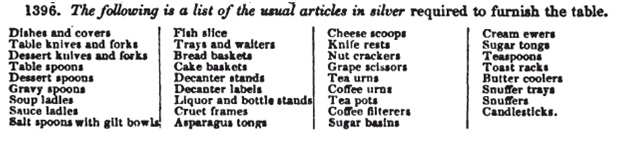
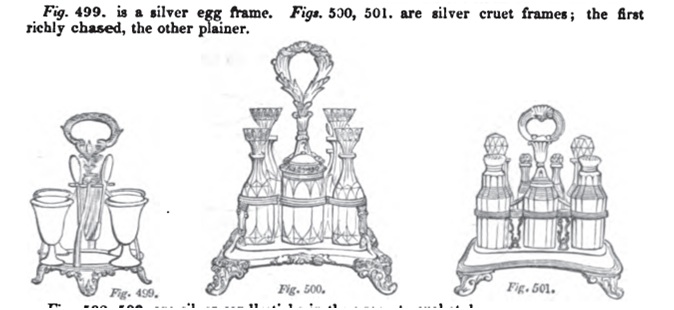
The author discusses silverware, flatware and cutlery extensively with occasional illustration. Those areas are so very detailed, I will not attempt to choose what to clip out. Here is a list of the “Usualy articles in silver required to furnish the table”:


Cruets are just something I want to learn more about. So, I pulled this image of silver-plate to share:

Published in: on November 8, 2011 at 1:16 am  Leave a Comment  

Clips of Domestic Economy – pt 5

I had to switch to the 1852 version of An Encyclopedia of Domestic Economy by Thomas Webster because the 1845 version I downloaded was only half there. This edition was published in London instead of New York.

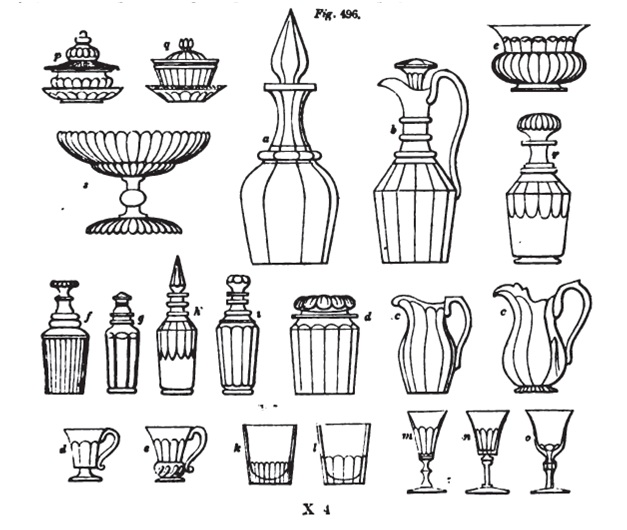
I know there has been recent discussion of glassware for the table. In that light, this illustration and description is quite handy:

“Glass Used as Table Furniture – The use of glass in furniture is too well known to require much illustration. We shall confine ourselves, therefore, to an enumeration of the  various articles in common use. Mirrors have already been mentioned for chandeliers and other holders for lights in Section on Lamps. Glass for the table consists of, decanters for the usual wines, a, fig. 496; ditto for claret, b; liquor bottles, r; water jugs, c, c; pickle glasses, d; finger cups, e; custard cups, d; cruet glasses, f, g, h, I; tumblers, k, l; wine-glasses of various kinds, m, n, o, including those of green glass; butter basins, p, q, s, salad basins, &c.

Published in: on November 7, 2011 at 1:11 am  Leave a Comment  

Clips of Domestic Economy – pt 4


Today from An Encyclopedia of Domestic Economy by Thomas Webster, published in 1845 in New York, we have some bed and bedding items.

One note –  Being written about 15 years prior, these pieces would not have been new in 1860 and in some areas could be seen as out-of-date.

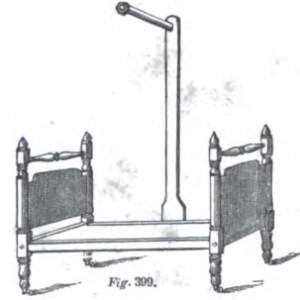
There are quite a few beds shared in the book ranging from simple to draped or canopied to iron and fold-out beds.


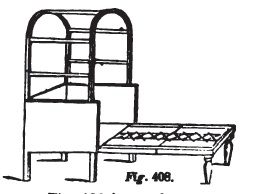
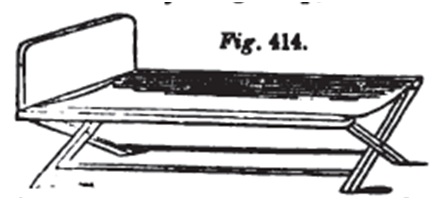
I’m sure one of the most of interest will be this folding bed:

“The folding camp, or tressel bedstead, fig 414, is one of the cheapest made, and has the great convenience of being easily put aside to make room when folded, consisting merely of two frames connected by the sacking. When extended, it is kept open by the head-board, which has two pins that drop into holes in the side rails, with the addition of a foot-board, made in the same manner as the head-board; there is no better bedstead for men servants or young people; and being so moveable, they are easily kept clean, not requiring taking to pieces. They may be had complete for less than [ 1 pound]. If required, nothing would be easier than to add curtains, in the manner of the French bedstead. They are also made sometimes of iron.

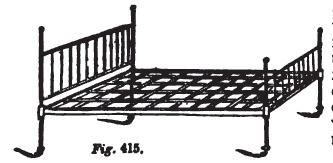
Camp bedsteads, to fold in little room, are made sometimes of iron; but the best and most elegant are of hollow brass rods, which are particularly convenient for travelling by land or sea, and are occasionally useful in the house from being easily put away. Those of brass are about twice the price of iron ones. Couches are made on the same principle.”


In the bedroom section, this book details on several pages the types of materials used for bedding or mattresses. Starting on page 296, these include:

Feather beds stuffed with feathers – The author notes some people rub the inside of the ticking with bees wax or a combination of bees wax and soap to help decrease the dust connected with feather beds. He also says the ticking must be as close, thick and stout as possible. Feather beds are softer than the mattresses they often sit on, which follow.

Mattresses “are firmer kids of beds, usually placed under the feather beds, but sometimes preferred to the latter for sleeping upon, as being less soft, and not so relaxing. They consist of a bag of canvass or ticking stuffed with various materials; but as these are not intended to be moved or shaken, they are fixed in their places by packthread put through, and tufts fixed at equal distances: the edge or border of the mattress is formed square. The materials with which mattresses are filled are usually horsehair, wool, flock, millpuff (a kind of coarse wool), chaff, straw, ulva-marina, cocoanut fibre, or coils of elastic wire. Hay and chaff are occasionally employed.”

Descriptions of each are detailed by the author. He also discusses alternate beds being introduced – the French paillasse “a very thick mattress stuffed hard with drawn wheat straw”, an air bed of India rubber invented in 1813 and a “Dr. Arnott’s water bed” intended as invalid furniture.

Published in: on November 6, 2011 at 1:53 am  Leave a Comment  

Clips of Domestic Economy – pt 3

I am greatly enjoying An Encyclopedia of Domestic Economy by Thomas Webster, published in 1845 in New York. I hope you are enjoying the pieces I am sharing.

One note –  Being written about 15 years prior, these pieces would not have been new in 1860 and in some areas could be seen as out-of-date.

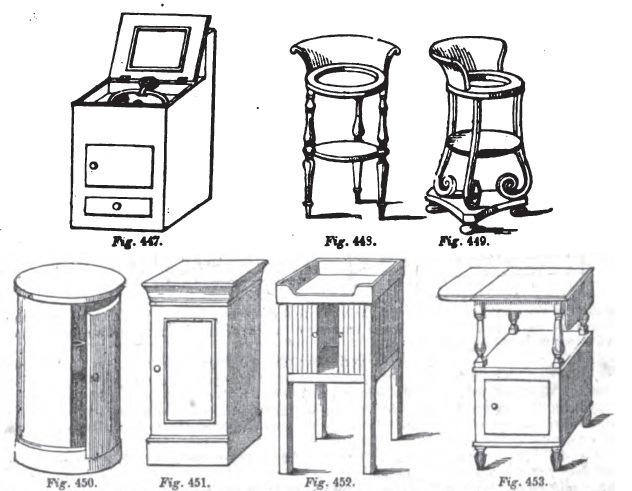
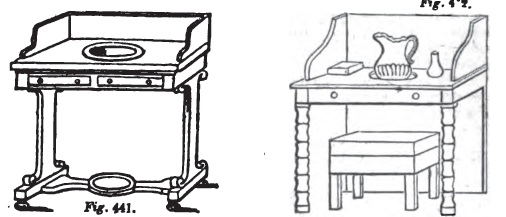
The book has several dressing tables and wash stands, some of which I really like.

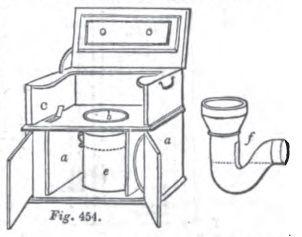
 This portable water-closet is one I thought especially worth sharing:

“Portable water-closets are useful where fixed ones cannot be had, and in case of sickness; as they may be placed in a dressing-room, or even a bedroom. If ill constructed, they are a nuisance; butt we can recommend the following , patented by Wiss, near Charing Cross, London. Fig 454, a, a, is the cistern for water, surrounding the three sides of a box which holds the pan, b; the cistern is filled by lifting up a small lid, c, and pulling the handle of an engine, by which the water is forced into the pan through the washer. This water, by its weight, opens the hinged valve at the bottom of the pan, and carries the contents into a pail, e, placed beneath. This pail has a cover with a projection that dips into a groove containing a little water, that effectually prevents any effluvia from coming out. The pail can be removed to empty it. This apparatus many be made in a variety   of forms; as a seat, an arm-chair, a commode, settee, &c. The   same moveable box, with the cistern and pan, may be used without a pail, and be more complete, where there is the convenience of connecting it with a pipe to go into a drain or cesspool. In this case there is a curved tube, f, to be joined to the pipe, which, being always full of water up to the dotted line, stops any smell from ascending.

Published in: on November 5, 2011 at 1:49 am  Leave a Comment  

Clips of Domestic Economy – pt 2

 Today I have more items from An Encyclopedia of Domestic Economy by Thomas Webster, published in 1845 in New York.

One note –  Being written about 15 years prior, these pieces would not have been new in 1860 and in some areas could be seen as out-of-date.

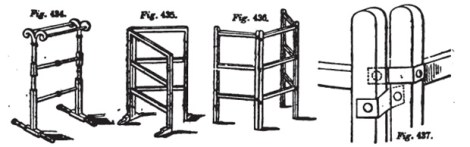
When I first looked at these towel and wash stands in the bedroom section, I noticed fig 434 looked like what I had always thought of as a quilt stand. This is something I will need to look into better. My next thought was about how useful one of these would be at an event. I prefer to drape the clothing I’ve taken off to air out or in some cases dry out due to the weather being hot and humid or wet. I often end up draping my cloths over a chair. One of these would be so much more useful. After all that is what these are for.

“Towel and wash stands. 1234 – Towel and cloth airers. Fig 434 is the form at present most in fashion for towels. Fig. 435 is more convenient for airing clothes; from the mode in which the feet are fixed on, it will stand whether open or shut. Fig. 436 is still more convenient, as by means of a very simple hinge I may be made to fold backward, and in several different positions. Fig. 437 represents the hinge, which consists of only two strips of leather nailed on as in the woodcut: it may be made by any carpenter: there are four such hinges.”

Published in: on November 4, 2011 at 1:46 am  Leave a Comment  

Clips of Domestic Economy – pt 1

I’ve been reading through An Encyclopedia of Domestic Economy by Thomas Webster lately. Published in 1845 in New York this book is packed full of useful and interesting pieces of information. I thought I would share some of those I find either particularly interesting or potentially useful.

One note –  Being written about 15 years prior, these pieces would not have been new in 1860 and in some areas could be seen as out-of-date.

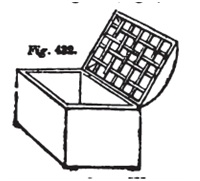
This box-stool is something I would love to duplicate either for use at home or an event. It is a box with the top padded for sitting. The inside has a grid pattern used for hanging caps from. The text says “Fig. 432 is a box-stool, having the top stuffed to sit on, while the inside may hold caps, or other articles of dress, pinned to the girt in the lid.”


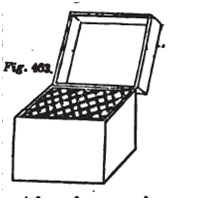
Quite similar is this traveling box meant for caps or bonnets. “Traveling boxes, for caps or bonnets, have a frame with a narrow girth crossed within, as fig. 463, to the underside of the which the caps are pinned, so as not to touch the sides, or each other. Frills, laces, and light articles of that kind are fixed upon the upper side of this network. Care should be taken to carry the boxes always top uppermost, and the caps will arrive at their destination without the slightest injury. The outside of the box is covered with some water-proof substance, as painted canvas.”


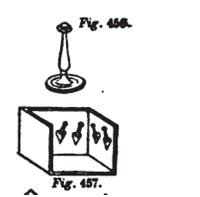
While looking at pieces which store caps and bonnets, I want to share these parts of a wardrobe meant for storing bonnets and caps. “Fig. 455 represents one of the simplest and cheapest wardrobes, being a press with folding doors and sliding shelves. At the bottoms is a deep drawer for holding bonnets and caps; these are best placed upon bonnet-holders within the drawer, fig. 456, or hung on hooks fixed in the inside of the drawers, as in fig. 457.”


Published in: on November 3, 2011 at 1:41 am  Leave a Comment  

“Our Dictionary of Needlework”

 Have you ever stumbled across something and instantly thought “everyone should see this”? That is what happened when I scrolled over Peterson’s Magazine’s 1858 series called “Our Dictionary of Needlework”. The odd thing is I’ve gone through this edition countless times looking for shawls, hoods, needle-books, etc., yet it didn’t stand out until today.

So, of course I had to put the year long series into a single file for everyone…..

Our Dictionary of Needlework” from Peterson’s 1858

If there is a video at the end of this post, it is an advertisement. My apologies for the inconvenience.

Published in: on October 5, 2011 at 11:54 am  Comments (1)  

The Newest “Must Have” Books for Your Christmas List

Whether shopping for the perfect gift for someone special or making your own wish list, there are some great new books out this fall that ought to be on your Christmas list.

For the needle-worker, seamstress and quilter, there is Fanciful Utility: Victorian Sewing Cases and Needle-books by Anna Worden Bauersmith. This book shows step-by-step how to make an assortment of well researched sewing cases, housewifes and needle-books. Filled with templates and color photographs, this book is sure to keep the hands busy all winter long.

Everyone who dresses for the Civil War era will want Dressing the Victorian Civil War Lady: A Guidebook to Dressing the 1860s by Joy Melcher of the Civil War Lady. This book is filled with original photos, illustrations and tips for interpreters, reenactors, seamstresses and stage costumers.If you love to dance, you will have to have the West Side Soldiers Aide Society’s release of  The Ball-Room Manual of Belfast, Maine from 1863. The facsimile book has page after page of period contra dances acceptable to “the Young, as well as the Old Folks at Home”.

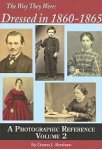
I was very excited to see this second volume available. The Way They Were: Dressed in 1860-1865, Volume 2 by Donna Abraham. Volume 2 takes a closer look at the details of the clothing women, men and children wore through newly published photographic images magnified for an indepth study.

The following books aren’t brand new, but if you don’t already have them, you should have them on your wish list:

Anyone making their own mid-century clothing, or just looking to understand it better should own The Dressmaker’s Guide by Elizabeth Stewart Clark.

Donna Abraham’s The Way They Were: Dressed in 1860-1865 is packed full of original CDV images. I just love this book as my copy is filled with notes and arrows.

What else is on my wish list? Well, I need to learn more about men’s clothing so I can make my husband a full set of civilian attire. (I also need to convince him this is a great idea.) With that in mind, on my wish list we find The Victorian Tailor by Jason Maclochlainn as well as Mr. Ruley’s digital version of Louis DeVere’s 1866 Handbook of Practical Cutting on the Centre Point System.

How to Dress for a Photographer

This is a guest post thanks to Jenna Theissen. She shared this piece from the May 27th, 1865 edition of  All the Year Round, Weekly Gazette & Comet out of Baton Rouge, Louisiana. Thank you to Jenna for sharing this interesting piece of information.

A lady or gentleman, having made up her or his mind to be photographed, naturally considers, in the first place, how to be dressed so as to show off to the best advantage. This is by no means such an important matter as many might imagine. Le me offer a few words of advice touching dress. Orange color, for certain optical reasons, if photographically dark. Blue is white; other shades or tones of color are proportionally dark or lighter as they contain more or less of these colors. the progressive scale of photographic color commences with the lightest. The order starts thus: White, light-blue, violet, pink, mauve, dark-blue, lemon, blue green, leather-bound, drab, cerise, magenta, yellow-green, dark-brown, purple, red, amber, maroon, orange, dead-black.


Complexion has to be much considered in connection with dress. Blondes can wear much lighter colors than brunettes; the latter always present better pictures in dark dresses, but neither look well in positive white. Violent contrast of colors should be especially guarded against. In photography brunettes possess a great advantage over the fairer sisters. The lovely goelden tresses lose all their transparent brilliancy, and are represented black; whilst the bonnie blue theme of rapture to the poet, is misery to the photographer; for is put entirely out. The simplest and most effective way of removing the yellow color from the hair is to powder it nearly white, is is thus brought to about the same photographic tint as in nature. The same rule, of course, applies to the complexions. A freckle quite invisible at a distance is, on account of it’s yellow color, rendered most painfully off tint when photographed. The puff box must be called inot the assistance of art. Here let me intrude one word of general advice. Blue, as we have seen is the most readily affected by light, and yellow the beast! It, therefore, you would keep your complexion clear and free from the tan freckles whilst taking your delightful rambles as the seaside, discard by all means the blue veil, and substitute a dark green or yellow one in its stead. Blue tulle oiler, no more obstruction to the actinic rays of the sun then white. Half a yard of yellow net though perhaps not so becoming, will be more efficacious and sonsderably chaper then a quart of kalydor.

This additional piece comes from the reverse side of a card from Flynn’s Gallery in Salem, N.Y.


“Some simple facts concerning Color will be useful to many, especially ladies, when deciding how to dress for a Photographic picture. Dark brown, dark green, maroon and plaind black goods, without gloss, will take a rich black color. Silks of the same will take considerably lighter, because they are glossy. Snuff-brown, dark blue, drab, scarlet, cherry, dark orange, crimson and slate, will take a very rich look. Violet, blue, purple, pink and magenta, will take very light and should be used dressing for photographs. The prevailing style of Plaids will take well. The hair should never be very wet or glossy.”


Published in: on September 13, 2011 at 8:54 am  Leave a Comment  

A Practical Look at Winter Clothing

I’m sure you’ve noticed my focus on being prepared for cool and colder weather as of late. It may seem a bit early since it is just now Labor Day, but for some of us the cold fall and colder winter weather will be here soon.

In my browsings I stumbled across this 1859 magazine published out of Buffalo, NY called The Home Monthly with a practical take on winter clothing:  

Winter Clothing – Style and Material

We do now propose keeping our readers in the latest Parisian style, for we have no Genio Scott, Genin or Brodie to consult, and we hardly think we shall fail of our purpose without them. We do not choose to cater to fastidious fondness for the very latest pattern, and encourage ladies in exhausting their entire time with thoughts in the “where-withal shall we be clothed.”

Every lady ought to be dressed well, if not her purse will permit, but that does not mean to cast off a garment, because something later than that has appeared in the fashionable world, and that too with no regard to the better uses to which such expenditures could be put. But of course we need not mention this, for that sort of woman would scarcely read a magazine without fashion plates.

To dress meanly with no reason for so doing, and above all, to make religion an excuse for shabbiness, as Timothy Titcomb says, is abominable. It lessens our usefulness. We should be as beautiful as we can make ourselves, but that is not accomplished by any means in following the rule of fashion plates.

Merinos, and all wool Delaines are the most sensible as well as most durable of all materials for out-door wear at this season. Cut with pointed basques on slender figures, and trimmed neatly, with a dainty cambric collar and sleeves, and you have a costume suited to all ordinary occasions for winter wear. One’s own taste and length of purse should be the guide for extraordinary ones. Large plaids on small people, stripes on very tall ones; and Bayedere on short persons, are all equally unbecoming. Indeed, all conspicuous patterns weary the wearer who has refined taste, as well as the beholder. Above all thinks, consult, if possible, in an indirect way those you love best as to color, &c., provided your complexion will permit a choice.

The prettiest and most serviceable bonnet for winter is a black velvet. It admits of remodeling, and can be worn with propriety with any colored outer garment, and any color about the face.

The loose sacque or raglan of ladies’ cloth, is exceedingly convenient, as well as pretty and inexpensive for a cloak, as not trimming is required – nothing but a binding neatly stitched on.

The same material to be used for children’s wear, both boys and girls. Pretty wool cheques are cheap and durable for girl’s winter dresses, and boy’s coatees for the house. Above all things, don’t let them be made too short at the top and bottom of the garment. Many a mother’s pride has been gratified by the praise bestowed upon the fair neck and rounded limbs of her child, and after her heart has been broken, while laying them from her sight forever. Which will your choose?

Dress them warmly and let them out into the frosty, fresh air to grow rounder and fairer, albeit no one but yourself see how fair. We did not purpose saying this much, but it is written. Quarterly we will endeavor to suggest whatever is worthy of mention among the novelties of the season, always keeping our peculiar views of substantiality and beauty side by side.

New Materials

The challies which are offered at very reasonable prices this fall, are pretty, and seem likely to be the most durable of any commone dress goods that we find. They are nearly all in bayadere stripes – some of them high colored, but where warmth and durability are required we think they will be found very desirable. There is also a new material of Angola wool for dresses – heavier than wool delanes or merinos, which we judge to be very desirable for these qualities, viz: strength and durability, unless the satin stripe that adorns it should be found to fray out. – Dresses of this material can be bought in New York at $6, the pattern. This comes the nearest to ladies’ cloth of anything we have seen. The high-colored printed cashmeres – merino styles – are offered as low as six shillings per yard, while we found recently at Stewart’s the best colors of printed French merinos at a dollar per yard. The bright chintz, patterned, all wool delaines are offered lower than ever before. But no delaine can be as cheap as a good merino at least to those who wear their dresses out. We are glad to see more durable material for dresses coming into market. Much time and labor in dress-making will be saved by those who emply these materials. It is also a saving of expense, for the cost of making and trimming a dress of good, and of worthless material is very nearly the same. Every lady, then, should feel that time and labor are wasted in the making up of flimsy material and even if her means should be at first seem too limited to purchase that which is better, she should make a special effort to save up “capital to economise with”.
Published in: on September 5, 2011 at 9:03 am  Comments (1)  
Tags: