Cassell’s Household Guide: Being a Complete Encyclopedia of Domestic and Social Economy Volume II, 1869 (published in London and New York.) While this is the final part of the entry, to me it seems like it should be the first or the second.
Nearly all embroidery is, when circumstances will permit, best worked when stretched in a frame, and lengths which are too great when stretched at one time, may be put in the frame in successive pieces. The best kind of frame for canvas is one in which the material is secured by blunt points, attached to the sides and covered with a wooden bar, cut half round, and having a groove, of a same width as the points, running along it; the canvas is stretched and the sides secured by screws. But all other materials would be injured by being fixed by such points, and must, therefore, be secured to the frame by being sewn to webbing. A frame capable of holding a piece of work three feet square is a convenient size, and costs about 10s. 6d. It is better that the frame should exceed the size of the work by some inches, and it is well, to secure a good purchase, that the material should be sewn to the extreme end of the webbing on either side. The selvage sides of the material should be sewn to the webbing, so as to leave an equal space at either end, with strong, double thread, in stitches of six to an inch, and a piece of tape to secure them, stitched along the wool ends of the material. The frame is then put together, stretched and secured by its pegs, and the woof ends are in their turn secured by sewing through the tape through the tape and over the opposite bars with twine.
In working at the frame, there will, at first, be some difficulty experienced in using the left hand simultaneously with the right, and particularly in bringing up the needle from beneath in the exact spot. The power of doing this can only be attained by perseverance, and the beginner should practice till the needle can be used as well with the one hand as the other. The worker should sit in as upright position as possible, and the frame should be fixed accordingly; as regards to light, a side light is best. In doing long stitch or gold bullion embroidery, both hands are rarely required above the frame; in couching, one hand guides the silk along the material, while the other sews it down, and in applying nearly all edging cords, the hands are occupied in the same way. While working with floss-silk it is necessary to keep the hands smooth, or they will catch it, and It is not well, for the same reason to wear rings. Perfect cleanliness of the hands is, of course, indispensable.
The implements required are needles, which should be large in proportion to the silk they have to carry, and with large, round eyes; from 7 to 9 are the sizes most often in use; the former few sewing-silks, and the latter for crochet and other coarse silks. Nos. 8, 9, and 10 are good sizes for gold bullion. Pins of a small size will be found requisite. As both hands are employed, two plain silver thimbles should be provided, scissors, &c. A stiletto will be required, and a steel piercer rounded and pointed at the end, and then becoming flat-sided, will be useful for regulating gold bullion, passing, pearl-purl, &c.
The embroidery paste, of which we have spoke is made by adding to three tablespoonfuls of flour as much resin as will lie on a shilling, mixing them smoothly in a half pint of water, stirring, mixing them smoothly allowing them to boil five minutes, when the paste should be turned out and left till cold.
The silks to be used are floss, Dacca, Berlin, three-cord, crochet-twist, and seedling. In the best old work, floss is the silk chiefly employed, either in vertical lines kept down by cross rows of fine gold thread, or split fine for flesh and hair; sometimes a thick line of it is used for outlines, while at others ,rows of twisted silk sewn down with it are used for that purpose. Dacca is a floss-silk , so made as to be easily divided into two filaments or plies, which can again be subdivided to any extent which is necessary, besides being more easily split than floss. Dacca is made in more shades; the English is he best, the French being deficient in softness and brilliancy. Berlin has a smooth, loose twist, and is well adapted for flat masses of colour, as also for scrolls and leaves. Three-cord is a close-twisted silk of three plies and best simulates gold bullion. The apricot shade is very beautiful, but, as it turns white, the more metallic yellows are to be used in preference. Three-cord is made in other colours that gold, but not in such variety as Dacca or Berlin; the French is not equal to the English. Crochet-twist is also of three piles, but is coarser and less tightly twisted than the above. It is most valuable of larger designs to be used in imitation of gold, and may be either applied in modern embroidery over card, or couched, either single or double, by stitches of purse silk, or it may be used as a substitute for cord in edging appliqué. Purse-silks are of three sizes – coarse, medium, and fine. The first is used in places where three-cord would be too clumsy; the second when a strong, even, and tolerably fine silk is needed; the third for such purposes as couching crochet-silk on an even surface. In sewing-silk, there is only one first-class quality, which should always be used (drapers’ silk on reels is value-less), and the best is bough in hanks, of from half an ounce to an ounce. Passing, that is gold thread, should be couched with sewing-silk.
Where twist-silk is being used, it is not possible to fill gaps with extra stitches, as in using floss; every stitch must, therefore, be laid with regularity, the piercer being constantly used to keep it in place; care should be taken that the stitches are of uniform tightness, and a needleful should never be gone on with when the silk dulls or strains, but another should be taken at once. A large-eyed needle should be used, and never too great a length of silk – twenty-seven inches is a very good length for a needleful.
Pearl-purl is gold cord , which resembles a close string of beads, and is used for edging bullion embroidery; it should be sewn down with single silk, previously waxed and the stitches concealed. Spangles are frequently useful for enriching embroidery; they are made both flat and concave, the latter have the best effect. Passing is a bright, smooth thread, formed by silver-gilt wire spun round yellow silk. Generally speaking, it should not be pulled through material, but should be couched and sewn down with colored silk.
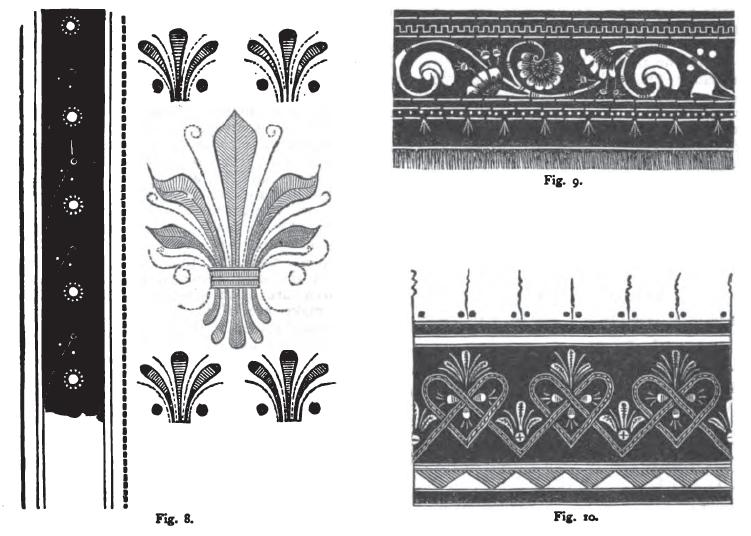
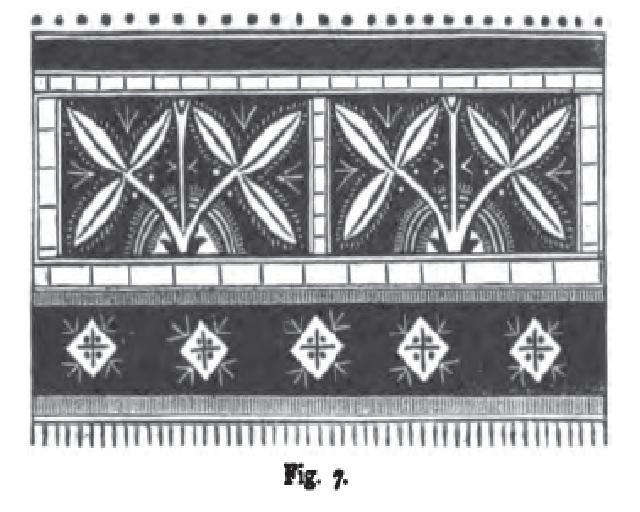
At present day, an important employment for the various kinds of embroidery we have described, is the decoration of church furniture; for which, indeed, such methods of work are alone properly applicable. The number of domestic purposes to which, also, it is now growing fashionable to apply them, is very large, some of the most favourite being, as borders for curtains and tablecloths, as hangings for mantelpieces, and, in narrow strips, to be affixed to various articles of furniture.







 If I Had My Own Blue Box: