Around the House – Tasty Bits of Food

Okay, these are things that sound tasty to me….

Baked Egg-plant – Parboil it until it is soft enough to stick a straw into; then cut it just in half; scoop out the inside, leaving the hull; shop it up very fine, and season very highly with pepper and salt, a good deal of butter, and crumbs of bread. Mix all well together and return it into the hull; then strew crumbs of bread on the top, and bake it for about an hour. (The Genesee Farmer, September 1860)

Fried or Broiled Egg-plant – Parboil it; cut into slices and season very highly with pepper and salt; fry or broil it (as you do mushrooms.) in a pan with butter. If nicely done, it is very similar in flavor to the mushroom. (The Genesee Farmer, September 1860)

To Preserve Rhubarb – Cut the stalks into pieces an inch or so in length; string and dry the same as apple, and stow away in a dry place for winter and spring use. (The Genesee Farmer, September 1860)

Published in: on July 13, 2013 at 7:00 am  Leave a Comment  
Tags:

How to Pack – A Trunk

I found this buried in my drafts folder….. From Eliza Leslie’s House Book, (Philadelphia, 1844)

To Fold a Dress for Packing – spread the dress, right side out, on a bed; and, taking it by the hem, make the bottom exactly even all round. Next, double the skirt lengthways in half, then fold it lengthways in four, turn up crossways about one-third of the folded lower part of the skirt; then give the remainder of the skirt a fold backwards, terminating at the gathers at the waist. Next, turn the body backwards, with the front uppermost, and the back resting on the folded skirt beneath. Lastly, spread out the sleeves; vie each of them a fold forward at the shoulders, and a fold backward at the elbows, and lay them across each other evenly on the fore-body.

Fold the pelerine right-side out. First, double it in half, beginning down the middle of the back. Next, give the doubled pelerine a fold backwards, then a fold forwards, and then another fold so as to leave the corners uppermost.

A belt-ribbon, for packing, should be rolled on a block, and fastened with two pins.

A lady’s travelling dress should be made to fasten at the side or in front, pelisse-fashion; that, during her journey, she may be able to dress herself without assistance.

It may be well to have a camphor-bag sewed to each of her night-gowns, that she may be less liable to attacks from insects when sleeping in such beds as are frequently met with in travelling.

To Pack a Large Trunk – Have all the things laid out ready, the light things divided from the heavy ones; and keep at hand a quire of soft wrapping paper. Spread a clean thick towel over the bottom of the trunk, and place on it the hard flat things, such as portfolios, music-books, a writing desk, boxes, books for reading, &c,; taking care to fit them well together, so as to be even at the top; and filling up the crevices with small articles that will not be injured by compressment, each of them, however, wrapped in paper, to prevent their scraping of defacing the other things. Never use newspaper for packing, as the printing ink will not fail to rub off and soil whatever it touches. You may stick in a pair of shoes here and there, each laid together as flat as possible, and tied round with their own strings. Some persons have shoe bags made of flannel or cloth, and stitched into compartments, each division containing a pair of shoes. Over the layer of hard flat things in the bottom of the trunk, spread a towel; and on this lay your flannels, linen, &c., filling up the interstices with stockings and gloves. Then cover them with another towel, and put your dresses, the muslin ones uppermost; filling in the corners with pocket handkerchiefs. On the top of your dresses lay your pelerines, collars, and caps, (if you have no other way of carrying them,) &c., finishing with a thin towel over the whole.

No trunk should be packed so full as to strain the hinges. If your trunk has a false top, you can fill that with any articles that may be rolled up tightly. Shoes should on no account be packed without covers, as the colour (particularly, if black)will rub off, and disfigure any white things that may be near them. Avoid putting any eatable articles in a trunk of box that contains things which cannot be washed, as they may be much injured by grease or stains. On no consideration, carry ink, even though locked up in a writing desk. You can always at the place which you are going, buy yourself six cent worth of ink in a small square bottle, which will also serve for an inkstand. It is well, however, to take with you a few sheets of good writing paper folded in the form of letters, each with a wafer stuck on one edge, to be ready, in case you have occasion to write before you reach your journey’s end, or immediately after. It is well to have read tapes nailed across the inside of the lid of your trunk, for the purpose of slipping letters and papers between them.

There are traveling trunks with a sort of movable tray fitting in near the top. This tray can be lifted in and out, and is for the purpose of containing pelerines, collars, scarfs, ribbons, laces, &c. Some very large trunks have a partition at one end, to hold a bonnet or other millinery.

It is best, however, to have a proper bonnet-box, either of painted wood or leather. To keep the bonnet steady, sew to it in convenient places under the trimming, pieces of tape, the other ends of which should be secured with tack-nails to the floor and sides of the box. In the corners, you may lay a few caps, &c., as light as possible.

Leather trunks generally have brass plates on which is engraved the name of the owner. It is now very customary to have the name painted on both ends of the trunk, and also on the bonnet boxes. Besides which, if you are travelling with several articles of baggage, it is well to have them all designated by a piece of red tape or something of the sort tied round the handles of each. A lady, before setting out on a journey, should be provided with a card or paper, on which she has written a list and description of her trunk, box, carpet-bag, &c. Previous to the hour before starting, she should give this list to the gentleman under whose escort she is to travel and it will save him much trouble in finding out and taking care of her baggage.

The best paper for wrapping light articles that are to be packed in trunks, is the thin, soft sheets of light blue, buff, gray, and other colours, that are retailed at six cents per quire. It is well to keep a supply of it always in the house.

For heavier articles, (books, &c.,) the nankeen paper will be preferable to any other, as it is both smooth and strong.

In putting a paper parcel to go any distance over twenty miles, it is better to secure it only with sealing-wax, (putting always a wafer under the seal,) than to tie it round with twine, as in the course of transportation, the twine is very apt to rub and cut through the paper.

When putting up a newspaper or any other printed sheet to go by mail, always leave the cover open at one end.

Around the House – Water-proof Cloth

I find these directions for water-proof cloth interesting, as well as their uses.

Transparent and Water-proof Cloth – To every quart of raw linseed oil, add half a pint of copal varnish and two ounces of sugar of lead. Mix well together and apply with a brush. This mixture applied to thin sheeting, answers a good purpose in place of glass, for hot-beds, letting in plenty of light, excluding cold and wet equally well, and protecting the young plants from the hot breath of the old shiner, which proves often time fatal to them. (The Genesee Farmer, April 1860)

 To Make Cloth Waterproof  – Take half on ounce of isinglass (Russian is best), put it into one pound of rain water, and boil until dissolved; take one ounce of alum, put it into two pounds of water, and boil till it is dissolved; take a quarter of an ounce of white soap, and one pound of rain water, and boil till it is dissolved. After each of these ingredients has been separately dissolved, strain them separately through a piece of linen; afterwards mix them well together in a pot, put it on the fire again till it simmers, then take it off, and while thus near boiling, dip a brush into it, and apply it to the wrong side of the cloth intended to be waterproof.

The cloth must be spread out on a table during the operation, and remain there until it is dry; after it is dry must be brushed on the wrong side against the grain; and then dipping the brush in clear water, pass it lightly over, and leave it again dry.

After that, the gloss caused by the application of the ingredients can be taken off.

Three days after the operation has been done, the cloth will be impervious to water but not air. (The Workwoman’s Guide)

You can also find an expanded description of water-proof cloth in Thomas Webster’s An Encyclopaedia of Domestic Economy.

Published in: on June 22, 2013 at 8:00 am  Leave a Comment  
Tags:

Around the House – Purchasing Furniture

Advice for purchasing new furniture, from The Workwoman’s Guide:

A misfortune of not very rare occurrence, is the splitting of valuable tables that are veneered. We have known the infliction, and we guard others from a similar annoyance.

One of the causes may be traced to the cabinet makers; it is not unusual for them to make use of wood for the foundation, that has not been sufficiently seasoned, and is besides of an open porous texture, so different from the close hard grained wood, which is to form the veneer, that a very long time is requisite before they can manufacture their goods without risk of shrinking.

In order to ensure this certainty of seasoning, a larger stock of wood is required than is always convenient to be on hand by a cabinet maker, either from want of capital or accommodation; hence, the purchase of new furniture requires circumspection.

In this, as well as every other requisite, we would enforce the oft repeated advice, that a preference is always given to the trader of know probity.

Chance bargains, cheap to the eye, almost always become dear and unsatisfactory in the end.

Veneered furniture which is purchased from a damp warehouse, and brought suddenly into a well aired warm room will almost infallibly fly.

Chests of drawers, particularly if they be made of coarse Honduras mahogany, scarcely fail to crack, and throw up from their edges slips of veneer, which snap off, and are swept away, leaving unsightly white gaps; these have to be replaced, and look shabby and patched.

Spanish mahogany, though much more expensive in the first purchase, is far more certain, hard, rich-coloured, and durable.

It is essential that new furniture should be insured by degrees to change temperature, in order to prevent this hazardous warping, and unequal contracting of the wood. Tables in particular, if intended to occupy a station opposite a fire, should be kept with the grain of the wood laying longways; not the ends of the grain and the joint pointing into the fire; for want of this simple precaution, we have known a beautiful rosewood table entirely spoiled.

Spanish mahogany was the beautiful wood which was first known in England, and which was said to be of so hard and close grain as to turn the edges of our workmen’s tools’ but since our possessions and commerce have been extended to the North of America, we have been stocked with vast quantities of that open grained inferior kind, that is made into almost all our household goods, and which, from it facility of working, is so cheap, that purchasers are continually deceived by unprincipled tradesmen, by the substitution of on for the other.

No person can well be deceived, however, to whom the two sorts of wood have been explained; the one (Spanish) being rich coloured, of an even texture, like satin, when polished, with not grain visible; the other plate, rough, and uneven when highly polished, shewing the coarse grain like threads; the latter too is so soft, that it is dented with the slightest touch, a pencil-case falling upon it, six inches from its surface, will leave a dent that never can be removed, unless the whole is plained over.

Published in: on June 15, 2013 at 8:00 am  Leave a Comment  
Tags:

Around the House – Laundry

Lets start the summer series, “Around the House”, with a little laundry.

Okay, I wasn’t going to start with laundry. But, then I found this section in Elizabeth Haskell’s The Housekeeper’s Encyclopedia on cleaning particular fabrics and items. I just knew you would all want to see it. (It is a PDF)

Here are a few more interesting snip-its:

To Polish Flat-Irons – If your flat-irons are rough, rub them well with fine salt, and it will make them smooth. (The Genesee Farmer, June 1860)

 To Wash Ribbons – Ribbons of any kind should be washed in cold soap-suds, and not rinsed. (The Genesee Farmer, June 1860)

 Old Crape – A pint of glue, dissolved in milk and water, will restore old crape. (The Genesee Farmer, June 1860)

 To Clean Silk – I have seen a good receipt for cleaning all kinds of silk, which I have used with good effect. Take equal quantities of alcohol, wood ashes, soft soap, and molasses. Mix them, and rub with a cloth on the silk; afterward rinse in a clear water with a little salt or alum. Your silk will look as good as new if it has never been washed before. (The Genesee Farmer, July 1860)

 For Cleaning Silk – (Correction from the July number.) – Take equal quantities of alcohol – whiskey will do – soft soap made of wood ashes, and molasses. Mix and rub with a cloth; afterward rinse in clear water once or twice, and dry it or wrap in cloth till ready to iron. (The Genesee Farmer, September 1860)

 Method of Cleansing Silk, Woollen, and Cotton. – Take raw potatoes in their natural state, and when well washed, let them be rubbed on a grater over a vessel of clean water, to a fine pulp; pass the liquid matter through a coarse sieve into another tub of clean water; let this mixture stand till the fine white particles of potatoe are precipitated, then pour off the liquor, which preserve for use.

The article to be cleaned should be laid on a table, and well rubbed with a sponge dipped in the liquor until clean, when it is washed several times in clean water, and then dried and ironed.

Two middle sized potatoes will suffice for a pint of water. The coarse pulp of the potatoe, which will not pass the sieve, is of use in cleaning worsted curtains, tapestry, carpets, and other coarse goods, while the liquor prepared as above, will clean silk, cotton, and woolen goods. (Workwoman’s Guide)

Published in: on June 8, 2013 at 8:00 am  Leave a Comment  
Tags:

Commode

I know some find it silly, but I have long wanted my own chamber pot for events. I’m just not a fan of three trips a night in the cold rain to the outhouse. So, now that I finally have just the right chamber pot, it is time for a commode.

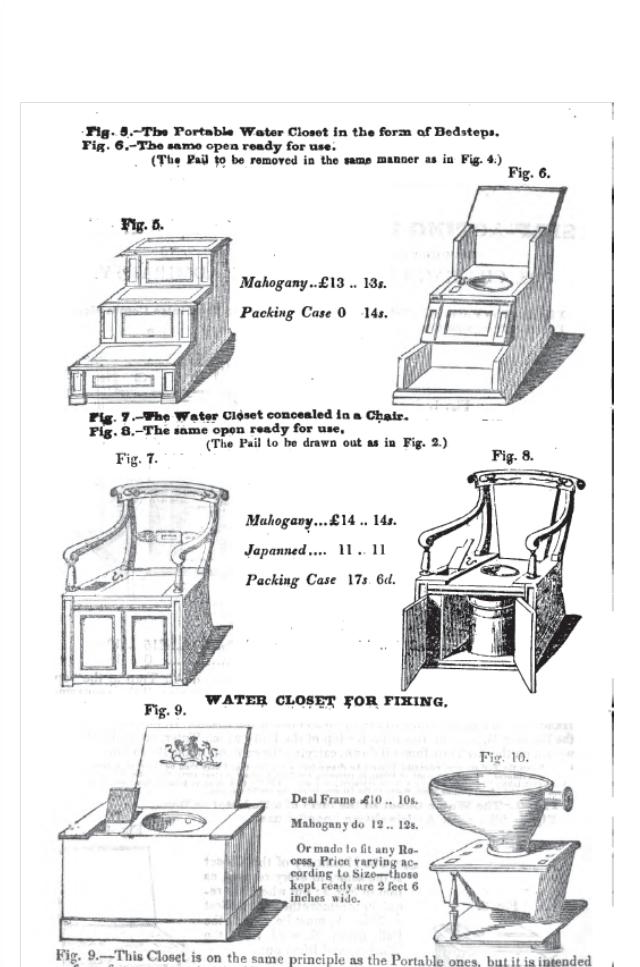
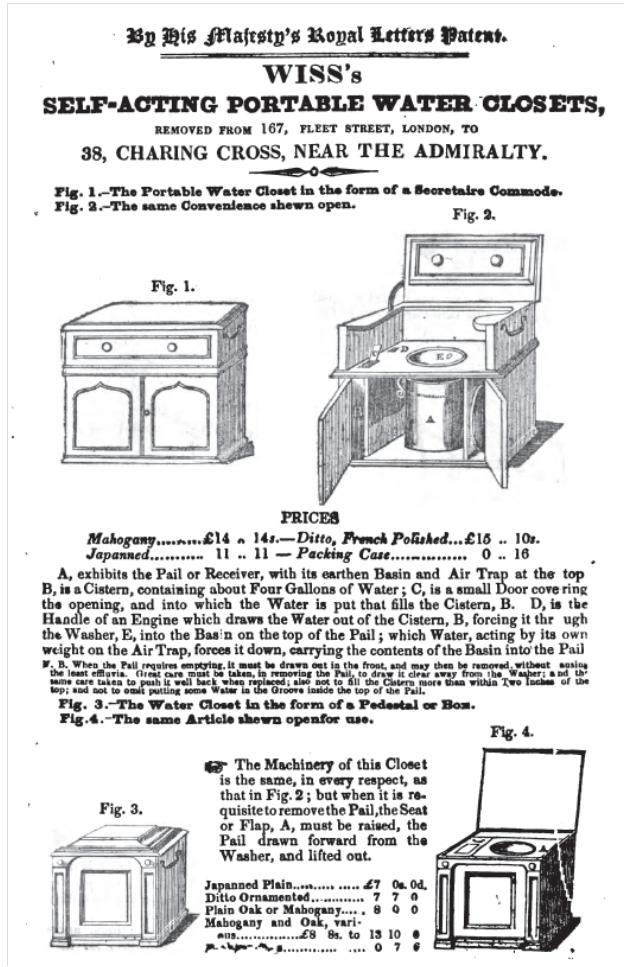
While I’ve had fairly simple, if not quite well thought out, ideas in my head, it seems some commodes were quite complex. Take a look at this advertisement printed in 1831, in both the Edinburgh Review and the Quarterly Review out of London. I am picturing something more like illustrations 3 and 4.

1 2

Thomas Webster discussed a version figures 1 and 2 in his Domestic Encyclopedia: “Portable water-closets are useful when fixed ones cannot be had, and in case of sickness; as they may be placed in a dressing-room, or even a bedroom. If ill constructed, they are a nuisance; but we can recommend the following, patented by wiss, near Charing Cross, London. Fig. 454, a, a, [reprint of figure 2 labeled a to f] is a cistern for water, surrounding the three sides of a box which holds the pan, b; the cistern is filled by lifting up a small lid, c, and pulling the handle of an engine, by which the water is forced into the pan through the washer. This water, by its weight, opens the hinged valve at the bottom of the pan, e, placed beneath. This pail has a cover with a projection that dips into a groove containing a little water, that effectually prevents any effluvia from coming out. The pail can be removed to empty it. This apparatus may be made in a variety of forms, as a seat, an arm-chair, a commode, settee, &c. The same movable box, with the cistern and pan, may be used without a pail, and be more complete, where there is a convenience of connecting it with a pipe to go into a drain or cesspool. In this case there is a curved tube to be joined to the pipe, which, being always full of water up to the dotted line, stops any smell from ascending. [additional small illustration]

Published in: on June 3, 2013 at 5:30 am  Comments (2)  

Summer Series – “Around the House”

I’ve decided the summer series will take a look “Around the House”. To kick this off, lets start with a bit of perspective.  

This passage comes from the “Ladies’ Department” of the June 1860 Genesee Farmer, published in Rochester, New York. Do keep in mind this is the forward thinking “Burned Over District.”

Women’s Occupation – In these days of progress and improvement, not the least among the many evidences we meet with of the triumph of science over difficulties hitherto supposed insurmountable is the invention of the sewing machines. Women need no longer be a mere mechanical drudge, doomed to pass her days forever in the seclusion of home – wasting away her energies, and her life in the everlasting occupation of needle-work. The days when Tom Hood wrote his pathetic “Song of the Shirt” have passed away, and are numbered among the things that were. It may perhaps be said by some, that with the introduction of the sewing machines, women’s occupation is gone. This, perhaps may be true of  many of those who, having been educated in a former age, find that education too limited for the present time, and have no resource to fall back upon, or the ability to adapt themselves to follow new channels of life

So long as the present system of female education is followed, the effect of this loss of her occupation will be to make her still more dependent. But a revolution in the system of education must sooner or later take place, and woman must be fitted – not to be a mere ornament to the house – a gewgaw to be taken around for show, like a little dog led by a golden chain, or as a mere household slave. No! woman must be be  [sic] so educated as to become not merely the companion, but the teacher of man. Her education must be carried out on a sounder and broader basis. She must be taught so as to be fitted to become herself a teacher. She must be fitted to take care of herself, and to feel that she has a mind, and that her mind is capable of being directed into channels of thought – by which she can acquire a position of independence and exercise a greater and better influence than she at present does. She should also become more accustomed to out-door exercises, and should study physiology; and take an interest in the discoveries of science, and what is going on outside of her immediate circle. ~~Progress.

 As I’ve been thinking a good deal about cooking lately, thanks to my little sister, I expected to find a similar passage regarding the leap forward in a stove for cooking. I have not, yet. It seems, period literature is far more concerned about the heat stove than the influence the cooking stove had on the daily life of women. (Or, atleast I should say the pieces of literature I have thus found.) I did find this to share: From Eighty Years of Progress of the United States, by CL Flint (1861) I suggest reading the entire chapter beginning on p245 http://books.google.com/books?id=OiEaAAAAYAAJ

Cooking was performed over an open wood fire; a mode in many respects more laborious and less convenient than the present use of stoves and ranges; but which, if skillfully conducted, gives the food a flavor more perfect and delicate than can be attained in any other manner.

As has been implied, the changes in food have thus been more in the treatment than in the materials of it. The chief of these changes, like those in warming houses, have arisen from the introduction of anthracite coal into use, which has caused the employment of cooking-stoves and ranges, instead of the open fire. Nearly four hundred patents for cooking-stoves and ranges were issued from 1812 to 1847, and great numbers of others have been granted since; the total number of such patents may safely be estimated at not less than six hundred.

An early style of cooking-stove, and quite a favorite ne in its day, was the rotary, whose top could in its day, ws the rotary, whose top could be swiveled round by a crank and cog-wheel geared to a ratchet underneath its edge, so as to bring any underneath its edge, so as to bring any sauce pan or kettle forward to the cook. This variety is, however, now nearly obsolete, and innumerable later inventions have succeeded, each enjoying a brief reputation, usually conferred rather by diligent advertisement than by any real peculiar merits in the stove itself.

The cooking range may be described as a modified stove bricked into a fireplace, instead of standing out in the room. Its oven, instead of being [in] back of the fireplace, as in a stove, is above it; and most patterns, so far back as to render it very hot and inconvenient for use. Some late patterns, however, have brought the oven sufficiently far forward to remedy this objection.

The use of stoves and ranges has rendered cooking much more convenient, but has, in a great measure, substituted the baking of meats in the oven for the better old fashion of roasting. Their advantages, however, are greater than their disadvantages; they are far cheaper and easier in management than an open fire; and in all older portions of the country are necessary, because would could not be furnished to supply the kitchens.


 Just a few other pieces:

If you are interested in perspectives on the duties or position of women entering the mid-century, you may find these of interest:  Woman’s Rights and Duties    Volume 2  and Lectures on the Sphere and Duties of Women 

 Of general, useful interest, I came across this: Hand-books for Home Improvement: Comprising, How to Write, How to Talk, How to Talk, How to Behave, How to Do Business.(1857)

Published in: on June 1, 2013 at 8:00 am  Comments (1)  
Tags:

New Season, New Saturday Series

How is it June already? May simply flew by. With spring turning to summer, the Saturday morning post series will be transitioning from millinery t…… well, I am not really sure. I have yet to decide what the next topic will be.

One idea is women’s involvement in nineteenth-century at social movements. This is a very broad topic.

Another is highlighting good interpretive techniques, activities, demonstrations, etc at events. This would share other’s ideas and accomplishments as well as my own ideas.

A third would be to look at domestic details such as housekeeping advice, the general knowledge most of us would have had.

What are your thoughts? Is there anything you would like to see?

Published in: on May 30, 2013 at 4:00 pm  Comments (2)  

Recommended Blog

Civil War reenacting friends, if you haven’t discovered it yet, I highly recommend checking out Civilian War Time. This blog transcribes letters and diary/journal entries each day. On the right hand side of the blog is a subscribe space. Enter your email to receive the posts daily.

Published in: on May 20, 2013 at 8:54 am  Leave a Comment  

Don’t Stress the Stress Lines

After a long winter and rainy spring, how many of us are trying on our dresses with hesitation?

Will it fit? Won’t it fit?

Will the bodice hook?

Will a button fly off?

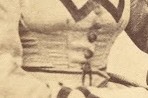
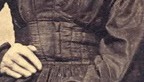
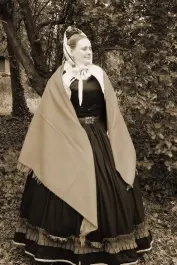
This time of year, how many of us stress over those horizontal wrinkles that show up around the midriff of our bodices? How many of us stress over those stress lines? I have, year after year. Frankly, it is inevitable through the years as our bodies just change, hibernating winter or not.

Deep breath. I say “Don’t stress the stress lines.” Why? Take a look at some of these original images:

Waist 2 Waist 1 waist

A few more of various ages: Link 1 Link 2 Link 3

Now, this isn’t a set of stress lines, but I am curious as to why she chose this particular look. I don’t know that it was a fashion choice. I also don’t promote recreating it. LINK

Published in: on May 17, 2013 at 12:21 pm  Leave a Comment