A Year in Millinery Fashion – 1864

1

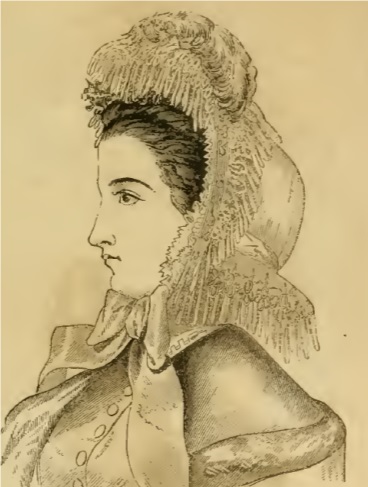
Spring bonnet of white crepe, trimmed with a fanchon of bright plaid velvet and chenille tassels. The cape is of plaid velvet, ornamented by chenille cord and tassels. A long white
plume curls over the front of the bonnet. The inside trimmings is composed of Scotch thistles and heather. (Godey’s, May 1864)

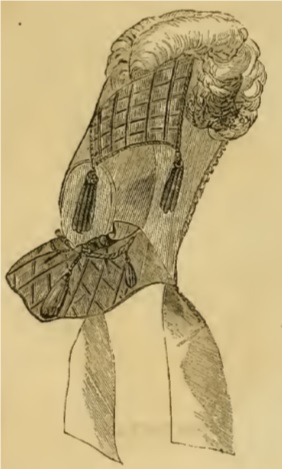
Bonnets are very much more becoming in shape that formerly. They are very close to the face at the sides, but not nearly so high at the top, and slightly flattened at the forehead. The trimming is place at the side or on the crown near the top. If flowers are used, it is generally a large one, such as an iris, or water-lily, and the leaves are left to fall gracefully over the crown. If a single rose, either pink or yellow is used, with one spray of leaves; then, at the side of the flower, there is a bow of ribbon, not the ordinary bow, but a collection of loops standing upright and arranged carelessly; from these loops an end of ribbon is carried across the crown, and finished off at the curtain with a smaller rose, or bouquet of flowers, then at the top of the crown. (Peterson’s, May 1864)

A Year in Millinery Fashion – 1864

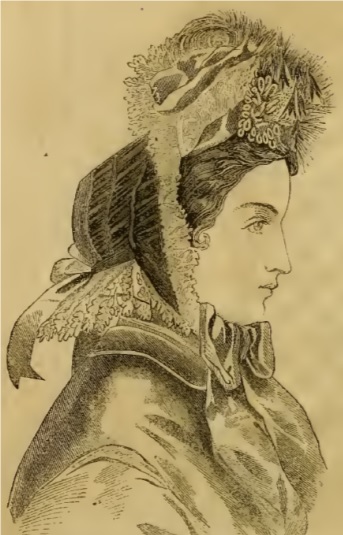
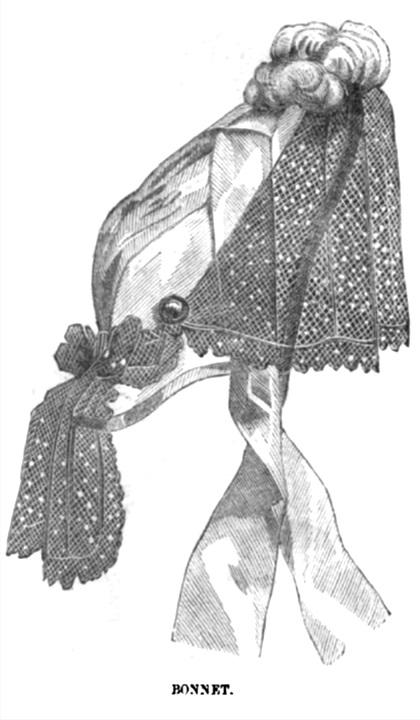
White crepe bonnet, made over white silk. A straw guipure lace falls over the face, and trims the outside of the bonnet. A straw colored feather is laid gracefully over the front. (Godey’s, May 1864)

4


FanU Patriotic Fabric Swap!!

Today is the day to sign-up for the FanU Patriotic Swap! New ideas Patriotic
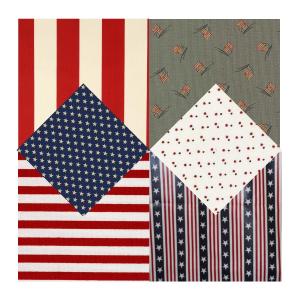
For the Patriotic Swap, Swappers will exchange nineteenth century appropriate cotton fabrics in red, white and blue or reproduced patriotic prints.  We will mail our fabrics on April 30th.

Please read all the details below. 

To Sign-up, simply comment below with your email and mailing address. (I’ll erase those before approving your comment, so the whole world doesn’t have that info.)

What is a Swap?

This is a chance for to exchange fabric with a small group of people. Each group will have 8 people exchanging pieces of fabric. All you need is a half yard of fabric and envelopes along with your copy of Fanciful Utility.

To Participate:

1: Sign Up Day!
On sign-up day, groups will be assigned on a first-in basis; the first eight will be the first swap group, second eight in the second group, etc. **Please be certain you will be able to fully participate by mailing your fabrics on the Mail-Out Date.**

Romantic Swap Sign-Up Day: January 13th
Paisley Swap Sign-Up Day: February 10th
Mini-Print Sign-Up Day: March 10th

Bonus Patriotic Swap Sign-Up Day: April 14th

2: Mail-Out Day:
Place a 9×9″ piece of fabric suited to the mid-19th century in envelopes for each of the 7 other people in your swap group, stamp them (be sure to double check at the post office, but the small 9×9″ pieces should mail in a regular envelope with a normal stamp), and send them off no later than the Mail-Out Day.

Romantic Swap Sign-Up Day: January 31st
Paisley Swap Sign-Up Day: February 28th
Mini-Print Sign-Up Day: March 31st

Bonus Patriotic Swap Sign-Up Day: April 30th

3: Get Fanciful!
Use your Fanciful Utility templates and techniques to make a project from the book, or copy your own from 19th century sources. We’ll all look forward to seeing your projects! You don’t have to sew right away, but don’t keep us waiting forever to see all the fun things!

(If you need a copy of Fanciful Utility, you can purchase them from the publisher at www.thesewingacademy.com

Fabric Guidelines:

  1. For the cotton and silk categories, your fabric should be early to mid-nineteenth century appropriate. (If there is a want for an earlier or later group, we can do that.) Prints and motifs should reflect those available in the 1840s, 50s and 60s. Cotton should be 100% cotton. Silk should be 100% silk.
  2. To keep the swap and sewing possibilities interesting, please avoid solids as best we can.
  3. Fabrics that do not work well for sewing cases should not be swapped. These include sheers, gauzes, heavy, thick, easy-to-fray, slippery and stretch fabrics.
  4. For the “crazy swap” category, think crazy quilt in a sewing case. This could include satins, velvets, textured fabrics. Quality synthetic fabrics are invited.  

Swapper Guidelines:

  1. Please be certain you can fully participate in the swap before you sign-up.
  2. If something arises after you sign-up that will effect the date you are mailing your fabrics, please email your group so everyone is aware.
  3. If you fail to fully participate in a swap, you will not be able to sign-up for future swaps. (We do understand medical and family emergencies. I need to be able to ensure swappers will receive fabrics when they send fabrics out.)

Q&A

Yes, you can participate in 1, 2 or 3 of the swaps.

Yes, if we end up with multiple groups, you can participate in more than one group to swap more fabric. If you participate in 2 groups, you should swap 2 fabrics.

Yes, you can swap large and small scale prints.

Yes, you can swap now and sew later.

Yes, we would love to see what you’ve made with the swapped fabric.

Yes, you can use your own fabric in your swapped project.
Published in: on April 21, 2014 at 6:00 am  Comments (4)  
Tags:

A Year in Millinery Fashion – 1864

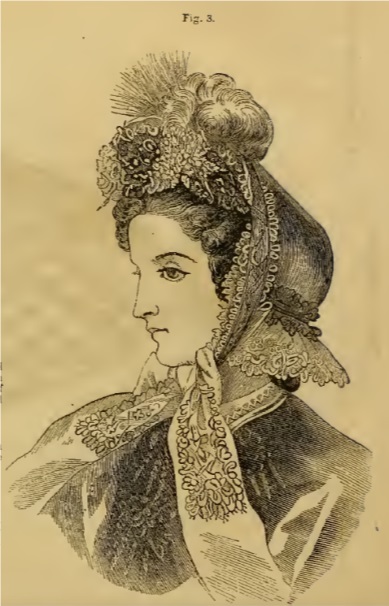
Violet crepe bonnet, trimmed on the front with a black lace insertion. The cape is covered by a rich white blonde, headed by a black lace. On top of the bonnet is a light violet
feather, and a pompon of spun glass. The inside trimming is of black and white lace, mixed with scarlet-berries and fancy grasses. A black lace barbe is tied in with the violet strings. (Godey’s, May 1864)

3

A Year in Millinery Fashion – 1864

The bonnet of drawn cuir-colored crepe, trimmed on the front with a fanchon of white lace, loops of green ribbon, and Scotch feathers. The inside trimming is of bright flowers, of the
Scotch colors. The cape is covered with a fall of white blonde. (Godey’s, May 1864)

2

A Year in Millinery Fashion – 1864

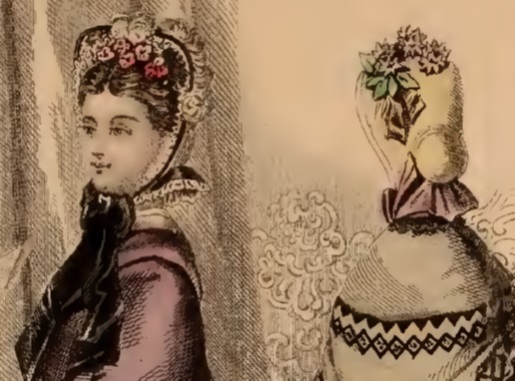
Left – The bonnet is of black and white crin, or horsehair, bound with black velvet, and trimmed with a natural feather. The inside trimming is of scarlet geraniums, and the strings are of black ribbon.

Right – Leghorn bonnet, with violet silk cape, and trimmed with violet-colored flowers. (Godey’s, May 1864)

1

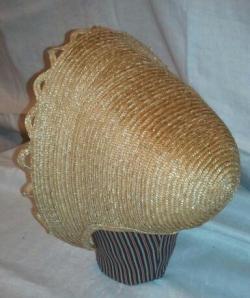
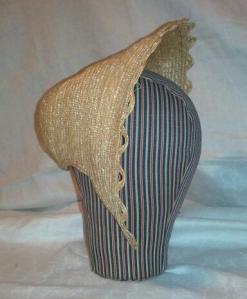
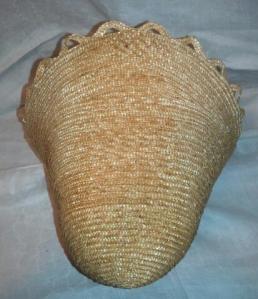
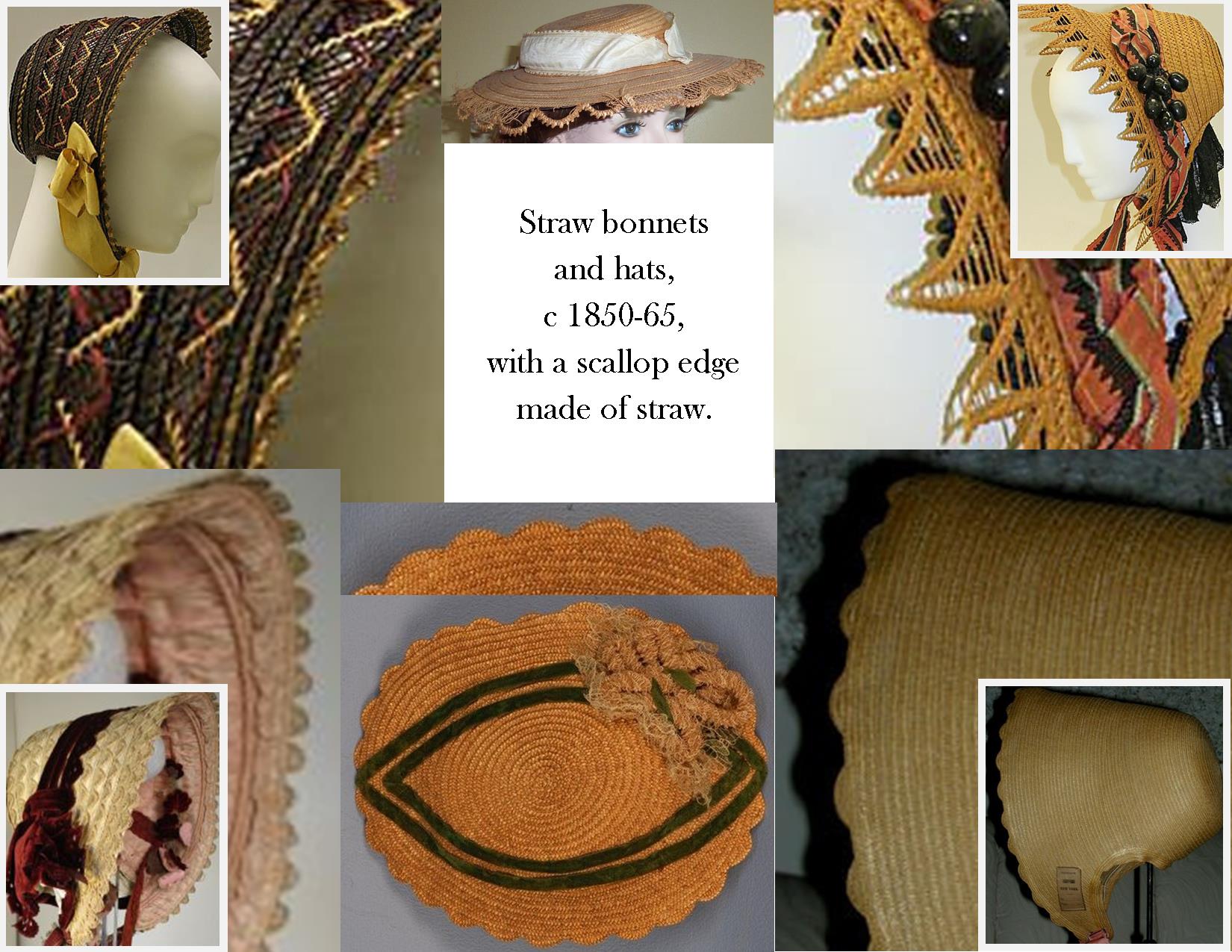
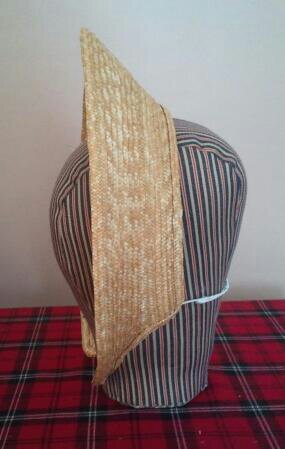
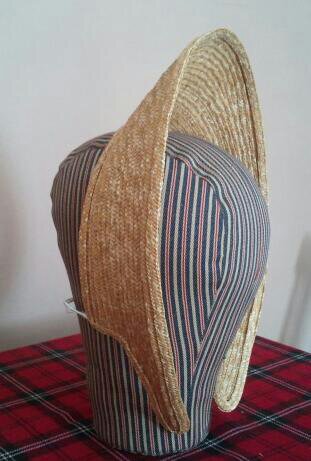
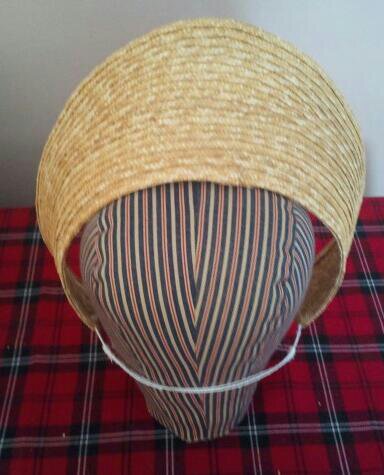
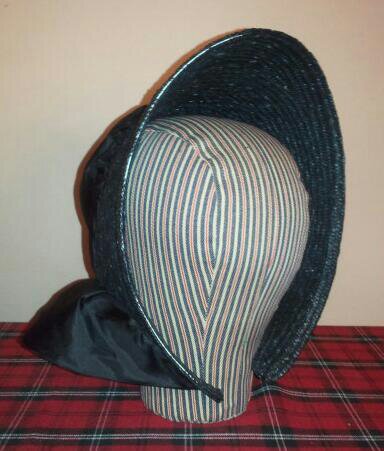
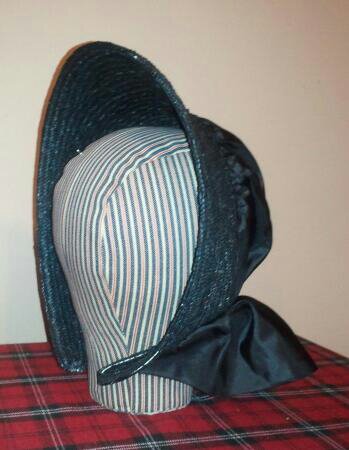
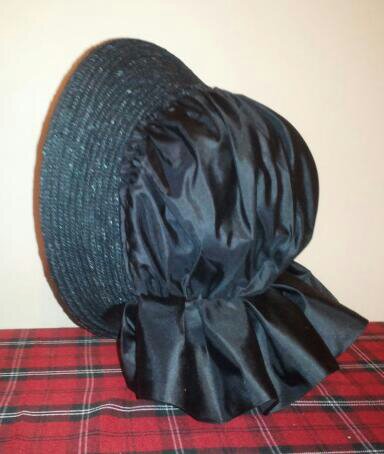
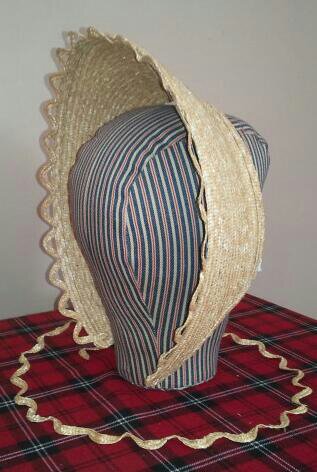
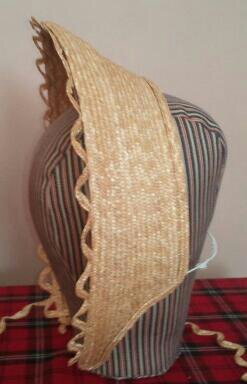
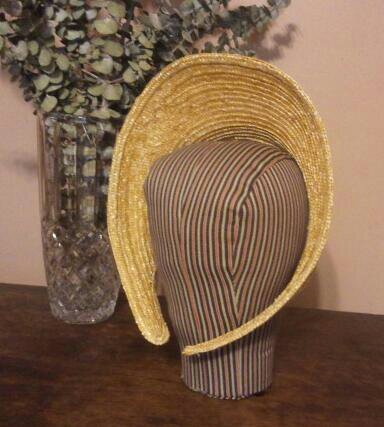
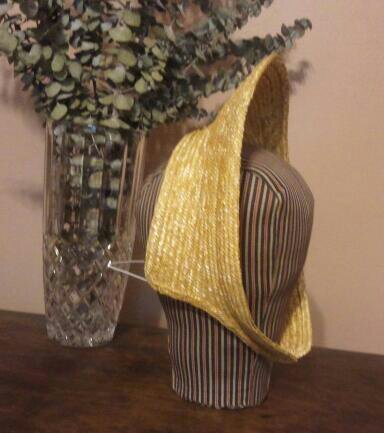
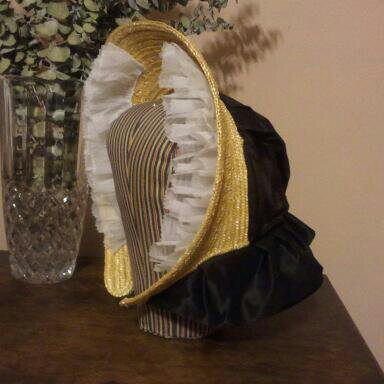
Scallop Brim Straw Bonnet

2014-04-01 06.15.04-1 2014-04-01 06.15.40-1 2014-04-01 06.16.11-1

For weeks, okay months, I’ve been wanting to replicate the scallop brim edge on extant bonnets & hats. I finally figured out a good way to make the braid wavy and a way to attach it that I am happy.  Scallop edge 1

Published in: on April 1, 2014 at 5:47 am  Leave a Comment  

A Year of Millinery Fashion- 1864

In bonnets we see a great variety of colored chips trimmed with ribbon to match or a good contrast. The fashionable flowers seem to be the elegant scarlet cactus, in bright, soft shades of velvet, which give it a peculiar lustre, magnolias, water-lilies, and geranium. Bright flowers, with brown grass and heather, have an excellent effect on the caps of bonnets which are trimmed with plaids.

Black crin, or horse-hair bonnets, are very much worn, and the new color Milan, which is between a salmon and a corn color, looks particularly well on them. Roses of this color, with scarlet berries and black ribbon, make a very stylish trimming.

Another new color is called flame de punch, from its resembling the bright, flickering light from the punch bowl. This color is particularly pretty for a white straw or ship bonnet. Amethyst is also one of the new colors.

Black crin also look[s] well trimmed with feathers having plaid tips. This is arranged by tipping each little feathery strand with a different color, which produces a plaid-like effect. Anther style of trimming for a black bonnet is a green and blue ribbon or velvet, and peacock’s tips; the last being very fashionable for children’s hats, for head-dress, and for trimming of ball dresses.

Tufts of feathers studded with jet, steel, and crystal, are much in vogue for bonnets and headdresses.

Travelling bonnets are made of silk to match the dress, or of colored straw. They are very much trimmed with chenille fringe, tipped with large beads falling over the face and crown.  (Godey’s, April, 1864)

A Year in Millinery Fashion – 1864

Bonnets are certainly smaller than they were a year ago, and have now, we think, attained a very good size. In Paris, efforts have been made to have the bonnets very small, but without success, as all the ladies of decided taste cling to a “just medium.” (Peterson’s, April, 1864)

1

Soft Crown Straw Bonnets

(Okay, I’ll add text later.)

image

image

image

image

image

image

image

image

image

image

image

image

image

image

image

image

Published in: on March 15, 2014 at 2:36 pm  Comments (2)  
Tags: