Pink & Black Soft Crown

wpid-2014-09-28-17.28.35.jpg.jpegWhen I finish bonnets they usually spark an “Oooo” or a “yeah” or some wordy expression. This one, goes on its stand and just gets a smile. I am so pleased with how this came together, I just enjoy looking at it.

This was a custom piece for a client. For many weeks we picked through silk colors, ribbons and flowers to get just the right combination.

wpid-2014-09-28-17.29.04-1.jpg.jpegThe straw brim is a black plait from England. The soft crown and bavolet are a combination of a pale pink silk taffeta and a beautiful, delicate black antique lace. The soft crown has the stripes of the lace running vertically, while the stripes on the bavolet are running diagonally, bias-esque.
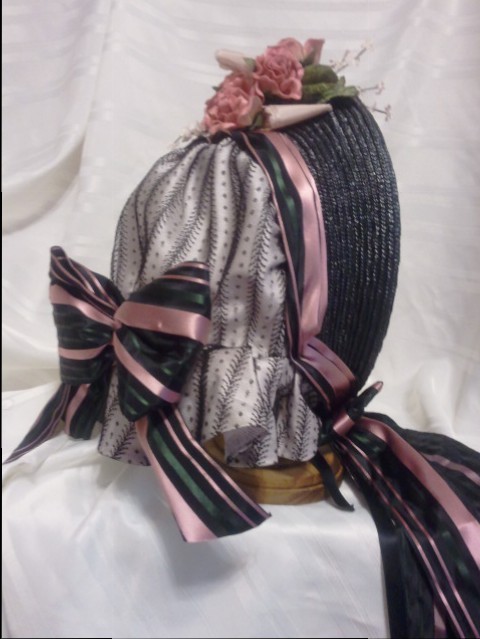


wpid-2014-09-28-17.29.30.jpg.jpegAn amazing ribbon drapes over the top of the bonnet along where the brim and crown meet, then down the cheektabs for the ties. This ribbon is a black taffeta with pink and dark green satin stripes. A large bow of this same ribbon sits at the base of the crown, just above the bavolet. Combined with the pink damask ribbon in the flowers, there are nearly 5 yards of ribbon on this bonnet.
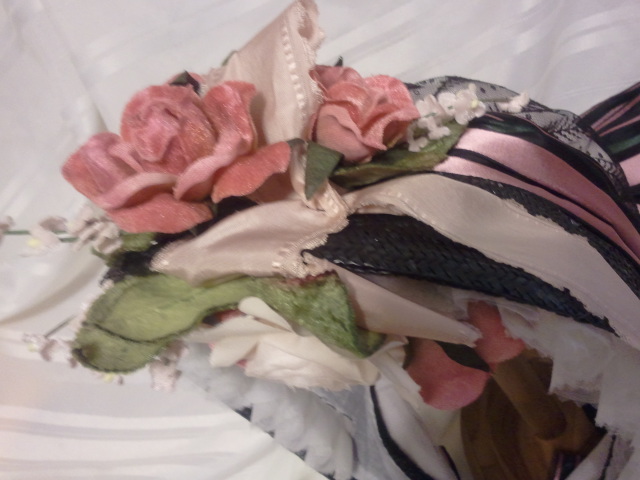
 

wpid-2014-09-28-17.30.19.jpg.jpegThe flowers are a combination of dusty rose and pink velvet roses with a pale pink rose and little pink velvet blossoms. The arrangement inside the brim is connected to the bouquet atop the brim by a soft pink damask ribbon that winds in and out of the flowers.

Getting the right balance was important to me. Too much weight in the back makes a bonnet slide; while too much weight in the front makes a bonnet feel heavy. I think this balances pretty well with the bow and flowers counter weighting each other. So, it is pretty and balanced. Happy me.

wpid-2014-09-28-17.28.39.jpg.jpeg


Published in: on October 3, 2014 at 4:52 pm  Comments (2)  
Tags:

A Year in Millinery Fashion – 1864

Curtianless bonnets are rapidly gaining ground in Paris. Some are but mere caps, almost entirely covered with flowers; others are a half handkerchief, with a small front; and other again have only a fall of lace for the crown. In the next number we will give a very pretty illustration of one of these curtainless bonnets, and the ladies will then be able to decide whether to accept or reject them. (Godey’s, September, 1864)

Published in: on September 29, 2014 at 1:01 am  Leave a Comment  
Tags:

A Woman’s Thoughts on Bonnets

Moore’s Rural New-Yorker from Rochester, NY, March 15, 1862.

Publication2http://www.libraryweb.org/rochimag/roads/moores.htm

Published in: on September 27, 2014 at 9:00 am  Leave a Comment  

Bleaching and Coloring Bonnet

Moore’s Rural New-Yorker from Rochester, N.Y., May 17, 1862

Publication2http://www.libraryweb.org/rochimag/roads/moores.htm

Published in: on September 26, 2014 at 8:50 am  Leave a Comment  

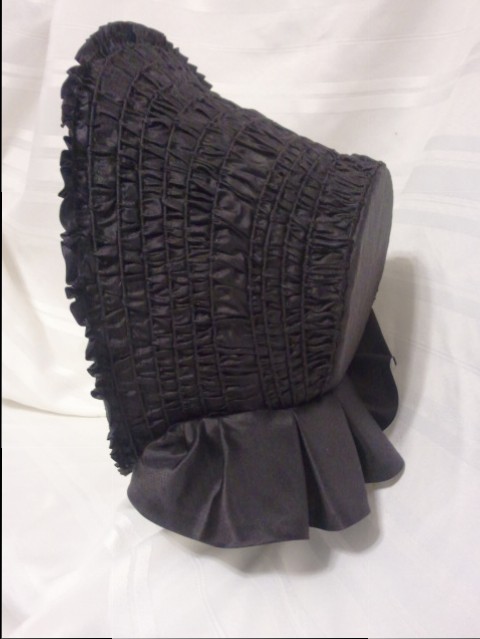
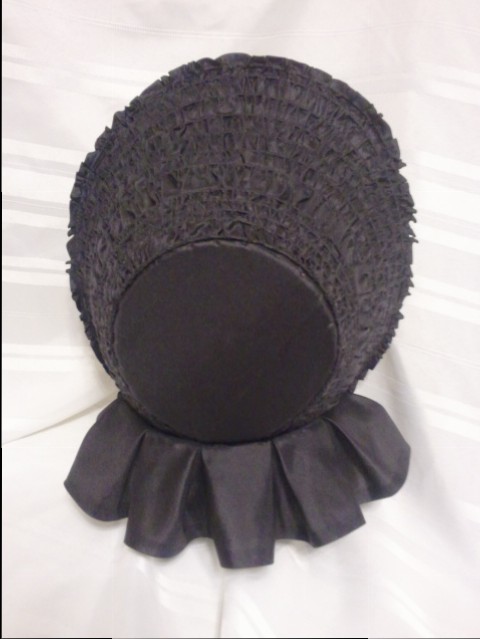
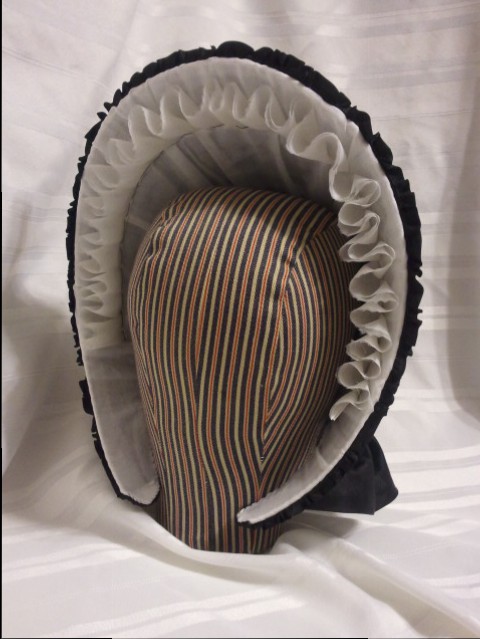
Black Silk Drawn Bonnet

wpid-2014-09-15-18.09.52.jpg.jpeg   This black silk drawn bonnet was a custom request. The new owner is adding her own flowers and ribbons.

wpid-2014-09-15-18.10.44.jpg.jpegThe silk is a flat black tissue taffeta. I like this silk because it is so similar in weight and weave to silks I’ve seen on original bonnets. It draws up nicely on the thinner cane and allows for tight gathers without looking bulky or adding too much weight, while also drawing lightly giving nice waves to the silk.

The buckram form base is shaped to have a nice flaring brim, fashionable yet flattering.

wpid-2014-09-15-18.09.27.jpg.jpeg

Inside, is a cotton sheer lining and a silk organza frill ready for flowers to be added. The bavolet is lined with white cotton net.

wpid-2014-09-15-18.11.44.jpg.jpegI’m sure some are wondering if this bonnet could be dressed for mourning. Yes, it could be. One could add matte black ribbons and simply fluff out the frill (I like to ship the frills un-fluffed) for a mourning impression. For later in the mourning period, purple ribbons and simple white flowers could be added.

Published in: on September 25, 2014 at 4:26 pm  Comments (1)  
Tags:

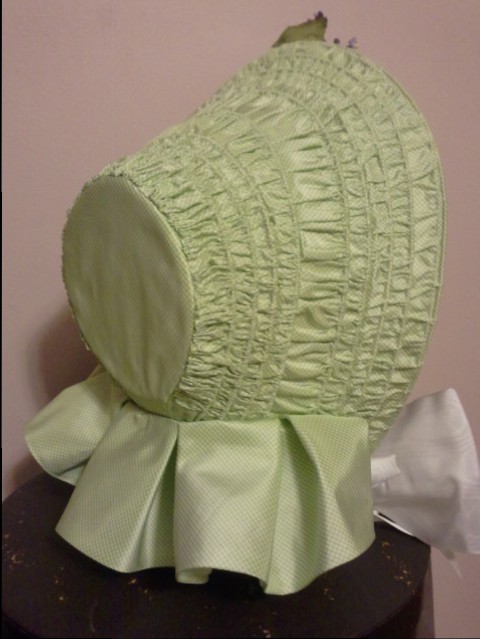
Green Mini-Check Silk Drawn Bonnet.

The form for this bonnet has been sitting on the work table since mid-summer, with the silk patiently waiting.

wpid-2014-09-24-21.13.06-1.jpg.jpegI played with the shaping of the buckram form to get the brim to flare up into a high fashionable shape. This is a shape that will want a bonnet stay. (Yes, I will get to taking some photos of stays asap.)

wpid-2014-09-24-21.12.43.jpg.jpegFor this piece, I wanted to play with the texture created by placing the drawn canes evenly together, following the curving shape of the brim. I used the thicker of the canes to play off the tiny check. I found this really emphasizes the curve of the brim and visually elongates it. I love how that works.

wpid-2014-09-24-21.12.57.jpg.jpegThe decorative ribbon is the German moire I like in white. It makes for a nice, wide ribbon that ties beautifully and lasts. The functional ties are silk satin, in ivory.

I set the organza frill high and slightly asymmetrically. Part of me wants to fill in the sides all the way through the cheektabs. But, this placement is supposed to emphasize the vertical line and height.

wpid-2014-09-24-21.13.49-1.jpg.jpegNow the flowers. As I worked with the silk, I knew it really wanted purple. I found a pair of pretty purple velvet roses and delicate white lilies whose edges have just a hint of purple. The spray of velvet blossoms add to the height. I went with a small bouquet set asymmetrically.

Almost forgot. This bonnet is available on Etsy.


Published in: on September 25, 2014 at 4:02 pm  Leave a Comment  
Tags:

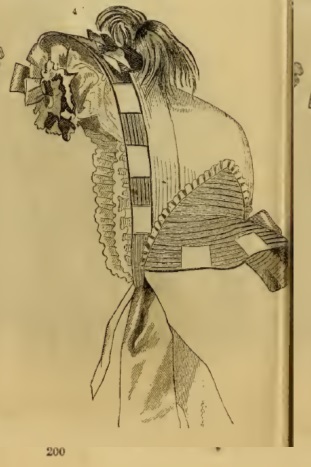
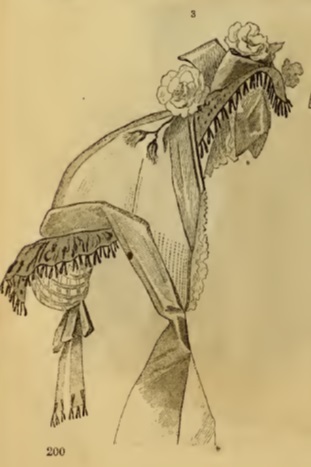
A Year in Millinery Fashion – 1864

A Leghorn bonnet, trimmed
with a salmon and black ribbon. The feathers are black. The inside trimming is
composed of scarlet velvet, black lace, and salmon-colored flowers.  (Godey’s, September, 1864)

3

Published in: on September 22, 2014 at 1:01 am  Leave a Comment  
Tags:

Children’s Headwear

Lately, I’ve been hearing an assortment of “kids didn’t wear…”, “children only wore…”, “she’s too young for….” and so on.

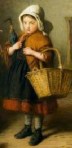
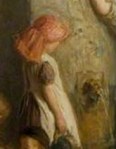
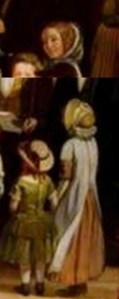
Ehhhh…. not so much. Children had a variety of headwear to choose from. Here is an attempt at a survey of paintings to help us get a better idea. (Clicking on the thumbnails will take you to the full paintings)

Let us start with this little boy from Britain.  The title, A Visit from the Hall, suggests his family rents or works the land.  He is young. I would estimate 2 or 3 years of age. He wears a long smock that may be a dress and what might be the start of pants underweight. He holds a cap in his hand.

A Visit from the Hall Edwin Cockburn 1855This little girl is getting direction from her mother, in Responsibility by Hugh Cameron (1869). I can’t help think “Little Red Riding Hood” here. Except instead of a red hood she is wearing a white, possibly blueish, soft bonnet or hood. It may be a quilted bonnet. The weather may or may not be slightly chilled outside, as she wears a light outer garment and not arm coverings. Responsibility  by Hugh Cameron 1869

In this Cameron painting, The Village Well (1871), the girl is wearing a short sleeve dress, pinafore and pretty pink sunbonnet. This appears to be a corded sunbonnet to me. The curtain/bavolet is long, hanging over her shoulders protecting her neck. In her hand (sorry I cropped that) is a jug for water. The Village Well Hugh Cameron 1871This girl coming through a garden gate is also wearing a pink sunbonnet. This one has a ruffle around the brim and a much longer curtain. At the Doorway  John George Brown 1867

This girl’s sunbonnet is white. You can see it tied under her chin with a ribbon that appears to have color. The Picnic John George Brown 1861For an additional sunbonnet, see Pay Toll.

The next few images depict fairs. Looking at the whole paintings, we see a wide variety of clothing. In Alfred Mudge’s Walking the Walsall Fair (1859) we see two girls wearing structured bonnets, meaning buckram or straw bonnets. The lower image shows a girl who wears a pinafore type garment over her dress which is just above the ankles. I think she is 11 to 14. Her bonnet hints at straw while distinctly showing the bavolet and ribbons. She is holding the hand of another child, possibly a girl if that is long hair, who is wearing a hat with a ribbon. In the upper image, which is to the right of the first girl in the whole painting, is a girl who may be a bit younger than the first. She wears a bonnet perched far back on her head, to the point of falling off. Walking the Walsall Fair by Alfred Mudge 1859This next child is a bit blurry because I tried to zoom in too far. She is from William Samuel P. Henderson’s Fair Day (1856). She is quite young, maybe 3 to 5. She wears a dark, possibly black, structured bonnet tied with light, possibly blue, ribbons under her chin. Fair Day by William Samuel P Henderson 1856

For additional “reading”, this page has several good paintings for clothing in general.

Also see, Looking out for the Engine while the Bell Rings for an assortment of head wear.

Published in: on September 19, 2014 at 6:50 pm  Comments (1)  

A Year in Millinery Fashion – 1864

White silk bonnet, trimmed with violet ribbons and pink roses. A net formed of ribbons is attached to the bonnet.  (Godey’s, September, 1864)

3

Published in: on September 15, 2014 at 1:01 am  Comments (2)  
Tags:

A Year in Millinery Fashion – 1864

Pearl-colored crape bonnet, trimmed with black lace. A fan of pearl-colored silk and white feathers, The trimming inside is of pink ribbon and stiff white feathers. (Godey’s, September,
1864)

3

Published in: on September 8, 2014 at 1:01 am  Leave a Comment  
Tags: