Spring Millinery Series – Index

Upcoming

  • A Lesson in Economy
  • To Clean a Bonnet
  • The Faux Customer
  • Among the Milliners
  • tbd 
  •  tbd
  •  tbd

And… A little something extra for remaking bonnets.

Published in: on April 24, 2013 at 6:04 am  Leave a Comment  

The “Great Students of Bonnets”

When first reading the following article, I honestly could not decide whether to laugh, or to be insulted. Either way, I suggest putting down your tea or beverage of choice while reading.

Bonnets

We are a great student of bonnets. Circumstances have led us to observe them. In fact, we hire our rooms of a fashionable milliner. – This gives us a great advantage.

We divide the human race into two classes: those who wear bonnets and those who don’t. The bonnet-wearers are our weakness. The wearing of bonnets is the great fact of our lives. We like them the better for it. It shows they have heads. A woman without a bonnet is like a cat without a tail; she don’t know what to do with herself. When a ship wishes to go ahead, she puts a bonnet on her jib. A woman does the same. The bonnet is the capsheaf of her glory; moreover it covers a multitude of sins. To judge of female character, Fowler feels a woman’s head; he’s an animal. We look at her bonnet; we are a philosopher.

There’s always a whole row of bonnets in Mrs. F’s show-room. They are mounted on sticks. The room looks as if it had been planted with bean-poles, and each pole had blossomed into a bonnet. Some of the poles, though, look like Broadway belles, “in undress.” There are all sorts of bonnets, from the modest straw trimmed with white, to the rich satin, surpassing the rainbow – the bonnet of the sky. There are all shapes, too from the jaunty chaise-op, thrown back to show the whole features, to the projecting coal-hod, exhiniting the face through a long perspective. There are the Touch-me-not, the Kiss-me-if-you-dare, the Kiss-me-if-you-can, the Kiss-me-if-you-please, etc., etc.

It is our favorite speculation, as we gaze into these empty bonnets, to imagine who is to occupy them. So when we see a fine lady descend from her carriage, and enter the tempting rooms, we take pleasure in wondering which of the flaring bean-poles will first attract her attention.

We have not had time, yet, to classify our observations; but, as soon as we have don this, we intend to publish a work on bonnetology, which we flatter ourselves will throw phrenology completely into the shade. We shall prove, in this work, that the bonnet is the organ of the mind. We shall show that every female faculty from philoprogenitiveness to philoprovocativeness (a faculty of our own discovery) is represented, not by a bump, but bay a bow. – We shall show also, in our analogical chapter, that w woman, like a horse, is to be managed by “the ribbons,” and that the old proverb – “straws show the way of the wind,” – had original reference to straw bonnets. We shall also establish a Bonnetian School of High Art, and demonstrate that although bonnets are above the heads of people, they may be made intelligible to the lowest comprehension. N. Y. Leader. (Huntingdon Journal (PA), August 2, 1854. http://digitalnewspapers.libraries.psu.edu)

I will, of course, be keeping an eye out for the published work on “Bonnetology.” 😉 In the meantime, lets compare the above with this additional “insight” into a woman and her bonnet:

A Woman’s Bonnet

A woman’s bonnet (always providing that her means are sufficient to gratify her taste) is a sure index of her character. Show me a gaudy bonnet, loaded with feathers and ribbons of all hues of the rainbow, decorated with j[sic]poneas and cabbage roses of bright blue and glaring yellow, and I will know its wearer before I see her, to be a vulgar woman, loud voiced intrusive and fond of show and finery. Beneath the brim of that little straw bonnet with its band of white ribbon, its little boquet of half opened and delicate face trimming of spotless blonde, with just one blossom nesting amid its purity, I can see a fair young face with eyes as blue as violets, and a mouth rosy and kiss invitign. It is a young wife, perhapes having the first [sic] of a newly married life. Under that fairy compilation of white and green, transparent and gossamer, with its soft, white marribouts[sic] and floating full of lace I can imagine a pair of worked, dark [sic] eyes and mass of braids and [sic] to susceptible masculine hearts Under black velvet, with drooping plumes and drapery of lace, and just a thought of white and crimson about the face, belong to mamma matronly and plumb – who would not be too gay for the world, but tells the milliner to put a little crimson on her bonnet be cause “he” likes it. That is just as certain as the lace that the drab satin without a particle of face trimming, and no cape to speak of, will grace the countenance of aunt Me[sic], who lives “up to Tompkinsvill,” and belongs to a Methodist meeting. Various pretentious bonnets, with a multiplicity of bows, and a perfect arbor of flowers and fruit about the face, and evidently the property of single ladies who have long since forgotten their birth days, and earnestly wish that other people would forget them also. And that gorgeous concern, evidently made with the intention of discovering how much a bonnet could cost if it tried, belongs most certainly to Miss Skewton, of one of her clique. Laugh if you choose, but show me a woman’s bonnet, and I’ll draw her a portrait for you. (Democratic Watchman, Bellefont, PA. June 23, 1855. http://digitalnewspapers.libraries.psu.edu)

Published in: on April 23, 2013 at 4:30 pm  Comments (1)  

A Thrifty Bonnet

With all the dreadful, un-spring-like weather, I wanted to share this story. I think a good many of us can relate to the panic of “my bonnet!” as the sky opens up.

This chapter, “Lydia’s Thrift,” comes from  “A New England Girl of Seventy Years Ago” (Lady’s Realm , 1898.) The story follows the life of  young Lydia, the youngest of 11.untitled

Lydia, so the story was told in her family, used the same cambric needle for her fine sewing during three years, and the same darning-needle for mending, during seven years. When the darning-needle at the close of its seven years of faithful service, lost its eye, Lydia made for it a fine head of red sealing-wax and used it for years longer as a shawl-pin.

Lydia is said to have worn the same bonnet to meeting, winder and summer from her ninth to seventeenth year, eight years and three months in all. The bonnet was of a very fine straw to begin with, – Lydia’s mother had feared it was an extravagance. She charged her  little daughter to be very careful of her new bonnet, for it must last her many years, and she was literally obeyed. One Sunday in August, not long after Lydia had her new bonnet, she was wearing it proudly home from meeting when a thunder shower came up suddenly and threatened it with utter destruction.

Lydia cried out, when the first bigs drops of rain began to fall, :Oh, my bonnet, my bonnet!” The chaise was not in attendance that day. Lydia’s mother, not being well, had remained at home, and her father had walked. She could not shelter her bonnet under the friendly roof of the chaise. There was not a house for a mile. It seemed at first as if it were fated.

“That green and white ribbon will run and stain the straw; your bonnet will be spoiled, but there’s no help for it.” said sister Tabitha grimly. “Run as fast as you can, Lyddy.”

But to Lydia came a fertility of resource born of desperation; a vision of her beautiful bonnet covered with unsightly green stains flashed before her eyes, and she made up her mind that it should not be.

She stopped running, pulled off her bonnet, and sat down beside the road with her back against the stone wall. Then gathered up the skirt of her gown like a bag, put the bonnet inside, put her shawl over that, then, to complete her protection, bent her small self over the whole. There she sat, the rain pelting on her bare brown head and her uncovered shoulders, until the shower was over. How thankful she was that she had been obliged to wear her merino gown that day, though it was warm, on account of her calico meeting-gown requiring to have a tuck let down, and her mother’s not discovering it until after the sundown on Saturday night. How thankful she was, too, that her mother had made her carry her little shawl, lest and east wind come up and she take cold in her delicate throat!

Lydia sate there fairly brooding over her bonnet while the rain fell and the thunder rolled she kept her eyes tightly closed and did not see the lightning. Luckily the shower was of short duration or Lydia might not have lived long to wear her bonnet. When it was over she got up and heastened home, still holding the bonnet in the skirt of her gown, lest the drops, from the wet trees spoil it after all the trouble.

Lydia’s mother was never quite sure whether she would have commended the child for obeying her and taking such care of her bonnet, or punished her for being so careless of her health. As it was she compromised by immediately  taking off Lydia’s wet clothes, putting her to bed, and making her drink some hot ginger-tea sweetened with molasses. As Lydia did not like to go to bed so early, and was fond of sweet ginger-tea, this course savoured of both punishment and reward; so the desired end might quite reasonably have been considered gained.

Lydia wore the bonnet with green and white ribbon all summer. In the fall a brown lutestring ribbon was substituted, as being darker and more suitable for cold weather. When spring opened again the brown was changed for the green and white. The two ribbons, worn turn and turn about, lasted Lydia three years. Then she had a plaid blue ribbon for summer, and a purple on for winter which served her turn well for three years more. Then, the bonnet having been twice bleached in the meantime, she had a white ribbon for summer, and a red one for winter, which in two years’ time outwore the bonnet itself. It cam at last to mending. Lydia tried that faithfully, but a bonnet was a difficult thing to mend. She was obliged to have a new one. She endeavoured not to feel proud when she came out in it, trimmed with the two seasons’ old white ribbon carefully washed, and a little wreath of fine pink rosebuds in a blonde lace ruching, under the brim.

Published in: on April 21, 2013 at 4:27 pm  Leave a Comment  

Milliner’s Wink

The Contrast: Or Modes of Education, by Hannah Farnham Sawyer Lee (Boston: 1837), especially as the milliner winks. This, combined with the previous post regarding what it takes to be a good millinery saleswoman, makes me wonder about the techniques used to sell bonnets to women, which milliners were honest all the time while others embellished here and there, as well as how often women walked out of a shop with a bonnet that would shock us.

‘You .promised,’ replied Eudora,’ you would take me this morning to get our new bonnets.’

Mrs. Stanley was too much satisfied with the past evening to refuse; and they were speedily equipped for their walk.

There seems to be no perfect happiness in this world. If a gleam comes over us, it is soon obscured; and so it proved with Eudora. They directed their steps to Madame la Boutique’s. When they entered the saloon, they saw on heads of every description, save intellectual and phrenological, the newly imported French hats. Even Eudora was excited to an unusual degree of animation, as she gazed at the splendid assortment. They walked round and round, admiring. At length, Mrs. Stanley made a full stop opposite a hat towards which Eudora was just tripping.

‘This is beautiful,’ said the mother.

‘Perfect,’ echoed the daughter.

‘Celeste,’ exclaimed Madame la Boutique, ‘regardez cette blonde, ces fleurs!’

‘They put nature to the blush,’ said Mrs. Stanley.

‘Will madarae please to try it?’

‘O,’ exclaimed Eudora, ‘it is for me we are choosing a hat.’

‘And for myself, too,’ said mamma, with dignity.

‘It is the very thing for one of you ladies,’ exclaimed madame.

‘Let me try it,’ said Eudora.

But Mrs. Stanley had taken off her bonnet, and the milliner placed the elegant French hat on her head.

‘O,’ exclaimed Eudora, ‘it is altogether too young for mamma!’

“Too young!’ repeated the milliner. ‘I will like to see a head-dress too young for madame. I have not no one in my saloon too young. Ah! what sensation madame will excite in Paris! Les Parisiennes do so love des fine womens!’

‘I think I will take it,’ said Mrs. Stanley. ‘Now, Eudora, we will choose one for you.’

‘I don’t wish for any,’ exclaimed the young lady, sullenly.

The milliner winked at her, and Eudora followed her to the other side of the saloon.

‘Let her have it,’said she, in a whisper. ‘I have the most prettiest one for you.’

There was, certainly, variety enough to have satisfied almost any lady; but no one seemed to restore serenity to the young beauty. Beauty! That word ought to be recalled. She was no longer a beauty. Her cheeks were flushed with anger, her eyes sparkled ‘with resentment, and her lips were protruded far beyond their natural limits. There was but one hat which both fancied. Mamma had decided for that, and Eudora was obliged to put up with another.

Such was the domestic education of poor Eudora. Accomplished she certainly was, in the common acceptation of the word. But she had acquired every thing just as she bought her French hat,—to set her off to advantage. She considered accomplishments as only to be brought out, like jewelry, on extra occasions.

Enjoy this article? Consider one of my straw bonnets available through Etsy.

Published in: on April 20, 2013 at 8:00 am  Leave a Comment  
Tags: ,

Color and Ornament

Home Circle (Nashville, Tenn, 1856) offers us a look at “Color and Ornament” in dress including that for millinery, which is found below in bold.

Having sought to free the figure from some of the trammels which, much to its detriment, fashion has so capriciously imposed, we may briefly refer to the assistance which the face may receive from color judiciously employed: —not carmine and pearl-powder, gentle reader, but colored draperies and accessories.

It is at once seen that, of the three primary colors, red and yellow are not of equal intensity, and that blue is very much less brilliant than either: also that the secondary colors (orange, purple, and green, each composed of two primaries) are weaker still; and that the tertiarios and broken colors are lowest of all. Thus we have three distinct classes of colors, of three degrees of intensity, and the components of each class having proportionate relative values. Each color, too, has a variety of tones when mixed with white, or of shades when mixed with black. But any given tone will appear lighter than it really is, when contrasted with a darker shade of the same

color; or darker, when placed beside a lighter tone. “When two different colors are placed together, not only will the light shade appear still lighter by contrast, but the hue of each will be considerably modified; each will become tinged with the “complementary” color of the other. This requires some explanation. If the eye be for some time fixed upon one of the primitives, (say red,) there will be seen another color, (green in this case,) formed of the two remaining colors, and which will be seen for a few moments, even after the exciting cause is removed. Thus, after gazing upon a bright yellow, violet will be called up, which is composed of blue and red; blue in its turn creates orange, which results from a union of red and yellow. The secondary colors are not often vivid enough to create an actual spectrum, though their influence is still considerable: thus green produces a tendency to see red, and therefore red will look more brilliant when seen after, or in contact with, green, than with any other color; and so with the rest. These are said to be ” complementary” or “compensating” colors; and in all cases form the most brilliant, as they are the most natural, contrasts. We quote from M. Chevreul a few examples of the changes produced upon each other by two colors in juxtaposition:

“Red and white.—Green, the complementary of red, is added to the white. The red appears more brilliant and deeper.

“Orange and white. — Blue, the complementary of orange, is added to the white. The orange appears brighter and deeper.

“Green and white.—Red, the complementary of green, is added to the white. The green appears brighter and deeper.

“Blue and white. — Orange, the complementary of blue, is added to the white. The blue appears brighter and deeper.”

The changes are greater when black is substituted for white:

“lied and black.— Green, uniting with the black, causes it to appear less reddish. The red appears lighter, or less brown, more oranged.

“Orange and black.—Blue uniting with the black, the latter appears less rusty, or bluer. The orange appears brighter and yellower, or less brown.

“Green and Mack.—Red uniting with the ] black, the latter appears more violet or reddish. The green inclines slightly to yellow.

“Blue and black.—Orange unites with the black, and makes it appear brighter. (?) The blue is lighter—greener, perhaps.”

Let us see the effect of analogous colors upon each other r

“1. Take red, and place it in contact with orange-red, and the former will appear purple, and the latter become more yellow. But if we put the red in contact with a purple-red, the latter will appear bluer, and the former yellower, or orange. So that the same red will appear purple in the one case, and orange in the other.

“2. Take yellow, and place it beside an orange-yellow: the former will appear greenish, and the latter redder. But if we put the yellow in contact with a greenish-yellow, the latter will appear greener, and the former more orange. So that the same yellow will incline to green in the one case, and to orange in the other.

“3. Take blue, and put it in contact with a greenish-blue: the first will incline to violet, and the second will appear yellower. But put the blue beside a violet-blue, and the former will incline to green, and the latter will appear redder. So that the same blue will in one case appear violet, and in the other greenish.

“Thus we perceive that the colors which painters term simple or primary, — namely, red, yellow, and blue, — pass insensibly, by virtue of their juxtaposition, to the state of secondary or compound colors. For the same red becomes either purple or orange, according to the color placed beside it; the same yellow becomes either orange or green; and the same blue, either green or violet.”

It must not bo supposed that because yellow and violet look well together, therefore any face will look well beside them; or that because blue is a cool color, it will harmonize with unimpassioned features. On the contrary, the idea is, that in every type of complexion some tint predominates, and with this tint the drapery must either contrast or harmonize. M. Chevreul instances the two extreme classes, — the light-haired and the dark-haired. In the former, the blue eyes are

the only parts which form a contrast with the ensemble; the hair, eyebrows, and flesh-tints being all of one general hue, so that the harmonies of analogy prevail. In the latter, not only do the white and red tints of the skin contrast with each other, but with the hair, eyebrows, eyelashes, and eyes; so that here the harmonies of contrast prevail. Now, as orange is the basis of the tint of blondes, skyblue, which is the complementary of orange, will be found the most suitable color; and, for a similar reason, yellow and orange-red accord well with dark hair, while blue is the most unsuitable color that can be chosen. But we quote further examples, verbatim:

“Rose-red cannot be put in contact with the rosiest complexions without causing them to lose some of their freshness. It is necessary, therefore, to separate the rose from the skin in some manner; and the simplest manner of doing this, without having recourse to colored materials, is to edge the draperies with a border of tulle, which produces the effect of gray, by the mixture of white threads which reflect light, and the interstices which absorb it. A delicate green is favorable to all fair complexions which are deficient in rose, and which may have more imparted to them without inconvenience. But it is not as favorable to complexions that are more red than rosy, nor to those that have a tint of orange mixed with brown, because the red they add to this tint will be of a brick-red hue. In the latter case a dark-green will be less objectionable than a delicate green. Violet is one of the least favorable colors to the skin, at least when it is not sufficiently deep to whiten it by contrast of tone. Blue imparts orange, which is susceptible of allying itself favorably to white, and the light flesh-tints of fair complexions, which have already a more or less determined tint of this color. Orange is too brilliant to be elegant: it makes fair complexions blue, whitens those which have an orange tint, and gives a green hue to those of a yellow tint. Drapery of a lustreless white, such as cambric muslin, assorts well with a fresh complexion, of which it relieves the rose color; but it is unsuitable to complexions which have a disagreeable tint, because white always exalts all colors. Black draperies, lowering the tone of the colors with which they are in juxtaposition, whiten the skin; but if the vermilion or rosy parts are to a certain point distant from the drapery, it will follow that, although lowered in tone, they appear, relatively to the white parts of the skin contiguous to this same drapery, redder than if the contiguity to the black did not exist.”

Our author then takes up the bonnet,—a delicate subject, and one that requires to be handled with care; but a subject also of such consideration that he has very properly “given his whole mind to it.” And first, of the fairhaired type:

“A black bonnet with white feathers, with white, rose, or red flowers, suits a fair complexion. A lustreless white bonnet does not suit well with fair and rosy complexions. It is otherwise with bonnets of gauze, crape, or lace; they are suitable to all complexions. The white bonnets may have flowers, either white, rose, or particularly blue. A light blue bonnet is particularly suitable to the light-haired type; it may be ornamented with white flowers, and in many cases with yellow and orange flowers, but not with rose or violet flowers. A green bonnet is advantageous to fair or rosy complexions. It may be trimmed with white flowers, but preferably with rose. A rose-colored bonnet must not be too close to the skin; and if it is found that the hair does not produce sufficient separation, the distance from the rose-color may be increased by means of white, or green, which is preferable. A wreath of white flowers in the midst of their leaves, has a good effect.”

Secondly, of the dark-haired type:

“A black bonnet does not contrast so well with the ensemble of the type with black hair as with the other type; yet it may produce a good effect, and receive advantageously accessories of white, red, rose, orange, or yellow. A white bonnet gives rise to the same remarks as those which have been made concerning its use in connection with the blonde type, except that for brunettes it is better to give the preference to accessories of red,; rose, orange, and also yellow, rather than to blue. Bonnets of rose, red, and cerise, are suitable for brunettes, when the hair separates as much as possible the bonnet from the complexion. White feathers accord well with

red; and white flowers with abundance of leaves have a good effect with rose. A yellow suits a brunette very well, and receives with advantage violet or blue accessories: the hair must always interfere between the complexion and the head-dress. It is the same with bonnets of an orange-color more or less broken, such as chamois. Blue trimmings are eminently suitable with orange and its shades. Whenever the color of a bonnet does not realize the intended effect, even when the complexion is separated from it by large masses of hair, it is advantageous to place between the latter and the bonnet certain accessories, such as ribbons, wreaths, or detached flowers, &c, of a color complementary to that of the bonnet: the same color must also be placed on the outside of the bonnet.”

Of course, the remarks here applied to bonnets furnish many hints for general application. It is not wise to wear more than two decided colors at the same time, and they must be not only harmonious contrasts, but well balanced as to strength or intensity; and a “startling effect” must be always avoided. Broken and semi-neutral shades will be found very effective as a sort of ground-work for brighter tints, which should be used sparingly, as in nature. The proportion of red and yellow in a landscape is very small, the prevalent hues being varieties of green, and the neutral tint of hills and distant objects; while the cool, calm, ethereal blue bends gratefully over all. Or you have the yellow broom and purple heather at your feet, but there is little color elsewhere; the few trees visible wear sober russet; above are the gray rocks, with their deep, dark rifts; and beyond, in the blue distance, are “the everlasting hills,” the heavy clouds dragging wearily against their summits. It is the same throughout the scale: the brightness of a flower is relieved by a proportionately large mass of leaf, and that again by the brown soil on which it rests: the bright tinting of the sea-shell is toned off to a colorless edge, and is relieved by the sombre hue of the outer side; and in the rainbow,—unique in its brilliant coloring, —the tints blend into each other so gradually, that it is impossible to say where one ends and another begins. Mr. Ruskin goes so far as to say, that “color cannot at once be good and gay. All good color is in some degree pensive: the loveliest is melancholy.” Without venturing quite so far, we confess to a partiality for sober tinting. But to return. Gray has the peculiarity of looking well in any contrast, giving something of brightness to more sombre colors, and subduing the glare of those more brilliant. Black and white are considered neutral, and, as we have seen, are seriously affected when brought in contact with other colors. The effect of black drapery is to diminish objects, and of white to enlarge them; so that the former ought to be avoided by persons—especially ladies—of diminutive stature, and the latter by those who are specially favored in measures of length and breadth.

As to ornament, young people especially cannot dress with too much simplicity. A pretty face looks best devoid of ornament, just as a jewel sparkles brightest in a plain setting; and a face that is not pretty will gain nothing from bedizenment, but may gain much from a tasteful arrangement of the hair, &c. In this question of hair, fashion allows unusual latitude, every one being at liberty to employ the style that best becomes her, whether curls, braids, or their endless combinations and varieties, by which the oval of the face may be assisted, more or less of the forehead and cheek displayed, apparent breadth given, or height added: in all this, individual taste has free scope. Flowers are appropriate. Sashes have always a graceful effect; that is, of course, when the body and skirt are of one color. Jackets are inadmissible on the score of taste, but are favored by considerations of economy. Jewellery is only suitable to the middle-aged, and even by them should be worn in moderation: nothing looks worse than an excessive display of rings, chains, and baubles. All studs and colored buttons are inappropriate: these belong exclusively to male attire. The hanging (inner) sleeves now so much worn are exceedingly elegant, both in their shape and the designs generally worked upon them. Embroidered and other white trimmings serve to mark the borders or edges of the various parts of the dress, and may be used freely with good effect, provided the several portions correspond with each other.

Dress ought to be so contrived as to set off the person to the best advantage; but in many cases this becomes a secondary consideration, and the person mainly serves to set off the dress. Some people carry their clothes, and some wear them; just as some men feed at dinner-time, and gentlemen quietly dine. Others seem to think that in order to dress well, it is necessary to follow closely every change in the fashions; whereas the bestdressed people follow these changes at just sufficient distance to escape singularity, and rather object to a “faultless perfection” in their outfit. A gentleman is as remote from the fop as from the sloven; and a true lady will see that she is neither over, nor under, nor tastelessly dressed. Ilerrick says prettily:

“A sweet disorder in the dress
Kindles in clothes a playfulness.
A lawn aboat the shoulder thrown
Into a fine distraction;
An erring lace, which here and there
Enthrals the crimson stomacher;
A cuff neglectful, and thereby
Ribbons to flow confusedly;
A winning ware, deserving note,
In the tempestuous petticoat;
A careless shoe-string, in whose tie
I see a wild civility;
Do more bewitch mo than when art
Is too precise in every part,”

It is not to be supposed that this is an apology for a slattern: it is merely the poetical way of expressing a preference for graceful simplicity over a too rigid perfection.

Perhaps we owe some apology to the ladies for picking their dress to pieces so completely. The alterations we have suggested are modifications of the prevailing mode rather than sweeping changes: the general design—out line—of modern female costume leaves little to be desired. But with regard to matters of detail,—appropriateness of color, pattern, and general ornament,—in short, all that is left to individual taste, there is undoubtedly much to be learned. There is always some style of dress more suitable than any other, and in which a woman appears to the best advantage. This style she ought to know, and not for her own sake only. Across the Channel they understand these things perfectly, and the toilet almost supplies the place of personal attractions. What an effect would be produced, if one result of the new alliance should be the union of French taste with English beauty 1 —though, so far as the sterner sex is concerned, the effect would be perfectly heartrending, and the words of Prior wonld find a universal echo:

“The adorning thoe with so much art
Is but a barbarous skill:
‘Tis but the poisoning of a dart,
Too apt before to kill.”

Those who suppose that we would inculcate a love of dress, greatly mistake; though we wish to direct attention to a subject that is imperfectly studied, and much misunderstood. As a rule, every thing is left to the milliner and tailor, and we helplessly acquiesce in their decisions. We should like to see more of independent judgment, and less direct imitation. Why should half the world go into livery, because one year blue cloaks are said to be in fashion, or scarlet cloaks in another? The same faces cannot look well in both. In most other matters we proceed upon some principles or rules of action, but in this we are guided by mere fancy or caprice. Not one lady in ten who enters a draper’s shop has previously made up her mind as to the color of the dress she is about to purchase; and is only confused by the number and rariety displayed; whereas a little attention and study would save muoh valuable time, and, in many cases, not a little annoyance. If it is difficult to know what colors are most suitable, it is not difficult to learn what colors are unsuitable; which would narrow the question, and simplify the process of choice. Dress should bo appropriate, as regards personal physique; harmonious, as regards its component parts; comfortable, for the sake of health; and consistent, as regards social position. Those who neglect the first three rules do less than justice to themselves; those who neglect the last, offend other people. If they dress above their station, they exert an evil influence upon their equals, and excite the contempt of their superiors; if they dress below their station, they presume upon their social position, and transgress the laws of good taste and good breeding.

Enjoy this article? Consider one of my straw bonnets available through Etsy.

“On the Suitability of Colours for Lining Bonnets.”

From The Handbook of Millinery, by Mary J. Howell. London: Simpkin, 1847

No one article in the whole range of female costume is more important in its effects than that comparatively small piece of satin, silk, or other material, that forms the lining of a bonnet. “From little causes great effects arise”; and the saying is applicable in its fullest sense to the case in point. Let the outside trimming of your bonnet be elegant or tasteless, it only proves more or less the judgment of the wearer; it is the lining that exerts an influence on the complexion.

Hence, our fair readers cannot be too careful in their selections, and should pause before adopting any peculiar shade that may strike their fancy, and ask themselves what effect it would produce. They should remember that the lining, particularly of a close bonnet, throws its hue directly upon the face, and that as much advantage may be derived from the judicious application of a desirable tint, as positive detriment to their appearance is to be apprehended from an ill-directed choice of colours. Take as an instance, one of those ruddy beauties to whose cheeks a superabundance of healthful vigour has imparted that over degree of colour which your fashionable ladies, who give the preference to gentility over nature, would style couleur de rose; you would not give her a pink nor a cherry-coloured bonnet, to increase the fault already too prominent,—in spite of Will Honeycomb’s advocacy of this somewhat homoeopathic system,’ —but sooner follow the precept of an old poet, who says with much naivete:

“The ruddie nymph most charms our wond’ring sight, When, like the leaves of spring, in green she’s dight.”

And either the green advocated by the poet, or dark-blue, would soften down the exuberant bloom that otherwise would have found no corrective to mitigate its effects; while the pink or cherry-coloured lining would throw a slight tinge on a pale cheek, and redeem it from its lifeless appearance; whereas, green or blue would render it void of animation—a charm that Bulwer says is the “best counterfeit beauty possesses.11 Linings, therefore, as well as transparent bonnets, have a great effect on the complexion: they must not be considered only as the frame that is best suited to the picture, but rather as the drapery that is to give it proper light and shade so to supply the tint that is deficient in the face, and steal away any harsh or over-prominent hues. But this must be done artistement, as the French would say; you must perceive the effects without seeing the machinery. We should take care not to overpower what little colour may be found in a lily cheeked blonde, by too glaring a contrast of pink or red. To obviate falling into such an error, we would recommend that the bonnet front should not widen after the fashion of the shape that now goes by the name of Pamela. All bonnets indeed that widen are apt to possess the disadvantage of impairing rather than aiding the complexion, by the very contrast that we advocate.

We would therefore advise that whenever fashion peremptorily compels the adoption of large and wide bonnets, that ample trimmings be inserted towards the edge, as this will tend to diminish the vacant and unbecoming appearance which size is apt to impart; and because the interposition of flowers and tulle of suitable tints will have a softening influence. The latter especially, if tastefully managed, has something light and graceful about it, suggestive of elegance and simplicity.

It is not our purpose in a work so slight to enter into a discussion upon the theory of colours. Our readers are well aware that there are but three primary ones in nature, viz.: yellow, red, and blue; and that all the gorgeous variety of hues that we admire, whether in a rich sunset, or in the exquisite plumage of the feathered tribe, are but so many different combinations where the same tints preponderate in a greater or lesser degree.

On these simple facts a clever modern writer has built a whole system, tending to shew that a due attention to the harmony of colours would be the most certain guide for treating a complexion properly. Thus, according to our author, yellow to a pale face produces a livid hue; red would impart a greenish tint; while blue would render it positively sallow: in which latter assertion we heartily concur.

According to the same authority, all such colours must be entirely discarded for purposes of reflection on the above-mentioned faces. Yet we think not entirely, since the unfavourable tinge may be redeemed by the flowers or ribbons that adorn the inside; and as it would be scarcely reasonable to expect that a lady would wear one particular colour incessantly, even though ever so becoming, some means of this kind must be occasionally resorted to, in order to break through the monotony of one eternal hue—almost as trying to the patience of. the wearer and her friends, as toujours perdrix to the abbe’s palate. Without, therefore, adopting all the conclusions of the clever author alluded to, nor advocating those elaborate classifications which would savour of pendantry when applied to dress, we quite agree with the sweeping precept, that light colours are best suited to the blonde, and dark colours to the brunette; and the reason is obvious. The contrast of a dark colour tends to make even a dark complexion seem fairer by comparison, by the aid, for instance, of a black or somber coloured bonnet; while a fair person who does not require to be rendered more blanche, appears to greater advantage in the lightest colours. That the truth of this system is not universally admitted we are well aware, and that even a directly contrary notion is prevalent, we gather from the preference that fair persons usually shew for black. Thus, in one of Kotzebue’s comedies, a flippant widow, in reply to the remark made by one of the characters, that the length of time she has worn mourning is a proof of her sincere regard for the departed, is made to answer: “Are you not aware that blondes look best in mourning?” And centuries before Kotzebue lived and flourished, Ovid adhered to the same opinion; and in his strictures upon taste (which certainly form a more complete code than a dozen modern handbooks on the toilet or on etiquette), he thus lays down the law:

“If fair the skin, black may become it best;
In black the lovely fair Brise is drest;
If brown the nymph, let her be clothed in white;
Andromeda so charm’d the wond’ring sight.”

In spite however of all authorities, whether ancient or modern, we prefer experience; and let those who doubt us, simply give us a fair trial before that most impartial judge—a looking-glass.

Some of the colours adopted for bonnets allow a great degree of latitude in the choice of trimmings; we mean as regards the hues of the flowers or ribbons selected for that purpose. Rich colours do not allow of much variety in their decorations; grave or sombre ones of still less. Delicate colours are more susceptible of contrast than variety. Dove and pink, oiseau, and the palest of pale blues, or a very light green mixed with lilac, are samples of a pleasing contrast, presenting “not harmony but agreement.”

With regard to the selection of trimmings for bonnets or head-dresses, whenever these are of a dull cast, we should advise the former, whether they be ribbons, flowers, or feathers, to be chosen of what is termed relieving colours. A black bonnet should invariably be lined with some vivid hue; the same as the uniformity of a white one requires being broken by some delicate coloured flowers or ribbons. These trimmings should, however, be rather sparing than profuse, especially when intended for the youthful, who are generally “when unadorned adorned the most.” Nor should these relieving colours be employed otherwise than sparingly, as when too prodigally lavished they are distinctive of each other’s effect.

Were such the case, instead of deserving the name of relieving colours, they would tend to be overpowering ones, and bring to recollection those gaudy mixtures of a celebrated modern painter’s pallet, which he is occasionally facetious enough to pass on the world of connoisseurs for a picture. A well-managed contrast throws up the colour relieved, while opposition would entirely spoil it.

A little attention on the part of our readers to the subject we have been treating, will soon reduce it into a regular system, which will sink into their minds and enable them, at no distant period, to judge all such questions without the aid of a book, and to become adepts in the laws of taste.

Enjoy this article? Consider one of my straw bonnets available through Etsy.

Published in: on April 6, 2013 at 8:00 am  Comments (2)  
Tags: , ,

Mad Hatter Bonnet Update

This week has been quite the straw filled week. I can show you the bonnets that are for sale. I can’t show you what is already spoken for because owners get to see that progress first.

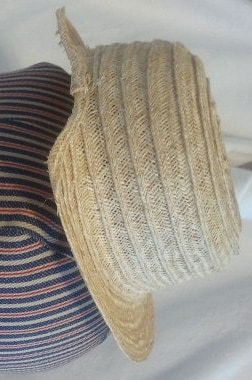
This is an 1850s bonnet for a slightly smaller head.

Moving into the 1860s… Here is a child’s bonnet

 Here is the Marie Stuart several people asked for. This was quite to fussy shape to work with.

These are a pair of 1880s bonnets that were my first adventure into the era.

Published in: on April 4, 2013 at 3:21 pm  Leave a Comment  

Mad Hatter Week update

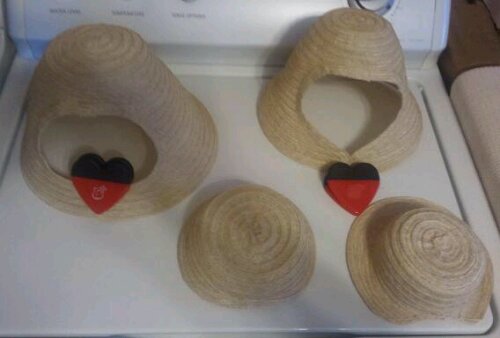
I’m a little behind schedule, well my ‘hoped schedule’, by three quarters of a day. I have 4 bonnets drying and 2 bonnets getting wired as of this afternoon.
The slight delay is a combination of the freak weather causing yesterday’s errands to take longer, one cranky bonnet giving me symmetry issues and the silly notion that I would throw a Marie Stuart into the mix.

image

Here is the batch drying – A mix of eras including a 50s commission, late 50s/early 60s, and two 80s, one from an advert and the other an original.

Published in: on April 3, 2013 at 5:37 pm  Leave a Comment  

The Rival Bonnets

From Trials and Confessions of an American Housekeeper. Philadelphia, 1854

I Have a pleasant story to relate of a couple of fashionables of our city, which, will serve to diversify these “Confessions,” and amuse the reader. To the incidents, true in the main, I have taken the liberty of adding some slight variations of my own.

A lady of some note in society, named Mrs. Claudine, received a very beautiful bonnet from New York, a little in advance of others, and being one of the rival leaders in the fashionable world, felt some self-complacency at the thought of appearing abroad in the elegant head-gear, and thereby getting the reputation of leading the fashion.

Notwithstanding Mrs. Claudine’s efforts to keep the matter a secret, and thus be able to create a surprise when she appeared at church on the next Sunday, the fact that she had received the bonnet leaked out, and there was some excitement about it. Among those who heard of the new bonnet, was a Mrs. Ballman, who had written to a friend to get for her the very article obtained first by Mrs. Claudine. From some cause or other a delay had occurred, and to her chagrin she learned that a rival had the new fashion, and would get the eclat that she so much coveted. The disappointment, to one whose pleasures in life are so circumscribed as those of a real fashionable lady, was severe indeed. She did not sleep more than a few hours on the night after she received the mortifying intelligence.

The year before, Mrs. Claudine had led the fashion in some article of dress, and to see her carry off the palm in bonnets on this occasion,

when she had striven so hard to be in advance, was more than Mrs. Ballman could endure. The result of a night’s thinking on the subject was a determination to pursue a very extraordinary course, the nature of which will be seen. By telegraph Mrs. Ballman communicated with her friend in New York, desiring her to send on by the evening of the next day, which was Saturday, the bonnet she had ordered, if four prices had to be paid as an inducement to get the milliner to use extra exertions in getting it up. In due time, notice came back that the bonnet would be sent on by express on Saturday, much to the joy of Mrs. Ballman, who from the interest she felt in carrying out her intentions, had entirely recovered from the painful disappointment at first experienced.

Saturday brought the bonnet, and a beautiful one it was. A few natural sighs were expended over the elegant affair, and then other feelings came in to chase away regrets at not having been first to secure the article.

On the day previous, Friday, Mrs. Ballman called upon a fashionable milliner, and held with her the following conversation.

“You have heard of Mrs. Claudine’s new bonnet, I presume V

“Yes, madam,” replied the milliner.

“Do you think it will take?” asked Mrs. Ballman.

“I do.”

“You have not the pattern?”

“Oh, yes. I received one a week ago.”

“You did!”

“Yes. But some one must introduce it. As Mrs. Claudine is about doing this there is little doubt of its becoming the fashion, for the style is striking as well as tasteful.”

Mrs. Ballman mused for some moments. Then she drew the milliner aside, and said, in a low, confidential tone.

“Do you think you could get up a bonnet as handsome as that, and in just as good taste?”

“I know I could.” In my last received London and Paris fashions are several bonnets as handsome as the one that is about being adopted in New York, and here also without doubt.”

“I am not so sure of its being adopted here,” said the lady.

“If Mrs. Claudine introduces it, as I understand she intends doing on Sunday, it will certainly be approved and the style followed.”

“I very much doubt it. But we will see. Where are the bonnets you spoke of just now?”

The milliner brought forth a number of pattern cards and plates, and pointed out two bonnets, either of which, in her judgment, was more beautiful than the one Mrs. Claudine had received.

“Far handsomer,” was the brief remark with which Mrs. Ballman approved the milliner’s judgment. “And now,” she added, “can you get me up one of these by Sunday?”

“I will try.”

“Try won’t do,” said the lady, with some excitement in her manner. “I must have the bonnet. Can you make it?”

“Yes.”

“Very well. Then make it. And let it be done in your very best manner. Why I wish to have this bonnet I need hardly explain to you. I believed that I would have received the bonnet, about to be adopted in New York, first. I had written to a friend to procure it; but, by some means, Mrs. Claudine has obtained her’s in advance of me. Mine will be here to-morrow, but I don’t mean to wear it. I wish to lead.”

“If you were both to appear in this bonnet, the fashion would be decided,” said the milliner.

“I know. But I have no wish to share the honor with Mrs. Claudine. Make me the bonnet I have selected, and I will see that it puts her’s down.”

“You will remember,” said the milliner, ” that her’s has been already adopted in New York. This will be almost sure to give it the preference. It would be better that you did not attempt a rivalry, than that you should be beaten.”

“But I don’t mean to be beaten,” replied the lady. “I have taken measures to prevent that. After Sunday you will hear no more of the New York bonnet. Mine will go, and this, I need not tell you, will be a feather in your cap, and dollars in your pocket; as I will refer to you as the only one who can get it up. So do your best, and improve the pattern we have selected, if it will bear improvement.”

The milliner promised to do her “prettiest,” and Mrs. Ballman returned home in a state of considerable elation at the prospect of carrying off the palm, and humiliating her. rival at the same time.

Mrs. Claudine, though a little vain, and fond of excelling, was a woman of kind feelings, and entirely superior to the petty jealousies that annoyed Mrs. Ballman, and soured her towards all who ‘succeeded in rivalling her in matters of taste and fashion. Of what was passing in the mind of the lady who had been so troubled at her reception of a new style of bonnet from New York, she was entirely ignorant. She was not even aware that Mrs. Ballman had ordered the same article, nor that she had suffered a disappointment.

Saturday came. Mrs. Claudine was busy over some little article of dress that was to add to her appearance on the next day, when an Irish girl, who had formerly lived with her, entered her room.

“Ah! Kitty!” said the lady pleasantly. “How do you do?’

“I’m right well, mum, thankee,” replied Kitty, with a courtesy.

“Where do you live now, Kitty?” inquired Mrs. Claudine.

“I’m living with Mrs. Ballman,” said the girl.

“A very good place, I have no doubt.”

“Oh, yes, mum. It is a good place. I hain’t much to do, barrin’ going out with the children on good days, and seein’ after them in the house; and I get good wages.”

“I’m very glad to hear it, Kitty; and hope you will not give up so good a home.”

“No, indeed, mum; and I won’t do that. But Mrs. Claudine—”

Kitty’s face flushed, and she stammered in her speech.

“What do you wish to say?” inquired the lady, seeing that Kitty hesitated to speak of what was on her mind.

“Indade, mum,” said Kitty, evincing much perplexity, “I hardly know what I ought to do. But yez were good to me, mum, when I was sick, and didn’t send me off to the poor house like some girls are sent; and I never can forget yez while there’s breath in me body. And now I’ve come to ask yez, just as a favor to me, not to wear that new bonnet from New York, to-morrow.”

It was some moments before the surprise, occasioned by so novel and unexpected a request, left Mrs. Claudine free to make any reply.

“Why, Kitty!” she at length exclaimed, “what on earth can you mean?”

“Indade, mum, and yez mustn’t ask me what I mane, only don’t wear the bonnet to church on the morrow, because—because—och, indade, mum, dear! I can’t say any more. It wouldn’t be right.”

Mrs. Claudine told Kitty to sit down, an invitation which the girl, who was much agitated, accepted. The lady then remained silent and thoughtful for some time.

“Kitty,” she remarked, at length, in a serious manner, “what you have said to me sounds very strangely. How you should know that I intended appearing in a new bonnet to-morrow, or why you should be so much interested in tbe matter is more than I can understand. As to acting as you desire, I see no reason for that whatever.”

This reply only had the effect of causing Kitty to urge her request more strenuously. But she would give no reason for her singular conduct. After the girl had gone away, Mrs. Claudine laid aside her work—for she was not in a state of mind to do any thing but think—and sat for at least an hour-, musing upon the strange incident which h%d occurred. All at once, it flashed upon her mind that there must be some plot in progress to discredit or rival her new bonnet, which Kitty had learned at Mrs. Ballman’s. The more she thought of this, the more fully did she become satisfied that it must be so. She was aware that Mrs. Ballman had been chagrined at her leading ofl’ in new fashions once or twice before; and the fact, evident now, that she knew of her reception of the bonnet, and Kitty’s anxiety that she should not wear it on Sunday, led her to the conviction that there was some plot against her. At.first, she determined to appear in her new bonnet, disregardful of Kitty’s warning. But subsequent reflection brought her to a different conclusion.

The moment Mrs. Claudine settled it in her mind that she would not appear in the new bonnet, she began dressing herself, hurriedly, to go out. It was as late as five o’clock in the afternoon when she called at the store of the milliner who had been commissioned by Mrs. Ballman to get the rival bonnet.

“Have you the last fashions from abroad?” enquired Mrs. Claudine.

“We have,” replied the milliner.

“Will you let me see them?”

“Certainly, ma’am.”

And the patterns were shown. After examining them carefully, for some time, Mrs. Claudine selected a style of bonnet that pleased her fancy, and said—

“You must get me up this bonnet so that I can wear it to-morrow.”

“Impossible, madam!” replied the milliner. “This is Saturday evening.”

“I know it is; but for money you can get one of your girls to work all night. I don’t care what you charge; but I must have the bonnet.”

The milliner still hesitated, and seemed to be confused and uneasy. She asked Mrs. Claudine to sit down and wait for a little while, and then retired to think upon what she had better do. The fact was, Mrs. Claudine had pitched upon the very bonnet Mrs. Ballman had ordered, and her earnestness about having it made in time i to wear on the next day, put it almost beyond

her power to say no. If she were to tell her that Mrs. Ballman had ordered the same bonnet, it would, she knew, settle the matter. But, it occurred to her, that if both the ladies were to appear at church in the same style of bonnet, the fashion would be sure to take, and she, in consequence, get a large run of business. This thought sent the blood bounding through the milliner’s veins, and decided her to keep her own counsel, and take Mrs. Claudine’s order.

“She’s as much right to the bonnet as Mrs. Ballman,” settled all ethical questions that intruded themselves upon the milliner.

“I will have it ready for you,” she said, on returning to Mrs. Claudine.

“Very well. But mind,” said the lady, “I wish it got up in the very best style. The hurry must not take from its beauty. As for the price, charge what you please.”

The milliner promised every thing, and Mrs. Claudine went home to think about the important events of the approaching Sabbath. On Sunday morning both bonnets were sent home, and both the ladies fully approved the style, effect, and all things appertaining to the elegant affairs.

At ten o’clock, Kitty, who was a broad-faced, coarse-looking Irish girl, came into the chamber of Mrs. Ballman, dressed up in her best, which was not saying much for the taste and elegance of her appearance.

“Are you all ready?” asked her mistress.

“Yes, mum.”

** Very well, Kitty, here’s the bonnet. Now, remember, you are to go into the pew just in front of ours. The Armburner’s are all out of town, and there will be no one to occupy it.”

Kitty received the elegant bonnet which had come on express from New York, and placed it upon her head.

“You really look charming,” said the lady.

But Kitty was not nattered by her words, and evinced so little heart in what she was doing, that Mrs Ballman said to her, in a half threatening tone, as she left the room—

“Mind, Kitty, I shall expect to see you at church.”

“Oh, yes, mum; I’ll be there,” replied Kitty, courtesying awkwardly, and retiring.

Not long after Kitty had retired, Mrs. Ballman, after surveying, for many minutes, the effect of her new bonnet, becoming more and more pleased with it every moment, and more and more satisfied that it would “take,” left her room, and was descending the stairs for the purpose of joining the family, who were awaiting her below. Just at that unlucky moment, a servant, who was bringing down a vessel of water, slipped, and a portion of the contents came dashing over the head and shoulders of the richly attired lady, ruining her elegant bonnet, and completely destroying the happy frame of mind in which she was about attending public worship. No wonder that she cried aloud from the sudden shock and distress so untoward an event occasioned; nor that she went back weeping to her chamber, and refused to be comforted.

Mr. Ballman and the children proceeded alone

to church on that day. On their return home, they found the lady in a calmer frame of mind. . But Mr. Ballman looked grave and was unusually silent. Kitty came home and gave up her elegant head-dress; and when her mistress told her that she might keep it, she thanked her, but declined the present.

“You went to church, of course,” she said.

“Oh, yes, mum,” replied Kitty.

“And sat in the Armburner’s pew?”

“Yes, mum.”

“Alone.”

“Yes, mum.”

“Was Mrs. Claudine there?”
“Yes, mum.”

“Did she wear her new bonnet?”
“Yes, mum.”

“It was exactly like this?”

“Oh, no, mum, it was exactly like the new one you had sent home this morning.”

“What!” The face of the lady flushed instantly. “Wasn’t it like this?”

“No, mum.

Mrs. Ballman sunk into a chair.

“You can retire, Kitty,” she said, and the girl withdrew, leaving her to her own feelings and reflections, which were not of the most pleasing character.

The appearance of Kitty at church, fully explained to Mrs. Claudine the ungenerous game that had been played against her. Her first thought was to retaliate. But reflection brought other and better feelings into play. Instead of exposing what had been done, she destroyed the bonnet received from New York, and made an effort to keep what had occurred a secret. But Kitty’s appearance at church in such an elegant affair, naturally created some talk. One surmise after another was started, and, at last, from hints dropped by the milliner, and admissions almost extorted from Mrs. Claudine, the truth came out so fully, that all understood it; nor was Mrs. Ballman long left in ignorance on this head.

As to the fashion, Mrs. Claudine’s bonnet became the rage; though, as might be supposed, Mrs. Ballman refused to adopt it.

Who will be the successful rival next season, I am unable to predict. But it is believed that Mrs. Claudine intends giving Mrs. Ballman an advance of two weeks, and then coming in with a different style, and beating her in spite of the advantage.                                      

Published in: on March 30, 2013 at 8:00 am  Leave a Comment  
Tags: ,

Alas, A Delay – NB Sewing Journal

It seems getting time to take measurements from my husband when we have dead opposite schedules is nearly impossible. The hour I see him each night is just enough for him to eat and get ready; not enough to have him stand still for the measuring tape.

So, alas, a delay in sewing for the Netherfield Ball. I am determined I to work on his clothing next rather than dive into my dress. This is because I’m worried I’ll have my clothes done and his not started. Not good. I am also determined with the upcoming week break from school to get his measurements. Then I will get them on to paper. (I also have to get my giant roll of newsprint out of mom’s storage.)

In the meantime, I am happily enjoying making straw bonnets. I have a lovely 50s bonnet I am making for a west coast friend. I love the shape of 50s bonnets. The straw lines up so well, creating great lines along the top of the crown and around the brim. (I am such a millinery nerd.) I’ve also been toying with an 80’s shape.  I’ll have a blocking/sizing night soon. I love that part. There are several shapes calling to me right now.

Published in: on March 27, 2013 at 11:08 am  Leave a Comment