Making a Hat Stand

I know several people found my fabric headform post helpful. Check out this realy nice ‘how-to’ on making a wooden hat/bonnet stand.

Tea in a Teacup

Ever thought a hatbox didn’t do justice to your collection of hats? Ever wanted to display your hat-making skills to the world, or at least to your visitors? Why not try making a hatstand!

After seeing some hatstands at a friend’s house, I have been keen to make a pair to display my Regency bonnets. Having my bonnets on display means that I could spend time admiring and enjoying my handiwork as a decoration, rather than always having them packed away awaiting my next costuming event.

Hatstands, both as larger hall furniture and as smaller dressing table pieces, became popular during the Victorian era. They could be made from wood or cast iron, and could be covered with a fabric, such as velvet. They were also often weighted in the base, which increased the stability of the stand once a hat was placed on the top.

This week I have…

View original post 655 more words

Published in: on May 27, 2013 at 12:38 pm  Leave a Comment  

Fun Fifty’s Bonnet

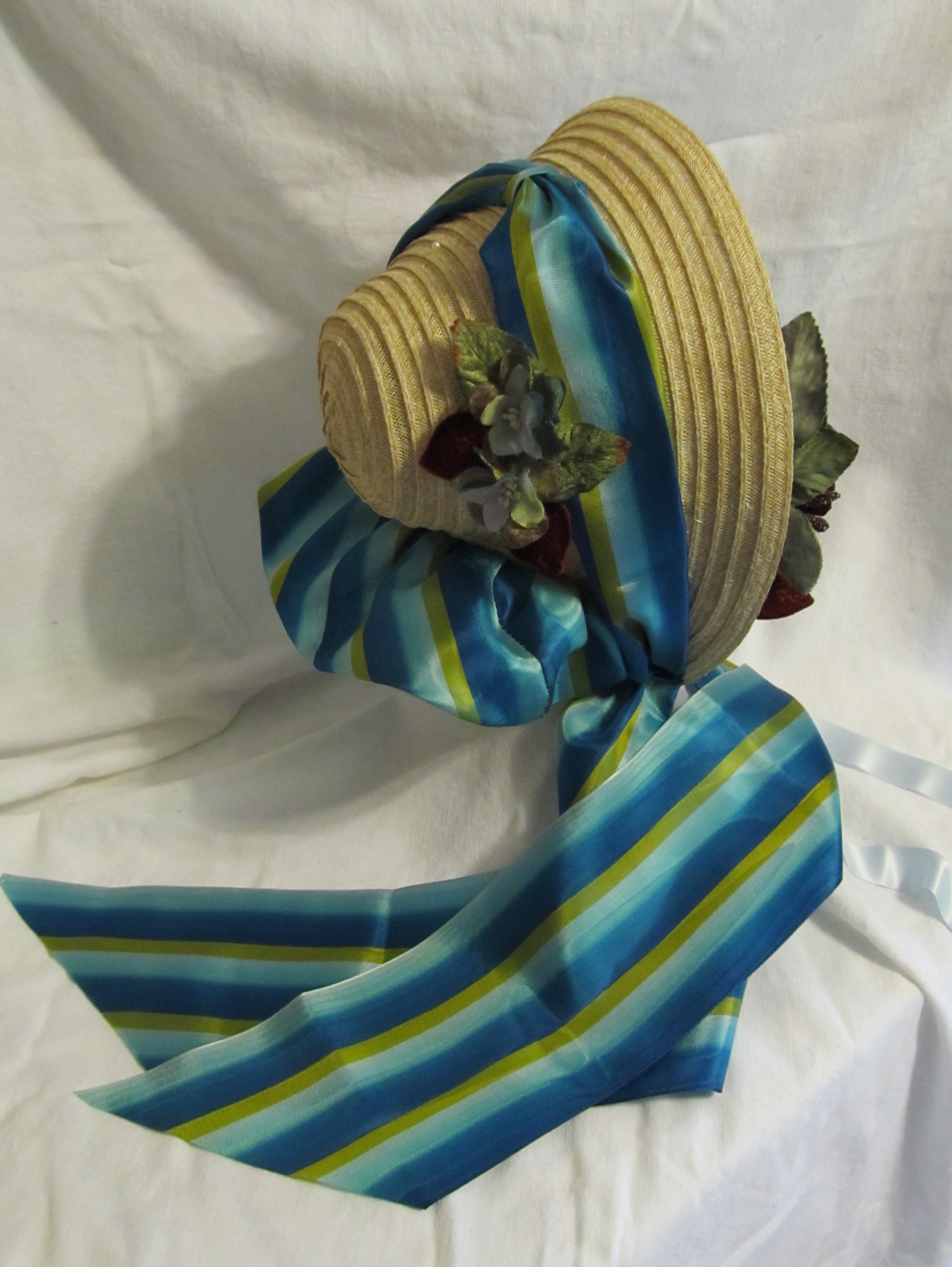
???????????????????????????????I wrapped up a tremendously enjoyable custom bonnet today. The recipient is truly one of those fun customers that you jump to work for. Together we picked out the flowers and ribbons for this 50s bonnet. The amazing striped ribbon is a vintage piece from Italy. The flowers are a combination of vintage and current done in luscious velvet including the strawberries.

??????????????????????????????????????????????????????????????

Thank You, B, for asking me to make this bonnet for you. I hope you enjoy wearing it as much as I enjoyed making it.

The Faux Customer

You already know I enjoy stories of my favorite topics be it travel, shawls or millinery. This story had me do a double take. It comes from  a book I’ve been enjoying, The Diary of a Milliner , by Belle Otis in 1867:

“To illustrate the importance of what I have been saying I will tell a tale of to-day. Those who like to turn every thing to instruction may whittle a moral therefrom

A well-dressed lady came up to me, and asked me to show her some of our handsomest bonnets.

I asked. “Are you looking for any particular style or color?”

“No. I wish to see what will become me best.”

She deliberately took off her own bonnet and commenced trying those that were on the saloon table. One after one she took them up, and put them on her head, till she had seen about thirty casting their differently combined tints over her complexion. She invited my comments and suggestions upon each one. She viewed herself in each in the five mirrors of the saloon, in all the various light she could command, and placed herself in ever conceivable attitude before them.

One thing or another was at fault with every one of them. She had asked the price of all, and cheapened each to the lowest possible fraction for which they could be bought.

She then went to the side-table, and performed the same operation with fifteen or twenty more. There were none that exactly suited.

“Haven’t you put some away in drawers?” she asked. I went the same rounds with a dozen drawers containing six or eight bonnets apiece.

When those were exhausted she pointed to the window, and asked if I would be kind enough to bring here two handsome bonnets that were hanging there.

Something in the inner life, probably it was that attribute of the dual denomination penetration, admonished me that she didn’t wish to purchase a bonnet, but was seeking an afternoon’s entertainment at our expense. Another something, whether it was a spirit tapping, tapping at the inner door I know not, admonished me that there are times when to practice the forbearing policy of the remarkable patriarch, of whom I have been speaking, is to cast pearls before swine. Instead of starting for the desired bonnets, looked at her steadily in the eye while I modulated my voice to a very respectful tone, and replied:

“If you really wish to buy a bonnet, I will go down and get them; but I fear that will suit you no better than the others have done.”

She saw that her role was played to the end and a successful actress she had proved herself. She had confined her audience in the closest attention for about  two hours. The other two bonnets were beyond her reach. With the most inimitable coolness and unconcern she looked me back and replied:

“I don’t wish to buy a bonnet. I bought mine last week.”

If she had struck me in the face I wouldn’t have been more startled and surprised than I was at the exhibition of such boldness. I could scarce refrain from crying out, “O shame, where hides thy blush!”

After a moment, the ease with which she had accomplished her consummate piece of impudence. Moderated by my indignation to a sort of admiration. I would like to know more about you, I thought.

I could conceive of no motive that could induce a lady – so she appeared on the surface – to make so irredeemably mean an exhibition herself. I abnegated self in apparent interest in her affairs, and quietly asked:

“If you didn’t wish to purchase, why have you tried on so many bonnet?”

“I wanted to find out your prices, to see if I got cheated in mine. If I did I’ll never trade at the place where I bought  it again.”

She had told me the truth, but not the whole truth. I like to sift truth to the bottom, so I pursued:

“You needn’t have tried all those bonnets to find out the prices. I would have told you that, with pleasure, if it would have given you satisfaction.

“Oh, I wanted to see, too, if you had a bonnet in your store more becoming to me than mine. My milliner told me if I could find one in the whole city more so I might keep the bonnet and she would give me the money back!”


After extensive internal exasperation for the milliner, the discussion continues revealing the faux-customer had every intention of retrieving her money and leaving the bonnet she purchased as a way of punishing the shopkeeper, claiming “I haven’t worn it but three times, – once to church, once out to Roxbury, and once to the Museum.” and Store-keepers do tell such shocking lies in order to sell their goods, I see no other way but to keep strict watch of them, and bring them up to the mark when they overreach and don’t tell the truth.

Published in: on May 25, 2013 at 8:00 am  Leave a Comment  

Friday Night Millinery

With Dan off to an event, I slept in. How lovely is that? Now, before I dive into a full day of sewing, I want to share last night’s.
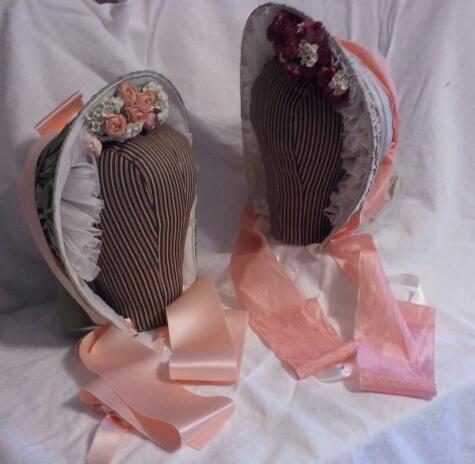
I lost track of time for ordering the pink ribbons to finish off the bonnets that have been dangling in the livingroom. Carole, at The Ribbon Store, came through for me. Here are the two bonnets with her pink ribbons. The green on the left is Lily’s. The pearl gray is mine, which I’ll be wearing tomorrow at GCV for their Red Day.
image
image
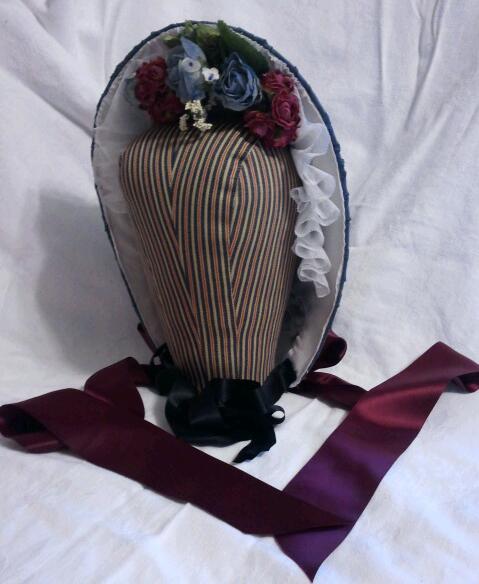
To wrap up the trio, the slate grey bonnet finally got its ribbon and flowers attached too.
image
I also moved the waist gathers on the green dress to eliminate that odd tug at the top closure. (Hopefully photos of that dress tomorrow)
So, now that I’ve read my 37 Saurday morning emails, it is time for a late breakfast followed by my Netherfield Ball dress.

Published in: on May 18, 2013 at 9:09 am  Leave a Comment  
Tags:

To Clean a Bonnet

Miss Leslie’s Lady’s House-book; a Manual of Domestic Economy Containing Approved Directions for Washing, Dress-making, by Miss Eliza Leslie, 1850.

TO CLEAN A STRAW OR LEGHORN BONNET

Having separated the crown from the brim and the cape or neck-piece, and removed the lining and wire, the next thing is to take out whatever stains may be found in the bonnet, the crown of which should be put on a wooden block. For grease, rub on with your finger some powdered Wilmington clay, or a little magnesia; and in an hour or two brush it off, and renew the application, if necessary. For other stains use either cream of tartar or salt of sorrel, put on a little wet. If salt of sorrel,must be washed off again almost immediately, lest it injure the straw by remaining on it. Afterwards (keeping the crown still on the bonnet-block) go over the whole surface of the bonnet with a brush dipped in a weak solution of pearl ash in lukewarm water, (a tea-spoonful to a quart.) Then scour it off at once, with a strong lather of brown soap and cold water, put on with a clean brush. When all the bonnet is well cleaned, rinse it in cold water, and hang it in the sun to dry. Bonnet cleaning should never be undertaken in damp weather. When the bonnet is perfectly dry, you may proceed to whiten it. Fill a chafing dish or portable furnace with burning charcoal; carry it into a small close room or into an empty press or closet, and by a line suspended across, hang the bonnet over the charcoal, at a safe distance, so that it will be in no danger of scorching. Then strew over the coals an ounce or two of powdered brimstone, and immediately go out and shut the door, seeing that no air whatever can get into the room. After the bonnet has hung in the vapour six or seven hours, throw open the door, (having first left open an outside door or window, so as to admit immediately the fresh air,) and go into the room as soon as you find you can do so without inconvenience from the fumes of the charcoal and sulphur. Then bring out the bonnet, and hang it in the open air till the smell of the brimstone has entirely left it. If the day is windy, so much the better; but the bonnet must on no account be hung out if the weather is damp, and it must be brought in before sunset. If it is not sufficiently white, repeat next day the process of bleaching it with charcoal and brimstone.

The next thing is to stiffen the bonnet. To make the stiffening, boil in two quarts of soft water, a quarter of a pound of vellum shavings, (the vellum of buffalo’s hide is best,) filling it up occasionally, if it seems to be boiling too dry. It must boil or simmer slowly for six or seven hours. Then, when you take it from the fire, let it stand a while to settle; after which,

pour it off into a basin, and it will become a thick jelly. To the sediment left in the pot, you may add a second two quarts of water; and after a second boiling, it will form another jelly or sizing, strong enough for similar purposes. When you are going to use it for a bonnet, melt up a pint of this jelly, and mix with it a small half-tea-spoonful of oxalic acid, (not more, or it will injure the straw,) and then with a clean sponge or brush go all over the bonnet, inside and out, with the sizing. Dry the bonnet; and when quite dry, go over it again with a second wash of the stiffening. Dry it again, and then spread over it a wet piece of jaconet muslin; or damp the bonnet all over with a sponge and lukewarm water, and then cover it with a fine white handkerchief, while you press it hard and evenly with a warm box-iron, exerting all your strength. The crown must be pressed while on the bonnet-block; the brim may be done on an ironing-table. Afterwards expose the bonnet to the air, till it becomes perfectly dry; and next day it will be ready for putting together, lining, and trimming; first mending whatever defective places may be found in it.

The front of a bonnet will keep its shape much better if the wire is thick and stout. In lining a bonnet, the best way for a novice in the art, is to pin a large sheet of thin soft paper on the outside of the brim, and (having fitted it smoothly) cut it of the proper shape and size, allowing a little for turning in at the edge. Then pin the paper into the inside of the brim, and if it fits perfectly smooth, cut out the silk lining by it. A piece of oiled silk sewed all round the inside of the crown, at the joining place, and extending down a little upon the brim, will prevent the stain from perspiration, that so frequently disfigures that part of a bonnet.

—Without a regular cleaning in the preceding manner, a discoloured straw bonnet may be improved in appearance, if previous to putting on a fresh trimming, you stretch the bonnet on a block, (or something that will answer the purpose,) and go all over it with a sponge dipped in lukewarm water, in which has been dissolved pearl-ash, in the proportion of a small tea-spoonful of pearl-ash to a pint of water; afterwards rinsing it off, wiping it hard with a flannel, and drying it well. Next, go over it with a clean sponge dipped in strong rice-water, which will be the better for having dissolved in it a half-teaspoonful of sugar of lead. Then dry the bonnet, and having damped it all over with a wet sponge, cover it with thin muslin, and press it hard with a heavy and moderately warm iron.

TO TAKE CARE OF BEAVER HATS A hat should be brushed every day with a hat-brush; and twice a day in dusty weather. When a hat gets wet, wipe it as dry as you can with a clean handkerchief, and then brush it with a soft brush, before you put it to dry. When nearly dry, go over it with a harder brush. If it still looks rough, damp it with a sponge dipped in vinegar or stale beer, and brush it with a hard brush till dry.

A good beaver hat should always, when not in constant use, be kept in a hat-box, with a hat-stick extended inside of the crown.

Published in: on May 18, 2013 at 8:00 am  Leave a Comment  
Tags: ,

Pair of Hats

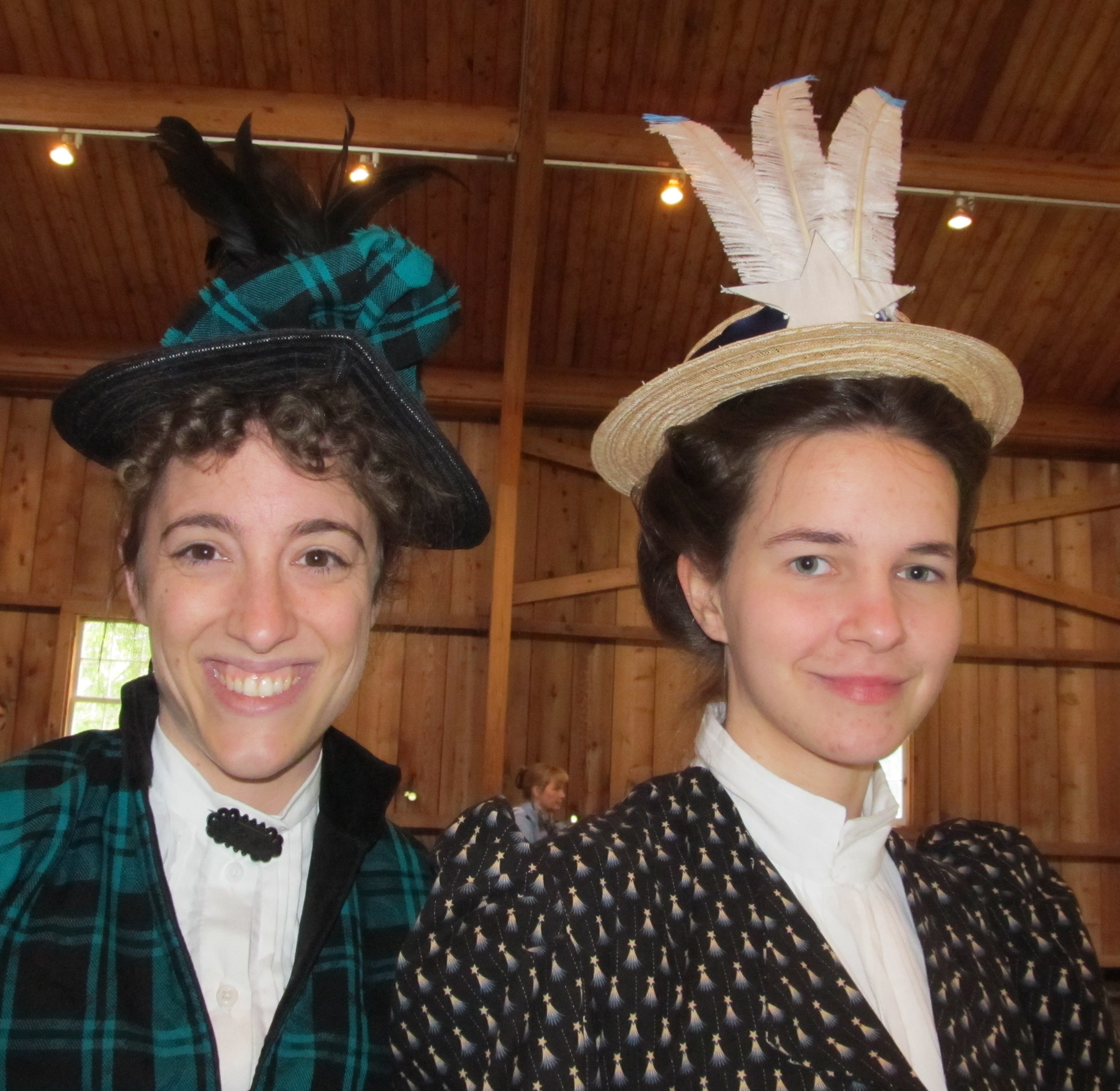
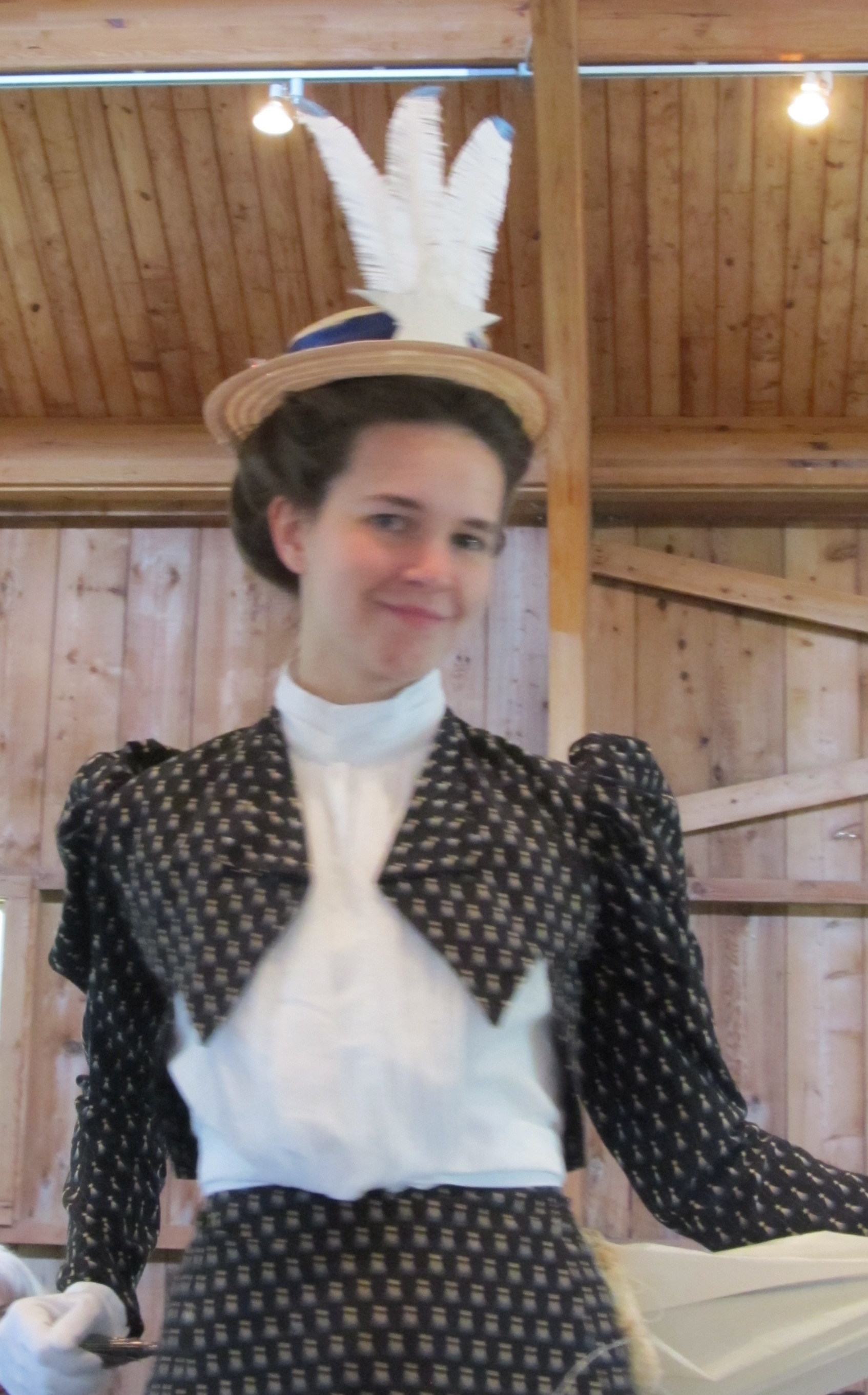
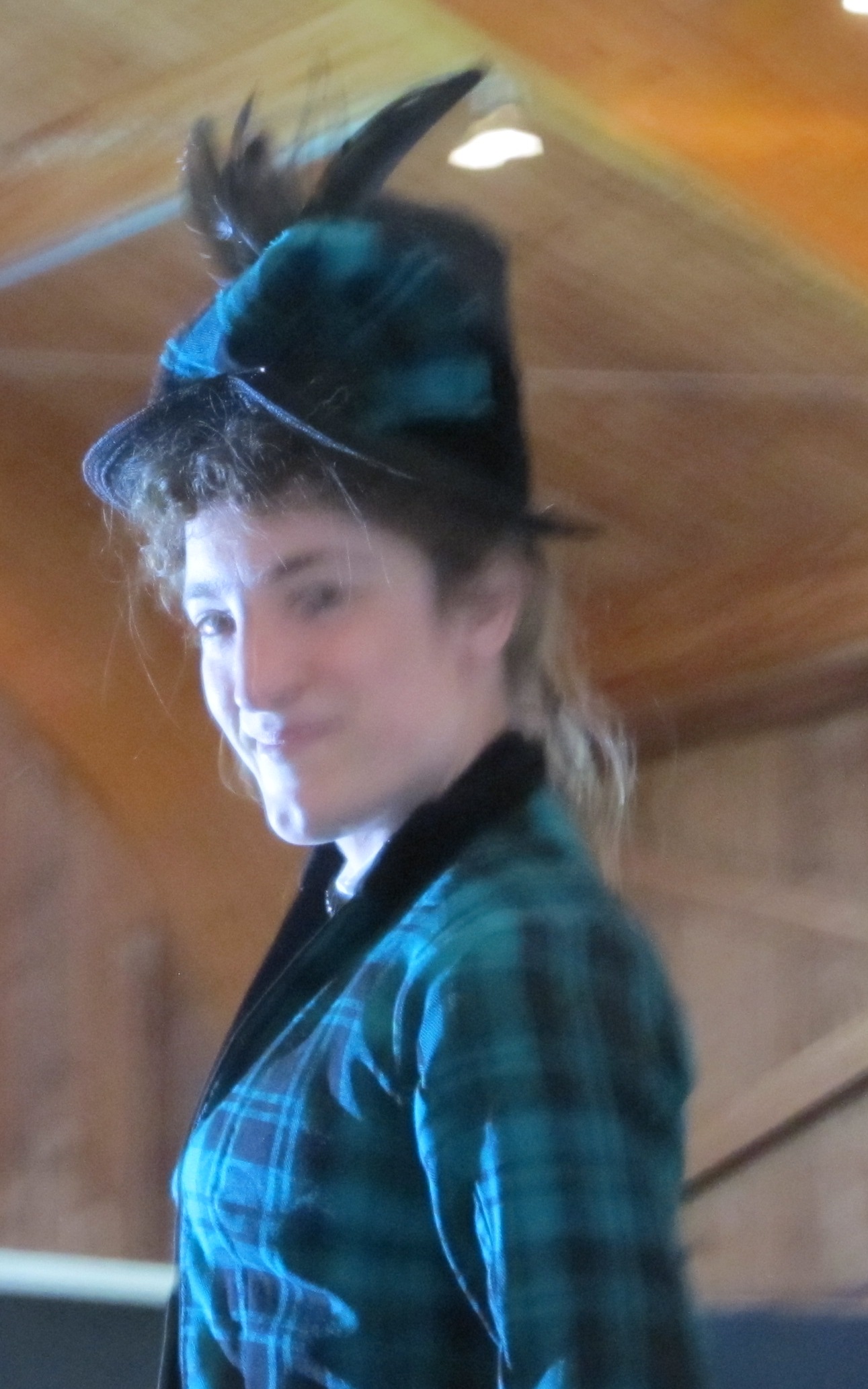
Up until this year, I stuck firmly in the mid-century for straw millinery. When Bevin suggested I give the 80s and 90s a try I soon became ‘wowed’ by the shapes of the 80s. Talk about an era of amazing lines, shape, curve, height. What fun. I can’t wait to do more.

Finally, I get to show you the pair of hats as they were worn in the Genesee Country Village’s Mother’s Day fashion show. I did the straw forms of fine hemp plait. Each one is hand sewn, wired and blocked freehand. Bevin had the fun of doing the feathers. (Now, the photos aren’t the best as I need to check the camera’s settings.)

???????????????????????????????

 ??????????????????????????????? ???????????????????????????????


A Lesson in Economy

In  the lesson “Economy” from The Village Reader (1841) we find this little story.

“If you please, mother, I will now tell you why I called Mrs. Marsh stingy; and I am sure, much as you like economy, you will think she carried it a little too far.” When she had detailed the occurrences of the morning, she added—” Now that seems a saving too small to be worth any one’s attention.”

 “That, my dear, is because you think of the ‘little matters’ alone, and not, as you should, in connection with the very serious consequences, which flow from daily and hourly neglecting such ‘little matters.’ One cent a day seems very little indeed; but I should like to have you tell me how much it would amount to in a year.”

 Elizabeth, after a momentary pause, answered, ” Three dollars and sixty-five cents; is it possible!”

 “Certainly, my dear. ‘Little matters,’ you see, by continual accumulation, amount to great matters in time. Drops make the ocean; minutes make the year.”

 “Well, mother, I believe I must allow that my opinion of Mrs. Marsh was too hastily formed.”

 “And not very decorously expressed—you will acknowledge that, too, my daughter, I hope.”

 “Yes, mother,” answered Elizabeth, with a crimson cheek. “But still I cannot think Mrs. Marsh was quite right; for when we went into the milliner’s shop, she de clined purchasing a bonnet for Laura, which she reall needs.”

 “Perhaps she wants it, but does not need it.”

 “Indeed, mother, the milliner said she needed one and Laura said so; and I said so. Now I am sure you think that parents ought to supply the wants of their children, if they can.”

 “Certainly, my dear, the real wants, but not the fancied wants. If I rightly remember, Laura’s bonnet is quite fresh and clean.”

 “Yes, but that is because she is so careful of every thing; she has worn it a long time.”

 “That is no reason why she should not continue to wear it, if it be unsoiled and unfaded.”

 “But it is so unfashionable, mother.”

 “Unfashionable! What magic is in the sound! No matter how comfortable, or pretty, or becoming any thing is, let but that word be breathed over it, and it passes at once into oblivion! But this is not to the purpose. I think Mrs. Marsh was quite right in judging for herself about what she could afford, or what was proper for her to purchase, instead of suffering herself to be led by others. She best knows her own resources, and the demands likely to be made upon them.

 “Mrs. Marsh is not rich. She has enough for the comforts of life—nothing for its costly decorations. Yet limited as her income is, she contrives by her excellent management to command all that is really valuable and useful; all that can actually add to the happiness of herself and family.

 “You can perceive, my dear, that if there be only money enough to purchase necessary and useful things, and part of it go for superfluities, there must be a deficiency of the others. You would not much like to see your friend Laura with a new bonnet, and an old, untidy pair of shoes; or with a pretty necklace and a faded dress. It would shock Mrs. Marsh’s taste, even more than yours. There is a beautiful fitness and propriety in her whole establishment, which shows her judgment and good sense.

 “She has the true economy to proportion her expenses to her income, while she makes it produce to her family all the happiness it is capable of producing; and she has the true wisdom to wish for those things only, which it is proper and right for her to have. If the occurrences and conversation of this morning prove a salutary lesson to you, if [sic]  will make Mrs. Marsh your model in the management [sic] your yearly allowance, I shall dare to hope that you will [sic[ time become as useful and estimable a woman.”

Enjoy this article? Consider one of my straw bonnets available through Etsy.


Published in: on May 11, 2013 at 8:00 am  Comments (1)  
Tags: ,

A Must Read with exerpts

Today I offer a “Must Read”. This book happens to be from 1872. Regardless of what era you portray, this book is a Must. Just keep in mind the year. The chapter “How and What to Buy” walks through the fabrics available in the 1870s, looking at widths, weave, price, use, and quality. How I wish I had a book such as this on hand for each decade of the 1800s.

Please add Hints on Dress, or what to Wear, When to Wear it and How to Buy it by Ethel Gale( 1872) to your reading list.  http://books.google.com/books?id=hlkRnnkqFbIC&printsec=frontcover#v=onepage&q&f=false

As we are talking about millinery this spring, there are a couple passages to which I would draw your attention.

“Bonnet’s silks – rank as next finest in quality. These are twenty inches wide, and vary in price according to the weight and “finish,” from $2.75 to $8.00 per yard. The lower priced are too light for much service, while the higher, though beautifully finished, are so heavy and closely woven that they are liable to break, and on account of a tendency to hold dust, should never be used for walking dresses. For the latter purpose the medium qualities, lettered G, H, I and J, ranging from $4.50 to $5.50 per yard, are the best of the Bonnet silks.”

“Black English crape for veils comes in two widths, one yard and a quarter, and one yard; and of several qualities, from that sold at $4.50 per yard to that at $8.50; those at $6.00 and $7.00 being equally serviceable if not quite as heavy as those above these prices. Trimming crapes of the same qualities are found in narrower widths, vary from $3.00 to $6.00 per yard. Those at $4.50 and $5.00 being sufficiently good for all useful purposes.”

“Bonnet velvets, eighteen inches wide, cost from $4.50 to $5.50 per yard, the price depending more upon the tint than the quality.”

 There is a similar text online coming from England – How to Dress on L15 a Year as a Lady. Though, I must say I find the recommendation for a straw bonnet to be soft enough to sit on without damage a silly one. A well wired and blocked bonnet will wear well for years if cared for. A soft straw will become floppy, sag and lose its shape requiring the attention of the milliner regularly. Granted, this author also talks about changing out the ribbons to go with each dress. This is a thought process very different than the decades prior.

Published in: on May 1, 2013 at 4:00 pm  Leave a Comment  

A Change of Mind

(Rural Repository, “Laura Lovel “ By Eliza Leslie 1837)

Laura had tact enough to perceive that any further attempt at a conversation on books, would be unavailing; and she made some inquiry about the annual exhibition of pictures at the Athenaenm.

‘ I believe it is a very good one,’ replied Mrs. Brantley. ‘ We stopped there one day on our way to dine with some friends out of town. But as the carriage was waiting, and the horses were impatient, we only stayed a few minutes, just long enough to walk round.”

‘ Oh ! yes, mamma,’ cried Augusta, ‘ and don’t you recollect we saw Miss Darford there in a new dress of lavender-colored grenadine, though grenadines having been over these hundred years. And there was pretty Mrs. Lenham, as the gentleman call her, in a puce-coloured italianet, though italiancts have been out for ages. And don’t you remember Miss Grover’s canary colored reps bonnet that looked as if it had been made in the ark. The idea of any one wearing reps!—a thing that has not been seen since the flood ! Only think of reps !’

Laura Lovel wondered what reps could possibly be. ‘Now I talk of bonnets,’ pursued Augusta ; ‘ pray, mamma, did you tell Miss Pipingcord that I would have my Tuscan leghorn trimmed with the lilac and green riband, instead of the blue and yellow ?’

‘Indeed,’ replied Mrs. Brantley. ‘ I found your cousin Mary so extremely ill this afternoon when I went to see her, and my sister so very uneasy on her account, that I absolutely forgot to call at the milliner’s as I had promised you.’

‘ Was there ever any thing so vexatious !’ exclaimed, Augusta, throwing down her beadwork—’ Really, mamma, there is no trusting you at all. You never remember to do any thing you are desired.’ And flying to the bell she rang it with violence.

I could think of nothing but poor Mary’s danger,’ said Mrs. Brantley, ‘ and the twenty five leeches that I saw on her forehead.’

‘Dreadful!’ ejaculated Augusta. ‘But you might have supposed that the leeches would do her good, as of course they will. Here, William,’ addressing the servant man that had just entered; ‘ run as if you were running for your life to Miss Piping cord, the milliner, and tell her upon no account whatever, to trim Miss Brantley’s Tuscan Leghorn with the blue and yellow riband that was decided on yesterday. Tell her I have changed my mind and resolved upon the lilac and green. Fly as if you had not another moment to live, or Miss Pipingcord will have already trimmed the bonnet with the blue and yellow.’

‘ And then,’ said Mrs. Brantley, ‘ go to Mrs. Ashmore’s, and inquire how Miss Mary is this evening.’

‘ Why, mamma,1 exclaimed Augusta; ‘ aunt Ashmore lives so far from Miss Pipingcord’s that it will be ten or eleven o’clock before William gets back, and I shall be all that time on thorns to know if she has not already disfigured my bonnet with the vile blue and yellow.’

* Yesterday,’ said Mrs. Brantley, ‘ you admired that very riband extremely.’

‘ So I did,’ replied Augusta, ‘ but I have been thinking about it since, and as I tell you. I have changed my mind. And now that I have set my heart upon the lilac and green, I absolutely detest the blue and yellow.’

• But I am really very anxious to know how Mary is to-night,’ said Mrs. Brantley.

‘Oh !’ replied Augusta, ‘ I dare say the leeches have relieved her. And if they have not, no doubt Dr. Warren will order twentyfive more—or something else that will answer the purpose.—She is in very good hands—I am certain that in the morning we shall hear she is considerably better. At all events I will not wear the hateful blue and yellow riband—William what are you standing for ?’

The man turned to leave the room, but Mrs. Brantley called him back. ‘ William,’ said she,’ tell one of the women to go to Mrs. Ashmore’s and inquire how Miss Mary is.’

‘ Eliza and Matilda are both out,’ said William, ‘ and Louisa is crying with the toothache, and steaming her face over hot heebs— I guess she won’t be willing to walk so far in the night-air, just out of the steam.’

‘ William !’ exclaimed Augusta, stamping with her foot, ‘don’t stand here talking, but go at once ; there’s not a moment to lose. Tell Miss Pipingcord if she has put on that horrid rihin, she must take it off again, and charge it in the hill, if she pretends she can’t afford to lose it, as I dare say she will—and tell her to be sure and send the bonnet home early in the morning—I am dying to see it.’

To all this Laura Lovel had sat listening in amazement, and could scarcely conceive the possibility of the mind of so young a girl being totally absorbed in things that concerned nothing but external appearance. She had yet to learn that a passion for dress, when thoroughly excited in the female bosom, and carried to excess, has a direct tendency to cloud the understanding, injure the temper, and harden the heart.

Till the return of William, Augusta seemed indeed to be on thorns. At last he came, and brought with him the bonnet, trimmed with the blue and yellow. Augusta snatched it out of the bandbox, and stood speechless with passion, and William thus delivered his message from the milliner—

‘ Miss Pippincod sends word that she had ribanded the bonnet afore I come for it—she says she has used up all her laylock green for another lady’s bonnet, as chose it this very afternoon ; and she guesses you won’t stand no chance of finding no more of it, if you sarch Boston through ; and she says, she shew you all her ribands yesterday, and you chose the yellow blue yourself, and she han’t got no more ribands as you’d be likely to like. Them’s her very words.’

‘ How I hate milliners !’ exclaimed Augusta, and ringing for the maid that always assisted her in undressing, she flounced out of the room and went to bed.

‘ Miss Lovel,’ said Mrs. Brantley, smiling, ‘you must excuse dear Augusta. She is extremely- sensitive about every thing, and that is the reason she is apt to give way to these little fits of irritation.’

Laura retired to her room, grieving to think how unamiable a young girl might be made, by the indulgence of an inordinate passion for dress.

Enjoy this article? Consider one of my straw bonnets available through Etsy.


Published in: on April 27, 2013 at 8:00 am  Leave a Comment  
Tags: ,

Chitchat on Straw

Chitchat Upon New York and Philadelphia Fashions, For April 25, 2013

At this season, when every one is wearing straw bonnets and everybody buying them, the expense of Leghorns and the so-called Tuscans, our English and French straws, is often a matter of wonder and questioning. We are sure our readers will be interested in an account of their manufacture, be for we go on to chat about their shapes and styles. Leghorns come, as, perhaps our readers know, in the shape of a flat, round mat, and from it are cut and pressed into any prevailing shape. April 61

“It is chiefly in the neighborhood of Florence, Pisa, the district of Sienna, and the upper part of the Valley of the Arno, that the best mats are for straw hats. In these countries, whole families, old and young may be seen occupied at this kind of work; and it is certain that this branch of industry brings in a very large sum annually to the country. The cost of the raw material is inconsiderable; but the value of the work is so great that the women of the Valley of the Arno commit their domestic affairs to people of the mountains, that they may be able to devote all their time to the lucrative manufacture of straw plait. The following is the information which the author of this notice has obtained relative to this kind of industry. The straw used in working these mates is grown in districts mountainous and sterile. It is produced from a kind of wheat, of which the grain is very small. The straw, though slender, has much consistency, and the upper part of the stalk being perfectly hollow, is easily dried, It is pulled out of the earth before the grain begins to form. After being freed from the soil which adheres to the root, it is formed into small sheaves to be winnowed; the part above the last joint of the stem is then plucked off, which is from four to six inches long, the ear remaining attached to it. This being done, it is bleached alternately by the dew and the sunshine. Rain is very injurious to it, and destroys much of its whiteness. When a sudden shower comes on, every one is in motion gathering up the straw. The lower parts of the straw are treated in the same manner, and employed in forming mats of an inferior quality. The upper parts, torn off just to the knot, are sorted according to their degree of fineness. This sampling is made with much care, and usually  affords straw of three different prices. A quantity of straw worth three-quarters of a paoli (4 1/2d.), after having undergone this process, is sold for ten paoli (4s. 7d.). The tress is formed of seven or nine straws , which are begun at the lower end, and are consumed, in plaiting, to within an inch and a half of the upper extremity, including the ear. All the ends of the straws that have been consumed are left out, so that the ears shall be on the other side of the tress. As fast as it is worked it is rolled on a cylinder of wood. When it is finished, the projecting ends and ears are cut off; it is then passed with force between the hand and a piece of wood, cut with a sharp edge to press and polish it. The tresses thus prepared, are used so that a complete hat shall be formed of one piece. They are sewed together with raw silk. The diameter of the hat is in general the same, the only difference consists of the degree of fineness, and consequentaly, the number of turns which the tress has made in completing the hat. These hats have from twenty to eighty such turns, the number regulating the price, which varies from 20 paoli (9s.2d) to 100 piastres (upwards of L20). Those of the first quality have no fixed price. A hat which sells for 100 piatres affords a profit of 40 to the merchant; the straw and silk costing 20 piastres, and the labor 40 piastres. The workers gain about three to five paoli (1s.4d or 2s. 3d) per day. Several mercantile houses at Florence and Leghorn buy these hats on the spots where they worked. There is one of these houses which annually exports them to the value of 400,000 florins (L3,500). French speculators have tried to cultivate this sort of straw, but they have not been able to obtain so fine a quality as that of Tuscany.”

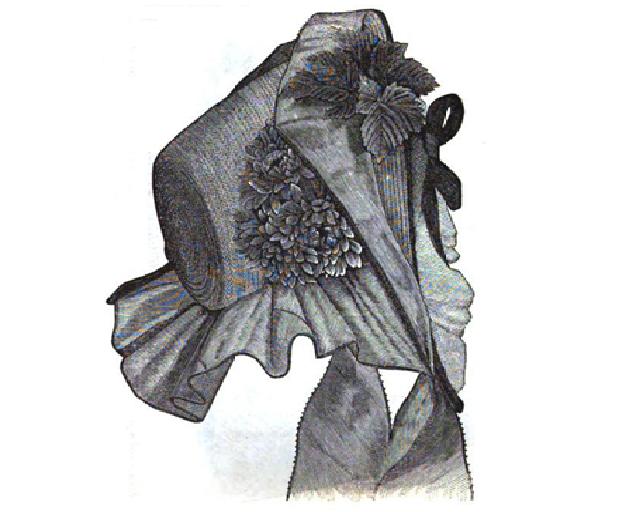
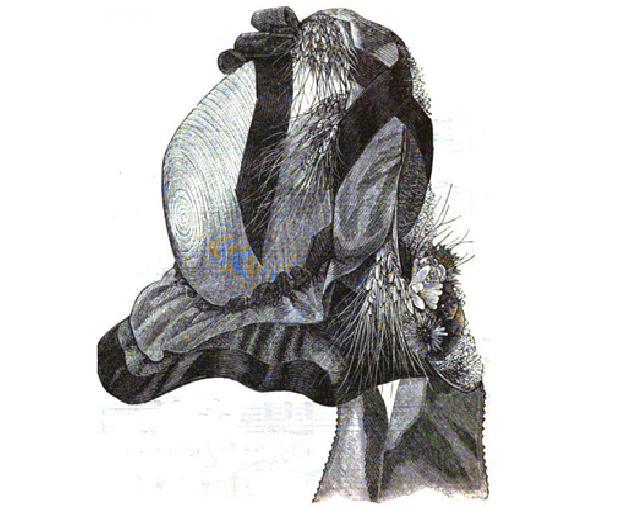
Many of the Leghorns this season are simply and gracefully trimmed with a plume of feathers on one side, and on the inside is a roll of velvet, with a small feather or bouquet of flowers. Tabs are not so much worn this spring; they are replaced by the roll or bandeay of velvet and the full inside lining described in the last chat [March, 1861 See below], but this style is not generally as soft as the lace tabs. Clusters of cherries make a pretty trimming, as shown in Fig. 6 of our fashion-plate [sorry, I have a different illustration]

For travelling bonnets we notice at Mrs. Scofield’s May plain-colored silks trimmed with silk, forming great contrast. The shapes are not so drooping over the face as they have been during the past winter, but stand high on the head, and are of medium size. English split straws and thin lace straws will be much worn, the fronts being bound with a wide ribbon, violet, apple gree, havanne, and lilac being the favorite colors

Hats, not so universally worn by ladies at watering places, and also much liked for travelling, are of great variety this season; they are trimmed with pheasants’ and other game birds’ feathers; the graceful Coque plume is also much worn. We see a number of the turban-shaped hats for children, handsomely trimmed with plumes.  (Godey’s Lady’s Book, April 1861)

This concludes the section on bonnets.

 The reference to March:

March 61The shape of bonnets is much less of a poke than last year; flatter on top, and more open at the ears. A drawn lining for straws of crape, silk, or satin, with the edge projecting a little to form a tiny ruff of the material, when seen from the outside. The tendency is to discard blonde ruches all together for bands, rolls and plaitings of ribbon, plain blonde, and flowers. There is a great variety of braids, mixtures of gray and brown orin prevailing, and some delicately-fine Dunstables and split French straws; chip is also seen with rice straw. Leghorns are the only straw bonnets on the street, as yet.

Published in: on April 25, 2013 at 5:01 pm  Leave a Comment