Readings for Rural Life

From Moore’s Rural New-Yorker in Rochester, NY

May 7th, 1864

Two Kinds of Women

Perhaps the secret of Catherine’s fascination lay in those strange eyes of hers, which seemed to wake in all who came near her a trembling and a stir as of wings, a sudden yearning for forgotten good or for noble aims. Few professed  to lover her, fewer still to admire her; but they came to her when they were perplexed for counsel, when they were sorrowful for comfort. Instead of making love to her, they loved her; instead of talking to her of the idle things of the world, they were silent, and thought of heaven. Such a woman made a man forget that she was woman and he man. He remembered only that souls answereth out the hidden things of the spirit. Such a woman was not likely to have many lovers. The wicked inspire passion more easily than the good. It is they who are the most hotly loved, the most madly suffered for. It is they who make men easy dupes to their deceit, and victims to the perjury. They accept hearts as they would bonbons; they trouble a man’s peace as idly as they would throw a stone into a pool; they stir up a devil within him, and show him the very depths of anguish. Happy for their victims if they, do not leave desolated homes, seething madness, and death in their track. Thrice happy is he who, escaping from the net of such a one, even through great bitterness and suffering, shall shake himself from the bonds like Samson, and recover his strength. It is useless to rage against such a woman. They never understand what they have done, what they are doing, nor what they will yet live to do. Becky Sharp is the type of them all, and she thought herself clever to the end.


Published in: on May 7, 2014 at 6:06 am  Leave a Comment  
Tags:

FanU Patriotic Swap

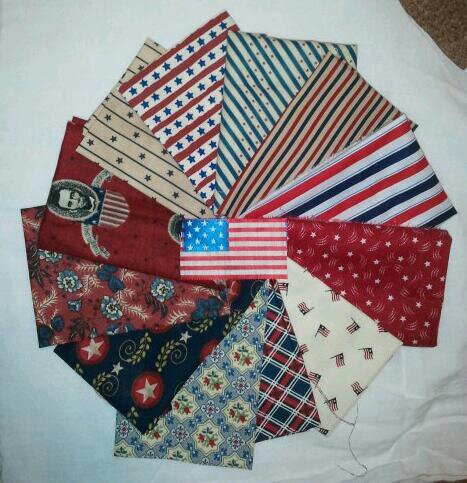
This last swap of the season seemed to fly by. These are the fabrics of the Patriotic Swap, the fun Bonus swap.
image

Don’t these designs look fun?!

Published in: on May 6, 2014 at 4:11 pm  Comments (4)  

A Year in Millinery Fashion – 1864

1

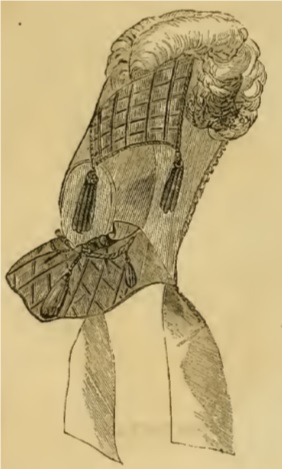
Spring bonnet of white crepe, trimmed with a fanchon of bright plaid velvet and chenille tassels. The cape is of plaid velvet, ornamented by chenille cord and tassels. A long white
plume curls over the front of the bonnet. The inside trimmings is composed of Scotch thistles and heather. (Godey’s, May 1864)

Bonnets are very much more becoming in shape that formerly. They are very close to the face at the sides, but not nearly so high at the top, and slightly flattened at the forehead. The trimming is place at the side or on the crown near the top. If flowers are used, it is generally a large one, such as an iris, or water-lily, and the leaves are left to fall gracefully over the crown. If a single rose, either pink or yellow is used, with one spray of leaves; then, at the side of the flower, there is a bow of ribbon, not the ordinary bow, but a collection of loops standing upright and arranged carelessly; from these loops an end of ribbon is carried across the crown, and finished off at the curtain with a smaller rose, or bouquet of flowers, then at the top of the crown. (Peterson’s, May 1864)

Aunt Betsey on Men’s view of Women’s Work

Moore’s Rural New-Yorker

July 29th, 1861


Letter from Aunt Betsey.

The man that’s telling about his wife scolding on Mondays, is in a bid “pickle,” to be sure. I’d just like to be lookin’ in at the kitchen window next time his “A.” washes, and see how things do go on, for if he’s as much of a saint as a body would think from hearing his side of the question, he really ought to be translated away from all that “domestic discord and discontent.” As for his wife, she must be a dreadful cross woman, troubled with a drop of black blood in her heart, or something of that kind, if she can’t be satisfied when he tries to help her.

There’s precious few men that have the knack of helping a woman more than they hinder, but it always make [sic] good natured just to have Joshua try to help me, even if he knocked down twenty things where he picked up one, and put the fire all out trying to kindle it, ‘cause he showed his good will, and that’s the main thing. I don’t happen to be constituted so that I think a man isn’t a true man – or as near true as anybody gets to be in this world of mortal failin’s – if he don’t always see when he might do a chore to help his wife; for let folks that has boys to bring up, say what they will, and do what they will, to learn ‘em to do chores in the house, if it isn’t in them to be quick to see, and handy to do, they can’t be made over.

But about that scolding and feeling cross on wash days. There’s quite a number of reasons why a woman may feel out of sorts – some of the “Country Cousin” and the rest have given – and seeing that I’ve had the cares of a family (as you may know by my gray hairs), maybe I’m qualified to give a little bit of advice, too. It isn’t in human natur’ to really like to be sweating over a tub of hot suds and soiled clothes, breathing steam and scrubbing till shoulders ache and fingers are blistered; and the men would only have to try it a few times to find that it brought out some dirty streaks, even in their angelic natures; but when it has to be done, a body must make the best of it, and one way to do this is to begin with that first law, order. Know just what you are going to do, and how you are going to do it, then go ahead. If you do your work alone, get your breakfast and have things go on a near right as they generally do; if you go to snapping, you’ll be likely to get snapped at back again, and that’ll be a load for your heart to carry, a slight heavier than any your hands will find. Pick up things, and sweep your rooms, not as thoroughly as you generally do, if you have not the time, but still so that they’ll look decent, for if you’re naturally tidy, having your rooms look worse than usual will be one thing that’ll fret you. There’s something in your personal appearance, too. It’s all very well to have a wash-dress, but there’s no sort of use in having it torn half off the waist, ripped under the arms, or any such thing. I don’t blame men for not feeling much like helping a woman in such a rig, with her hair hanging down her back, like enough, and her face looking as sweet as could be expected in such a settling our; but if you look as well as you may, and ask as pleasantly as you can (if he don’t think to do it without asking) to have wood and water brought for you, you’ll be likely to get it. Then if you are sensible, you will be very glad to have your liege lord say, “Is there anything more we can do to hell you?” to which you will answer, “No, thank you;” and he will go to do his work and you to yours, neither of you to be disturbed by the other’s petty trials if you are wise enough to keep then to yourselves.


Hoping that the afflicted “A.” and his wife may be benefited by confiding their troubles to the public, I am, respectfully, your Aunt Betsey.


Read more “Their Life; Their Words

Published in: on May 4, 2014 at 4:00 pm  Leave a Comment  
Tags:

Woman’s Rights and Aunt Betsy

Moore’s Rural New-Yorker

May 11th, 1861


Woman’s Rights and Aunt Betsy

Seeing a communication from “O.” to Aunt Betsey, and feeling somewhat interested in the old lady, – of whom, by the way, I have some slight knowledge, – excuse the liberty I have taken of saying a few words on the subject, which shall be done with due deference for her gray hairs.

Our aunt, being country born and bred, has a heart, – a real, loving heart, that feels for others woes. She is ever ready to assist the needy or relieve the distressed, and as she is naturally of a very cheerful disposition, I think something must have happened, which “riled” her more than common, when she spoke of woman’s rights. Often does she gather us about her, and many are the words of wisdom which fall from her lips as she relates her experiences in order that we may profit thereby. She is called a kind, charitable person, and I beg you, “O.,” not to judge her by that conversation. I cannot agree with her, for to me life appears like the April day, all clouds and sunshine, and that “Woman’s Rights” are to guard woman’s home from the storms that oft will cloud the domestic sky, and so to arrange her culinary affairs that the “butter and honey” of forbearance and love, in place of being all used at once, shall be spread so evenly on the bread of everyday life. In such a home, the husband, instead of treading her “rights under his foot,” will feel that his right to cherish and protect her is the dearest one on earth. As for the wood and water, not true man will let his wife bring them in while he sits idle, and when he asks for his shirt, it is not because he knows your dislike to tumbled drawers; and does not his smile amply repay you for your trouble. Yes, indeed, and there’s another of your right, to win that smile, from your liege lord, by kindly deeds and pleasant words, and a true woman will value it more than all the rights of suffrage which can be granted her.

I do not wish to be understood as saying that there are no abused women, for alas, there are many such; but I cannot think “the best of men” will so far, forget their manhood as our aunt declares, – if so, oh shades of Horace, deliver me from such a fate. Better for us, Cousin O., to live the unloved, unloving old maid’s life, than the loving but unloved one of a husband’s slave.

Jennie. Dowittville, N.Y., 1861.


Read more “Their Life; Their Words

Published in: on May 3, 2014 at 4:00 pm  Leave a Comment  
Tags:

Queries for Aunt Betsey

Moore’s Rural New-Yorker

April 13, 1861

Queries for Aunt Betsey

Dear Aunt Betsey: – Will you allow one of the “girls” who hasread what you thing of “Woman’s Rights” to say a few words? I like to look at the bright side. Now, honored Aunt, I know that woman’s home is, in many respects, her “world,” and that there are many things to learn away from boardin’s schools and ‘cademys; but Aunty, do you really think we are all going to get our necks broken when we jump off that “precipice” you told up about? I know you did not exactly say so, but then, )we have no precipices on the prairies,) in all the stories we read about people jumping or falling off them, they are sure to get killed. Do you really think, too, that when we “get married” and “go tagging after a man,” we shall “never see him at home?” Are you sure he never will bring in a pail of water or an armful of wood? Will he never ask if there is anyting he can do to help us? Do you know he will be unable to find his own shirt, if we, (as we ought,) have a place for it and keep it there? Must we always leave the shirts till there are a dozen to mend? Do you think it will “take half an hour to find a needle” every time we want one? Is it imposisble to get along without a “honey moon”? – or, can we not have the “butter and honey” spread all over the bread rather than on one spot? Now, Aunty, I will know there will be a great many “briars and sticks.” But will he never help us over them?

If you are sure all these evils will befall me if I get married, your admonitions will save one of your nieces from a “woman’s fate.” Please tell me, Aunt Betsey.

Respectfully, your niece, O. Princeville, Ill., 1861.

Read more “Their Life; Their Words

Published in: on May 2, 2014 at 4:01 pm  Leave a Comment  
Tags:

Image Link – 1860s Children & Toyes

I just stumbled upon this image of a father, daughter and her toyes. It is a staged photo. But, full of information.

http://cdm16694.contentdm.oclc.org/cdm/singleitem/collection/p16694coll8/id/1085/rec/98

Published in: on May 2, 2014 at 11:38 am  Comments (1)  

Woman’s Duties

Moore’s Rural New-Yorker
April 6, 1861

Woman’s Duties
My subject you may call a trite one, and such I fancy it will be unto the end of time, if the newspapers of our land continue, as persistently as ever, to herald forth the duties, obligations, and dependency of woman. I must say I have become perfectly disgusted with this constant prating. One might as well imagine that woman was utterly ignorant of her peculiar duties and adaptations, and that the rest of the race, in commiseration thereof, had set them selves up as her instructors. Now, with all due deference to the wondrous knowledge possessed by the “lords of creation,” it certainly seems to me that females are usually quite as intelligent as the other sex, and I imagine they know about as well how to “act well their part in life.”
We are told again and again, that home happiness depends mostly upon the wife, mother, sister, and daughter. Don’t we know this? Don’t we know that after a day has been spent in the discharge of the many wearisome household duties, and the husband and father, sons and brothers, return from their labor, or, as in frequently the case, from lounging in some public place talking politics, – listening to or retailing scandle, – don’t we know that, under such circumstances, some tact is necessary to meet dissatisfaction and discord with content and pleasantness? to have things so righted round, and straightened out, that home shall present a cheerful aspect?
Besides this, there is a wonderful cry among some about the dependence of woman upon man. It sounds in our ears from the Atlantic to the Pacific, – by priest and people. Why, they say, of course, they are particularly dependant [sic] upon us, – of course, they Bible says do. I have known men that could quoite only one passage of scripture correctly, and that you will find in Collossians, iiic, 18v. Moreover, common sense teaches it. If this is common sense, I am glad I was endowed with it.
Now, we know that we are, in some sense, dependant creatures, – that one person must rely, somewhat, upon another; but the wife is no more dependant on her husband, than he upon his wife. Supposing his earning do provide the provisions and clothing, what’s it all going to amount to if his wife does not know how to use these things to the best advantage? How is a man to gain wealth, if his wife or daughters spend faster than he can earn. Many a man has acquired wealth who never would but for the economy and thrift of his industrious wife, and many are struggling now to provide the mere necessities of life, who might have been prospering, had they, in the management of their business, heeded the advice of the wife. But, dear me, no, – they are not going to have a woman interfering in their affairs; and thus they often come to be dependant upon the exertions of their “better half,” for the support of themselves and families.
They talk to us, too, of our great influence upon society, – how essential it is that we should be models of purity and goodness, so that all who come within this magical influence shall be metamorphosed there-by. Now, how potent soever this may be in some cases, when I see the sons of some of the best mothers following so closely in the footsteps of upworthy fathers, I am convinced it is necessary somebody should be good besides the mother.
When clouds of darkness and sorrow surround the pathway, who endures best the blast of adversity, – is it man? Nay. In the severe trials of life, the stern man is often the soonest shaken, and finds himself dependent upon the weak woman for aid and sympathy, – the closest observers of human nature have testified to the truth of this.
Some talk much of the great necessity of woman being Christians. Is it because the soal of man is less precious, – because he is holier by nature, or because his responsibility to the Creator is less? – that he considers it so much more oblicatory upon females to yieled their wills to the Saviour? Such is not the case. They know that the influence of the Gosple is to make one meek, patient, long-suffering, under all circumstances, and such a spirit as this they like to deal with. One that will not conflit with their pet whims and might wills. In most instances, when you really probe to the bottom of the thing, you will find it is all selfishness which prompts this cry about the great adaptation of religion ot the hear and life of woman. That there are noble exceptions I grant, but among the masses they are few.
You men who are so supremely particular about your food, your clothes, and, in fact, everything, – who want your wives and children always to be apple-pie order, and think they can keep so, no matter what engaged in, how do you suppose you would manage to gratify your exquisite taste, without the aid of some one or more of those depenant beings called women? Don’t you believe there would be some muddy coffee, – some burnt cakes, – some ragged garments, and some tumbled linen? It really distresses me to think of it. But, after all, what’s the use of talking or writign? To be sure it frees my mind a little, but that is not much consolation, when the conviction is constantly forcing itself upon me that,
“A man convinced against his will,
Is of the same opinion still.”
Gainesville, N.Y., 1861. Maude Elliott

Read more “Their Life; Their Words

Published in: on May 1, 2014 at 4:06 pm  Comments (1)  
Tags:

Love it Hate it….

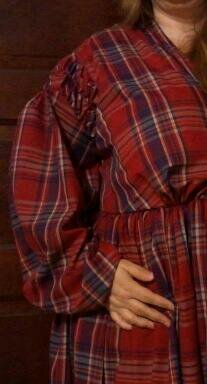
I had this nice long, photo filled post that my phone ate. It came down to…. I can’t decide if I like this sleeve or hate it… if it looks like a huge, sloppy coat sleeve or a quasi-close enlarged elbow.
It was reworked from a flopped inspiration in a rush to meet a deadline, which also includes another dress & two full pieces of millinery.
Photos sans-undergarments:
image

image

Do I shorten the cuff & trim it (narrow bias going up the outside)?
Recut it into an open sleeve (despite having 2 other semi-sheers with open sleeves)
Turn the sleeve over and recut it?
Or???

Published in: on April 30, 2014 at 10:09 pm  Comments (2)  

Woman – Incentives to Duty

Moore’s Rural New-Yorker

March 30, 1861

Woman – Incentives to Duty

It is a well-proved fact that woman is an inferior existence; – that she never ascends to the highest pinnacle of intelligence, and takes the blessings which Heaven offers? Is her soul so dead that she never longs to drink from the deep fountain of intellectuality, at which her brother man satiates his thirst for immortal good?

With one earnest glance of life, all these interrogations arise, and a solution, either correct or incorrect, followers. In studying these living marvels, we find it to be an invariable fact, that the of intelligence which illuminate the human mind, are convergent in the mind of man, and divergent in the mind of woman. Man concentrated every ray of truth upon a specific object until he can clearly see to perfectly accomplish that object. He perfects the thought that interests him most, and thereby makes proficiency in something. Woman’s thoughts are seldom, if ever, brought to a focus; consequently there is not the requisite light in her mind to enable her to penetrate any intricate subject, and, therefore, she makes proficiency in nothing. The fault is not that Nature did not make an equal distribution of gifts, but that woman, by will and circumstance, has become almost incapable of excelling in anything useful. It is true that some, comparatively very few, have excelled in literature, science, and aft, but these few have scrupulously obeyed the aspirations of the soul, and listened to the whisperings of genius as to the commands of a divinely commissioned teacher.

Another cause of the mental inferiority of woman is, that she allows herself to be attracted by every passing vanity, and instead of consulting the garden of the mind, she neglects it altogether, and spends the golded moments “in stooping the pinion back to earth, which beareth up to heaven.”

It is the climax of folly for women to complain of oppression, until she better improves the privileges that she now possesses. When the era shall arrive in which woman will walk just as far as permitted in the field of truth, then we shall see the gates opening into other, and more extended, avenues, that she may go on and on, until she reaches the fountain of perfect justice. Worthiness will secure for her the longed-for equality! It is but seldom we find a woman who possesses genuine nobility of soul, – that sterling principle which causes her to be a purifying element in society, – and it is because she has so long stooped to the conformity of foolish and fashionable customs, that she is mentally deformed; and while she is being “delightfully entertained” in the gossiping circle, man is pursuing something useful, and increasing, therefore, the disparity of mind, and also position!

Impatience is another cause of woman ever being with the substrata of society. If, perchance, a glorious thought springs up in her mind, she cannot wait for its maturity, but, in her eagerness, she gives it to the world only half grown. She evidently cannot learn that a thought needs time, as well as a nutriment, to complete its beauty and usefulness.

Man is not the oppose of the elevation of woman that is frequently supposed. How often have we heard good old orthodox people say that, “we can have the religion we live for.” Thus it is with woman, she can have all the rights for which she will live.

Amie W. Livonia, N.Y., 1861

Read more “Their Life; Their Words

Published in: on April 30, 2014 at 4:00 pm  Leave a Comment  
Tags: