Readings for Rural Life

From Moore’s Rural New-Yorker in Rochester, NY

Sept 24th, 1861

Fires in the Bedrooms.

Most people, even many intelligent reformers have the idea that to sleep in a cold room is good – essential health. It is an error. It is better to have an open fire in your bed-room. The atmosphere is not only by this means constantly changed, but with the fire you will keep the window open, which will add greatly to the needed ventilation. But more than his, with the fire you will have fewer bedclothes over you, which is a gain, as a large number of blankets not only interferes somewhat with the circulation and respiration, but prevents the escape of those gases which the skin is constantly emitting. Even furnace or stove heat with an open window is better than a close, cold room. Interchange with the external atmosphere depends upon the difference between the temperature of the air within and that without. But let us have the open fire. Let us go without. But let us have the open fire. Let us go without silks, broadcloths, carpets, and finery of all kinds, if necessary, that we may have this beautiful purifier and diffuser of joy in all our houses. In my own house I have ten open grates and find with coal at eleven dollars the expense is frightful, and if it were in any other department of housekeeping I should feel I could not afford it; but in this I do not flinch, so important do I deem the open fire. Dr. Lewis.

 

Published in: on September 24, 2014 at 6:04 am  Comments (1)  
Tags:

A Year in Millinery Fashion – 1864

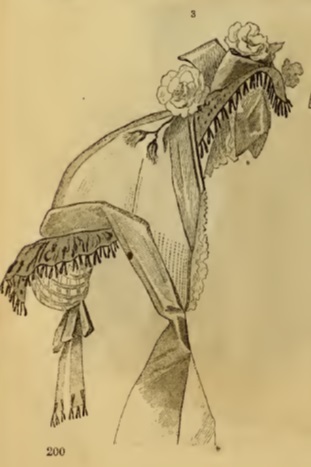
A Leghorn bonnet, trimmed
with a salmon and black ribbon. The feathers are black. The inside trimming is
composed of scarlet velvet, black lace, and salmon-colored flowers.  (Godey’s, September, 1864)

3

Published in: on September 22, 2014 at 1:01 am  Leave a Comment  
Tags:

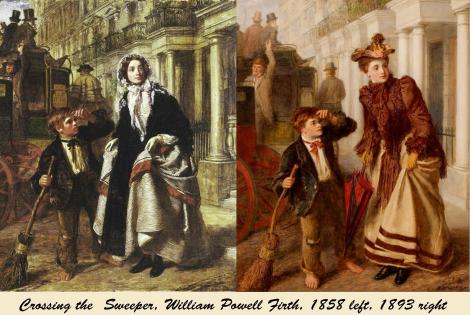
Comparing the Crossing

crossing

Published in: on September 20, 2014 at 9:20 am  Comments (1)  

Children’s Headwear

Lately, I’ve been hearing an assortment of “kids didn’t wear…”, “children only wore…”, “she’s too young for….” and so on.

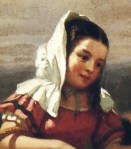
Ehhhh…. not so much. Children had a variety of headwear to choose from. Here is an attempt at a survey of paintings to help us get a better idea. (Clicking on the thumbnails will take you to the full paintings)

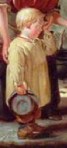
Let us start with this little boy from Britain.  The title, A Visit from the Hall, suggests his family rents or works the land.  He is young. I would estimate 2 or 3 years of age. He wears a long smock that may be a dress and what might be the start of pants underweight. He holds a cap in his hand.

A Visit from the Hall Edwin Cockburn 1855This little girl is getting direction from her mother, in Responsibility by Hugh Cameron (1869). I can’t help think “Little Red Riding Hood” here. Except instead of a red hood she is wearing a white, possibly blueish, soft bonnet or hood. It may be a quilted bonnet. The weather may or may not be slightly chilled outside, as she wears a light outer garment and not arm coverings. Responsibility  by Hugh Cameron 1869

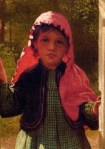
In this Cameron painting, The Village Well (1871), the girl is wearing a short sleeve dress, pinafore and pretty pink sunbonnet. This appears to be a corded sunbonnet to me. The curtain/bavolet is long, hanging over her shoulders protecting her neck. In her hand (sorry I cropped that) is a jug for water. The Village Well Hugh Cameron 1871This girl coming through a garden gate is also wearing a pink sunbonnet. This one has a ruffle around the brim and a much longer curtain. At the Doorway  John George Brown 1867

This girl’s sunbonnet is white. You can see it tied under her chin with a ribbon that appears to have color. The Picnic John George Brown 1861For an additional sunbonnet, see Pay Toll.

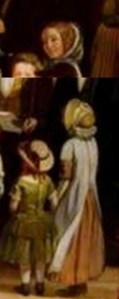
The next few images depict fairs. Looking at the whole paintings, we see a wide variety of clothing. In Alfred Mudge’s Walking the Walsall Fair (1859) we see two girls wearing structured bonnets, meaning buckram or straw bonnets. The lower image shows a girl who wears a pinafore type garment over her dress which is just above the ankles. I think she is 11 to 14. Her bonnet hints at straw while distinctly showing the bavolet and ribbons. She is holding the hand of another child, possibly a girl if that is long hair, who is wearing a hat with a ribbon. In the upper image, which is to the right of the first girl in the whole painting, is a girl who may be a bit younger than the first. She wears a bonnet perched far back on her head, to the point of falling off. Walking the Walsall Fair by Alfred Mudge 1859This next child is a bit blurry because I tried to zoom in too far. She is from William Samuel P. Henderson’s Fair Day (1856). She is quite young, maybe 3 to 5. She wears a dark, possibly black, structured bonnet tied with light, possibly blue, ribbons under her chin. Fair Day by William Samuel P Henderson 1856

For additional “reading”, this page has several good paintings for clothing in general.

Also see, Looking out for the Engine while the Bell Rings for an assortment of head wear.

Published in: on September 19, 2014 at 6:50 pm  Comments (1)  

Still Life with Bonnets, caps actually

Still Life with Bottles and Breton Bonnets is a slightly different still life than the usually pretty arrangement of dishes and fruit or pretty flowers. How lucky are we that Pierre Roy decided to paint it?!

Published in: on September 19, 2014 at 4:40 pm  Leave a Comment  

FanU “Fallen Leaves” Swap

Wow, this first swap of the fall went fast! It may have just been me. But, I received 1 envelop. Then, I received All the envelops.
It was so much fun opening that stack and seeing all the pretty fabrics. It seemed quite suitable that the fallen leaves arrived as the air turned such a chill. Let me tell you, boy do we have a lot of fallen leaves here.
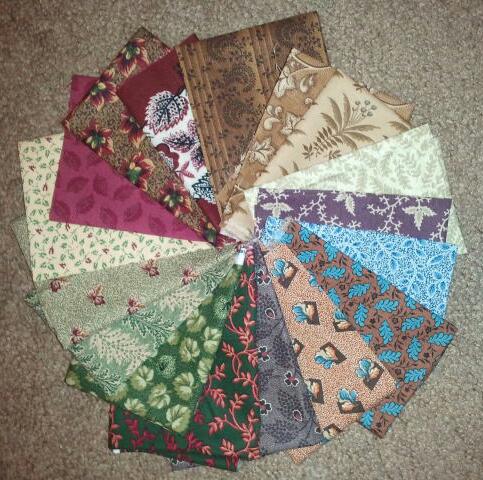
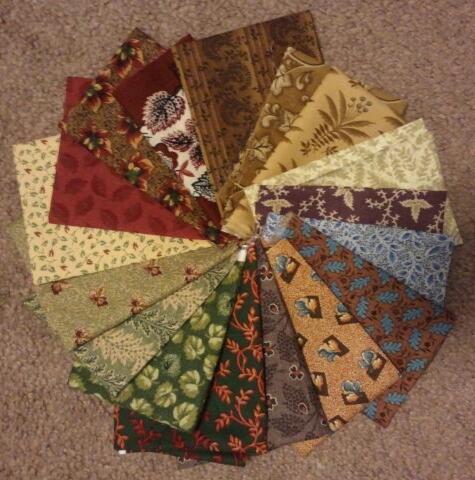
As most of you know, I get migraines. So, this round I didn’t do well at all sorting the fabrics into group 1 and 2. So, we have 1 big photo. Well, 1 collection with 2 photos, a non-flash and a flash.

image

image

In this grouping we have so many pretty prints spanning a few decades. (We’ll get to talk more about techniques when we get to the ‘Greene’ swap later.) Though, I will say I can se some that were roller prints and at least one I suspect was a bloc print. One is called “Dancing in the Rain”. Another called “TossedLeaves”. We have pieces that come from Old Sturbridge Village and the Victoria & Albert Museum. One is a DAR fabric. There are fabrics from the Civil War Melodies collection, the Windham Winter Carnival collection and the Dargate Botanicals.
Something that I enjoy personally is seeing which fabrics Grandma had or that she likely would have picked. This groups was strong in those respects.
Thank you to all my FanU swappers for participating. I look forward to the next swap!

Published in: on September 16, 2014 at 4:05 pm  Leave a Comment  

Worth Reading: Berlin Woolwork

This is an inspiring survey of Berlin Woolwork. There are a few pieces that would work for the memorial project. At the same time, the cats are so cute. (Which reminds me of an embroidery piece that really aught to be on the wall.)
http://victorianneedle.blogspot.com/2014/09/kristen-berlin-woolwork.html?m=1

Published in: on September 15, 2014 at 6:58 pm  Comments (1)  

A Year in Millinery Fashion – 1864

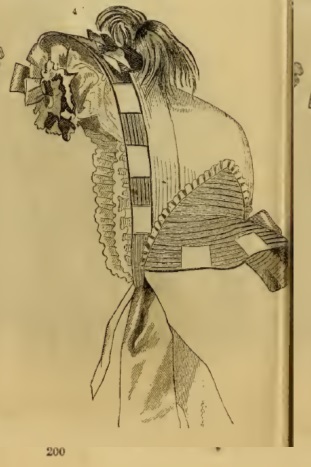
White silk bonnet, trimmed with violet ribbons and pink roses. A net formed of ribbons is attached to the bonnet.  (Godey’s, September, 1864)

3

Published in: on September 15, 2014 at 1:01 am  Comments (2)  
Tags:

Readings for Rural Life

From Moore’s Rural New-Yorker in Rochester, NY

Sept 10th, 1861

The economy of crinoline is thus discussed by a French writer: – Dresses require, to be worn over hoop s, at least three meters more than would be needed if worn over an ordinary skirt. As no less than twenty millions of ladies’ dresses are made every year in France, the additional quantity of material necessitated by the use of hoops is sixty millions of meters, which, taken at an average price of two francs per meter, makes a sum of one hundred and twenty millions of francs. In addition must be mentioned the extra quantity of material employed in the manufacture of the hooped petticoat itself, and the long, ample underskirt worn between the crinoline and the dress. This extra material can not be counted at less than one hundred and twenty millions more. The average cost of the hoops and the making of the cages can not be taken at less than an average of fifteen and fifty millions to be added to the cost of the woven goods calculated above. These three sums together make up a tribute of three hundred and ninety millions francs, or about one-fifth of the State Budget, paid yearly to a ridiculous and inconvenient fashion.


Published in: on September 10, 2014 at 6:02 am  Leave a Comment  
Tags:

A Year in Millinery Fashion – 1864

Pearl-colored crape bonnet, trimmed with black lace. A fan of pearl-colored silk and white feathers, The trimming inside is of pink ribbon and stiff white feathers. (Godey’s, September,
1864)

3

Published in: on September 8, 2014 at 1:01 am  Leave a Comment  
Tags: