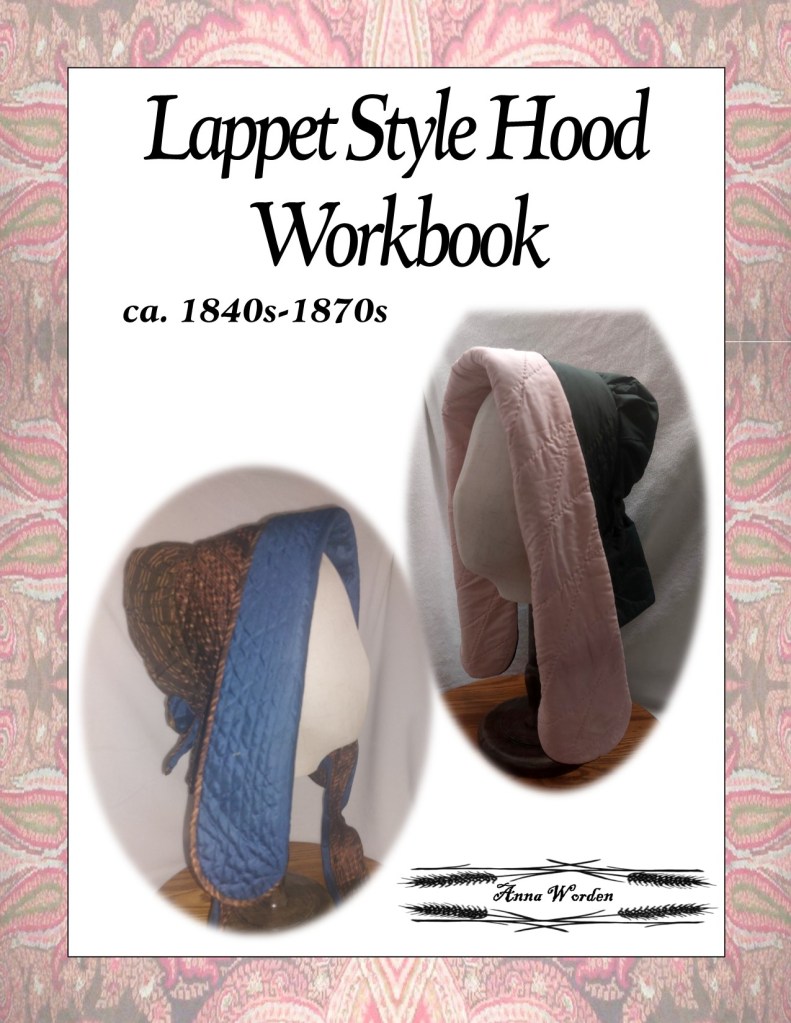
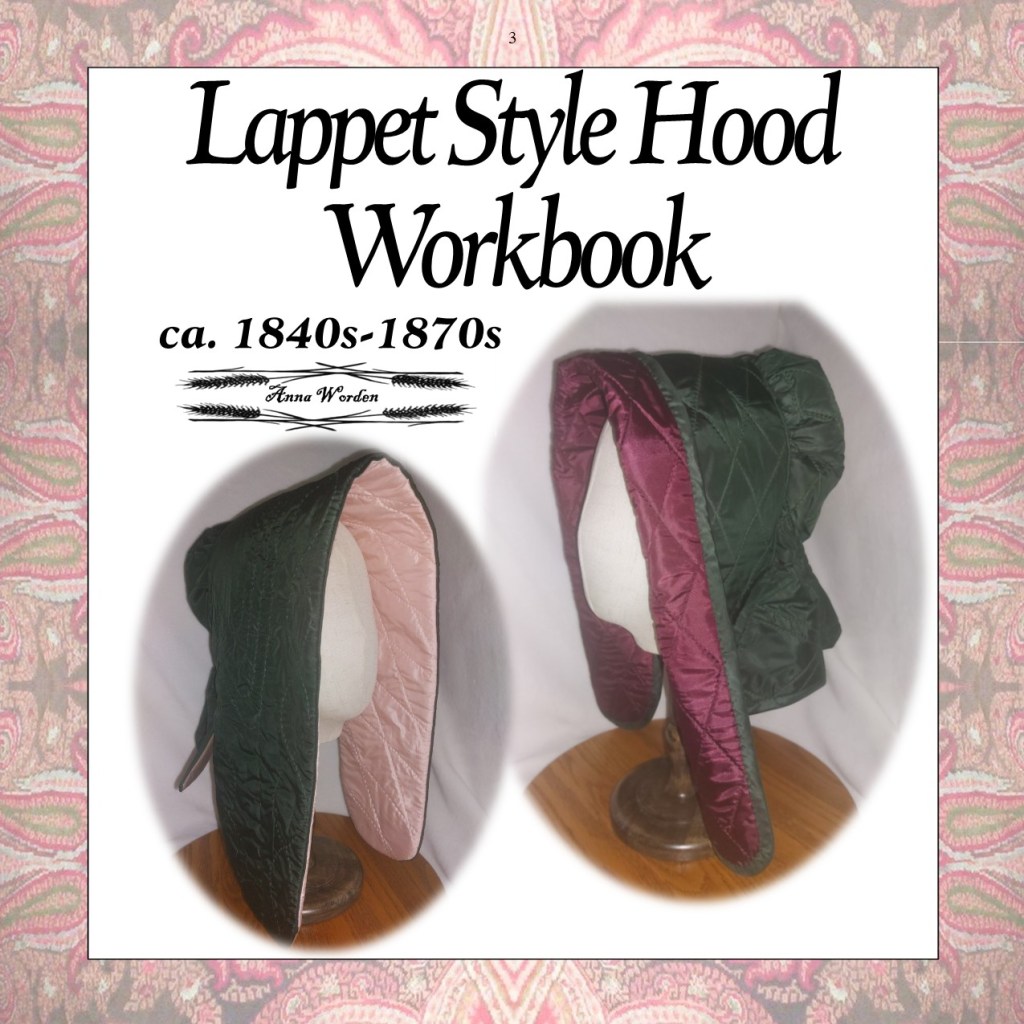
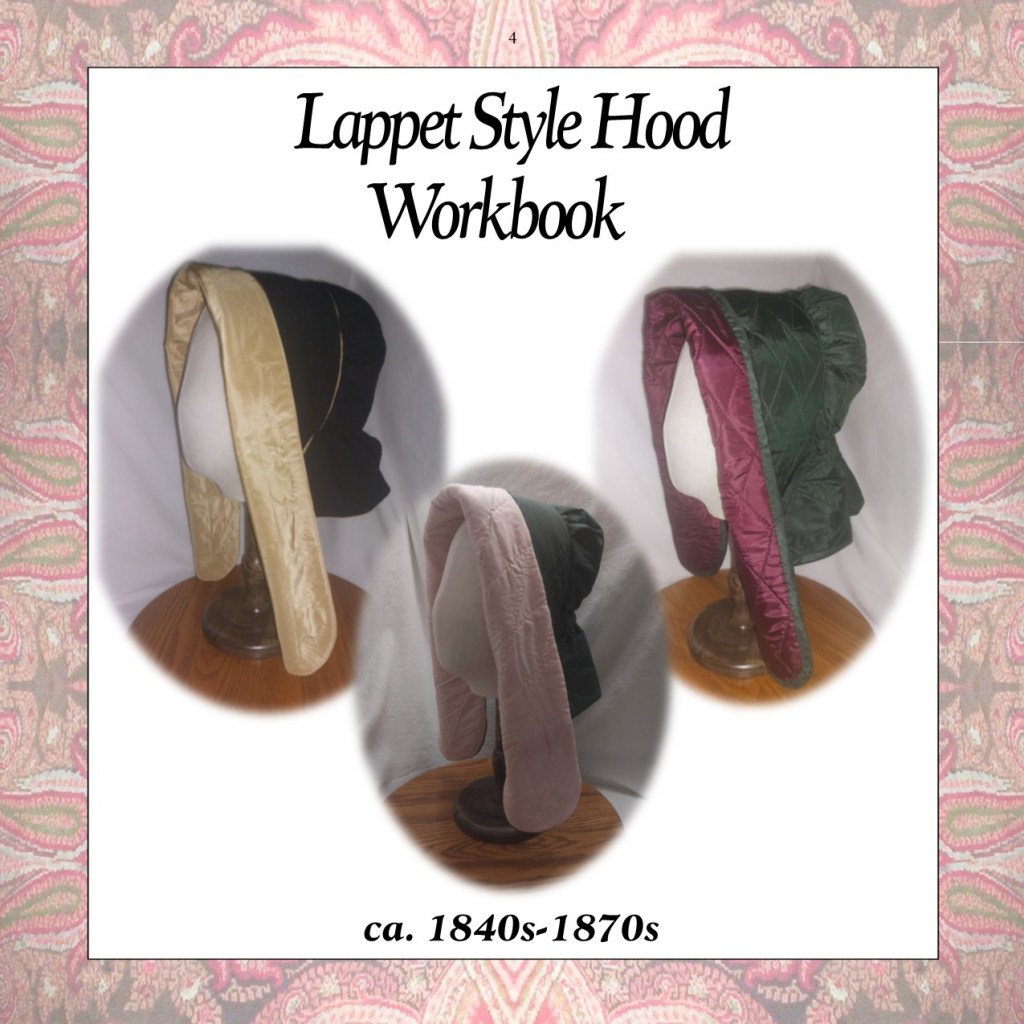
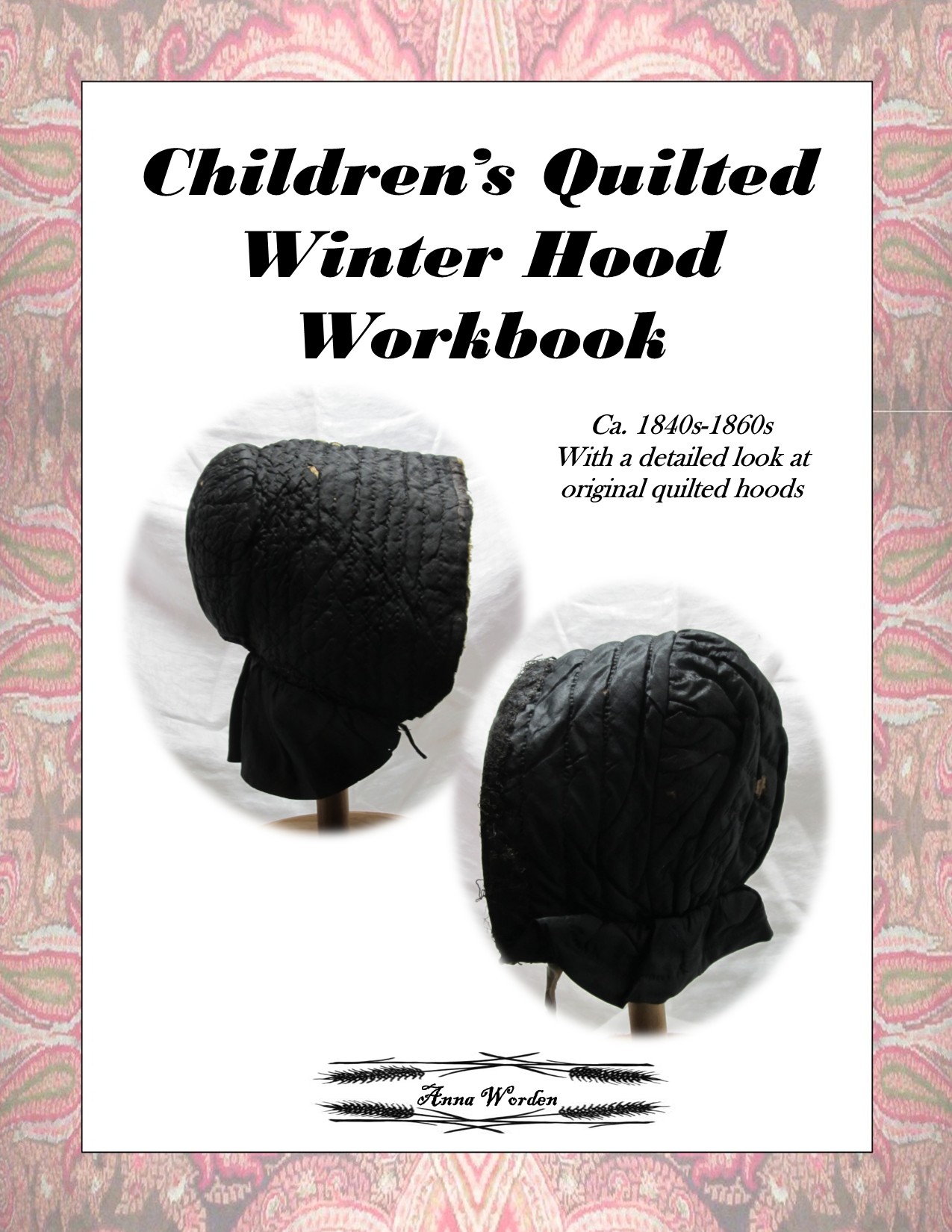
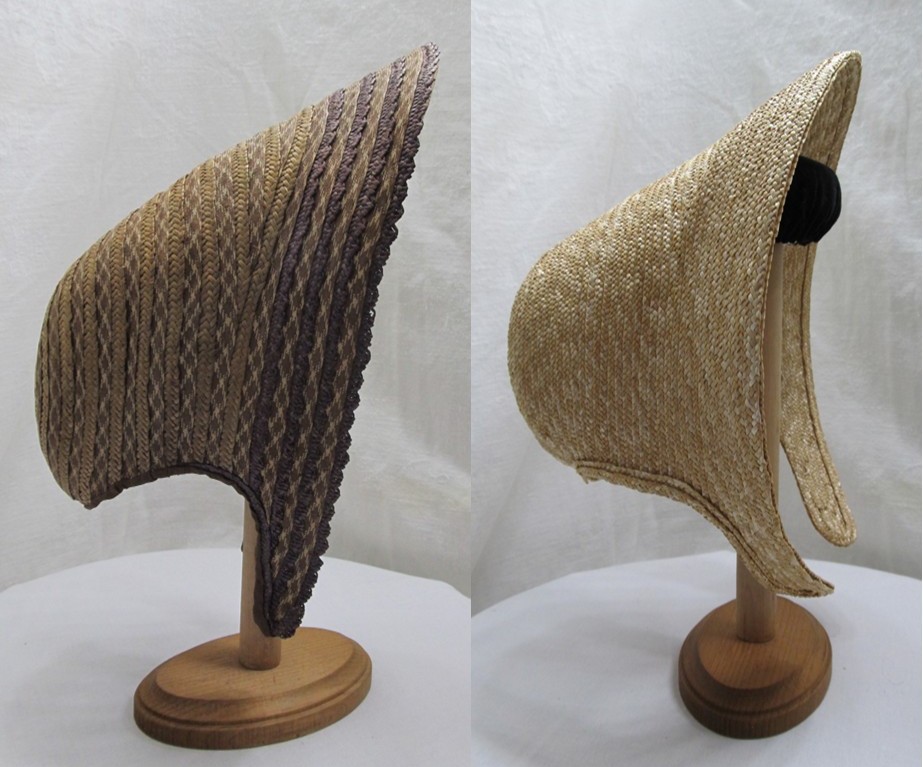
I am excited to announce the release of my new Lappet Style Hood Workbook!
In the past ten years, since its initial publication, my Lappet Style Winter Hood Pattern has been one of the most popular of my patterns.
This style hood is so lovely, it deserved a full workbook.
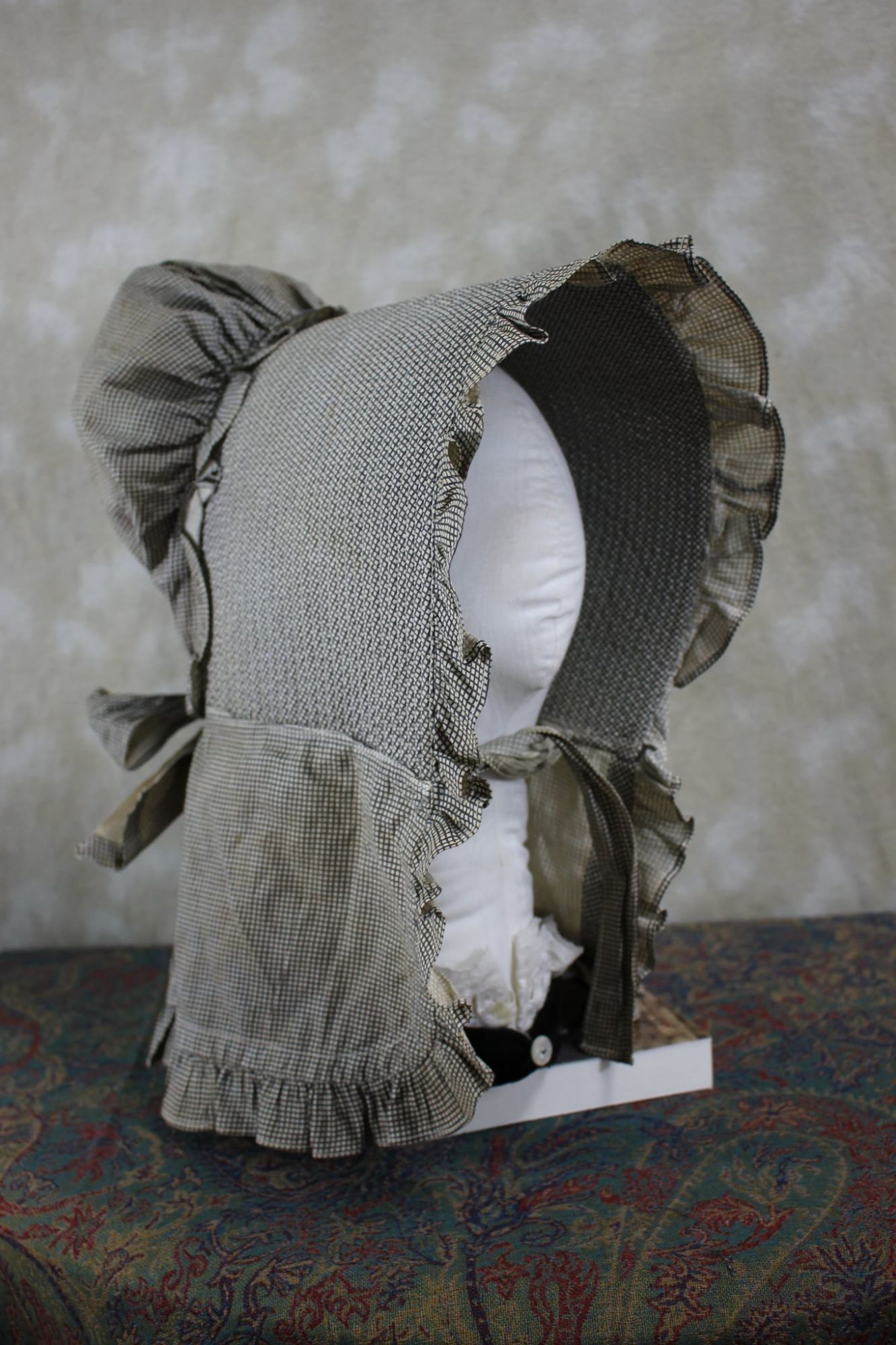
Now, you can see the details of an assortment of original lappet style hoods from my collection, ranging from light fall warmth to deep cold protection, from an economically pieced practical hood to an ingenious style mash-up with ultimate warmth in mind.
And, of course, directions for making your own hood.
The directions section is like a choose-your-own-adventure as it is filled with options to create your own lappet hood using historically accurate techniques.
Bonus: This workbook’s pattern pieces have 2 different printing options. I formatted them on 8.5″×11″ for printing at home and on 18″×24″.
The doll version of this hood will be coming soon-ish.
It seems odd to say I am mourning the loss of a computer program. But, with Microsoft eliminating Publisher at the end of September, I find I am. More so, I am mourning the loss of my work.
I am mourning the loss of decades of work forever frozen in PDF or in files that can not be opened. Hundreds, thousands of hours of writing and re-writing, layout, editing, cropping and fine-tuning
Frustration
Tears
Dried out contacts
Missed meals
and finally, Joy or even Glee upon completing a publication.
I estimate 70 to 80 percent of my work is in Publisher. Prior to recent years as spreadsheets have dominated my “day job” life, that number was much higher. For a little more than a quarter century, I have used Publisher to create workshop handouts, patterns, templates, little pamphlets, holiday freebies, e-books, and full workbooks.
For each publication, I have bits and pieces of thought, layers of process to get from an idea, a vision to come together into something presentable. The space around a Publisher page filled with fragments – photos, illustrations, passages that belong somewhere. Often five versions of a title waiting for me to decide which I like. That vast gray space acted as a worktable and an extension of my brain at the same time.
While I mourn the loss of my thought process for completed materials, I mourn my incomplete projects more. I have countless projects laid out in Publisher, incomplete spread across pages waiting for me to find the time to return to fill in the rest. Among them:
Children’s Quilted Winter Hoods (This is a skeleton half formed)
Pieced & Patchwork Pockets (A publication I planned for this summer)
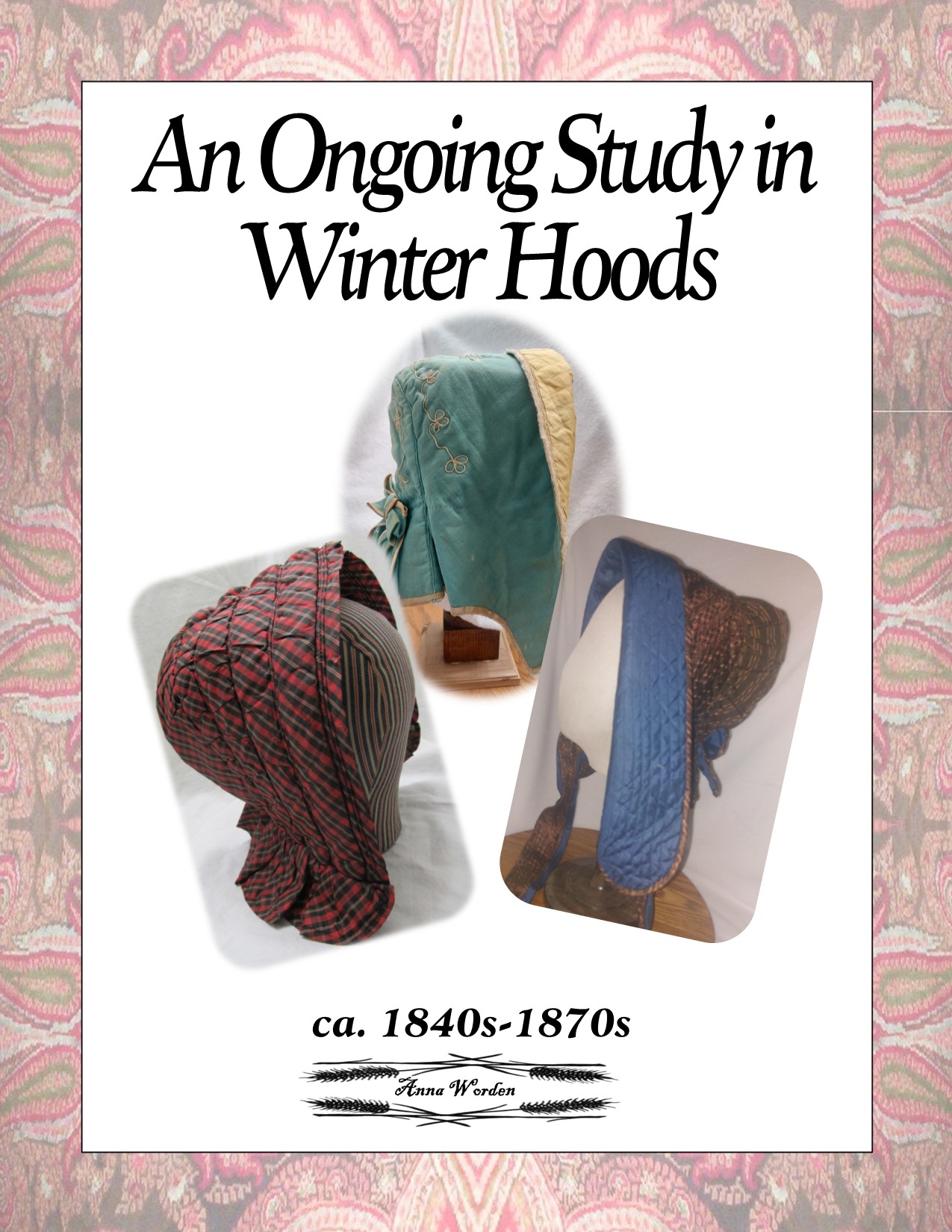
An Ongoing Study in Winter Hoods (A comprehensive volume on my work with winter hoods)
A publication on dolls used in sewing accessories
The 1840-1850s straw bonnet workbook
The 1880s capote bonnet workbook
I’ve been trying to save what I can. But, the reality is these materials saved as PDFs or page jpgs might as well be lost because they are not longer in a format that can be easily pieced back together. Quality is lost. The skeleton of the project is lost.
Each will need to be started again from scratch… after I choose, pay for, and learn a new platform/program.
In the end, losing Publisher and not being able to easily open decades of my work feels much like moth-balling a program, be it the end of a literacy program, or a summer camp. I am sad. I feel loss. I mourn.
I am retiring my 2016 Lappet Style Hood Pattern soon.
This winter hood pattern has been a favorite for years. But, after a decade, it deserves an update!
I am currently working on writing a new Lappet Style Hood Workbook!
This workbook will follow the format of my other winter hood workbooks, beginning with a discussion the style and a detailed look at extant hoods in my collection. Then, it will walk you though making your own hood with historically accurate construction and techniques.
Plus….. I am also writing a doll version! I have yet to decide if this will technically be a pattern or a workbook. I can say I have already drafted pattern pieces for 2 porcelain sizes!
My hard deadline is the end of September because that is when I lose access to Publisher, the platform I use. (After that, all other publications, including Patchwork Pockets, are on hold until I can select and purchase a new platform.)
My plan is to retire the 2016 pattern before the workbook release. This way, no one unknowingly buys the pattern version right before the workbook release.
If, for some reason, you really want the original pattern version, please buy it soon. It is currently $7.80 with my Back-To-School sale.
Ideally, I would have a big pool of billheads(receipts), an assortment of ledgers from many different milliners, and a few dozen diary entries to create a database of prices based on year, region, area, time of year, type of piece, etc..
Then, I would feel like I had a hint of an answer.
But, I don’t have that. I don’t think anyone has that.
Bonnets varied in materials. Even when looking at straw bonnets, there was a vast variety of quality. Then came trims. The ribbons, feathers, flowers, bobbinette, lace, etc all varied in price. Year, season, and location were all factors.
For years, I saved every 19th century bill/receipt that came up for sale. I have purchased several within a particular focus and my budget. I have a collection of wholesale billheads for every purchase a smaller milliner made for a year.
Even with this slowly developing pool, it is impossible to answer “a bonnet cost __this___ much.”
A single billhead can show the price of items from particular stores in a particular region in a particular year. When billheads are gathered together, for a milliner, for a region, for a year, a picture begins to develop.
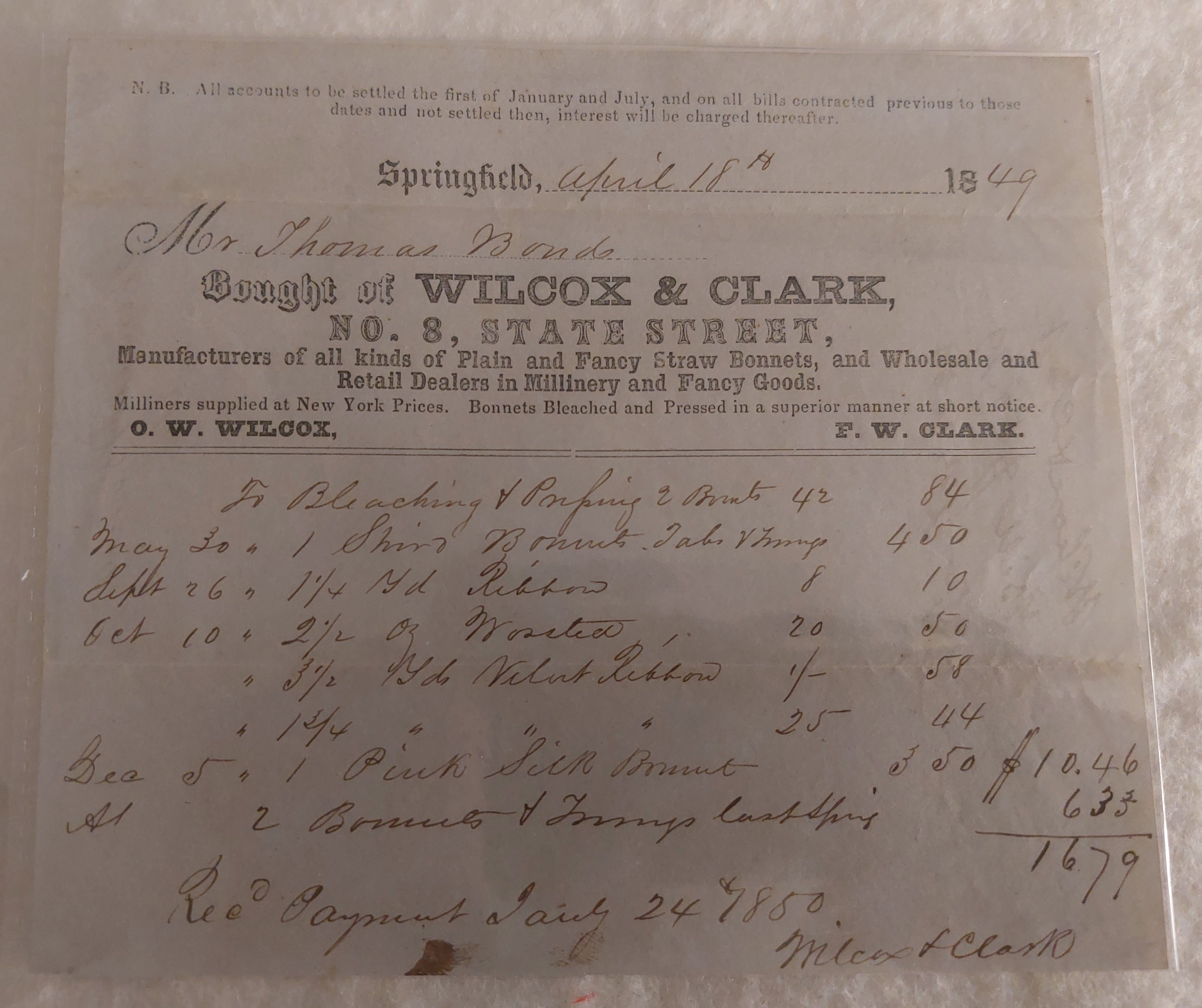
Sometimes (a rare accurace) a single billhead can give us a little more. This bill from 1849 lists several items purchased.
One trimmed bonnet cost $4.50 in May. A pink silk bonnet cost $3.50 in December. Two bonnets and trimmings “last spring” cost $6.35. (This bill also tells us the products and services this shop in Springfield provides, the frequency in which this family of an unknown number of women purchases bonnets, and the delay in payment from “last spring” to April, 1849 for this bill to January, 1850 for the payment.) ….
Diary entries like these from Caroline Richards of Canandaigua, NY give us a look at the prices she paid for her millinery:
Wednesday, 1854 – Ann Eliza is going down street with us this afternoon to buy us some new summer bonnets;. They are to be trimmed with blue and white and are to come to five dollars. We are going to Mr Stannard’s store also, to buy us some stockings.
April 12, 1856 — We went down town this morning and bought us some shaker bonnets; to wear to school. They cost $1 apiece and we got some green silk for capes to put on them. We fixed them ourselves and wore them to school and some of the girls liked them and some did not, but it makes no difference to me what they like, for I shall wear mine till it is worn out. …
Saturday, 1854 – We got our new summer hats; from Mrs Freshour’s millinery and we wore them over to show to Aunt Ann and she said they were the very handsomest bonnets she had seen this year.
If I have to give a price, I can give a window for the mid century of as low as $1 for Shaker bonnets for school to $4.50 for a decorated silk bonnet. But, my answer has holes in that these examples span two different geographic regions and come from two different size cities.
Do you enjoy reading my blog? Do you find it helpful? Please consider supporting through Patreon or Sending a Tip.
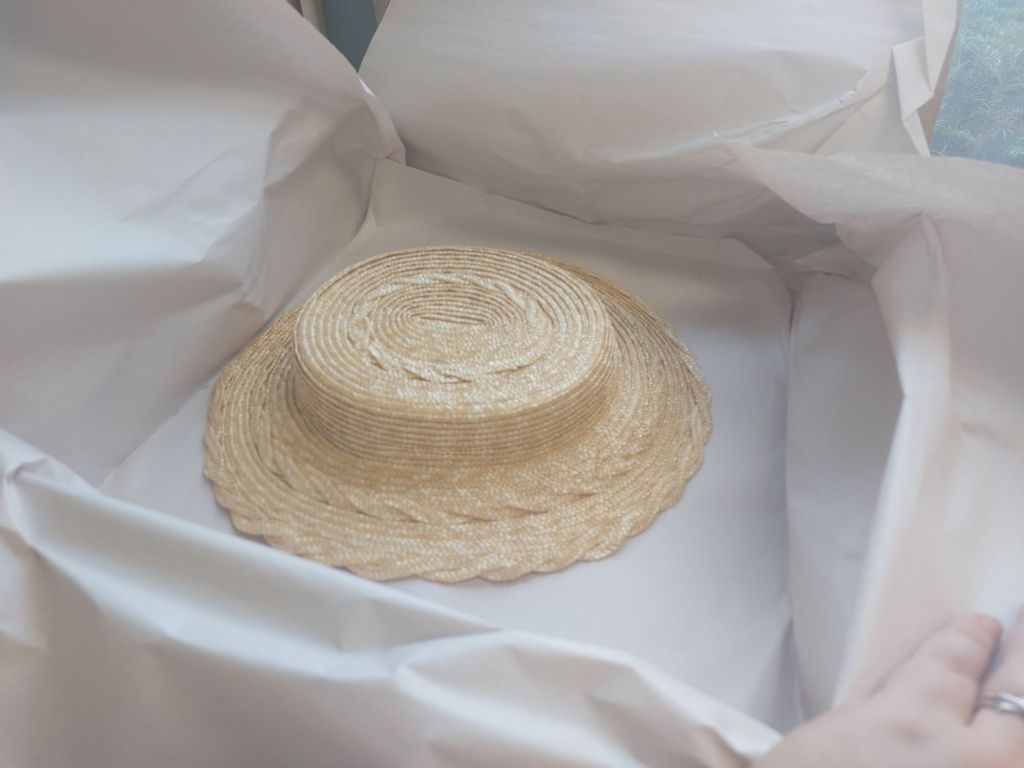
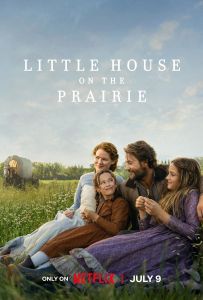
I finished this hat just barely in time for the release of Little House on the Prairie. I shipped it on July 6th, thinking it would arrive July 8th, in time for the owner to have it in the 9th.
It seemed to be moving as expected, arriving in the destination state’s distribution center the morning of the 8th. Then it just stopped. For the next 3 weeks, there was no movement on tracking.
Nothing.
This morning, while dropping off other packages, my Post Master had a very sad looking box for me. Somehow, the shipping/postage sticker printed at the PO fell off at some point.
I had purposefully switched from Priority Mail boxes to these brown cardboard boxes for many if my hats & bonnets because I had issues with the free PO boxes getting damaged, particularly in one region. This was the first time I had one of these brown boxes get damaged like this.
I surmise a heavy box, or multiple heavy boxes were placed on top of this box, crushing nearly directly down.
Seeing how crushed the box was, I was hesitant yet still hopeful.
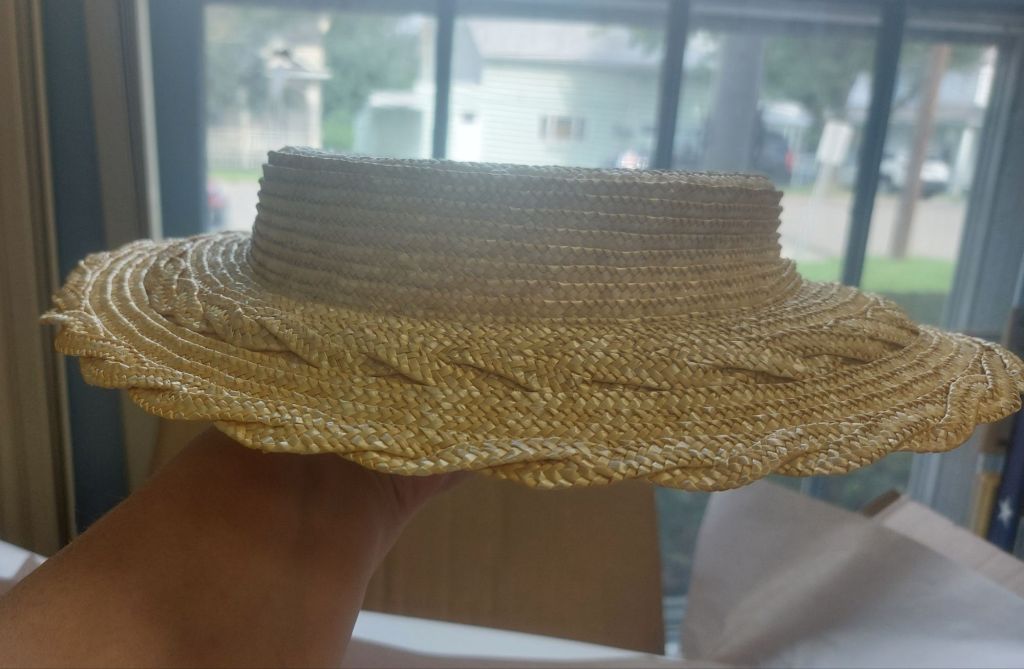
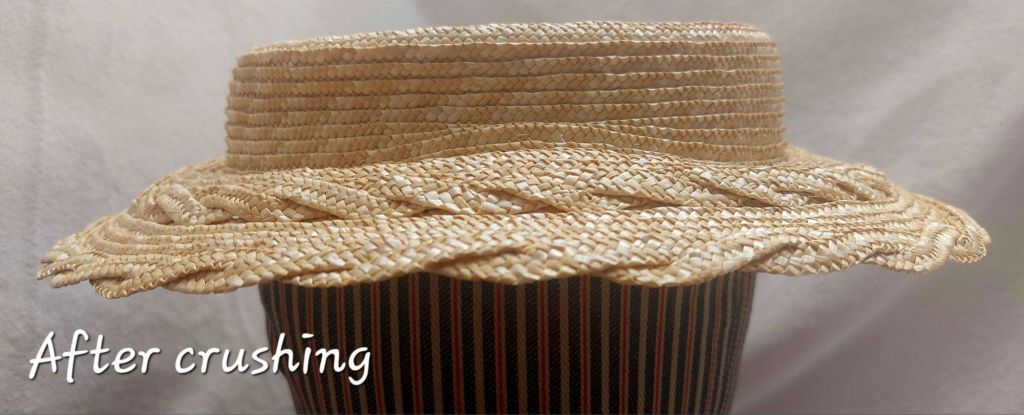
I opened the box right at the Post Office, just in case. I was pleased to see the straw hat inside withstood the box being crushed around it.
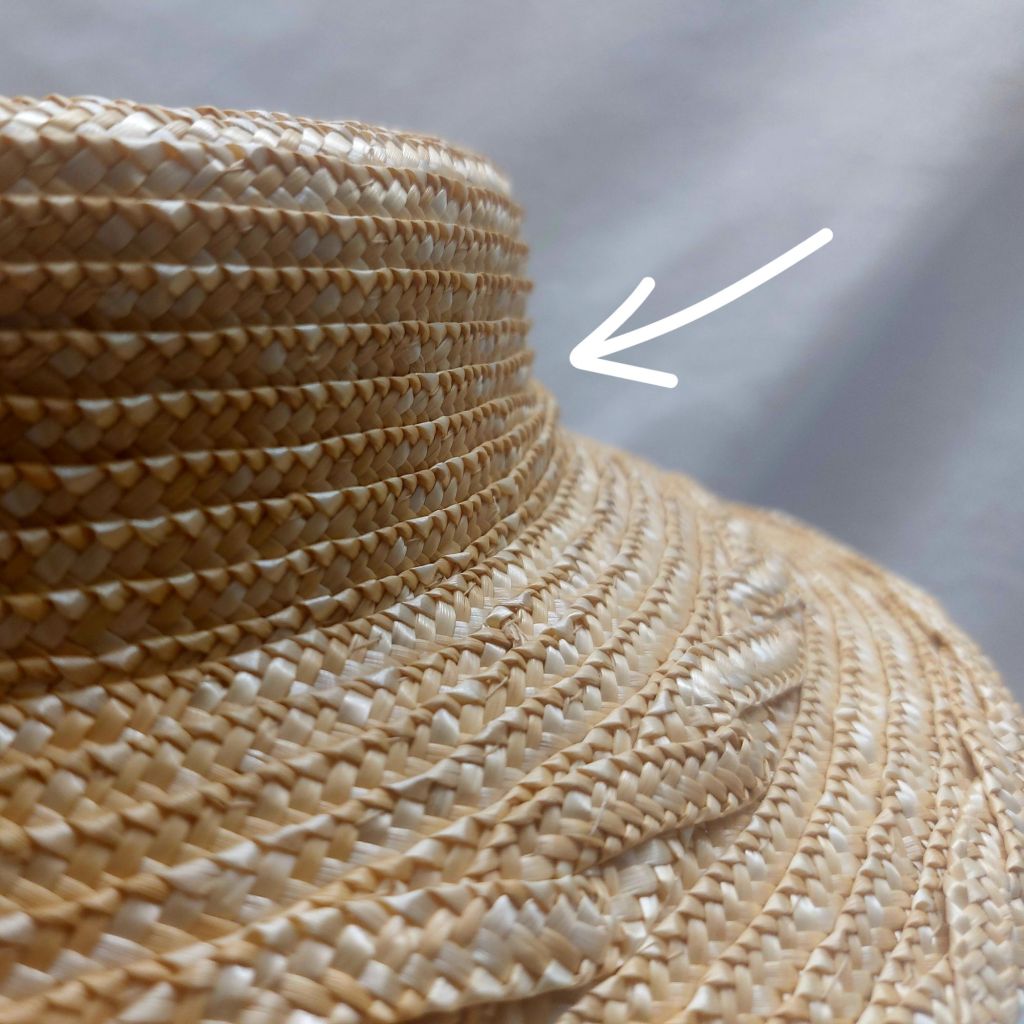
No straw was broken.
No stitches were broken.
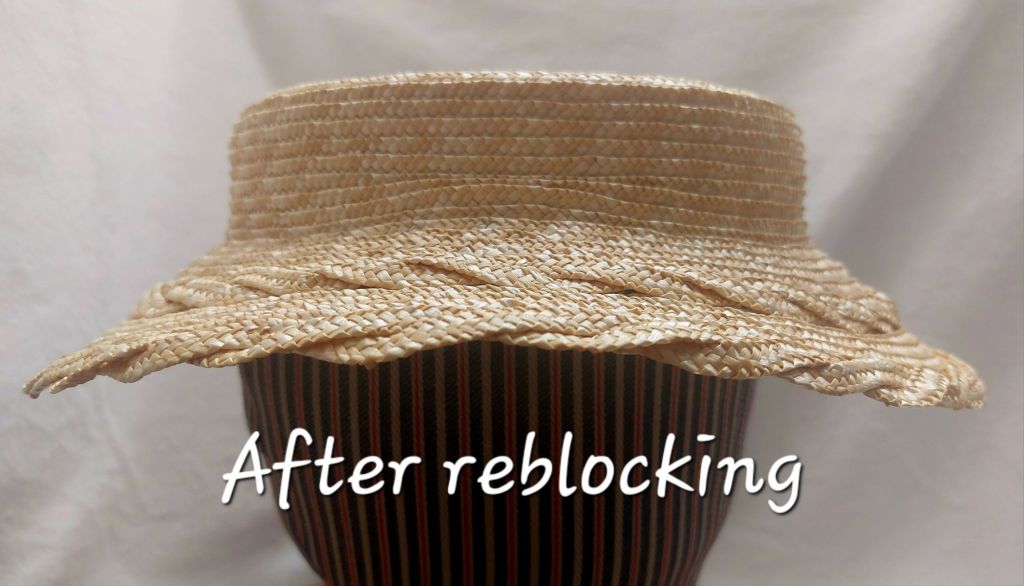
There was minimal misshaping, all of which could be fixed with re-blocking. Re-blocking happens to be a common practice in the 19th-century.
The front right of the brim pushed down, creating a small concave.
The whole brim flattened bit. I suspect the box was crushed somewhere where it was humid, which allowed the straw to soften while crushed.
All in all, I am glad the hat wasn’t completely lost or destroyed. This goes to show just how durable well-made straw hats can be.
When Little House on the Prairie premiered, I intended to write a post introducing the hats and bonnets I made. Instead, I found myself swept into the conversations surrounding the bonnets. Questions about their shapes, styles, and historical accuracy filled my inbox and social media, and before I knew it, I had written several posts explaining nineteenth-century bonnets. In all of that excitement, I realized I had never actually shared the two hats that also made it to the screen.
2 of my hat styles appeared in season 1 of Little House on the Prairie. One is worn by Caroline Ingalls and the other is worn by Emily Henderson.
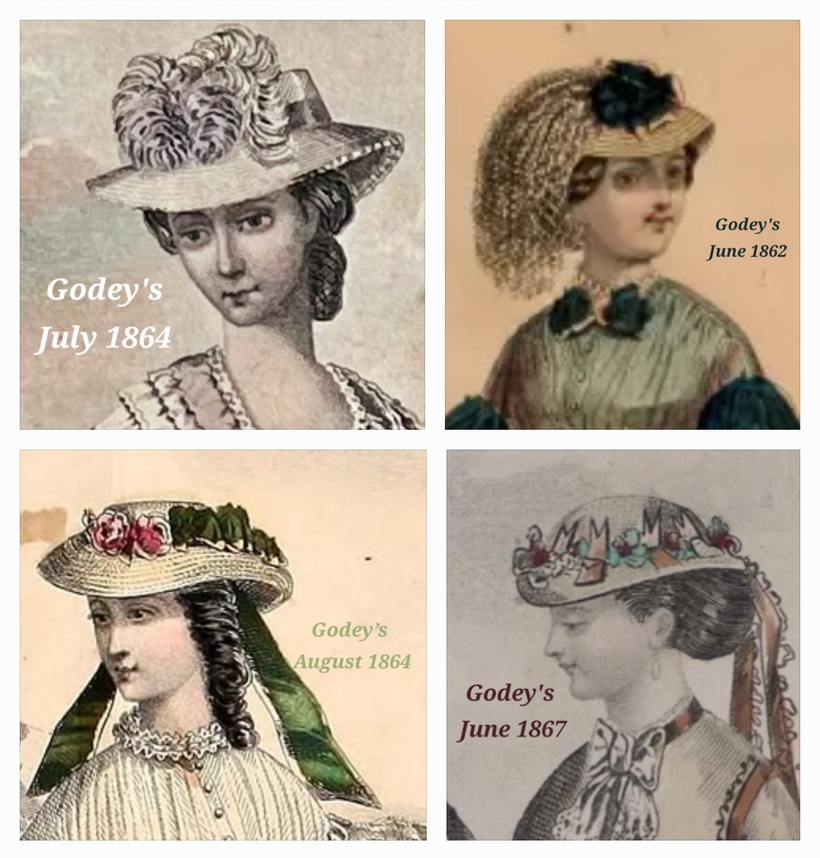
Godey’s July 1862
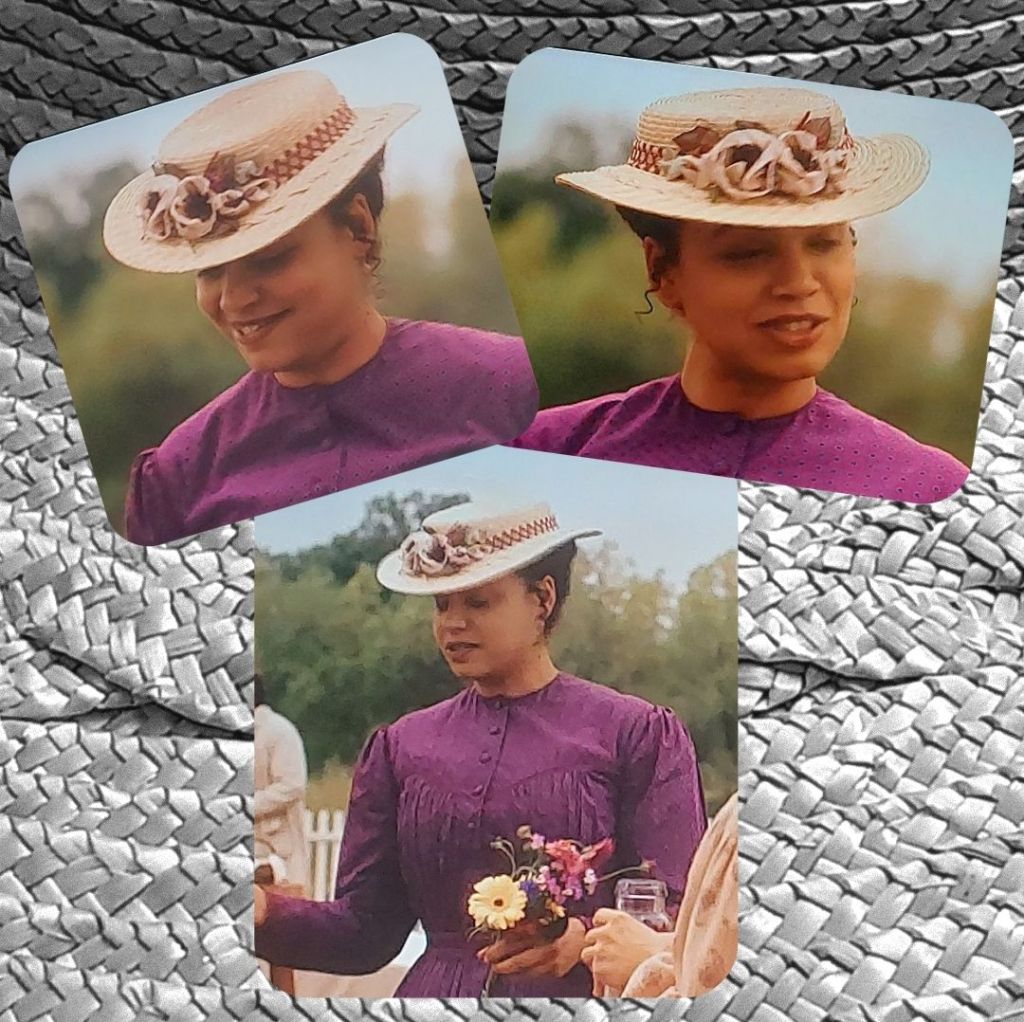
Emily first appears wearing her hat during the day of the church yard social. Her hat is a style very popular in the 1860s. This style is possibly the most commonly illustrated in the decade. The crown is shallow and tapered, while the flat brim dips in the front and the back. A band of vining straw circles the brim in the middle. This hat is a nice balance of determination and sweetness.
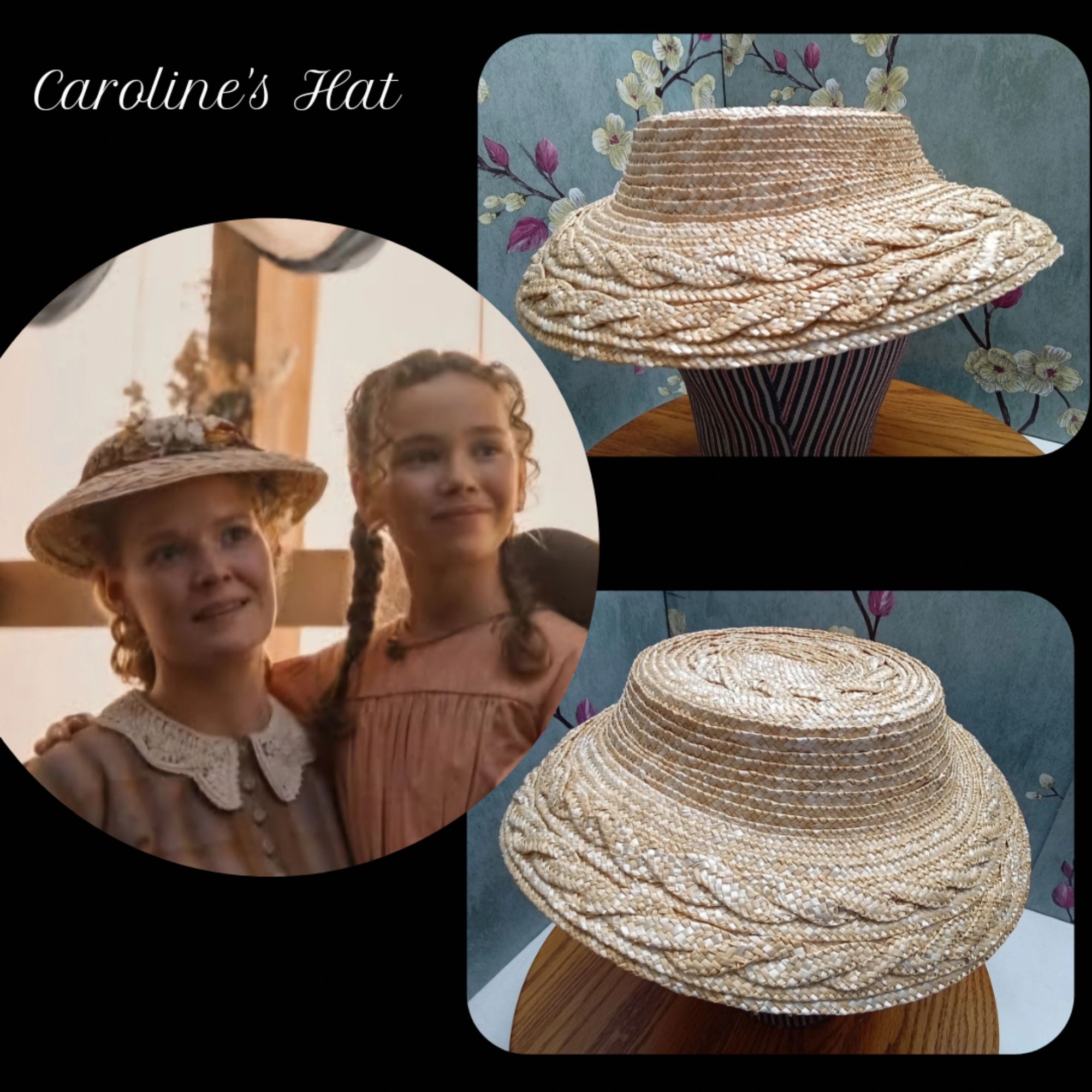
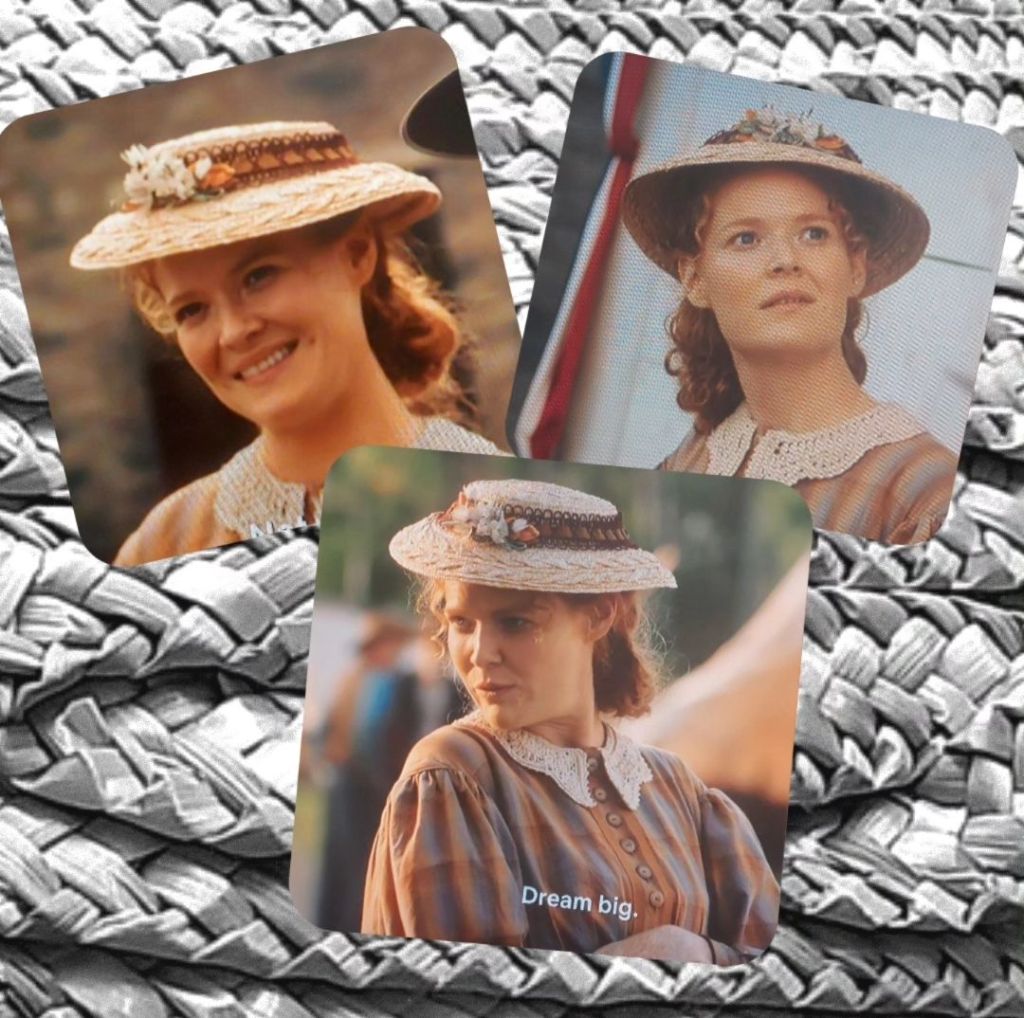
Caroline wears her hat to the ladies’ social at Jemma James home. Her hat is an 1860’s fashionable hat with a shallow, tapered crown and shaped brim curving down all around while dipping in the front and back. This style hat is seen in fashion illustrations of the 1860s and in carte de vistas of the era.
Caroline’s hat is made special with bands of vining straw wrapping around the crown top and brim. This vining straw is hand shaped by curving two lengths of plait as it is sewn in place while building the crown and brim. This vining moves the eye around her hat while adding texture for the camera to capture.
Although Emily’s and Caroline’s hats are different styles, they were made using the same traditional hand-sewn techniques I use for all of my nineteenth-century straw millinery. Each hat begins as a hank of straw plait, which I hand-sew coaxing the straw into shape. Every step, from sewing to shaping to the final finishing, is done by hand, much as it would have been in a nineteenth-century millinery workroom. I just have the luxury of modern lighting, a softer couch, and Netflix.
One of the things I appreciate most about nineteenth-century millinery is that a well-designed hat complements the wearer rather than competing for attention. It frames the face, balances the figure, and supports the overall impression.
At the same time. ensuring a person feels pretty, beautiful, powerful, and/or their best-selves while wearing of my hats of bonnets is important to me. Admittedly, sending my millinery out into the world to be trimmed by someone else can be a little nerve-wracking, whether it is a single piece to an individual or a half dozen to a costume department. As my coworkers can tell you, I am working on letting go.
In watching season 1, I found I didn’t need to worry. I was delighted to see how my hats contributed to the vision for each character as well as how the costume department trimmed the hats. Each hat was trimmed in a way that suited both the historical style and the character wearing it, allowing the hats to become part of the storytelling rather than the center of attention.
Much of the recent discussion about the bonnets has centered on whether they are “correct.” Before we can answer that question, it helps to understand that not all bonnets served the same purpose. A fashionable straw bonnet and a cotton sun bonnet were different garments, designed for different occasions. Comparing one to the other is a bit like comparing a evening gown to a work apron.
Types of Bonnets in the Mid-19th Century
This is a generalized diagram of how I classify types of bonnets worn during the Mid-19th century, ca 1840 through 1870. This diagram does not include specialized bonnets such as those worn by religious groups, organizations, or mourning attire. This diagram also does not include caps, which are a different type of accessory in the case of decorative caps or personal garment in the case of sleeping our house caps. Hats are noted but not elaborated on. I placed hats off to the side in this explanation to keep thing simple.
Bonnets of the mid-19th century can be broadly grouped into two categories: Fashion Bonnets and Functional Bonnets. Fashion bonnets were worn as fashionable accessories, while functional bonnets were designed for practical purposes such as protection from the sun or cold weather. This is a simplified overview intended to help explain the basic differences. (Pardon the creative variation of an outline—WordPress doesn’t have an outline format.)
A. Fashion Bonnets – Worn as fashionable accessories. Provided little to no sun protection. Styles changed seasonally. Typically trimmed with a combination of ribbons, flowers, feathers, etc.. Typically made by milliners and purchased.
A1. Straw Bonnets – Bonnets made from plant fibers such as wheat, rye, and oat. Can incorporate additional fibers such as horsehair and spun glass.
A1a. Straw Plait Bonnets – Created from straw braided into lengths called plait which are hand sewn into shape.
A1b. Woven Straw Bonnets – Created from straw woven into the shape of a bonnet. Can be a closed or open weave.
A1c. Fancy Straw Bonnets – Created with a combination of braiding, weaving, and crocheting straw and twisted straw threads. Often open designs that can look lace-like
A2. Foundation Bonnets – Bonnets made with foundation of a stiffened or firmly taut material such as buckram, willow, or net over wire.
A2a. Silk Bonnets – Exterior material, most commonly silk, is arranged smoothly over the foundation. Can also include other materials such as velvet and lace.
A2b. Drawn Bonnets – Exterior material is arranged over the foundation gathered on canes or cords.
B. Functional Bonnets – Worn for a functional portion of the wardrobe. Styles and construction change slowly. Often made at home. Could be made from reclaimed materials such as an old dress.
B1. Sun Bonnets – Bonnets with the primary purpose of sun protection. The brim keeps the sun off the face while the curtain keeps the sun off the neck and shoulders. Most commonly made from cotton or wool.
B1a. Slat Sun Bonnets – The brim is supported by pasteboard, chipboard, or thin wood strips inserted in the brim between the exterior and interior layers. This brim can not be turned back.
B1b. Corded Sun Bonnets – The brim is supported by rows of cording between the exterior and interior layers. This brim can often be turned back.
B1c. Quilted Sun Bonnets – The brim is supported by rows of quilting stitches, often but not always with a layer of batting, additional fabric, or stiffened fabric inside. Some of these brims can be turned back.
B2. Winter Hoods – Type of usually soft bonnets worn during the winter to protect the wearer from the cold and weather.
B2a. Wadded Winter Hoods – Loose wool roving, down (feathers), or reclaimed wool is stuffed into channels creating a pillow-effect. Warmest of the winter hoods. Brim edge hugs the face.
B2b. Quilted Winter Hoods – Layers of batting are placed between the exterior and interior fabrics, then quilted in place. Brim is often turned back to reveal the lining and improve peripheral vision.
B2bi. Lappet Style Winter Hoods – A style of quilted hood with long extended portions to the brim.
B2c. Draped Winter Hoods – Structureless winter hood that drapes over the head. Includes novelty hoods from lady’s magazines.
This is only an introduction to the wide variety of nineteenth-century bonnets. Each branch of this diagram has its own history, construction, and changing fashions. Of course, there are many variations and exceptions, but recognizing the difference between fashion bonnets and functional bonnets makes it much easier to understand the styles and variations.
Enjoying this article? Consider tipping on Ko-Fi or supporting on Patreon.
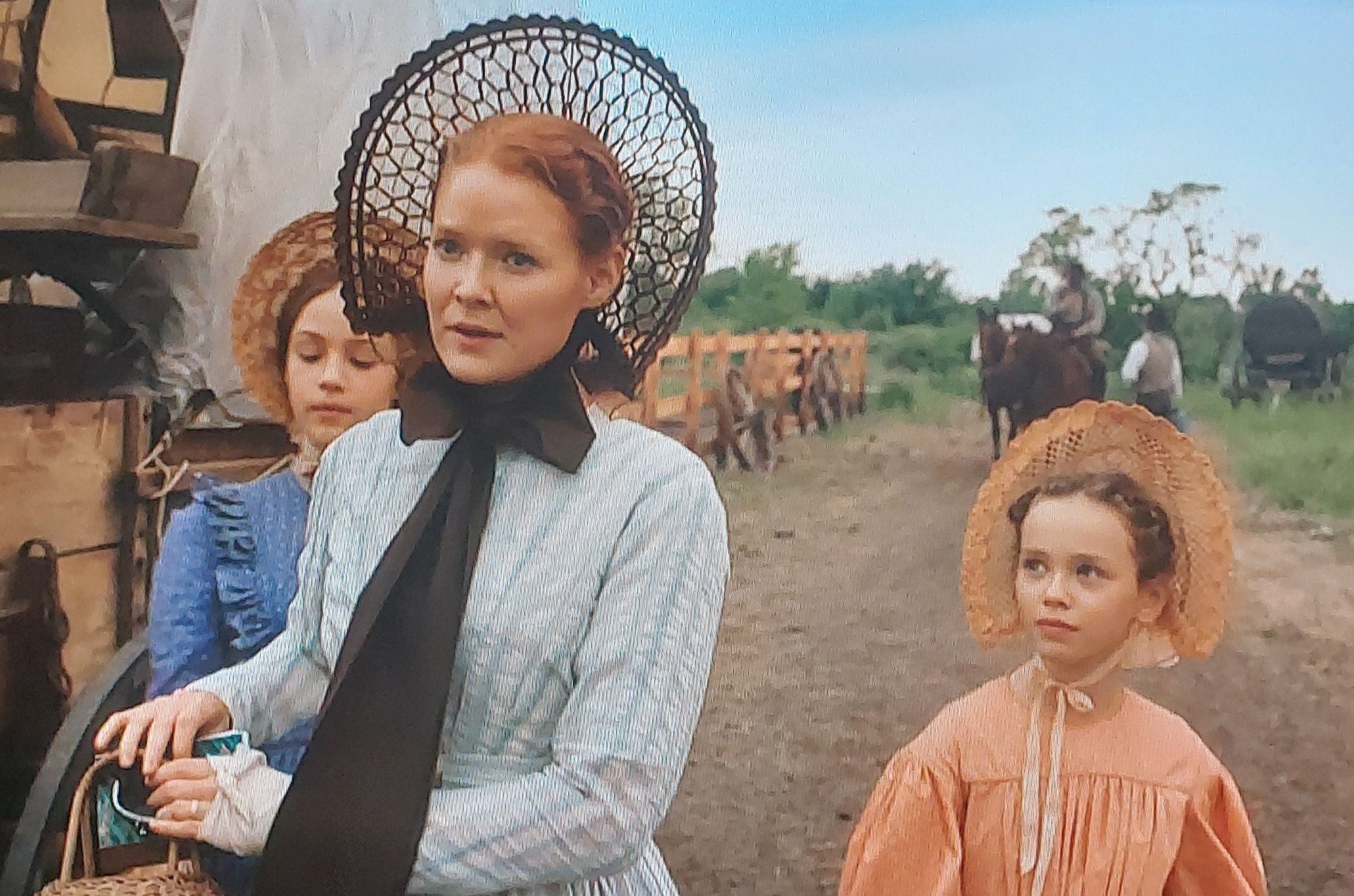
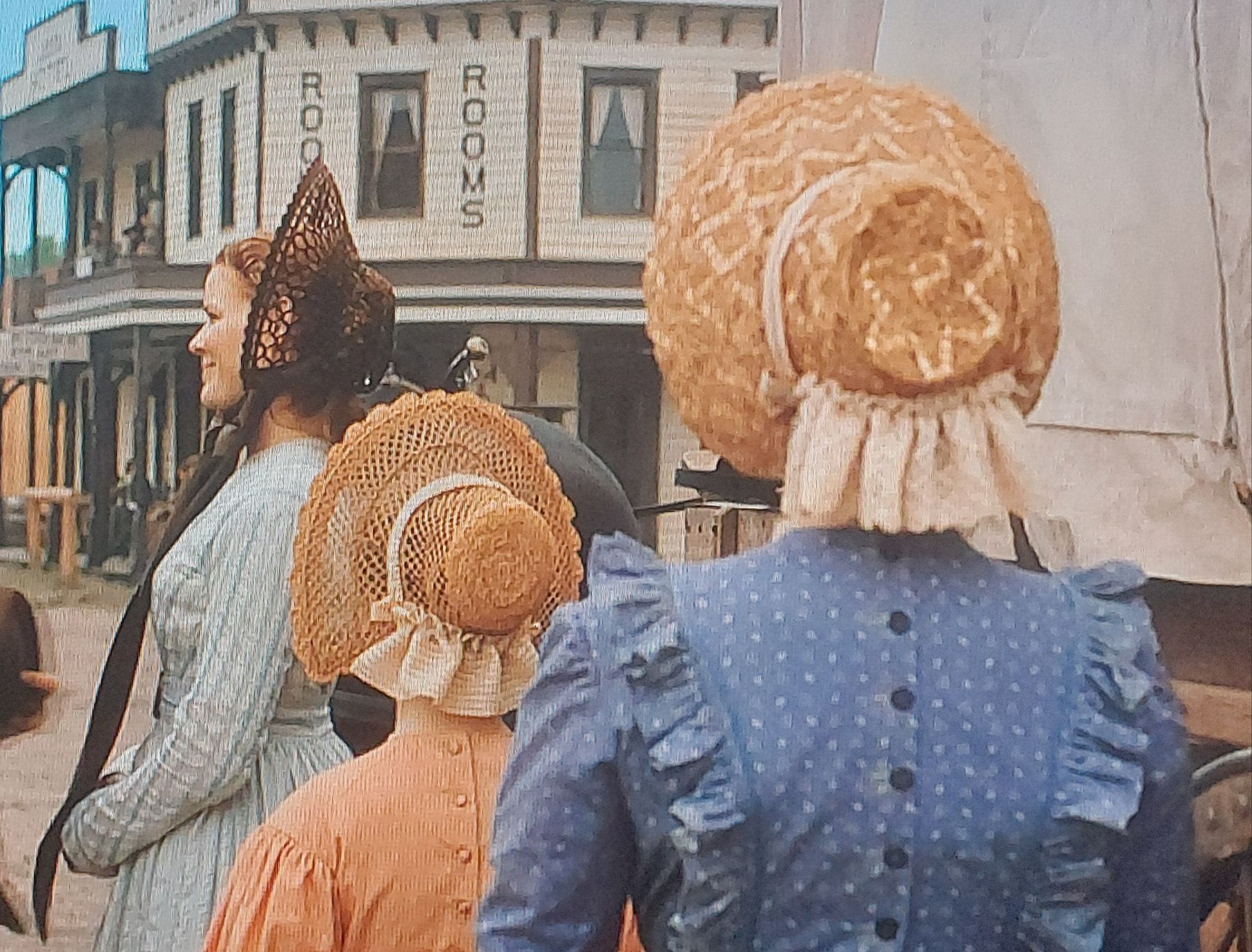
I have had a myriad of questions about the straw bonnets Caroline, Mary, and Laura are wearing as they enter Independence for the first time. Questions in post comments, private messages, text messages, in-person, and on the live watch party. Questions ranging from what “are they?” to “how accurate are they?” to “did you make these.”
The shortest, easiest question/answer is: No, these bonnets are not my work. I primarily work with straw plait. Initially, I thought these bonnets were made from fancy straw loosely shaped forms called capelines and blocked to shape. I’ve since learned Caroline’s and Laura’s are both a fancy straw braid, Caroline’s being antique straw and horsehair. I am in awe of these materials and would love to see how one would come out blocked on one of my original bonnet blocks.
Moving on, I will start with what are they.
These are fashion bonnets from the 1860s. Fashion bonnets differ from sunbonnets.
Sunbonnets being the type of bonnet many associate with Little House on the Prairie. Sunbonnets were made of cloth with the purpose of protecting the face, head, and shoulders from the sun. The brims were supported with either cording, quilting, pasteboard, or a combination.
Original Slat Sunbonnet, ca 1860-1870s from the Collection of Marna Davis (with cords between the slats)Quilted Sunbonnet, ca 1890s from the collection of Marna Davis
Fashion bonnets were for fashion. They provided no sun protection in the later 1850s through the 1860s, as the edge of the brim barely reached the hairline. Fashion bonnets could be made of straw or made with a buckram/willow/wire foundation and covered in silk. (I will focus on straw.)
Left: Original straw & horsehair bonnet ca 1855-1863. Right: Reproduction straw bonnet by Anna Worden. See Anatomy of a Straw Bonnet to learn the names of the parts.
The most common straw bonnets, those worn by the vast majority of women of the era, were made using straw plait sewn into fashionable shapes for bonnets and hats. Straw plait is wheat or rye straw braided into long lengths. Little House on the Prairie fans may recall a passage where Laura describes Ma/Caroline braiding oat straw and sewing it into hats for the family. This is essentially the same process used to make straw hats and bonnets in this era. Straw bonnets had advantages over silk bonnets. First, during the summer they breathed well, helping keep the head cooler. Second, straw bonnets could be redecorated, reblocked, and to some extant recut to reflect changing fashions.
Straw was also used to create fancy braids and weaves with beautiful open designs. At times, other fibers including wool, silk, horsehair, and grasses were also worked together to create intricate designs. This fancy straw made fancy straw bonnets. These fancy bonnets were more costly than plain straw plait. Below, are two examples of this type of straw bonnet from the Metropolitan Museum of Art’s collection.
I believe this is the type of bonnet Caroline, Mary, and Laura are wearing.
To me, these bonnets are a nod to the life they left behind, their “old life” as Jemma James puts it. Symbolically, these are bonnets of comfortable income, bonnets of “back east.” As the season progresses, these bonnets are left behind by Caroline and Laura as the family shifts into their new life. Mary continues to wear her’s, which I suspect signifies her holding on to that part of herself and longing for her family and friends.
Historical Accuracy vs On-Screen
You will notice similarities and differences between the MET examples and the Ingalls’ bonnets. Both have beautiful open work straw. Both sit on the back of the head. Both have round/circular bonnet tips. Both have bavolets, the curtain of fabric on the back of the bonnet over the neck.
I was Very pleased to see the circular bonnet tips and bavolets. These are two areas often portrayed incorrectly both in living history and on-screen millinery.
Two distinct differences are the shaping of the brim and the lack of long, defined cheektabs. The brims on the show flare up and out away from the face. While I do not know for sure, I suspect this was to ensure a clear view of the face without any shadows. We can see such shadowing when Jemma James comes to visit (right). See how the edge of this brim casts a shadow on her face? While this works with this scene, it would have distracted from entering Independence scene.
I find this to be a good balance between history and cinema.
And….
I happen to love the opportunity for discussion.
Enjoying this article? Consider tipping on Ko-Fi or supporting on Patreon.
For More Information….
on the author, who made other millinery for the show, read: Reintroducing Myself
on historically accurate sunbonnets, see Marna Davis
on the Straw Cottage Industry, read my booklet From Field to Fashion
on making straw bonnets read my Straw Bonnet Workbook
on an in depth look at the history of the straw industry read Straw Plait
The kid in me, who watched the original Little House on the Prairie on the days I was home sick from school, wants to call her “Ma.” Grown me, who sees the sweet, romantic scenes in promotional images and video, knows she is Caroline, more that just “Ma.” So, I will be calling this hat “Caroline’s Hat.”
Caroline ’s hat is an 1860’s fashionable hat with a shallow, tapered crown and shaped brim curving down all around while dipping in the front and back. This style hat is seen in fashion illustrations of the 1860s and in carte de vistas of the era.
Caroline’s hat is made special with bands of vining straw wrapping around the crown top and brim. This vining straw is hand shaped by curving two lengths of plait as it is sewn in place while building the crown and brim. This vining moves the eye around her hat while adding texture for the camera to capture.
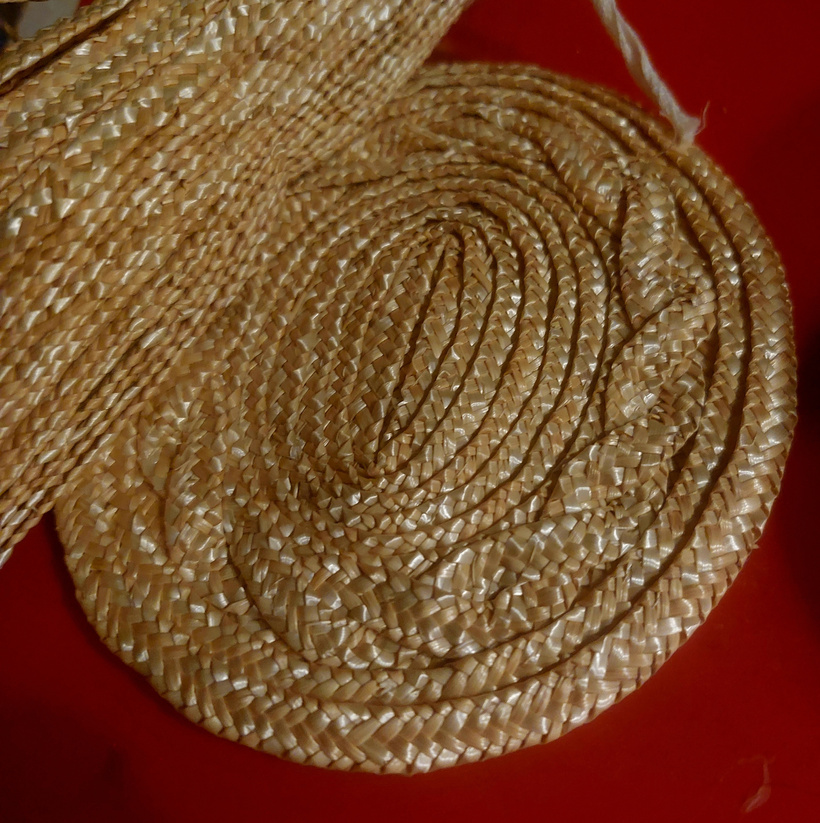
Her hat was created in much the same way as I create any 1860s straw hat. I soften the straw plait with warm water until the straw is supple and able to bend without breaking. A short straight of straw becomes the center of the crown tip/top. I coax the straw plait into curves, sewing as I go, creating an oval. Short stitches on the outside. Long stitches on the inside. For the vining, I add a second soft length of plait and curve both plaits back and forth against each other. As I work, I check the size against an antique millinery block. When the oval is the correct size, I manipulate the plait to curve against the turn of the crown, following the shape of the block. I continue to sew rows around the crown, checking it against the block, until it is the right depth. I generally let the straw of the crown dry overnight on the block so the shape can set it. This gives a firmer foundation for building the brim the next day.
The next day, I turn the straw from the crown to the brim. I work from the center out again, hand sewing. The whole length of the brim needs to have the straw plait coaxed into the right curve. A flatter brim needs a tighter curve. A soft domed brim like Caroline’s needs a gentler curve. As with the crown, the vining is created by adding a second length of plait. This time the vining needs to be created while maintaining the curved shaping of the brim. It can be a challenge to get the brim to the right curve as some straw has a distinct mind of its own. When the entire brim is sewn, some brims are shaped or blocked on a brim block. Caroline’s hat is shaped by hand while the whole hat is coated in a layer of sizing that makes the hat stiffer and helps hold the shape in place.
After the hat has dried, I hand sew a millinery wire to the undecided of the brim. Many to most original bonnets and hats leave the wire visible. I cover the wire with a row of plait for both aesthetic and safety reasons. I don’t want the wire to distract from the overall look of the hat or to come loose is snagged on something.
To me, it is important that a hat brings out the best in the person wearing it. A hat shouldn’t fight the wearer for attention or overshadow the wearer. I think this was well achieved by the Little House on the Prairie costuming department as they decorated Caroline’s hat. I am very pleased with the finishing they chose. The simple ribbon band around the crown appears to have a lighter wavy stripe that picks up the vining bands in the hat. A simple arrangement of white and green flowers adorn the front. This balances Caroline well without overwhelming her, allowing her to be seen before the hat.
Enjoying this article? Consider tipping on Ko-Fi or supporting on Patreon.
As the first season of Netflix’s newLittle House on the Prairie reaches audiences, I want to say thank you to everyone who brought this beloved story to life for the 21st century audience. Bringing a cherished story to the screen requires the talents of countless people: writers, actors, directors, craftspeople, costumers, and so many others whose work is often unseen but deeply felt. I am especially thankful to the costume department for inviting my hand-sewn straw millinery to become a small part of that collaborative effort. It has been a privilege to see historically inspired craftsmanship woven into a production created with such care, and I am honored that my hats found a place in telling this new version of the Ingalls family’s story.
Straw Hats
I have already had many questions about which hats are mine, including some incorrect assumptions about bonnets being mine. To make it easier, I’m sharing some notes.
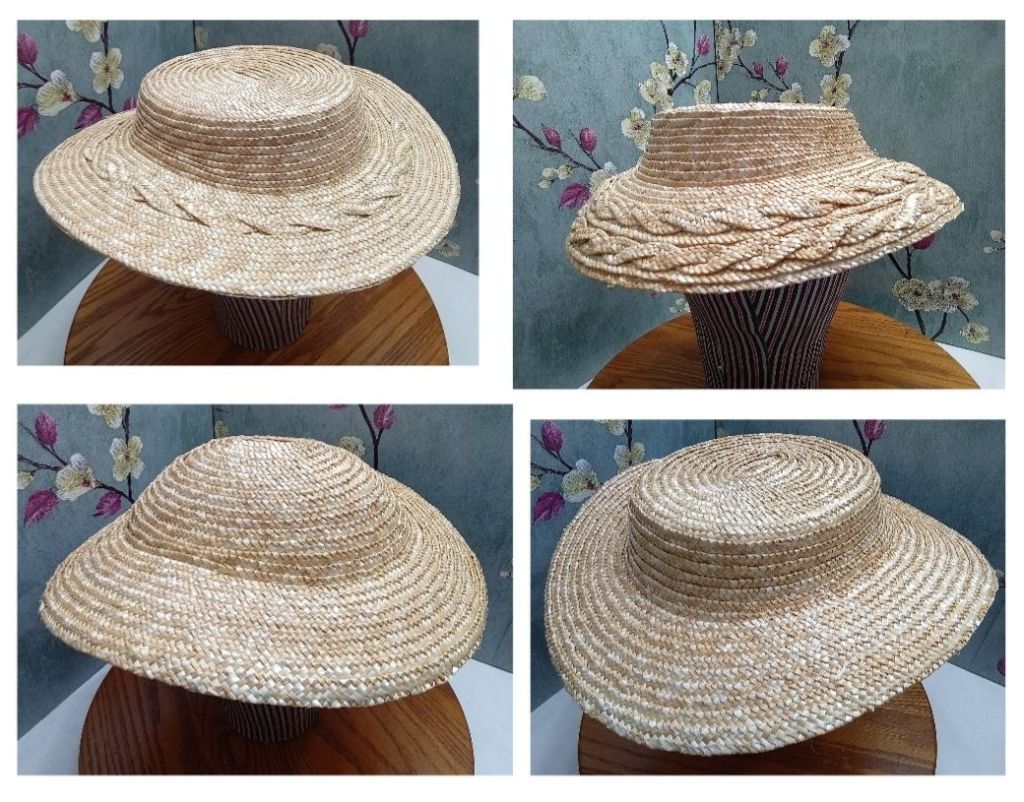
I sent 4 hat styles for season 1. The top left is the style Emily is wearing. The top right is the style Caroline is wearing. The bottom two I did not see in the show on the first viewing. (I think I may have seen the top of the bottom right in the audience during Founders Day. ) The many other bonnets and hats in the season were not created by me.
Emily’s hat is a tapered crown style made specially for Barrett Doss. The brim is stylishly shaped with a dip in front and back. A ring of vining straw circles mid-brim.
I am thrilled with how amazing this hat looks on Emily. She is wearing it perfectly!!!! If anyone is ever looking for an example of how to wear this style hat, this is how.
Caroline’s hat is a perfect pairing in my mind. The curves of the straw vining in the crown & brim work so well with her curly red hair. But, it is more than that. I love the way Caroline and this hat compliment each other, bringing out each other’s beauty and personality.
I will have a post coming up that takes a closer look at how I made Caroline’s hat.
First Thoughts
Warning: Potential Spoilers ⚠️
I watched the whole of season 1 as the sun rose on premiere day. More precisely, I started at 3:02 am, after fussing with Netflix to refresh, and finished at 10:20 am. There were several points in the show I felt personal connection with and details I appreciated.
Something that stood out for me was a sense of texture. Texture in materials selected. Texture in finishing details. Texture in natural elements. I do not know if this was intentional or purely my interpretation. It may have started with seeing the vining in Caroline’s hat on screen. It continued with seeing the carving in the backboard of the wagon, the bark on the assorted trees used for the cabin, the placement of items in the general store, the choice of lace for collars. I look forward to hearing if others saw this.
The opening scene of the first episode was on the edge of kinesthetic memory for me. I’ve had the privilege of being able to camp under the open stars in both 19th and 20th century comfort. This time around a campfire with family and friends is something I cherish. I found myself wondering how many people watching have had this opportunity and how many never will as time moves forward.
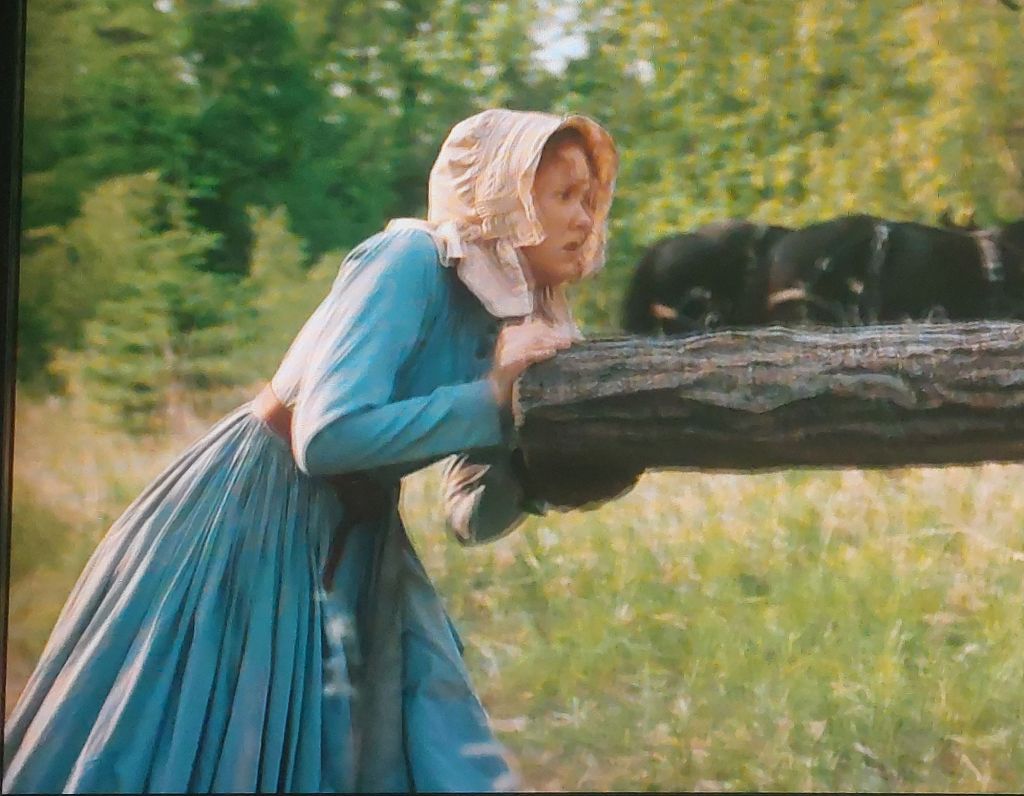
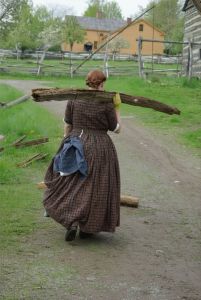
Caroline and Charlie building the cabin also triggered physical memory for me. Caroline picking up logs for the cabin, literally flashed me to picking up rails for building a fence. I can only imagine how much heavier the fresh cut full logs were. I cringed at the sound of the crack, with pain shooting through my own foot where a wood pole with metal spike came down one summer. Very well done!
I have so many thoughts on ‘a way out’ and ‘follow you anywhere’ but I am not ready to share those personal feelings publicly.
There were several pieces of material culture I appreciated. Among them: the workbox or writing slope behind Caroline & Charles in the tent, the dolls in the general store, the many pieces of dark flow-blue, the well selected folding chair. I was giddy over the dolls on the chairs in the window on Founders Day.
That’s all for now. I need a nap.
Enjoying this article? Consider tipping on Ko-Fi or supporting on Patreon.