
What happens when I break my “no buying” rule and put in an offer on a dreamy little bonnet when I really, really shouldn’t?
The most well packaged box arrives on my doorstep when I am in the midst of a curl in a ball migraine. I brought the box in, set it on the table, took my meds, and layed on the couch in misery.
Eventually, I talked myself into going to bed. Or, maybe that was the cat. Against all sensibility, recalling the last straw bonnet I bought, I decided to just open the top to make sure the inside looked okay.
I cut open the tape on the 14″ cube. Looked inside to see the cute sticker attached to the newspaper. And curiosity won. I removed the layers of paper to find an air filled, clear plastic bag. Inside the bag was a vintage hat box. As I untied the bag, I thought, “Of course, this would have made a great unboxing, and I’m not filming.” The vintage hat box was darling, with a handwritten note on top. I was so grateful the seller took the time to take such care in packaging.
I allowed myself a peek inside. This is where I knew I needed to stop. I could not trust myself to touch the bonnet while I had a migraine.
Fast forward 2 days. Yes, it took that long for the migraine to fully pass before I trusted myself to look at this bonnet.

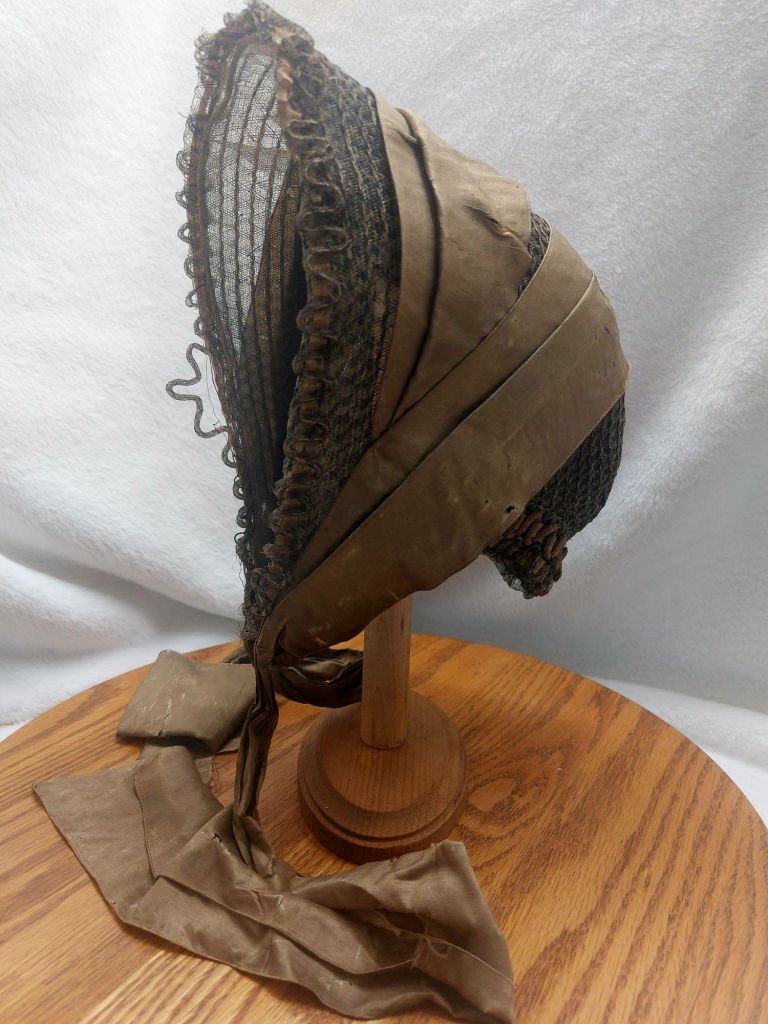


This bonnet is almost entirely horse hair. There are multiple braids or weaves used. The main bonnet is a plait of black or dark grey and white, which is nearly clear. The plait sewn as straw plait would. The thread used is thicker than the hair used in the plait and accounts for the slight hue of light brown in the body of the bonnet.
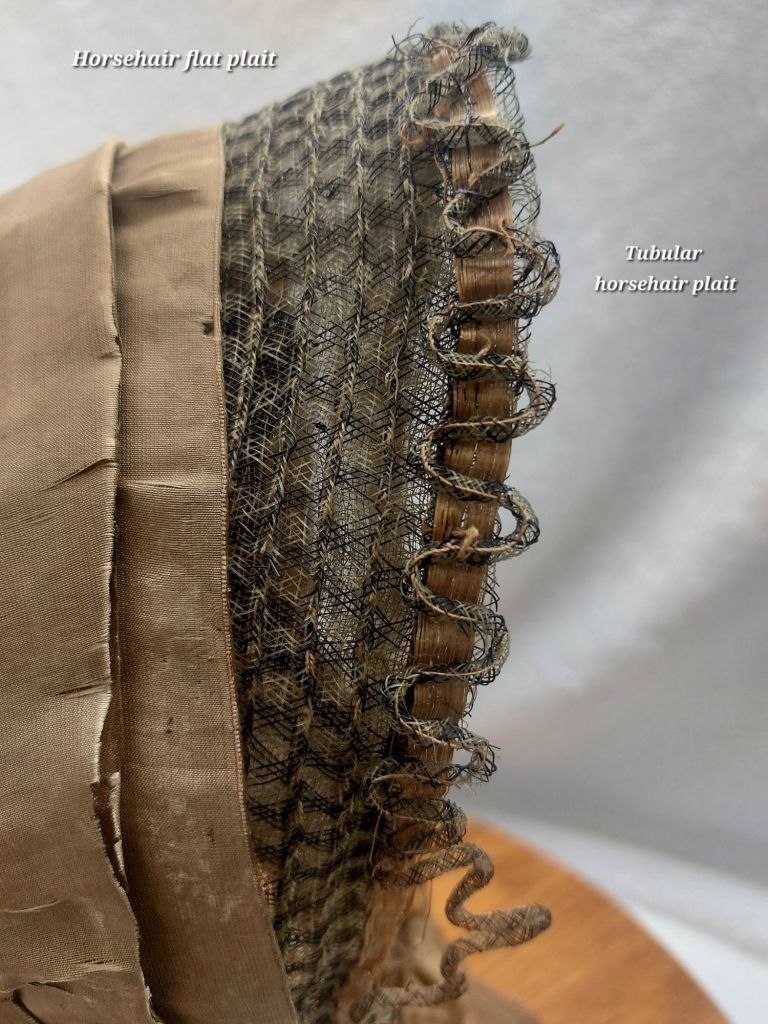
A tubular braid/weave edges the front of the brim. It is set in a wavey pattern over a flat light brown tbd. The tubular braid is made with the same colors as the body plait, but of slightly finer hairs. The flat tbd is a width of light brown fibers that aren’t straw, look more hair-like but looks flat to the eye. The fibers are layed side by side and sewn across.

The neck edge has a narrow bavolet created from rows of plait, the same used in the body of the bonnet, and two rows of tubular plait over the flat tbd. The lower tubular plait is the same as what is used on the brim edge. The upper row of tubular plait is a brown fiber that is not straw and thicker than horse hair.

The bonnet is wired around the inside. This wire is intact. (Often bonnets stored flat have broken wire. The seller indicated this bonnet was stored flat.) It is lined with two layers of an open weave material. There is some firmness or stiffness to this material. (Visually, this material is similar to what I’ve found in straw bonnets.) The bonnet is simply trimmed with a brown silk ribbon. There is thread evidence of ties previously on the inside of the cheektabs.
I almost forgot to write about its time frame. I prefer to loosely date, particularly when it comes to bonnets or hoods that have become misshapen over time or have lost their fullness. Loosely, this bonnet is ca 1860s to 1865. With what I think I see in the lines from crown to brim and the tabs, it is likely 1864-1865. It may even match up with one of my blocks.
I need to find my magnifying glass to get a better look at the unknown fibers in this bonnet. These are not something I will be able to put under a microscope, though. I would also like to do some side by side fiber comparison in photographs for people to see.







 If I Had My Own Blue Box:
Leave a comment