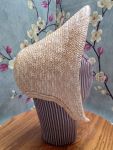
If you’re new to historical costuming or want to take the next steps in improving your interpretation, understanding how an accurate straw bonnet is made can help you make a confident selection in headwear.

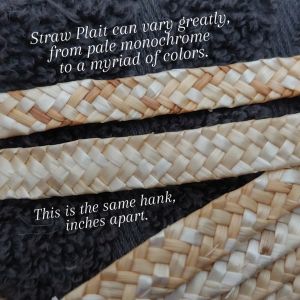
A historically accurate straw bonnet* begins with a length of plaited straw and a spiral. Wheat and/or Rye straw is braided into narrow lengths called plait. (To learn more about this process, please read From Field to Fashion.)
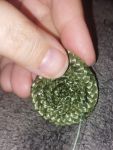
That tight little coil of plait you see in the center of a bonnet tip is where it all starts. I sew each length of plait by hand, working in a spiral from the center outward.
The shape must be coaxed as I go. Tension, curve, and stitch placement all matter as I create the tip, crown, cheektabs, and brim. Attention needs to be paid to variations in the straw including width, firmness, and even fragile or dry areas. There’s no shortcut, and no one-size-fits-all template.

Along the way, I check the developing shape on a millinery block. With some straws, this needs to be done frequently. With others only occasionally. The goal, of course, is to create a bonnet accurately mimicking the shape and techniques of original bonnets.

When the bonnet is sewn from tip to brim, with extended cheektabs, I dampen the straw and shape it to the millinery block. Using original and reproduction millinery blocks ensures accurate shapes and period sizing.

When the bonnet is dry, I add a single or double row of straw plait around the whole bonnet. Inside the edge of the bonnet, I attach millinery wire. For safety, this wire is then covered with another row of straw. I add a coating of sizing, a type of stiffening, to the interior of the straw. The bonnet must then rest overnight, some times over two nights, to dry.

If you want to learn to make your own mid-nineteenth century straw bonnet, please consider my Straw Bonnet Workbook.
Each of the above images is of a mid-nineteenth century bonnet. I use a similar process for making mid-century hats and later bonnets.
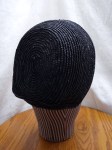
This image shows a tapered crown hat and millinery block.
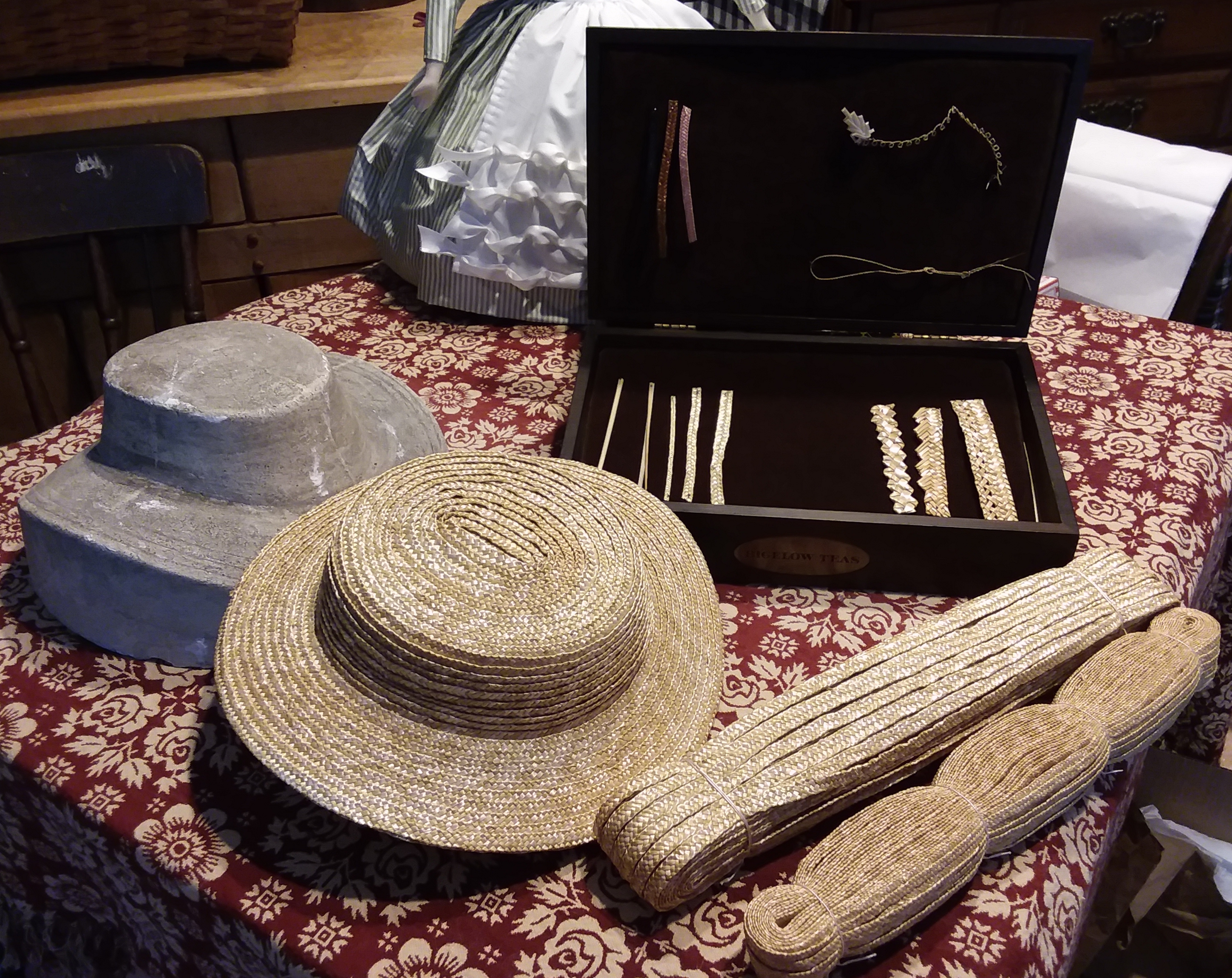

This is an 1880s capote bonnet block. While it is much smaller than it’s predecessors, the same process can be used. This is the time when hand sewing decreased in straw bonnet construction as the straw sewing machine came into regular use. I feel some of the nuances in shape can not be achieved as well with machine sewing as the can with hand sewing.
Notes:
*Some straw bonnets were made from woven straw and grass fibers. These were woven directly on a block, creating the bonnet or hat shape. This style is now created using a woven capeline or hood shaped over a millinery block.






 If I Had My Own Blue Box:
Leave a comment