As this confusing winter hints of spring, this seems to be the year of the picnic.

I am excited to see several history minded picnics coming up this spring. It looks like people are planning both smaller intimate gatherings and larger events, as well as year specific events and timeline events.
As those with a picnic or two on their schedule prepare their picnic attire and neccessities, I am getting questions about picnic headwear.

In developing straw millinery pieces, I rely strongly on visual inspiration. In this case, seeing picnics, those attending, and their hats & bonnets. I keep a file of paintings, photographs, stereoviews, and illustrations in my phone to reference as I work.

These images show us women wore both hats and bonnets were worn during picnics. Some scenes also show women wearing sunbonnets.
These captured picnic scenes also show us the transition in millinery styles from the 1850s to the 1860s and through the end of the century. For the most part, the bonnets depicted in images follow the fashion norms of the time or year. Through the 1850s and 1860s, hats also maintain the basic shape and size norms but tend to have minimal decoration with a simple ribbon being most common. This difference seems to lessen in the 1870s with more adornment on some hats, while the variety of hats expands.
Selecting a Picnic Hat
1850s
The hats of the 1850s have shallow crowns and wide brims. The crown, the top portion that sits on the head, can be a curved dome shape or a flat top with tapered sided. This crown rises only a couple inches, making the hat sit high on the head. (This can feel quite different compared to a modern hat.) The brims depicted in paintings range from about a handspan on each side to as wide as shoulder width. (My shoulders are 15 inches wide. A friend’s are 17 inches wide.) These brims are shaped, dipping down at the front and back. Views from the side, the brim edge creates a soft C facing down. This curved shape is supported by wire sewn into the edge of the brim.


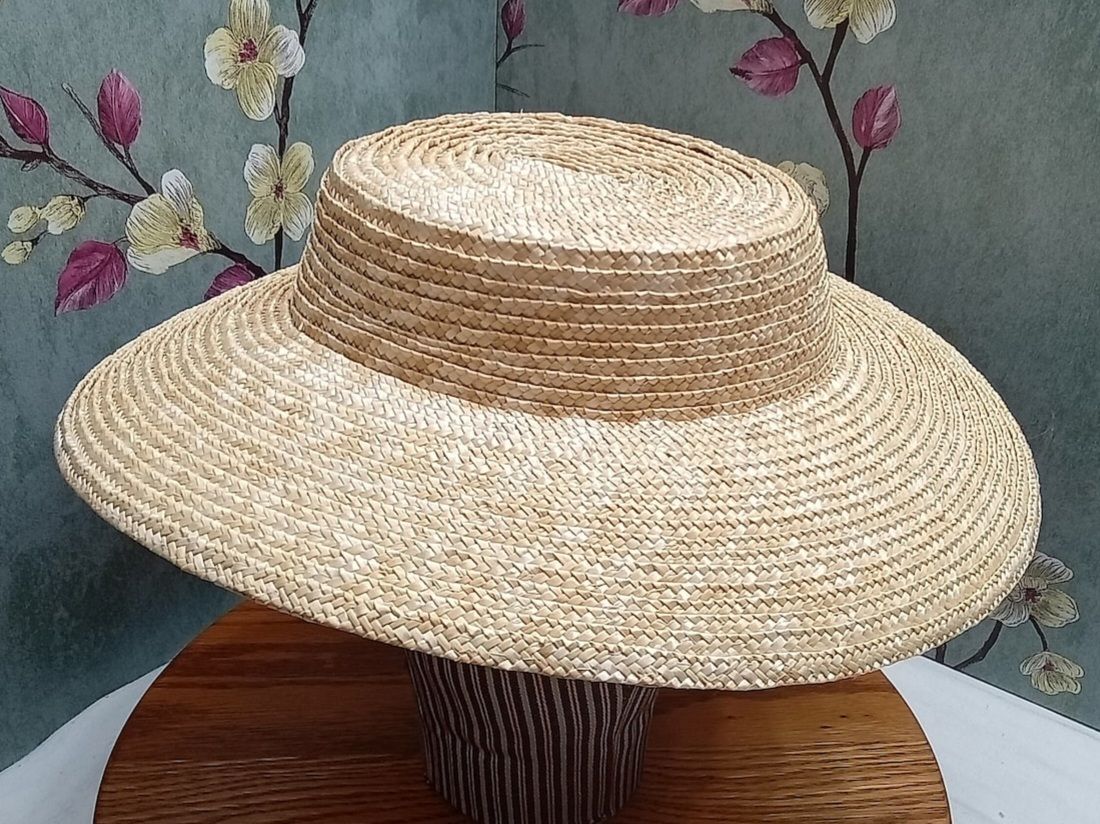

Paintings and photos show these hats trimmed with ribbon. Most often, ribbon encircles the crown with a bow centered at the back. Some hats are shown with loops or ruche of ribbon at the front or sides as well. A very limited number also show ruched ribbon at the brim edge, or a few flowers.
1860s
Hat crowns stay shallow in the first half of the 1850s while the brims become much narrower, spanning less than a hand width. This image shows two hats made with the same crown but different width brims, the top for the early 1860s, the bottom for the late 1850s. Hat brims of the 1860s provide little to no shade for the face. As with the previous decade, these brims are shaped, dipping down at the front and back. Views from the side, the brim edge creates a soft C facing down. This curved shape is supported by wire sewn into the edge of the brim.

Those desiring a wider brim for this decade may want to consider a country hat. This hat has a brim that is slightly wider while doming down around the head.


Images show 1860s picnic hats trimmed with simplicity similar to that of the 1850s, using ribbon as the primary embellishment. This is a style shape I see in photos of picnics and croquet.
1870s
At the risk of over generalizing, it seems once we pass into the 1870s, the variety of headwear in picnic images increases notably. Those depicted are fashionable for the season. More trims are evident on hats.
I will make a point to create hats and bonnets with picnics through the spring. Please check my shop for pieces available.
I will also be creating some pieces with rural cemeteries in mind as a new exhibit on The Rural Cemetery Movement will be opening in May. The millinery worn when visiting or picnicking in a cemetery is similar. Though one particular piece stands out on my to-do list:





 If I Had My Own Blue Box:
Leave a comment