Paisley and Paisley-type Shawls
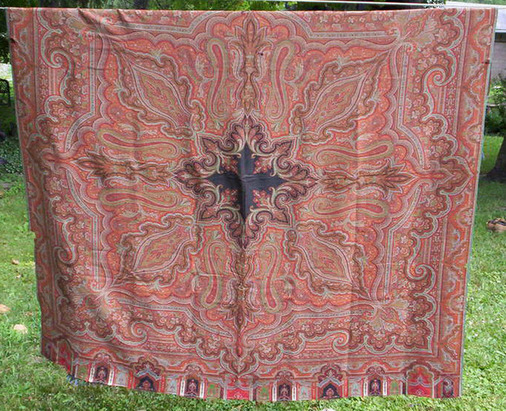
Fibers, weave and size: These shawls should ideally be made of hair brushed from the Kashmir/cashmere goat or from a wool and silk blend. The silk should be the warp or blended into the wool in a small amount. Avoid shawls with a rayon or acetate blended with the wool. Original Kashmirs are very light weight because of the tapestry twill weave. I have yet to be able to compare the weights of original and new. Look for sizes around 64 inches square or 64×128 inches as a double square.
Design: When looking for a Paisley shawl, look for a strong cone motif. The cone motifs should radiate out from a center field of black, white or red. These radiating motives create a star or spoked flower appearance from a distance. The spokes should be connected with ribbon like borders consisting of small floral motives. By our era a newer shawl would have a smallish center. But, the higher cost of these shawls along with their durability means it would not be unlikely for a grown woman to have a shawl with a larger center from her youth. The outer border can be on two or four sides. This borer should be comprised of smaller designs brought together in the border. Kashmir borders will have more independent blocks of design while French borders will visually entwine each block with it’s neighbor.
Two other design options include the striped shawl and the border shawl.
Where to look: There are some nice shawls coming out of India. Many of these are available on online and via Ebay for various prices. When doing an online search use “Paisley Shawl” or “Cashmere Shawl” or “Antique Shawl” for your key words.
Woven Shawls

Fibers, weave and size: Wool or wool/silk blends. These should also be 64 inches square or 64 inches by 128 double square. A shawl relatively near these dimensions will look nice. The weave should be a tight plain or twill weave. The shawl can range from light weight to rather heavy if hand-woven.
Design : Look for solids, checks, plaids (preferably symmetrical) stripes and border plaids.
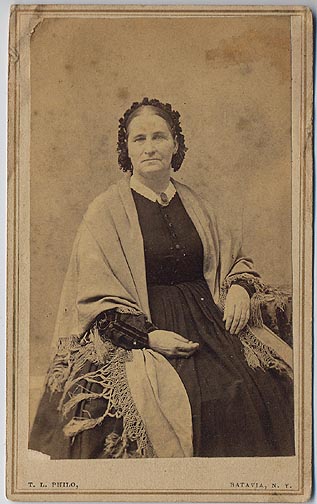
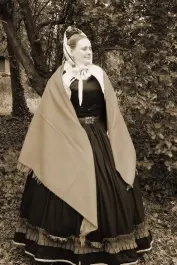
Where to look: This is a type of shawl you can make yourself. Many Museums offer weaving classes thru-out the year. You can also make a fabric shawl from woven wool lengths. You will need a dress weight to coat weight wool rather than a heavy weight in a 54 inch to 60 inch width. Plain woven fabric and plaid woven fabrics work well. The yardage can fringed on the end by unravelling the ends by hand. To calculate your yardage, decide if you want a square or double square shawl and how long you wish your fringe to be on the ends. For a square shawl, purchase the width of the fabric plus 6 to 12 inches for fringe. For example: if you want a double square shawl out of 60 inch wide fabric purchase 130 inches for a 120 inch shawl with 5 inch fringe. (see the article on fringing a shawl)
Printed Shawls
Fibers, weave and size: Printed shawls come in wool, cotton and blends of wool, silk and cotton. Ideally, you would find a 64 inch square shawl, but the common 55 inch square shawl is not bad.
Design: Printed shawls vary by region. Look for period motifs and borders.
Where to look: It is difficult to find accurate printed shawls. The Russian Pavlovo Posad company still makes printed shawls using variations of their 19th century designs.
Sheer Shawls – Muslin Shawls, Grenadine & Barege
Fibers, weave and size: I still have not found sheer shawls that I like. These were silk, wool or cotton. They frequently had a plain central field and a stripe border creating a plaid motif.
Lawn, Gauze, Voile, Silk Organza & Batiste fabrics can be used to make a sheer shawl. The edges would need to be hand finished with a rolled hem. This isn’t what original shawls have though. You may want to starch the fabric as well. You can add tucks to the border or ribbon to the border or edge.
Design:: Plain, woven plaids, woven checks, woven border plaids.
Where to look: – Online fabric merchants including Exclusive Silks and Fashion Fabric Club
Silk Shawls
Fibers, weave and size: I have not yet found the ideal silk shawl. Thai Silks has larger white shawls in their scarf section. These are a little smaller than ideal, but may suit your needs.
To make your own shawl, you want a durable silk, in the 64inch square range, no slubs with or without fringing. Look for a taffeta, china or habotai silk. Do not use satin. I have seen solid color, shot (or changable silk) and patterned silk shawls. A couple of the India, China and Thai merchants sell nice silk shawls. I tend to think play it safe for silk shawls and go for simple. Also, many list as silk but are selling Viscose.
Design:: If you want to embroider your shawl, I highly suggest looking extensively at originals.
Lace Shawls

Sadly, accurate lace shawls are not reproduced currently as far as I am aware. Modern lace shawls tend to be synthetic, with incorrect motifs.
Original lace shawls are fragile. In my opinion, they should not be worn.
Knit and Crochet Shawls

Great thing about these is you can make them your own. There are several patterns available in magazines and guide books. Many of these patterns are available digitally through Accessible Archives and online from various sites. There are now social media groups dedicated to 19th century knitting and crochet.
If you are purchasing a shawl, be sure to ask where the pattern design came from and what fibers the shawl is made out of. The shawl patterns above are worked in wool or silk.
For more in-depth information, read Paisley, Plaid, & Purled: Shawls of the Mid-Nineteenth Century






 If I Had My Own Blue Box:

Leave a comment