Straw and Winter Millinery


From the Work Box – Sewing Birds
Recently, Janet Smith of the Button Baron shared their reproduction sewing bird on a Facebook group. Many people asked “what is it?” This made me think it would be nice to do a series looking at tools in the Work Box. I will start with the sewing bird.
Here is my sewing bird, an original patented in February 15th, 1853.
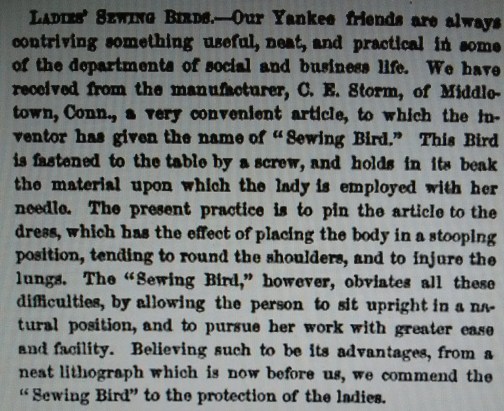
 A sewing bird clamps to the work table. The bird is meant to hold one end of your work in its beak. Some, but not all, sewing birds come with a pin cushion either next to or on top of the bird.The Knight’s American Mechanical Dictionary (1881) illustrates and describes it here:

Godey’s Lady’s Book hints at the advent of sewing birds in 1852:
While being called sewing birds, birds were not the only figure adorning them . They were also made with different figures, such as dogs, butterflies, serpents, dragons and other birds. See the variety on this Pin board.
Sewing birds came with and without pin cushions. The pin cushions could be found in front of, behind, below and above the bird itself. Some also had two pin cushions. (There are also sewing clamps with just pin cushions, not clamping birds.)
Just six years following the Godey’s mention, we see the quick popularity in this poem, The Sewing Bird (Arthur’s Home Magazine, 1858)

Additional Resources:
This article discusses the differences between some originals and some reproductions. (I have yet to dig deep enough into the construction of sewing birds to evaluate statements in this article.)
Here is an article about an original sewing bird at the Museum of the Grand Prairies.
This is an image of assorted sewing birds in the National Museum of American History collection. ***A must see***
Patents for sewing birds and improvements in sewing birds can be found from the 1850s on.

Year In Review
I have an awful time remembering what projects I do each year. Luckily, I started a list at the beginning of this year. Then, I forgot to keep writing them down.
Projects of 2016:
January
 To start the year off, I launched Paisley, Plaid, & Purled: Shawls of the Mid-Nineteenth Century. My many, many year writing baby was finally in print. Well, E-print.
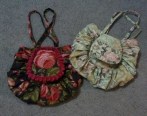
We also started the year with a Sew-Along. The first of the year being a work bag in cotton or silk. I had no idea how popular these would be.
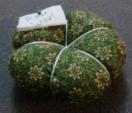 It seems January was pretty busy. This is also when I started my pin cushion experiment. I took the same shape and size pin cushion, made of quilt weight cotton, and stuffed each with a different filling to see how each performed. This will be a continued experiment.
February
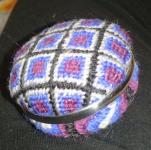
Going from February into January, the local historical Sew Along group worked on pin balls. Participants used a wide variety of researched techniques for their pin balls.
March
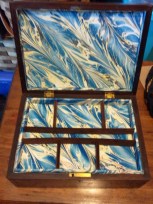 Come March and April, I was focused on preparing sewing boxes for a discussion during the 140th’s Civilian Seminar in the Greene Gallery at GCV.
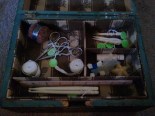
I lined two boxes, one for original tools and one for reproduction tools.I used hand marbled paper for the original sewing box. I used fabric for the box I was constructing a tray for.
April
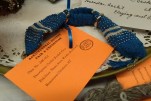 The next Sew Along: A Purse began in March, but became a many month project for me. I made a crochet long purse, known as a miser purse.
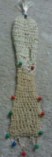
I first made one for Cali. Then made the one for me. Both are silk with cut steel beads.
May
As the weather warmed, estate and yard sales began. Several local friends were looking for appropriate chairs. Inevitably, as I was photographing chairs, some came home with me. In a couple ways this is good because my well used chairs are getting loose and now, we almost have enough seats for Christmas.
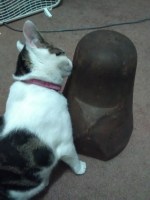
Galaxy arrived some time in May or June. It is kind of a blur. Clara joined the family in February.
June
June was pretty packed.This is when I fell behind on the purse project and way behind on the slipper project (see below.)
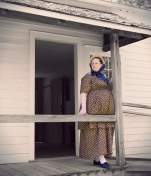
I decided I needed a dress appropriate for demonstrating sewing straw in. Something very much a work dress that could handle getting wet and I could be comfortable in.
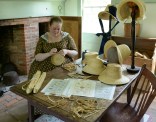
The dress got a test run at GCV’s War of 1812/Jane Austen event in June. I had a delightful day demonstrating the cottage industry, sewing straw plait into bonnet and hat forms.
July
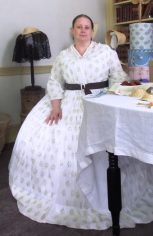
After the Regency era of June, was a switch to mid-Nineteenth century for July. I got to transform the museum’s Law Office into a Millinery for the Civil War weekend. This meant making the building obviously say Millinery – dressing the space with bonnet boxes, stands topped with bonnets and hats, bringing in additional color. It was a great weekend.
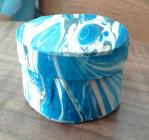
Somehow, I don’t have photos of just the boxes I worked on. Here is a mini-verion for Cali. I made a couple boxes. Then I recovered a number more in period appropriate papers. For next year, I really want to get to Cooperstown to buy a few of their boxes.
August
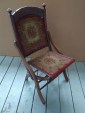
August was all about sewing, sewing, and sewing. I did break my “no more folding chairs” rule when I saw this chair in a yard sale listing.
August also saw Lily off. We spent much of the summer trying to visit a museum or site each week.
September
It was back to school in September. These transitions are usually difficult for me. I get in such a rhythm of heavy sewing through the day. Though I did have one project for October I was greatly enjoying….
October
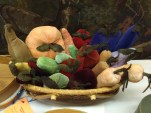
I had so much fun making my basket of vegetables in velvet. Some were cotton velvet, already dyed. Others were silk velvet, needing to be colored in chalk after I made them. I do wish more people were able to see this at the fair.
November
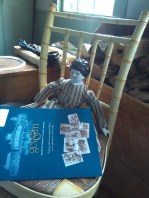
November was back to being busy again. First came the Domestic Skills Symposium at the Genesee Country Village and Museum. I lead a Sunday workshop on Millinery in Miniature with my helpful side-kick, Cali. Each participant made a doll scale hat while learning period appropriate straw sewing techniques.
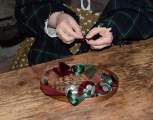
The following weekend was Preparing for the Holidays, back at the museum. This is when I was just amazed by how interested people were in the strawberry emery cushions I was making. I left completely thrilled and dumbfounded.
December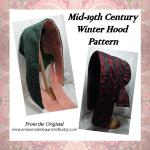
My big goal for December was launching my new Mid-Nineteenth Century Winter Hood Pattern. Drafted directly from an original hood in my growing collection, this pattern has two sets of directions in the information packed booklet.
Millinery, straw and winter, spanned the year. I had a few goals with straw for this year. I wanted to explore fancier plaits, learn decorative manipulations for plait and learn to make straw motifs. I also wanted to dig further backward and forward in time. I didn’t get quite as far as I had hoped. But, I did expand quite a bit. Here is a gallery of this year’s millinery:
Projects Yet to Complete (Or start in some cases):
This year has more than its share of projects not yet finished. Here is just a few:
I had this whole plan to roll research on veils into making veils. I got as far as doing a good bit of research and even a materials comparison. I have yet to make more than the veils used for the July millinery.
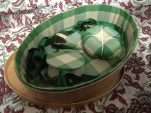
I have a box of Shaker boxes I meant to line and make sewing accessories for. So far, I have made this one and one that is a gift. I will hopefully get the others finished before it is time to buy some more. This really is one of the most convenient sewing boxes to have.

I have an on-going pin cushion project. One part is the filling analysis. The other is making pin cushions from original directions or replicating originals. I thought I might do one a month… Not so much. Next year.
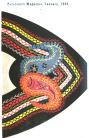 The slippers that were started last spring have not been touched in months. Some time in the depths of winter, when my feet are cold, I will finish them just to have them done.
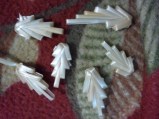
I had wanted to learn to make straw decorations and motifs. I got as far as learning to make leaves in the spring. Then I got so busy with bonnets and hats, I didn’t get back to it. This will definitely be explored more next year.
Next Year….
I will be doing a looking forward post soon(ish). I have dress lengths that have been long neglected. I also have some presentation/workshop topics churning around in my head.
Baskets at Work
A-Tisket, A-Tasket…. While neither yellow, nor green, this year saw to the task of getting the right baskets.
As with many tasks and utilities, I am picky, very picky. I fussed and searched and fussed some more for just the right baskets. I had a list of what each basket’s duty would be: to house and carry wool, to carry and hold straw for demos, to carry the day’s or weekend’s food stuffs. Each also had to be well made, sound, accurate and pleasing to the eye. In the end, baskets have been matched with their tasks and I am shy only one: a large, round basket I eyed at the flea market but failed to go back for… the basket I see holding straw in progress and bonnets at museum demos.
The baskets at their tasks….
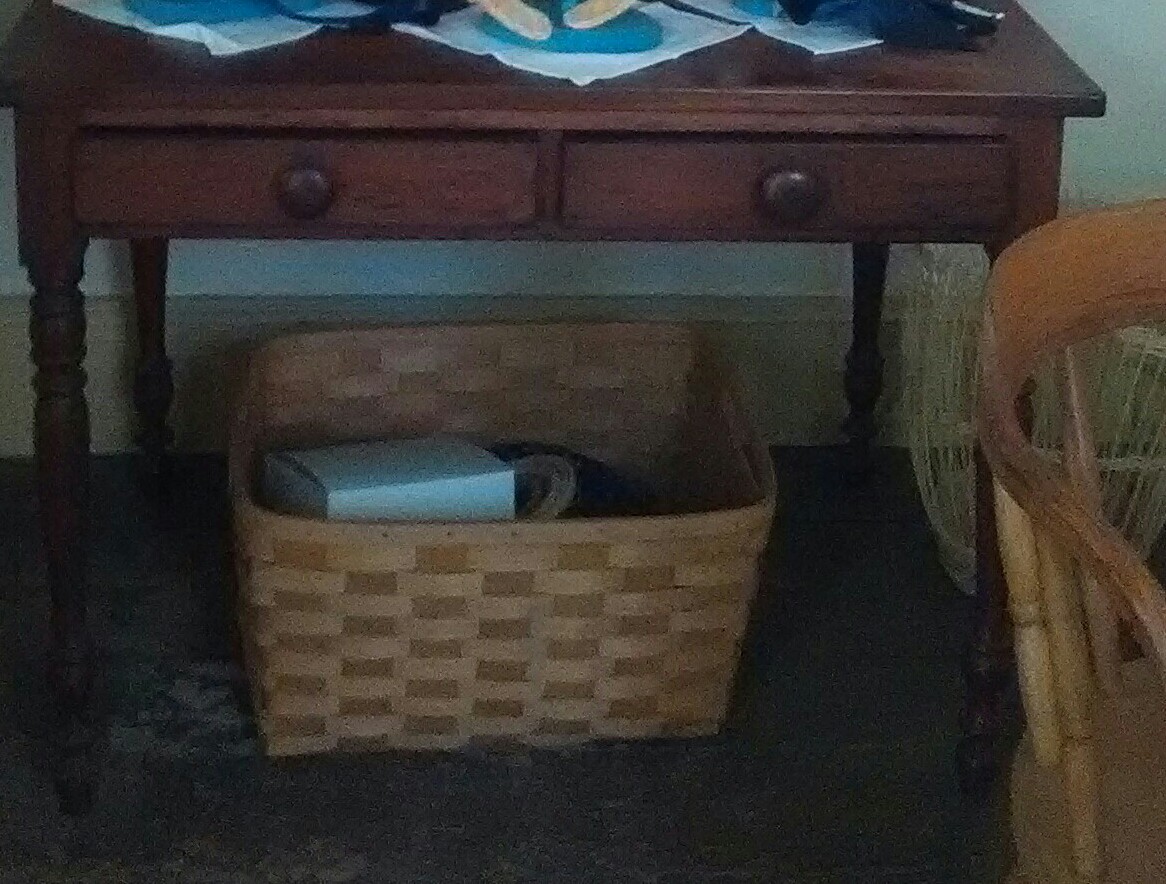
My largest basket is a rectangular one that serves nicely to carry small containers and stands into the millinery for set up. Here it is this past July under the desk in the Millinery Shop. It is in need of some tlc repairs due to cracked and broken areas from when I bought it. This large carrying basket is much like those we used in the 90s and 00s for carrying program materials about. Here is a similar basket at HSV.
 These next two baskets are “all purpose” baskets. The larger, top is one that was Dad’s it was loose on the top. I am sure basket makers are cringing at my millinery repair using the straw plait. The bottom one is by the GCV’s basket maker. They are nice for carrying. As you can see, each nicely holds a project at home. They can also carry a day’s or weekend’s food into the village. As crocks, especially full crocks, and water can get heavy, neither are overly large. Here is an oval example at HSV, and a rectangular, non-Shaker example at the same.


I have named this basket my wool basket as that is its task. When I am making hoods, I need a stash of wool easily at hand in an eye pleasing container. This moderatly sized basket fit that need nicely. Until I find the right straw holding basket, this may do double duty. The shape, with the squared bottom, and round, belly bulging sides, seems to be a common shape. I do still need to look into the decorative shaping in the reed. Here are two examples from HSV showing handles that fold down like this: first one with a loop construction, second with a pivot construction.
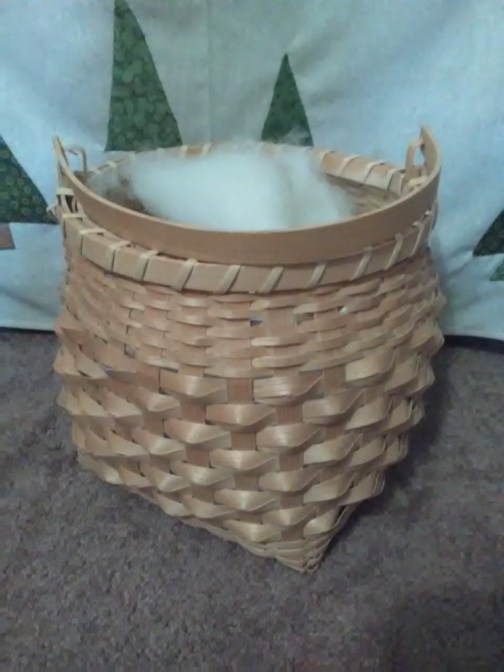
The newest edition joined us this weekend. I saw this basket a few weeks ago at my favorite bakery while I was picking up treats for work. We chatted about how nice it would look filled with seasonal greens for a table center piece. Well, the basket took root and I just kept thinking about it. This basket is just over a foot tall, perfect for its task as table decor. After the holidays, I think it will continue to serve a decor or have a light task because I suspect it is a bit old. This basket is quite like this example from HSV.

Additional Random Thoughts…..
Clara’s Basket
While Clara is not a box loving cat, she is a basket loving cat. This basket was part of a gift basket we won. While it isn’t strong enough to carry anything heavy, Clara declared it perfect for her.
[photo stuck in cyberspace]
Missing Basket?
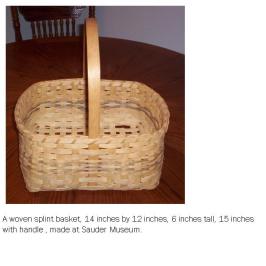
While looking back through my posts for a previous article on baskets, I came across this photo. I forgot I had this basket. This was taken in my old apartment. I wonder if I have this in storage still. It would be nice.
*There are a few, okay several, other baskets at use around the house. But, given their more modern aspects, I’ve not included those.
Videos of Interest on Baskets and Basket-making
Traditional Oak Swill (England, longer video)




 If I Had My Own Blue Box: