Connecting with Your Audience
I wrote this article back in 2010 for publication. As it was well read at the time, I followed it up with a “Connecting with Your Audience Supplement” and “Additional Resources for Connecting with Your Audience.”
There is an excellent discussion going on in a FB thread today that prompted me to want to reshare this article. Here it is as I wrote it a half decade ago. While some things have changed, I hope most thoughts are still applicable.
Most of our research and efforts are focused on aspects of history and material culture. This article focuses on our audiences who have chosen to spend their time with us rather than the materials and theories of history. Just as each of us looks for different aspects in our own living history experiences, so do the people who come out to visit our events and sites. In order to provide the very best program experiences for our visitors, we must understand what they are looking for. When considering our audience for each event we must ask ourselves two questions:
Who is our audience?
What is our audience looking for?
In recent years, museums have put a great deal of effort into understanding what their audiences are looking for. As reenactors and living historians we are likely well aware of school children as a group. These same children also come with their families making a unique audience. In surveys, museums found senior men, senior women and families are each looking to fill specific interests when they attend historic events. (A few acquaintances were kind enough to share survey results for museums and historic sites that are not yet published. Due to this unpublished state, I can not make direct references, just inferences.) In 2007, the Reach Advisors surveyed museum and site visitors to look at who visits sites, how often and why. The Reach Advisor’s survey looked beyond who visited and how often to what the visitors were looking for. According to Susie Wilkening and Erica Donnis in their History News article, mothers in their 30s and 40s (likely those of young and school age children) are looking for activities that “actively engage their children and make history come alive.”
Families with Young Children
In many ways we can look at this audience group as young children with families, rather then families with young children because the parents’ primary focus is usually that of their children’s experience. For many of us, this is special audience we often do not know what to do with. We may think of a toddler handling an antique piece of china we brought to the event or pulling on a tent rope and cringe. As a former art gallery manager, I can fully understand. I will never forget the time a three or four year old girl with hands covered in chocolate ice cream wanted to touch a bronze sculpture. As a person responsible for the artwork, my instinct was to protect the sculpture. But, what stands out along with that “eegads” was the excited look on that toddler’s face. She was drawn in by the tiny cobs of corn in that sculpture that screamed ‘touch me’.
So, how do we create an environment that captivates a young child’s attention, satisfying their needs and the needs of their parents?
We need to create an environment that is engaging for young children and informative for parents. My cousin, a mother of twin three year olds, and her mothers’ group shared with me what they are looking for when visiting museums or events. Mothers of toddlers are looking for a variety of hands-on experiences that engage their children’s senses and interest. Activities (or crafts) where the children can build, create and experience attract both children and parents. Staff (that’s us) who talk with the children on their level and not just the parents are a big parent pleaser.
If you are developing an area specifically for children several of the points offered by the moms’ group are useful. At the top of the list is safety. For moms this doesn’t just mean an area safe from injury but also one that is easy to keep an eye on the kids. This allows the parents to give their children a level of independence while being able to monitor where they are easily. Choose an area somewhat contained to help the parents see where their children are. An area bordered by the side of a house and a fence would work well. Avoid unsafe conditions that will attract children such as fire pits or tent ropes. The next point was a bit of a “duh” moment for me. My cousin explained how important it is to have activities with a variety of energy levels including built-in down times. When planning a day’s activities for scouts or pioneer day camp, I always controlled the level of activity scheduled through the day keeping in mind the heat and needed rest times. Of course it makes sense to the same planning for public events. For toddlers, down-time can be something like the opportunity to read or look at colorful pictures with mom or dad quietly. It could also mean sitting and petting a calm animal like a rabbit. Going another step beyond down-time is a quiet place. At events where there will be a battle, it is very helpful to the parents of babies or toddlers to know of a building where frightened or upset children can be calmed. This could be a building far from the noise, an art gallery, or restaurant.
School Groups
We have the opportunity to work with school groups in several different venues. A teacher may invite you into his or her classroom to talk with the students. A group of presenters may be given a large presentation area or a rotating presentation format. A class or whole grade of classes may take a field trip to the site you are at. Whether you are going into a classroom or a class is coming to a presentation day, there are a number of things to keep in mind to make the visit a success.
First, keep in mind these groups will be larger then those we see on the weekends. If you are presenting in front of a classroom, you will need to keep everyone’s attention. If groups are rotating through presentations, when organizing the program the planning group should keep the groups as small as possible. The smaller the group, the more attention you can give to each student. To me, an ideal size group is about a dozen students. This group can move quickly from station to station and each member can see fairly easily in most situations. Somewhat larger groups can be managed. But, in my opinion, significantly larger groups are a disadvantage to the students, chaperones and presenters because it is difficult to see, hear, ask questions and stay focused.
Second, make sure what you are talking about relates to what the teachers are covering. You don’t have to cover what the teacher has already covered. But, it helps to expand on what the students have already learned, highlight a particular area of interest for the students or deepens the students’ understanding of what they have learned. Learn what your State’s learning standards are in the areas of History, Social Studies, and Literacy/English Language Arts. There are many ways to implement these standards into your presentations. Talk with the teachers you work with. Learn what their districts’ curriculum maps include. Ask what teaching points they would like you to emphasize. (By working with a school’s curriculum maps you help your teachers justify your visit to the district.)
Third, remember to bring the historical, social or material culture topics you are presenting home for the students. Help them to relate to what you are talking about. You can do this by connecting the far away to their home or by connection the long ago with the now. For example, if you are in an area outside of the active war zones, find a local person with a connection to the war who you can share information on with them. A popular method of sharing history about everyday life is to tell a story about a day in the life of someone the students can relate to. As you tell the story, choose items from a basket or bag that has to do with the character’s experiences. Go beyond showing the objects by giving students a chance to hold and examine the items.
There are numerous resources for teachers using historic sites or artifacts for teaching history on the internet. These resources often include lesson plans, worksheets, activities and additional resource suggestions. Review some of these to see what museums and historic sites have implemented in their educational programs. This is a chance for you to learn what others are doing. It also lets you know what is available for teachers if one asks for program subject matter you don’t cover.
School Age Children with Their Families
School age children come with family groups including parents, grandparents and friends. The 2007 Reach Advisor’s survey found that when all children in a family reach elementary school, their family’s attendance at historic museums and sites increase significantly. Another important piece of information this survey found was that school age children tended to be accompanied to museum by their grandparents more often then their parents, and when accompanied by a grandparent instead of a parent they are more likely to attend history museums and sites compared to other museums. (I can tell you from personal experience as a child this was the case for myself and my cousins.) When family groups come through, you need to engage both children, parents and grandparents.
Those children returning to a site or museum they previously visited as part of a school group may act like mini-tour guides for their family members. This is great! In these cases, the child may want to share what he or she has learned as soon as you greet them. This is a wonderful opportunity to let the child show what he or she knows. It also shows you, and the parents, what the child is interested in. You can now expand further about what they have been talking about.
This is a very hands-on group. Bring items children can handle and look at. These can be reproductions or sound originals that won’t be damaged. Items such as dishes, pottery, kitchen utensils, tools, clothes, and blankets are good examples. Opportunities for kids to “try” is very important. Depending on their age, kids can card wool, try a drop spindle, crochet, knit, sew on a quilt or shirt, tear and roll bandages, ball lint, pack a box, write a letter, weave a part of a basket, the list goes on. Games and toys are a big attraction for children and families, which can keep attention for a good deal of time. If an area is designated for games and toys, be sure to include a wide variety including active and quiet games, games and toys for large groups, small groups and individuals. Another option to an area for games and toys is to incorporate a toy or game at a number of interpretive locations. Let families know in the program these are there for them to locate.
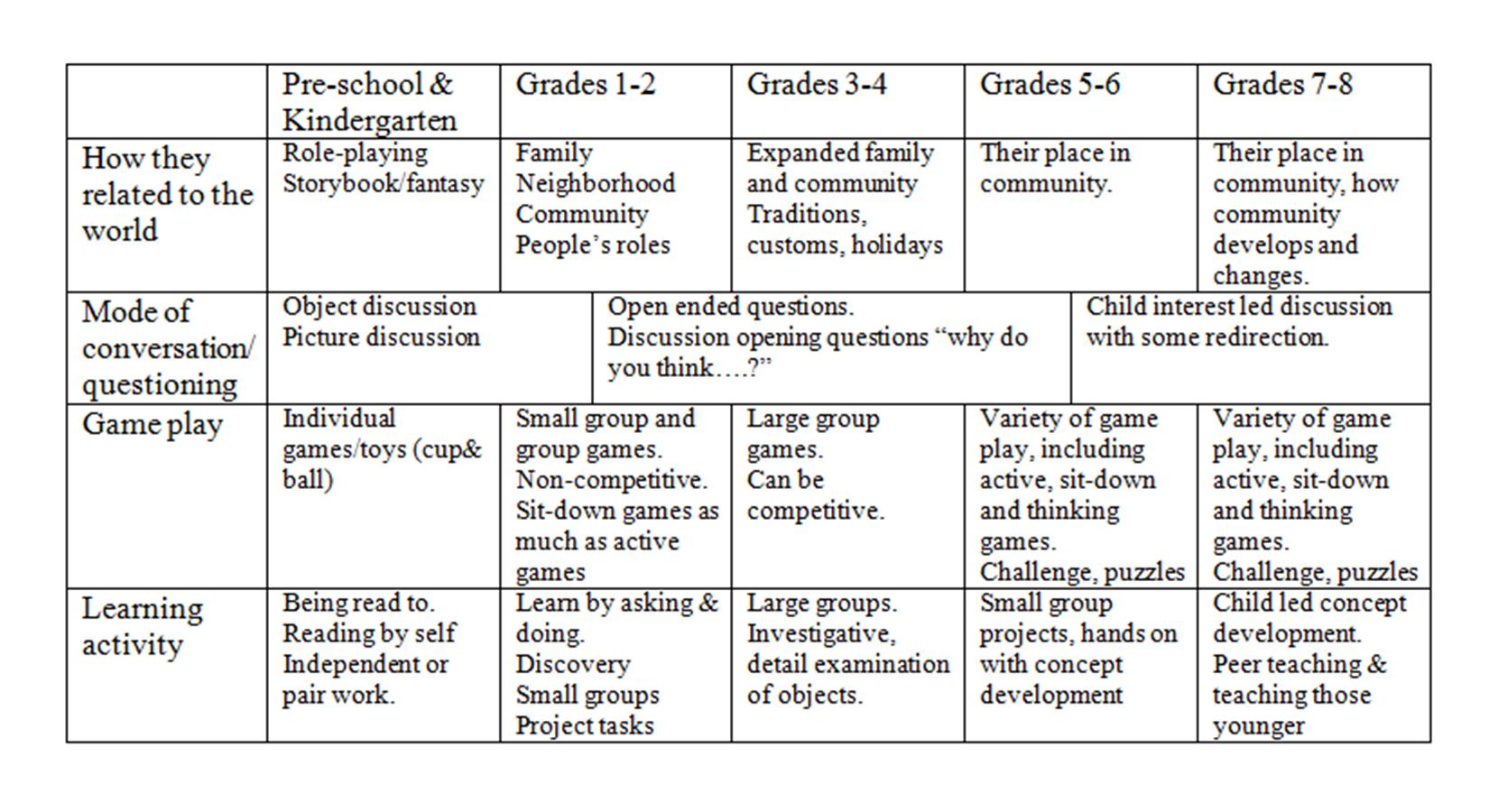
When engaging children keep in mind learning styles and interests vary according to a child’s personal learning style and age. This chart gives a brief outline:
Retired Men and Women
Retired men and women visit as couples, with grandchildren and part of tour groups. (I’ll talk about tour groups separately) When visiting on their own or with each other, retired adults are an audience you can spend a good amount of time with talking.
From experience, and supported by the Reach survey, retired adults tend to prefer third-person interpretation over first-person interpretation. Conversation with retired adults rolls nicely when discussing a site, material culture, and other aspects of history without the framework of first-person interpretation. Those who are from the area or those who are members may choose to just see a few things each day, getting the most out of each area. I remember one museum visitor who came in a couple days a month to look at one or two pieces of art then visit one building.
Retired adults and those reaching empty-nester age tend to show the interest divide between the sexes. Susie Wilkening and Erica Donnis point out adults over 50 tend to associate authenticity with original buildings and artifacts. The differences they found between men and women at this age are that women tended to want a place of respite and escape from the modern world where they can leave their lives behind while men looked for experiences they can participate in, in a hands-on way. (“Authenticity, is Everything”) A good example of when this difference was evident was when I had a retired husband and wife visiting our camp location set up in the parsonage yard. The husband examined my dishes while the wife wandered the flower garden.
Tourist groups
This a special audience for a number of reasons. The one I find most relevant is not the size of the group but the time constraints they often face. Much of the time, tour groups have a tight schedule that gives the members a limited amount of time at a site. To often this amount of time is less then most family or friend groups would spend at a site. I would suggest designing highlight cards with different themes to help members of a group focus their visit on what interests them most. For example, at a living history museum a selection of different cards highlighting interest areas such as a) arts & architecture, b) industrial arts & crafts, c) domestic arts & cooking, d) developing a community, and e) an abbreviated timeline would be available to groups with limited time at the museum. In the case of a weekend reenactment event, similar cards could be developed helping visitors on a schedule get the most of their visit. Cards at a typical event with full military and civilian activities could include focusing on military life, battle tactics & history, civilian life and domestic arts.
Tips for Reaching Your Audience
Display Eye-Line – When creating displays, consider the eye-line of different audiences. Place items that may be of particular interest or items you would like your visitors to ask about in an easy eye-line. By placing a variety items that would be of interest to the different visitors you open the door to engage those visitors. Choose items that you can readily talk about. Remember, children and those in wheel chairs will see displays from another angle. Sit in a chair or on the ground in front of your display or set up. What do you see? What don’t you see? Are there things you should see? Are there things you shouldn’t see?
Welcome your audience to converse – Welcoming your audience into conversation can be very easy with some and challenging with others. Some visitors will see you as there for them and feel comfortable asking you just about everything. Other visitors will be very uncomfortable asking questions. This can be because the person is shy themselves or they are respectful of what they see as your private space. Just because a visitor doesn’t talk with you first doesn’t mean they aren’t interested in talking with you. A suitable greeting or personal introduction is the first step towards inviting your visitors into a talking with you about the history or scenario you are part of. Don’t jump directly into giving them detailed information; wait for your visitor to respond to you. This lets them know you are each part of this educational experience. (Avoid yes or no questions, as this does not invite open discussion. Try to use questions that invite the visitor to expand on their thoughts or understanding.)
While writing this article, the topic of ‘ice-breaker questions’ came up. We often hear questions that we sometime seem as silly such as “aren’t you hot?” or “why do you all wear long dresses?” These may be the first question that came to the mind of a nervous visitor. I think we should do our best not to treat these questions as silly or ones that bother us, but rather as questions which are conversational ice-breakers. For example, if you are asked if you are hot, don’t just answer yes or no. Be honest. If you are hot talk about ways you might cool down in the time period or what you are wearing that might be helping with the heat such as your layers, crinoline, veil, parasol, etc. Talk about the differences between modern clothing and period clothing. Find a way to make the most about an ice-breaker question.
Find their interest – When you welcome your audience into the conversation, this is also an opportunity to feel for what they are interested in. You can offer a few points of discussion after greeting them. These points are just ones you touch on without expanding on. This allows your visitor to let you know what he or she is interested in. The hope is that they will ask or comment on one of the points you mention, or bring up something they are interested in. If not, watch where their eyes are traveling and use some of the items you have set in eye-line as conversation prompts.
Do Not Fluff – One thing to keep in mind when working with any of our audiences is don’t fluff. Our audiences can and often are quite knowledgeable. They will likely know if you are telling them something that is incorrect. Be honest with your audience on what you know and what you don’t know.
Know the Fluff – There are so many stories that have been propagated over the years that either simply wasn’t ever true, has been found not to be true, or has been exaggerated. In accuracies tend to fall into two categories, propagated inaccuracies and folklore, often local folklore. Propagated inaccuracies are pieces of incorrect information that has been spread by reenactors, educators, museum staff, etc over the years such as “women had their ribs removed to wear their corsets tighter”.These propagated inaccuracies are occasionally brought up by visitors who learned this information from previous visits, educators or books. It is important to provide our audiences with the most up-to-date research on these topics. Keep in mind it can be confusing, frustrating or even embarrassing for visitors to have their knowledge base corrected. Keep this in mind when sharing the new information with them. Folklore can be a little more challenging to address. I truly believe that folklore and local stories are very powerful and important. Even if their roots are loosely footed in accurate history, these stories may be strongly rooted in the hearts of those connected to it. It is important to know the folklore story and as much is known about the actual history. When talking with visitors about folklore type stories, share your information by adding it to the story with the intention of making it more complete rather than from the approach of correcting the story. (I, personally, have one firm rule – Never challenge a family story. It is great to add information to the story, to fill in the gaps. But, family stories are deeply connected to your visitor’s self-identity. Correcting any aspect of their story is like correcting them.)
Tips for Helping Your Audience Reach You
Advertising/PR/Marketing – Make sure people know there is an event. This may in the hands of the event hosts, host site or organizing committee. Each area’s marketing and advertising options is different. Often locals know an event is coming up. They will want to know what is new or special about this event. For tourists, nothing is like finding out about some interesting event at the end of their visit. Let local hotels know about the event by providing fliers, brochures or schedules.
Programs/schedules – When visitors arrive it is very helpful to them to have a guide for the day. For exceptionally large events it is worth making at least part of the program available well before the event. (I recall a time when a group of us in the car on the way to the event picked through a well designed program to make sure we saw everything we each wanted to see that day.) Programs should include not only a schedule for the day’s events but what is happening throughout the day in different parts of the event. A program should highlight areas of interest than may appeal to the range of visitors attending. For example, children’s activities as well as workshops or lectures. Also worth including in the program are details of visitor interest such as quiet places or good places for families to eat.
Signage – Signage can be a challenge to keep as authentic as possible. Signage needs to be used in conjunction with programs to help visitors find what they are looking for. The easiest in a village setting is street signs. These can help with giving direction. Period signs and broadsides can be used to guide visitors to different scenarios, presentations or activities.
Supplemental information – Often visitors want additional information about what you’ve been talking with them about. While it isn’t the most authentic to pull out a list of websites or a reading list there are ways to make supplemental information available. I’ve seen a few set-ups where hidden within tracts are mini-booklets with resources inside. Another option is a simple calling-card with a website or contact written on it. An event exit area could be set up with half page information sheets available.
Conclusion
I have to admit, writing this article was one of those times when the more I wrote, the more I realized I was missing more. I tried to keep this article as focused as possible for ease of reading. I’ll be adding additional information and a resource list to my website (www.annaworden.wordpress.com). In this article, I focused on age as a determining factor in working with audiences. Additional aspects of race, income level and education have been addressed by museum surveys. The results do show attendance and interest to vary according to these factors. If you are interested in these aspects, I suggest further reading. The articles I directly refer to in this article are listed below.
One final thought – On my most recent reading of “Authenticity: It Means Everything” an aspect of connecting rang through for me. There seemed to be a need in visitors to connect with the ‘be connected’ aspect of history. The authors mention how visitors saw their lives as becoming unreal. It seems when people come to visit they are looking to connect with history, see how everything is connected and in many ways connect with each other. We need to provide educational environments that help our audiences connect with us and with history.
Additional Reading:
- “Research Yields Important Information on Visits to History Museums and Historic Sites” by Susie Wilkening, Reach Advisors in Cultural Heritage Tourism News. Spring, 2008.
- “Authenticity: It Means Everything” by Susie Wilkening and Erica Donnis in History News: The Magazine of the American Association for State and Local History. Autumn 2008.
- The Reach Advisors Museum Audience Insight blog – reachadvisors.typepad.com/museum_audience_insight/history_visitors

Readings for Rural Life
Because it is that time of year for a tasty, even though it is bad for us, doughnut…..From Moore’s Rural New-Yorker in Rochester, NY
June 18th, 1864
Doughnuts
It seems very strange that women don’t study culinary arts and sciences more thoroughly when they are the levers that move the world. Women, if they choose, can lead their lords whitersoever they will, yet few understand that a good dinner is a powerful aid. “A contented mind and a satisfied stomach go together,” said a great philosopher the other day.
Among the various articles of food that claim the attention of a successful cook, the highest in importance is the one under consideration; no wise woman will omit doughnuts, or trust their preparation to and inexperienced hand. Bread, biscuits, muffins, waffles – they are good in their several places, but what are they compared to doughnuts – the quintessence of the whole tea table, blending subtly together the nourishing qualities of the “staff of life” and the sweetness of delicacy of the entire cake tribe. They fill the place of many a dyspeptic dish, do away with unwholesome sweetmeats and pastry, substituting instead their own unrivalled excellence. Imagine anything more grateful than their spice fragrance when the crisp, golden-brown lies in flakes dames of old knew nothing of their moral influence?
Doughnuts should not be eaten alone, pickles and cheese should keep them company always; not pickled peaches, apples, or pears, not cherrier, olives, or walnuts, but the small, green cucumber, prepared in no common way, but after the recipe found years ago in this corner of the Rural.
Then the cheese should be judiciously selected for one of poor quality would spoil doughnuts. It should not be one that falls off in white tough crumbs beneath the knife, dry and tasteless; nor the reddish yellow Herkimer, of doubtful age; nor the brown-sided Ohio, with its sharp strong flavor; but let it be one innocent of the press, whose creamy richness never departed under the torturing screw. It should be smooth at the bottom, tampering gently upward after the manner of a pine-apple; of a pale golden hue, soft of substance and delicious to the taste. Then, with it triangular pieces upon one side, and the good flint pickles upon the other, the doughnuts will certainly meet with favor. Dore Hamilton. April 1, 1864.
To Distract….
or, inspire gifty goodness….
This book is listed as a Fabric Sample Book from 1863, by Papeterie Darras-Heumann of Paris. The contents look quite like kerchiefs to me. Meaning the corners of them. Others have a look that almost has a deco feel.
A couple of them even mock the look of lace.
I don’t remember if I included this book in the list of swatch books I previously shared. This one is Imprimes en tous genres from France in 1860. There are dozens of swatches of pretty silks we don’t have any more.
These Embroidery Patterns are earlier than most of my readers look for, being 1730. But, I think you will see why I want to share them. They are lovely. They are also on a grid for those who like grids. I do not know enough about the 1700s to say what these patterns are suitable for. I do see that there is a variety of sizes with a mix of floral motifs and viney almost knotwork like motifs. Towards the end of the book, the designs seem to be for filling larger spaces or borders.(If border patterns are needed, also check out this 1759 Modelbuch.)
This turn of the century published book, Essai d’application de la peinture à l’art de tricoter, is absolutely adorable with the color illustrations that appear to be beneficial for a beginner in need of period design guidance. (I admit I do not know French and new to needlework myself.) I would love to know how these designs go together for a bonnet:
Ms. Eliza Reed made a book that one really needs to turn through in person because she layered different size pages on top of each other. Some designs appear to be tracings because of the way the lines flow. Others are free sketched. I can’t quite tell if the bonnets and caps are clippings or sketched.
Fourth quarter crafties:
- Ladies’ Fancy Work, by Mrs. C. S. Jones & Henry T. Williams – 1876 – Making flowers, feather work, hair work, shell work, frames, star work.
- Household Elegancies, by Mrs. C. S. Jones and Henry T. Williams – Stain glass, wall pockets, wall brackets, work boxes, etc.
Must Love Socks
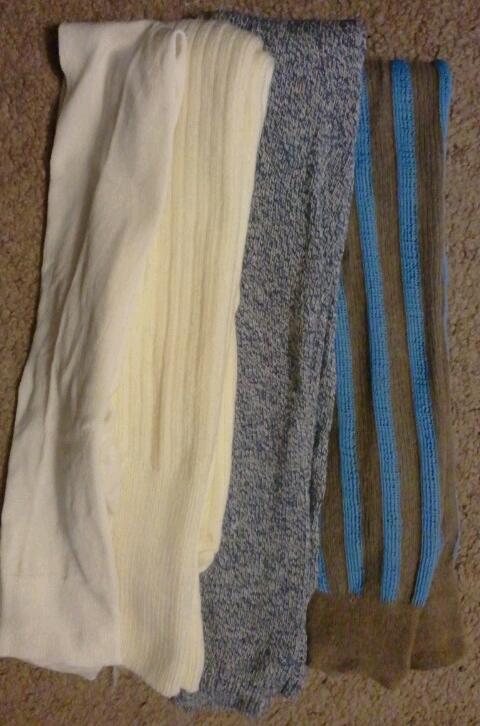 Especially when they fit.
As one with not small legs, comfortably fitting stockings for events can be challenging. A snug stocking can range from uncomfortable to downright painful as the legs swell with the heat. In the winter, a tight stocking is just awful because the constriction interferes with blood flow and warmth.
But, when you find that Oh, So, Comfy Fit….. Ah, the whole world is wonderful. Well, okay, at least it can greatly help.
My good friend, Gail, has recently decided to close her historic merchant business, Oakhill Clothiers. Today, I was lucky to select 4 pairs of the stockings from her, two cottons, a wool and a silk.
I happen to know she has more stocks/stockings like these and in many other colors to sell as she liquidates her stock. If you want a pair, I can get you in contact with her. (now that I am home, I’m wishing I had bought some red too.)
ADDED: ALL GONE
With winter coming up, wool stockings are nice to have whether you are doing a historic event or just live where it is cold and snowy. These wool stockings have a nice smooth fit. The knit pattern hugs the leg without feeling overly snug anywhere. This is particularly nice.
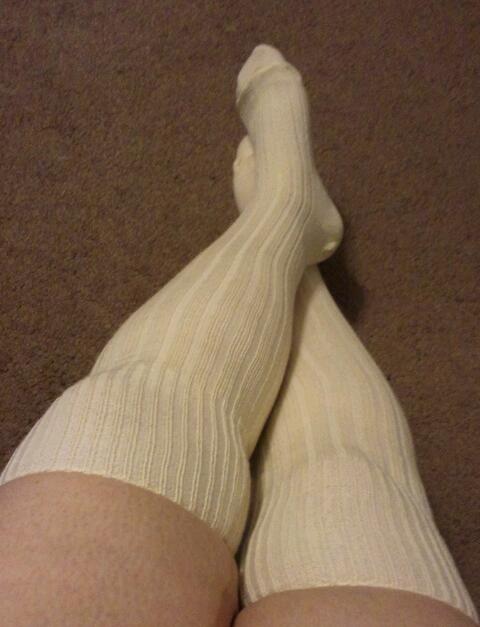
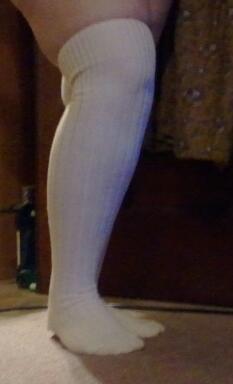
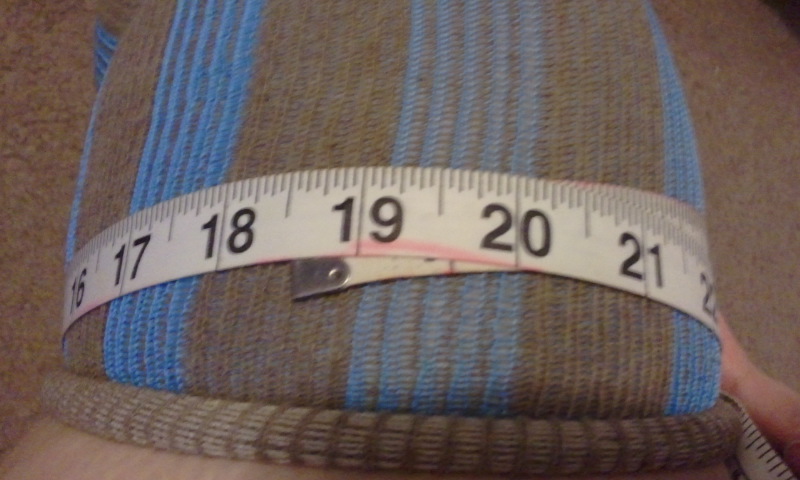
This pair of vertically striped blue and brown cotton is very comfy. These are soft and a loose knit. So, they will breathe. They comfortably fit over my knees. I have a size 7 wide foot. They do not constrict in the toes at all. The heel comes a bit past mine. So, these will fit a larger foot nicely.
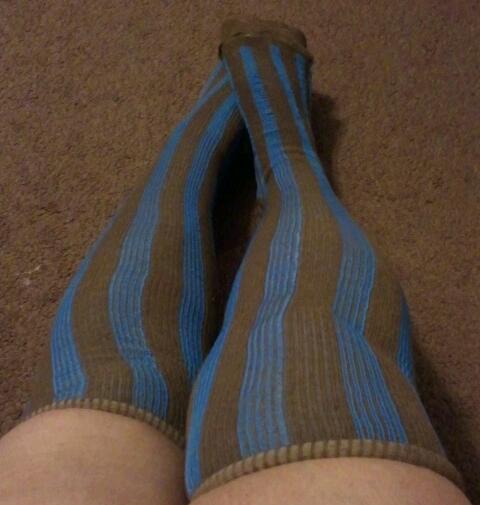
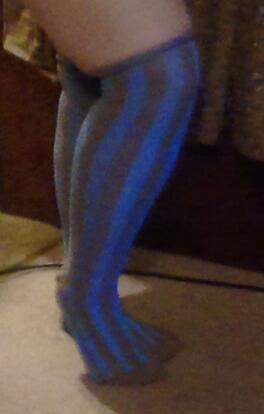
Here are some measurement photos. There is plenty more give to these, meaning they will fit larger legs.
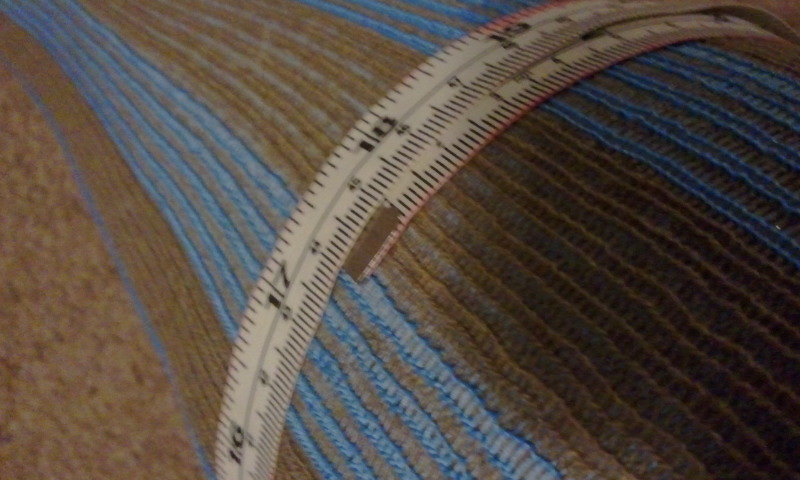
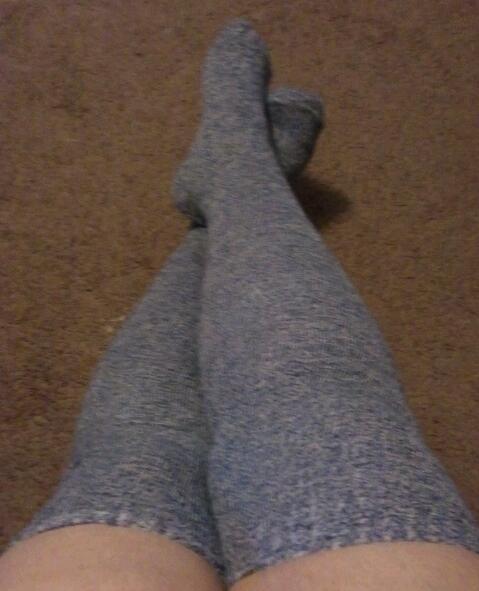
I just had to have this blue and cream pair. I have a feeling these will be worn A Lot this winter. They are just that comfy.
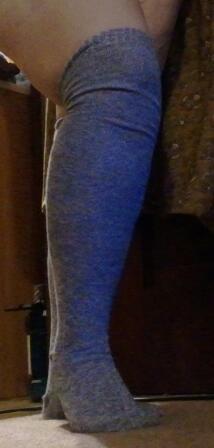
She had a really nice pair of silk stockings with a clocked pattern over the ankle. I like the white on white clocking. It is subtle, yet pretty. These fit through my calf nicely. They don’t stretch quite as well over the thigh. This is just fine with me because these will be for dancing, which means I’ll be wearing the below the knee.
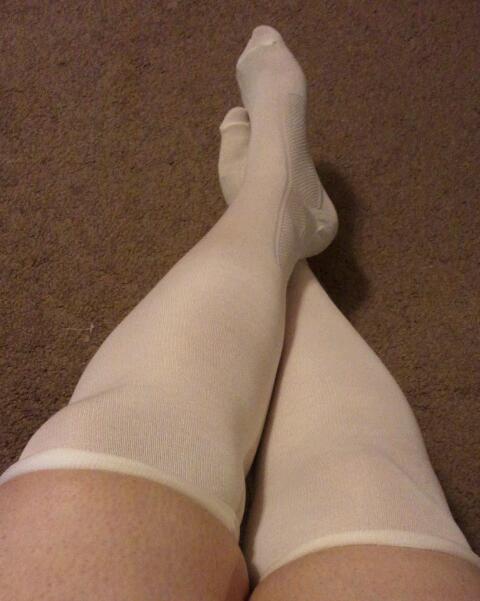
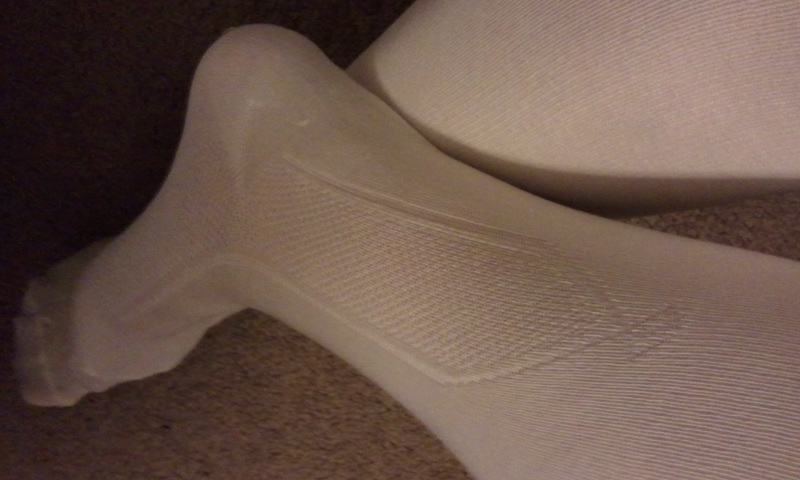
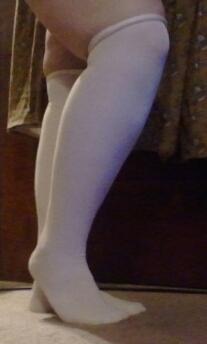
For my Regency friends, Gail also has long knit gloves. Here Gail is modeling them. (I have short fingers and just don’t do gloves justice.)
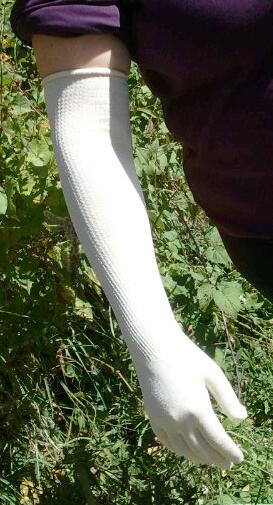
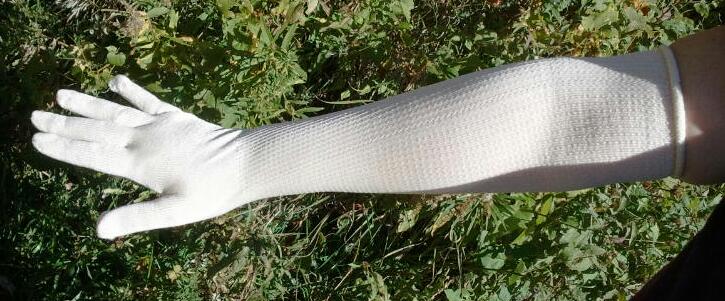
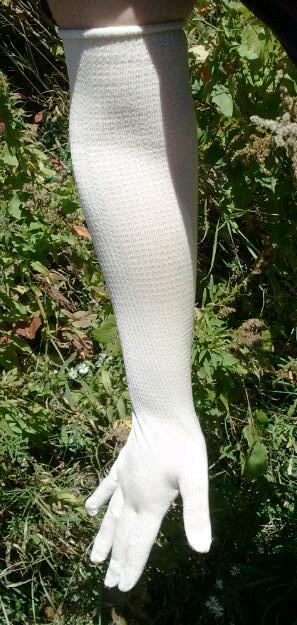
ADDING: Here are the many choices Gail has:
Wool
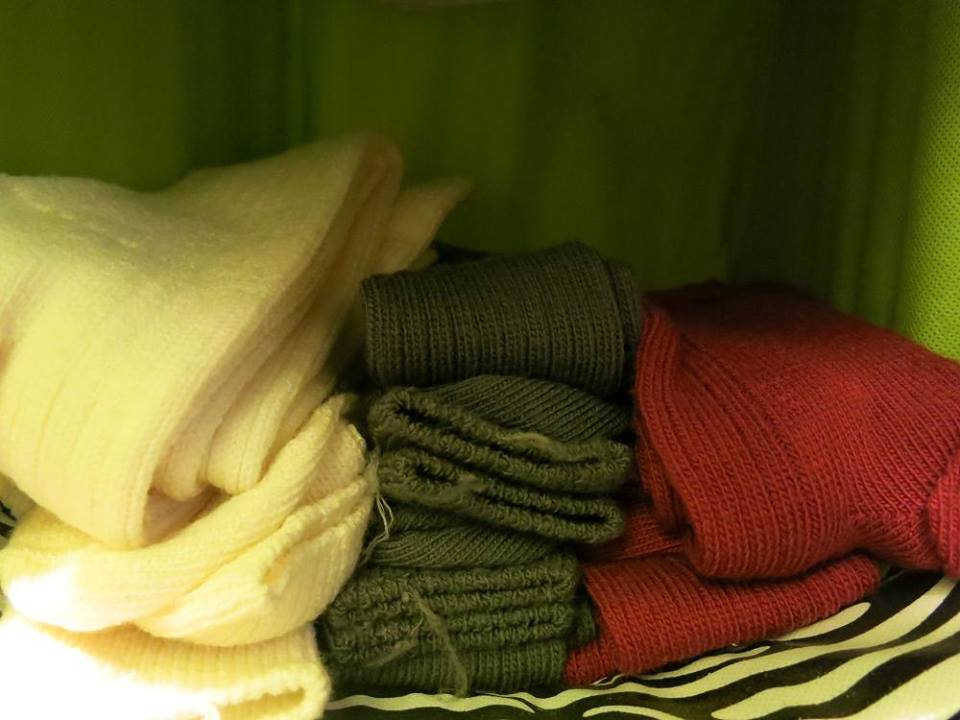 Silk, cotton stripes and I have to check.
 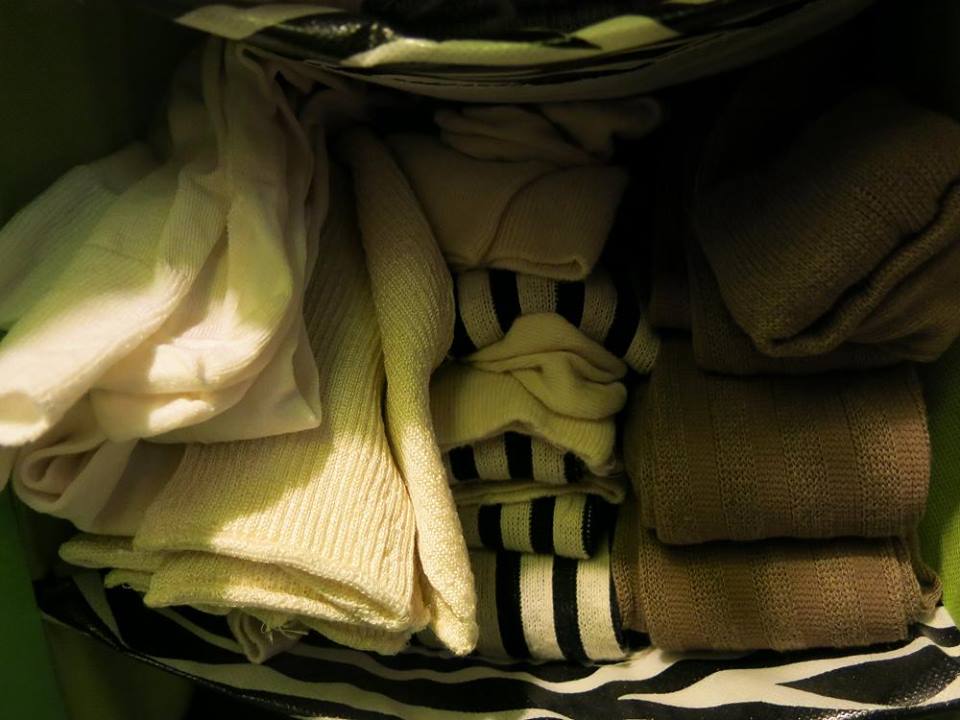 Cotton
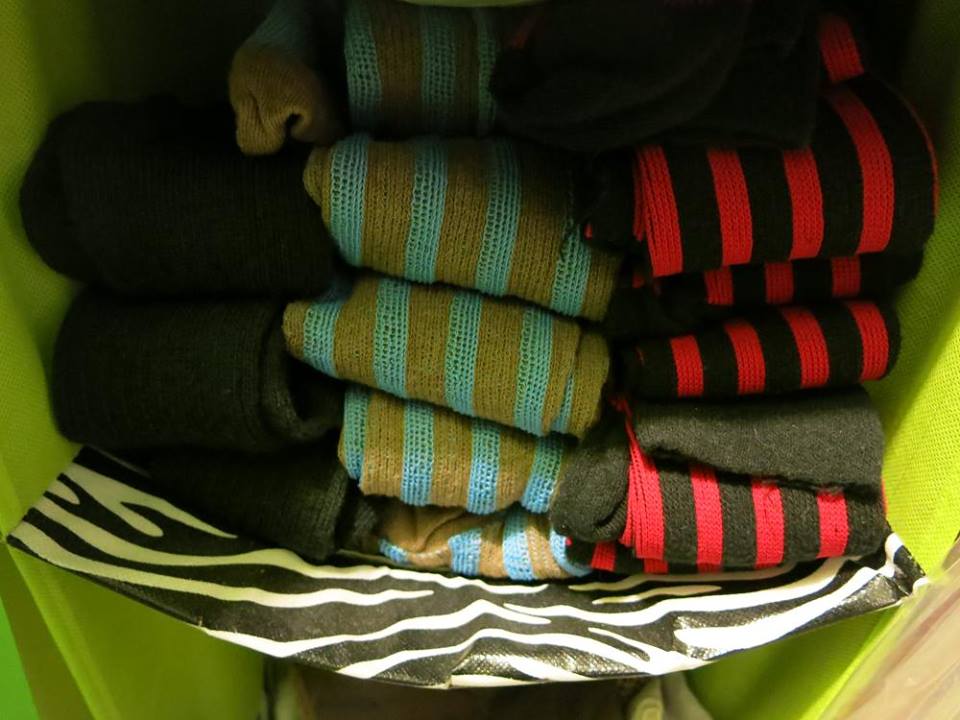 Cotton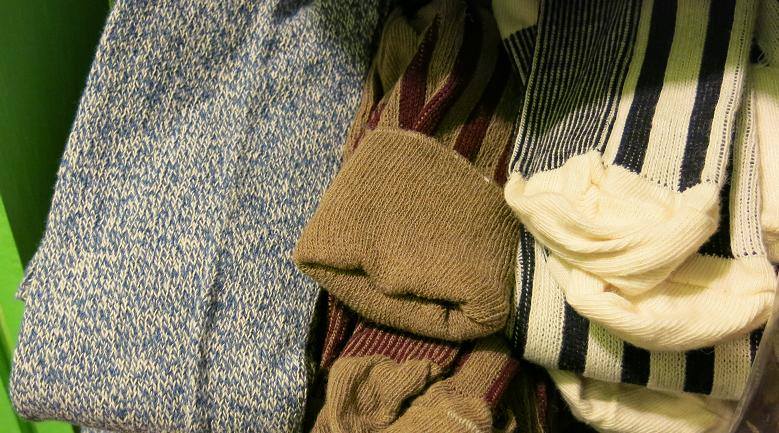
Scattered Leaves – Scattered Brain
I don’t know what it is, but lately my brain has been as scattered as the falling leaves. Really. No matter how much I neaten up the leaves, sweep them off the porch, the next thing I know the leaves are scattered all over the place again. Basically, it is:
So many projects….. so little time.
I should really be focusing on wrapping up a last, delayed straw project, pairing up the all too chatty silks and linings for the season’s winter millinery, pinning down the bits and pieces for the upcoming winter sew-alongs floating in my head and finishing up cutting the bits and pieces for the upcoming workshops at the Domestic Skill Symposium.
But, these nifty ideas keep falling out of nowhere. There are all these tastefully distracting “Ooooo, I want to make that”s.
Florence Hartley’s The Ladies’ Hand Book of Fancy Work is a ridiculous level of distraction. (Some of these likely look familiar to 1850s/60 periodical readers.) The book is page after page of projects to make. The book has something for just about everybody. This time of year, I find the slipper patterns too tempting. Who doesn’t want a pair of warm, soft slippers for the winter? (For those who love knitting or crochet, you may find The Lady’s Album of Fancy Work, 1849 additionally interesting.)
Then there are the amazing personally made design books, those women compiled with their own drawings or clippings they have used. They are full of beautiful designs to make. At the same time, they are beautiful in and of themselves. How tempting it would be to make my own book of designs in an early to mid nineteenth century style. Mrs. Watson’s 1824 Book of Designs is full of hand inked designs. The first several appear to be edges that would work for petticoats, chemises and drawers. Some would be nice for kerchiefs, early fichus or personal whites. Her illustrations increase in size as the book continues. She also includes several circular designs and horseshoe-esque shapes.
One can only wonder what she was working on.
Similarly, this 1850 book of Embroidery Designs is packed full of pretty embroidery designs. While the author/illustrator is unknown, the shapes of the designs with the occasional outline, give us an idea of what each piece may have been for. I see a few that may have been a fichu, other collar edges. She even has a one that is likely a cap.
This Design Book just wins me over though. Again, the author/illustrator is unknown, as is the date (though there is a clipping pasted in the middle of the book with a male’s name and 1839 date.) It is filled not only with designs for needlework, but also shapes I think were for quilting. The shapes are cut from an assortment of papers. Some are plain with a bit of visual texture to the makeup. Some are printed papers appearing to be periodical publications. Some are handwritten (notice how the words are repeated as though from school?) The cut outs were either for the quilting itself or for the pieces. I am pretty sure I see a couple that make up parts of an album quilt. Wouldn’t it be great to take her shapes and see what they could make??? (I am really puzzled by the clipping with the name/date. That clipping has a pin pricked design on it. Turning the page, there is an additional clipping, also with pin pricking, that has the same name and multiplication problems on it.)
So, this is why I need to not touch my laptop when I am home and have things to do. Too many tempting projects…. too little time.
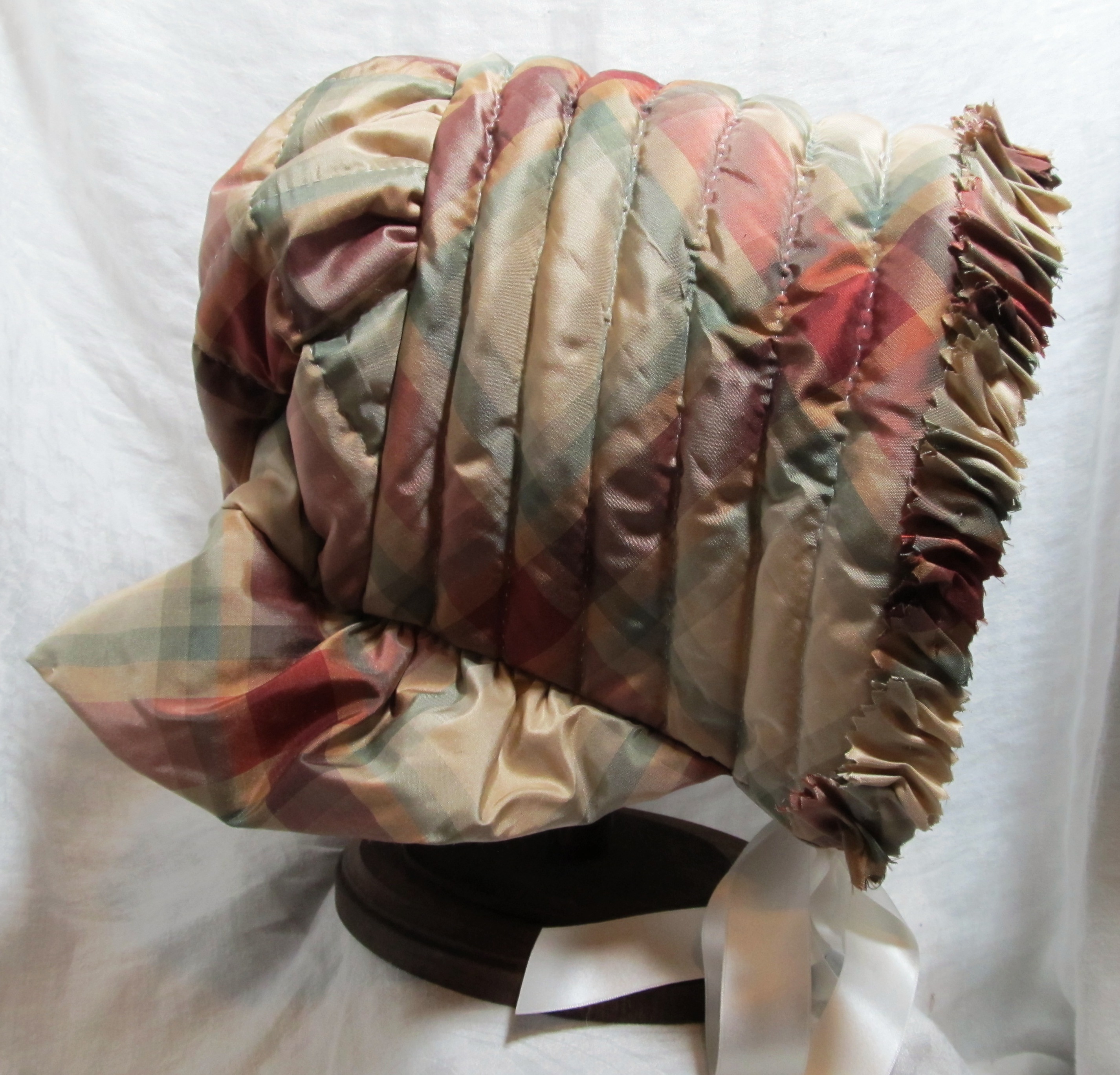
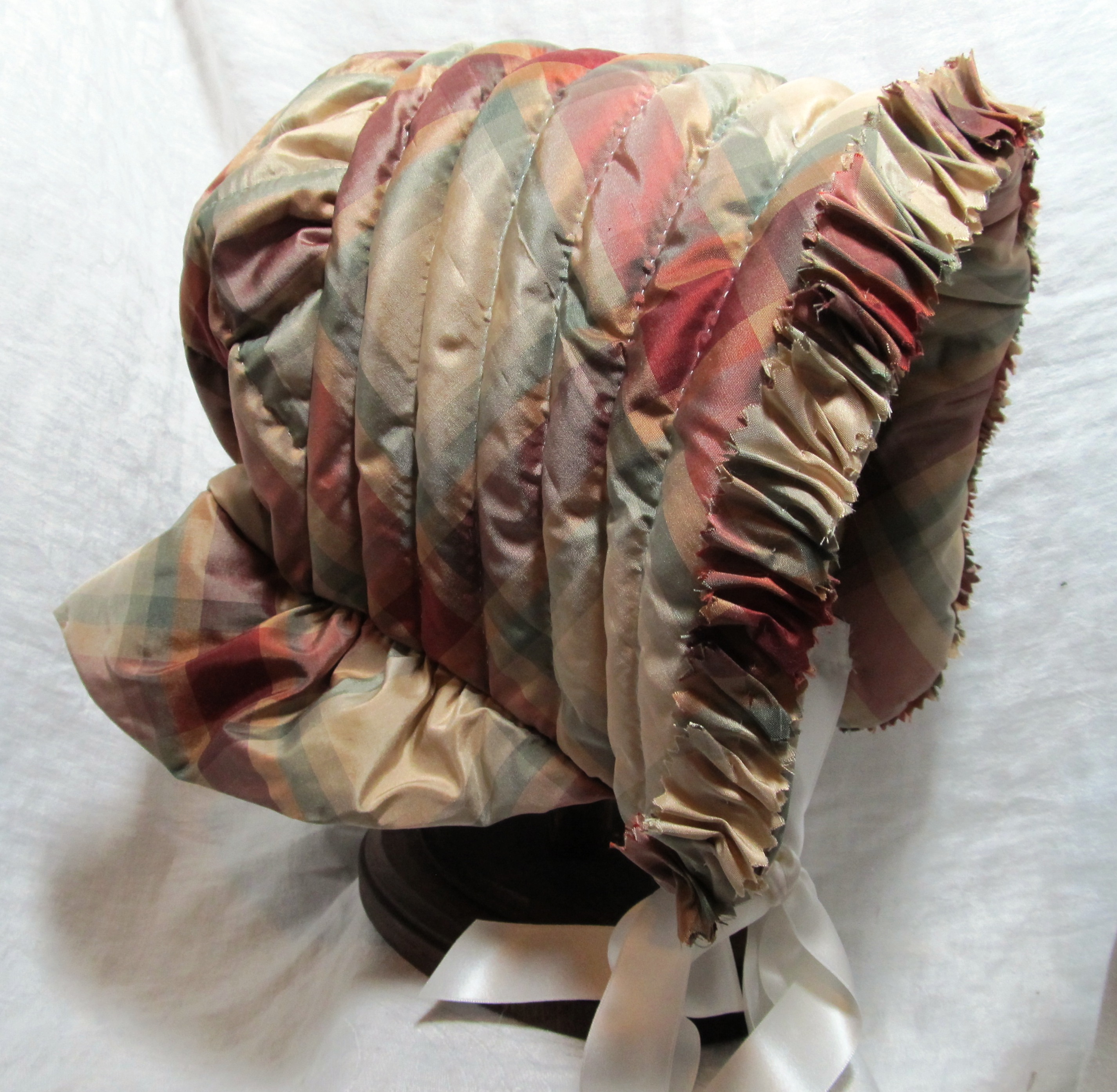
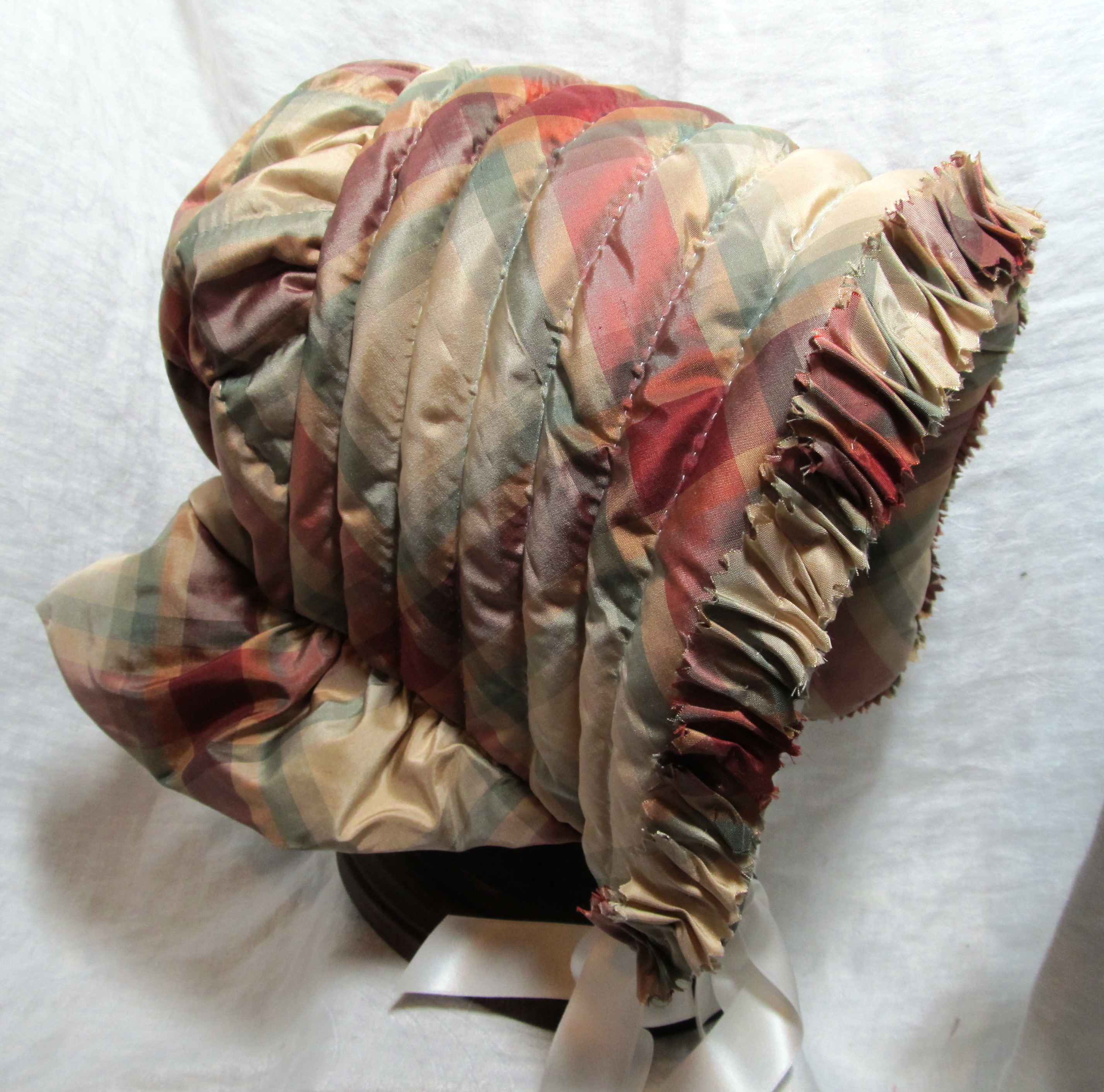
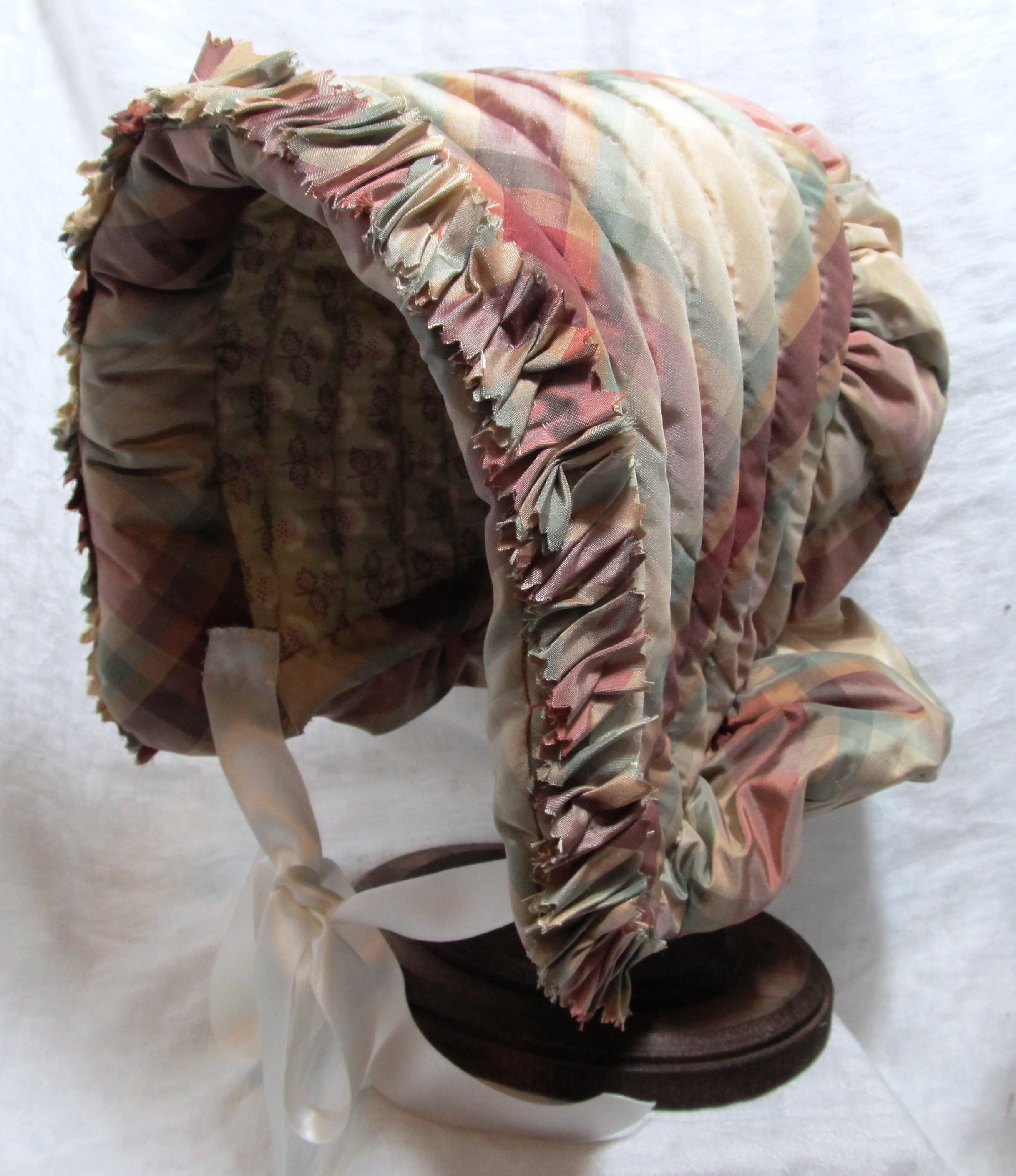
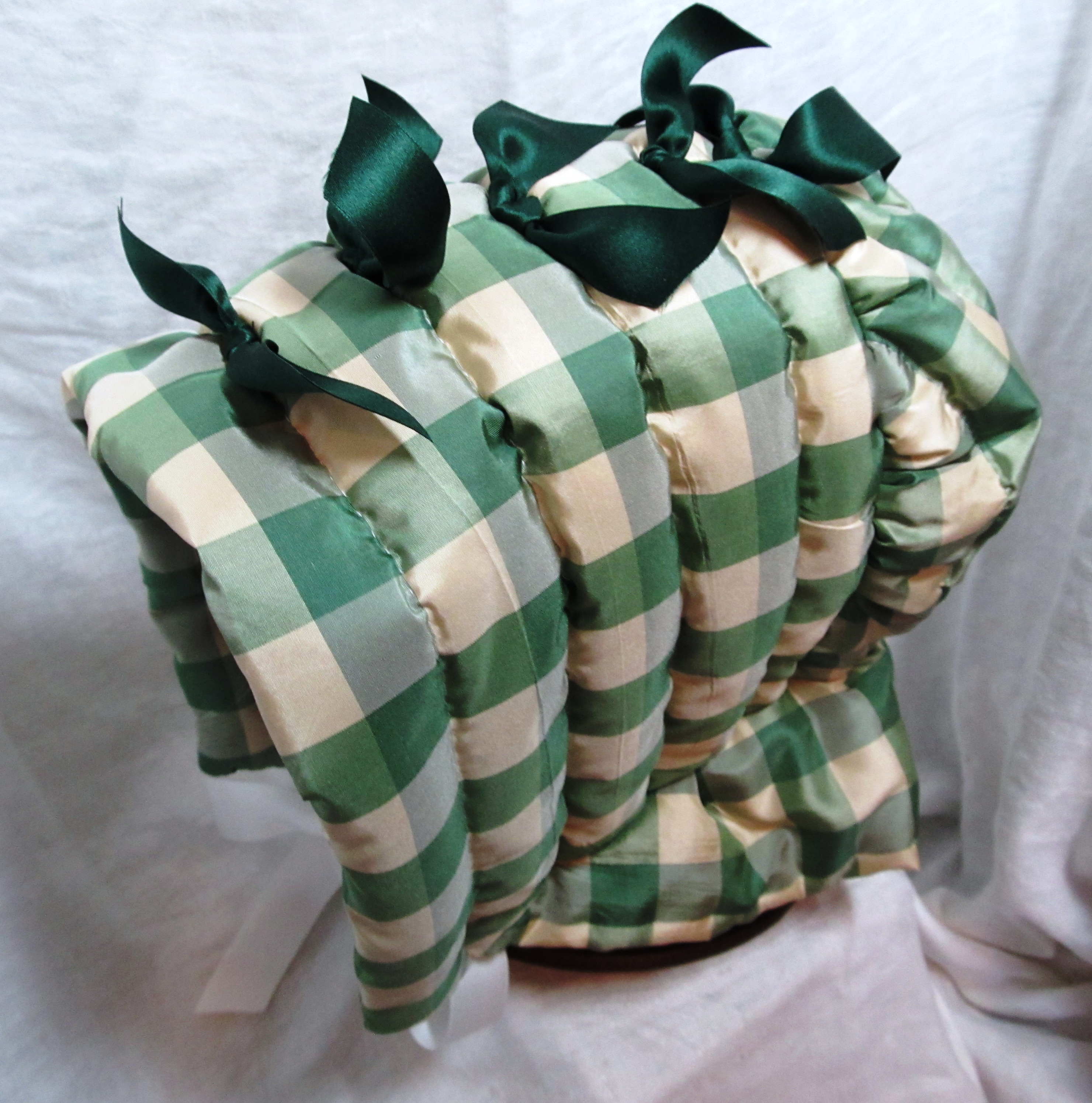
This Week’s Winter Hood: Green & Cream Silk Check
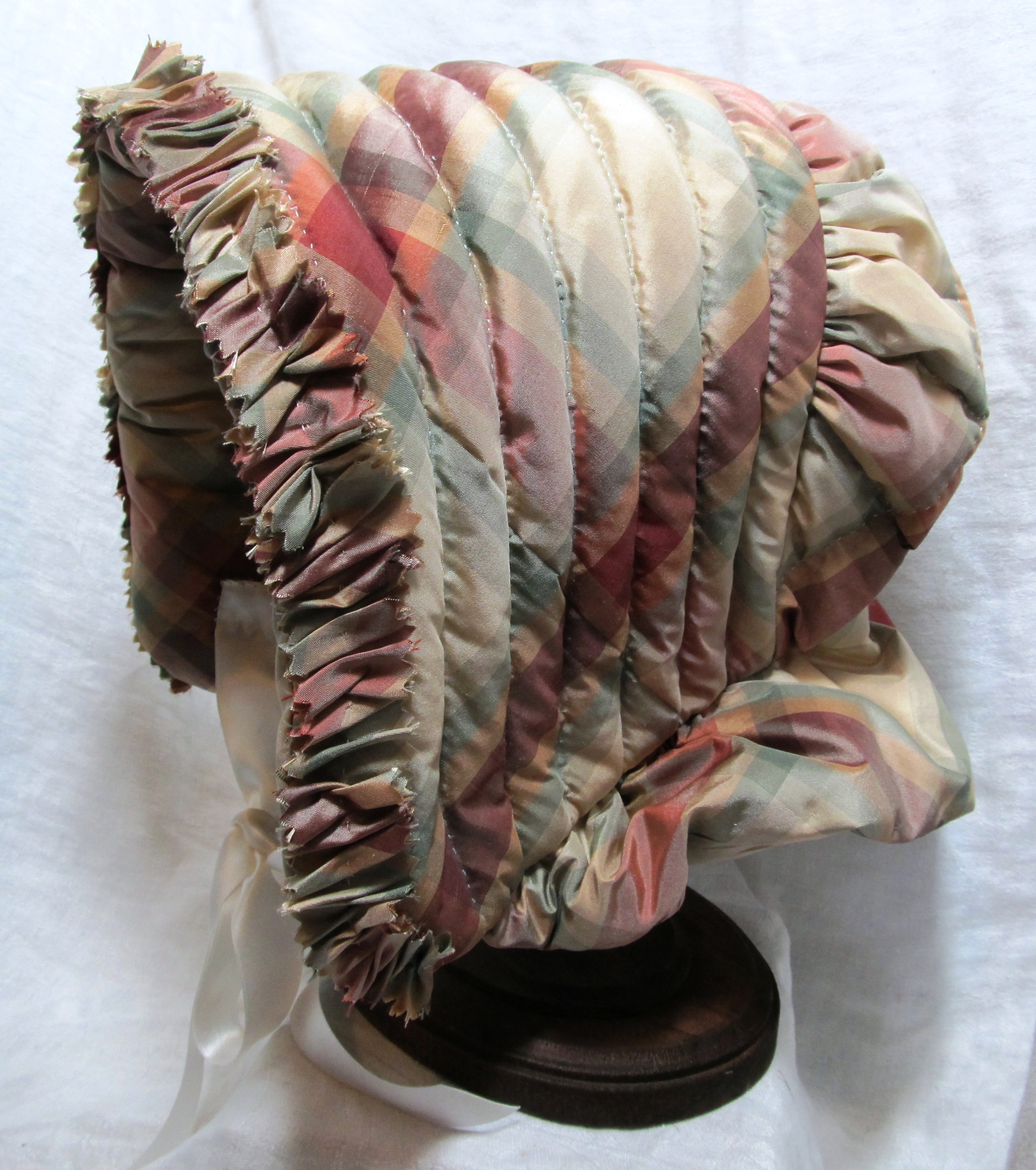
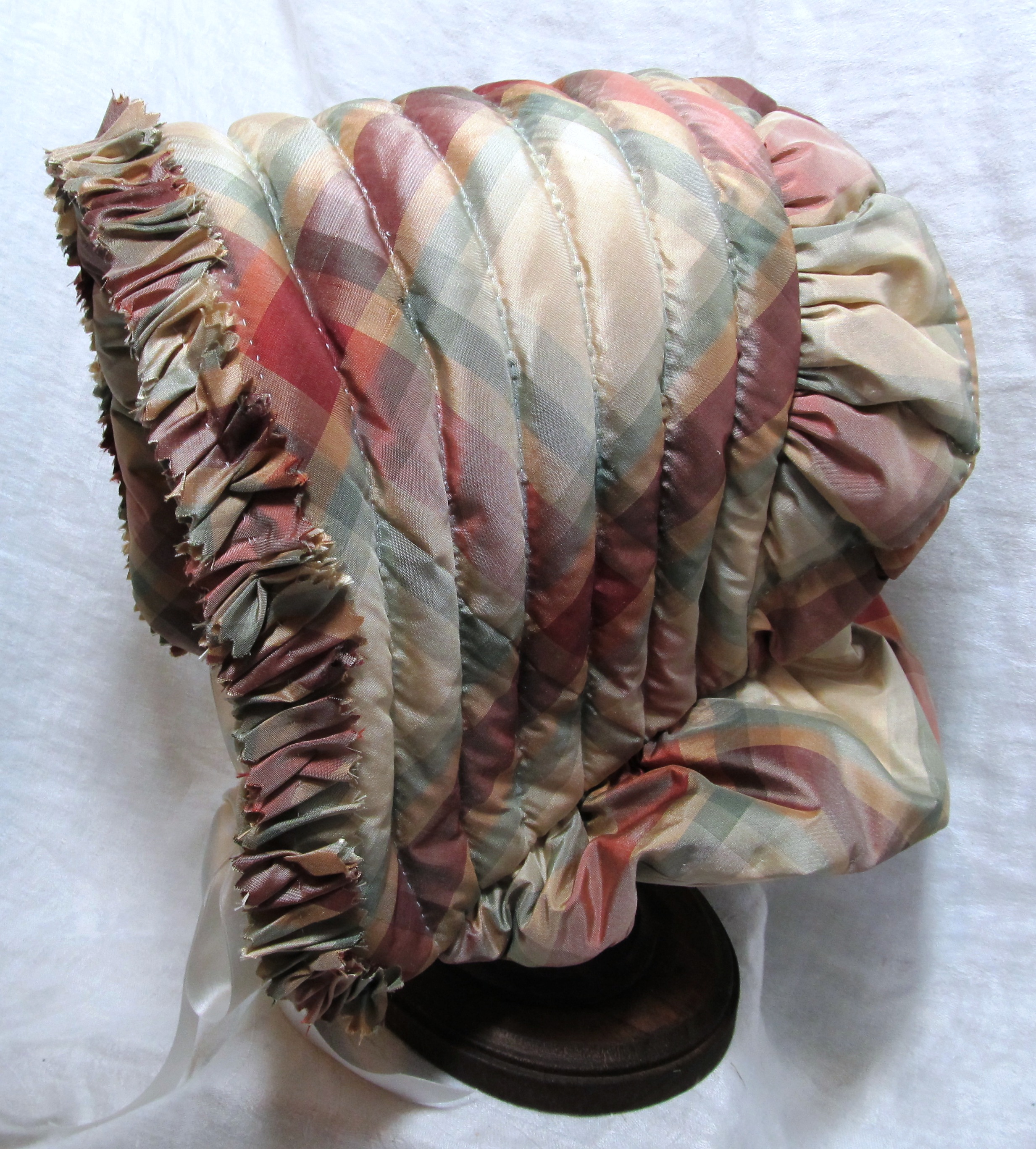
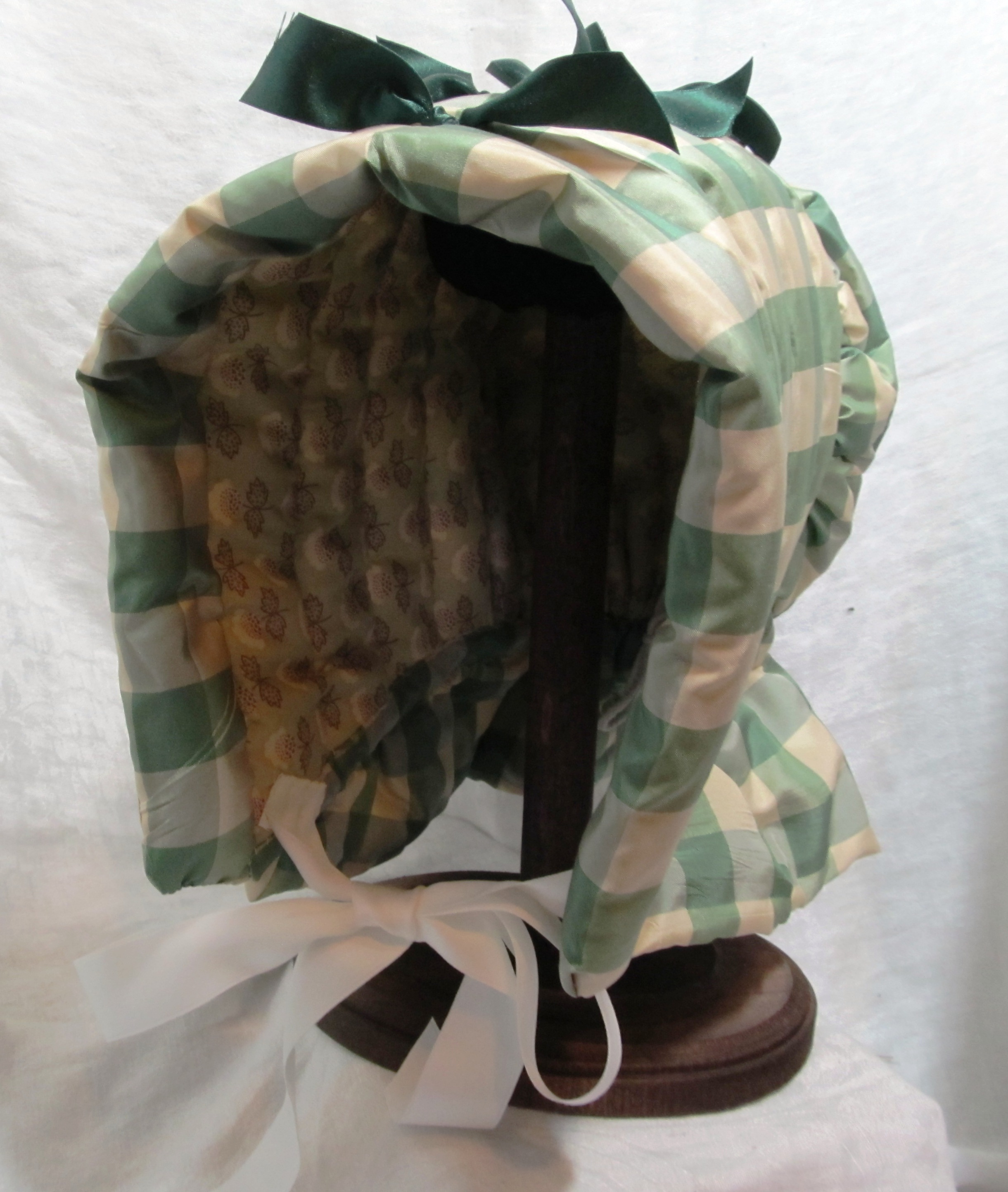
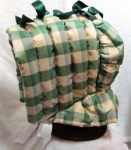 Winter wear in a pretty green and cream silk trimmed with dark green silk ribbons. The wide lofts filled with squishy wool are quilted along the lines of the check. The double layer of wool batting makes this hood soft and warm. The full crown gives plenty of room for your coiffure. It is also adjustable along the neckline.
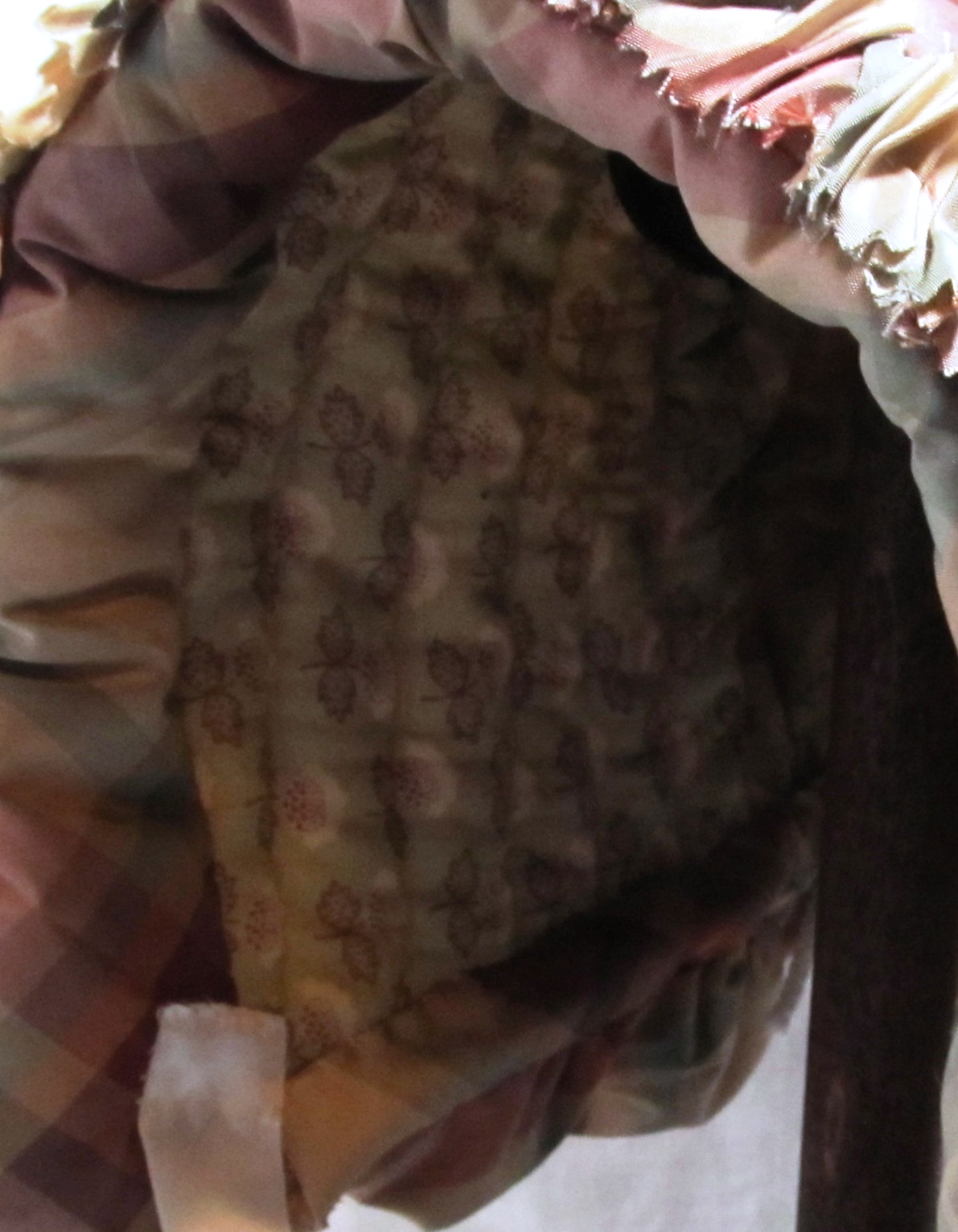
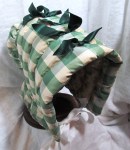 Inside is a pretty period cotton print with fluffy white flowers. It ties closed with a durable white cotton sateen ribbon.
This hood is currently available in my Etsy shop.
~
I Don’t Cook
Please read this post from Kitty Calash: “Men, Women, and Work.”
Years back, I determined “I do not cook.” This started out thanks to summers of doing a residential scout camp all summer where I cooked outside each and every week. I had enough of campfire cooking.
This stance of “I do not cook” has evolved into the observation Kitty shares: All too often women are tied to a campfire at military events.
For me, that is many levels of unappealing
I acknowledge some women love to cook, enjoy cooking, choose to cook. Cheers to you! Some of you do your research and impressions exceptionally.
Then there expected or assumed situations that ‘wife’, ‘girlfriend’, ‘mom’ is going to cook and care for me in camp.
Um. No thank you.
When little sister started developing an interest in historical interpretation, I repeatedly cringed at mom’s suggestion, um, read “push”, to cook. To me cooking is….. having to tow around heavy pots and pans…. having to box and store dishes…. having to deal with digging a fire pit…. having to deal with a fire…. having to deal with food… being stuck in camp….
Ugh. No thank you.
I am so very, very thankful for historical settings that invite a variety of domestic, social and business based interpretations. I am so very, very thankful for period publications, such as Moore’s Rural New Yorker, that show women venting about their distaste for the kitchen and those who hire in instead.
Shattering Silk – Why Not to Use Antique Silk Ribbon
Since our 21st century selection of silk ribbon is a teeny, tiny fraction of what it was in the 19th century, all to often we look to antique and vintage ribbon for embellishing our millinery. The silk florals, stripes, plaids, damasks, moires, pretty colors…. are all too tempting. They are just so pretty.
Well…. there can be a huge drawback to using antique or vintage ribbon for reproduction millinery.
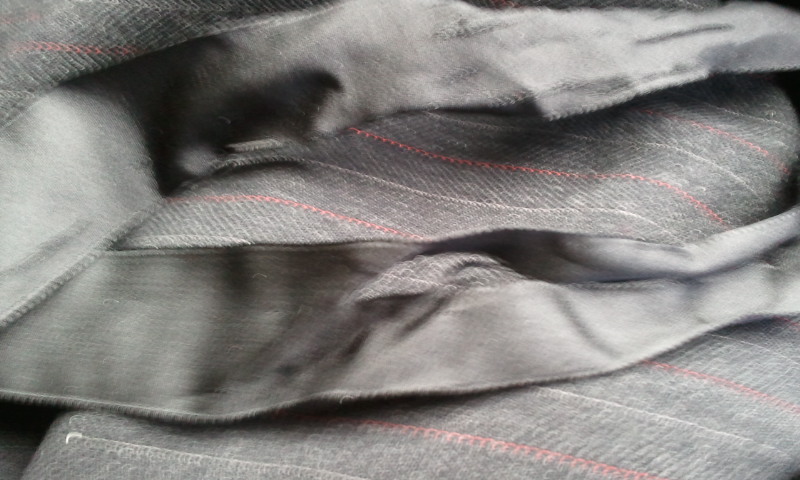 Antique and vintage silk ribbons can be fragile. Even if they appear to be in strong shape, they can still be easily damaged. This black ribbon to the right is an example of this. This is 1″ ribbon on one of my personal winter bonnets. This is after the first wearing. The ribbon was tied in the morning when I left the house. It was not untied/retied at all through the day. This is how it looked when I took it off in the afternoon. This ribbon was part of an order of several black ribbons when I was out of my regular silk ribbon and my ribbon supplier was also out of ribbon. The ribbon appeared strong, being soft and supple. Obviously, this was not the case.
Bad for me. Good for you because this is a good chance to show what can happen.
The fractures or splits on this ribbon run the length of the ribbon. This means the weft threads are what broke. The weft threads, those running across the ribbon, are usually less strong than the weft threads that run the length of the ribbon. These fractures are along the lines where the ribbon folded/wrinkled in the bow. So, these fractures make sense. (This is also good to see because it can be compared to future observations of silk fractures. These would occur from the wearing. Other fractures can occur during the storing.)
Now, imagine this happening with a wider ribbon. This narrow ribbon only cost a few dollars a yard. A wider ribbon can cost $10, $20, even $50 a yard. Multiplied out by 2 to 5 yards going on a bonnet…. there would be lots of tears. I had a client who loved this wide green silk ribbon. It looked quite lovely. When it arrived, it was obviously quite dry and brittle. Using the ribbon would have been a disaster.
~
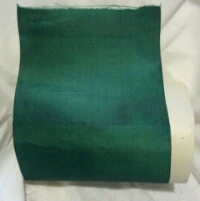 Here is another example I picked up at an estate sale for the ribbon collection. It is a brilliant green silk in a five inch width. This ribbon appears to be in nice shape on the roll. But, just the pressure of a finger nail can break the fibers like a razor blade. Notice how this break is across the ribbon. This means I am breaking the warp threads, which should be the stronger fibers.
 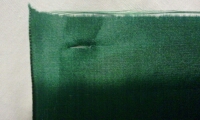 This ribbon, assuming it survived being attached to the bonnet (which I doubt it would) would shatter in the wearer’s hands.
~

This pale blue silk is another example. this two inch wide ribbon appears to have a nice sheen. It is soft to the touch. It does not feel dry or have that weird crisped feel some aged ribbons can have.
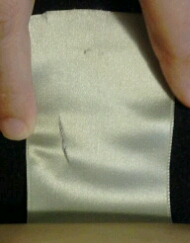
Yet, it is still quite fragile. This break cuts across both the warp and weft threads.The break formed just from pressure in that area.
~
Of course, not using antique and vintage silk ribbons leaves us with vintage blends, narrower modern silk ribbons and wider ribbons in modern fibers. I highly recommend feeling some orginal ribbons when you can. Also, feel the different qualities of modern an newer vintage ribbons so you can have a tactile knowledge of what is available and how it compares to originals.
Having a Ball
I completely forgot how much fun balls can be. Btw, I mean the round, spherical kind not the dancing kind. Though, those can be fun too.
“the little ball, the great, the empty ball, and the leathern ball.” (Ebenezer Landells)
Back when I taught Pioneer Days Camp at Stone Tolan, I included a ball project for some of the weeks. I took the ball design from The Girl’s Own Toy-Maker, by Ebenezer Landells. In this book, the author suggests sewing the ball of cloth or leather, alternating colors and filling with bran. The same author writes a little more about balls in his companion book The Boy’s Own Toy-Maker. Here he suggest, for a handball, the use of India-rubber or cork wound round with worsted (a woolen yarn/string) until the size of an orange.
While these written directions obviously intend these balls to be toys, we also find balls that were used for pin cushions. Eliza Leslie writes of a twist on the ball pin cushion, transforming it into a ball needle-book. I have yet to make this one.
These ball pin cushions is what has recently reminded me how much fun balls can be.
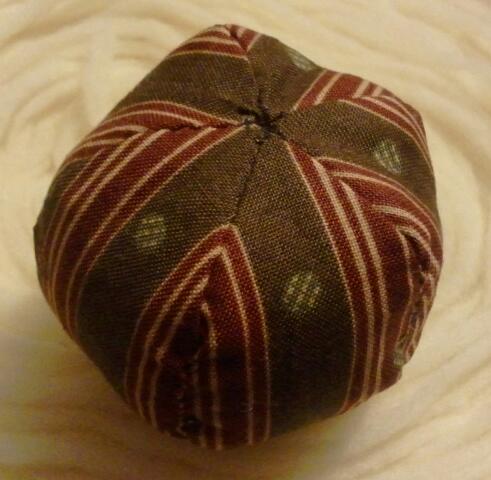 I have been filling most of my balls with wool wadding rather than bran. Have you ever tried using something like bran with small children? Let’s just say it can get a tad messy. Other filling options of various function and authenticity, could include walnut hulls (I have a lovely one with lavender from the quilt shop), rice, sand, emery (for small pin cushions), sawdust or small beans.
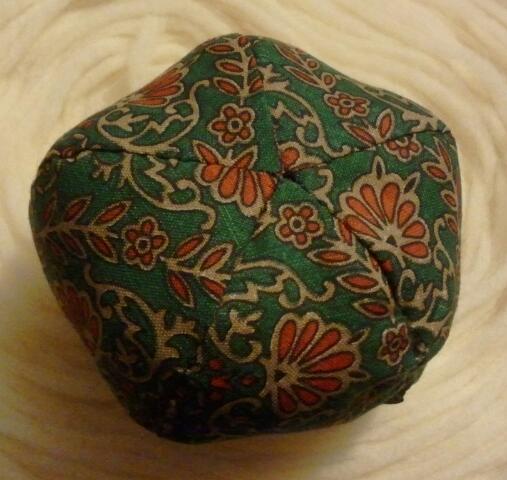 I like using the shape from above. For lack of a better word, I’ve been calling it a petal because it sorta looks like a flower petal. If you are worried about the proportions, there is a simple formula to use:
- SW=2H
- S is the number of segments
- W is the width of the segments
- H is the height of the segments
- So, a 3″ tall petal would need to be 1″ wide if you want 6 segments or petals.
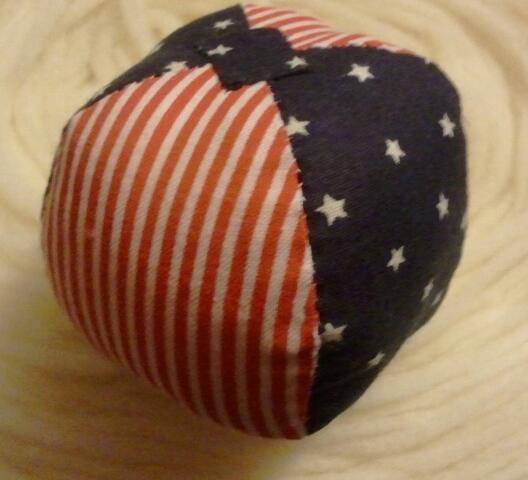 Of course, the fun part is selecting the fabrics. With an even number of petals, you can alternate fabrics. With an odd number, you can use an assortment of fabrics. There are an endless number of combinations. Alternating velvets and silk taffetas can create a play on texture.
 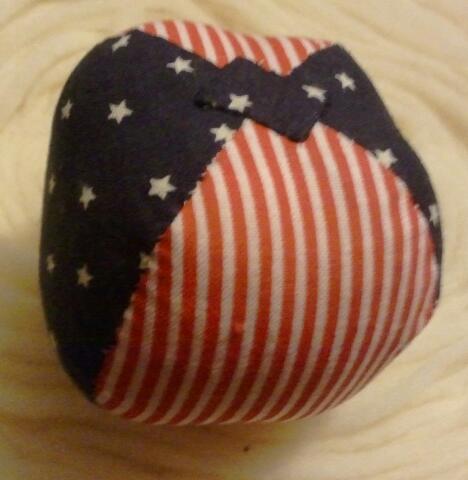 Using red and white stripes in combination with white stars on blue can make a patriotic ball. The stripes in a corded fabric can be angled to play with a single color.
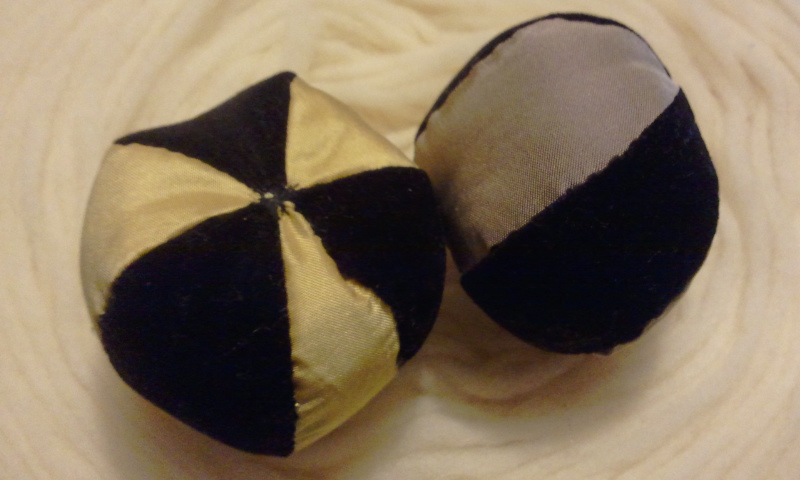 Many other ways of making balls that seem to pop up over time – triangle, octagons, etc. I’ve started a pin board just for these here.
For more toys and games, I recommend
- An American Girl’s Book by Eliza Leslie
- The Little Girl’s Own Book by Eliza Leslie and Lydia Maria Child
- The Girl’s Own Toy-Maker by Ebenezer Landells
- The Boy’s Own Toy-Maker by Ebenezer Landells




 If I Had My Own Blue Box: