When I recently mentioned the possibility of writing out and publishing my fashionable fichu pattern, a friend and reader asked me about a neckerchief style fichu. It took me a few more weeks to get that information to her than I initially planned due to the wild fun of work and husband sewing. But, finally I did. Now, here that information is for everyone else.
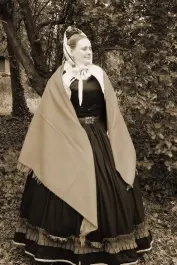
Since I am very fond of V neck dresses, I find a long diamond a very useful and functional form of neckerchief. (Oh, I should say it seems through the first half of the century the word fichu referred to a kerchief that was worn about the neck. Then as we reach the 50s, or the mid-50s, the word fichu is used for a more fashionable accessory still worn about the neck technically, though it was more often pictured draped around the shoulders, high at the neck in the back, then falling gracefully over the bust to the waist or past, sometime crossing in the front. The accessory I am showing here is of the first instance.) Folded lengthwise, the short points nicely tuck inside my dress’s collar following the V in front. Sometimes I will pin the point of the V the kerchief creates, other times I will leave it as is. My use of this diamond shape comes from a discussion on The Sewing Academy some years back. So, I can not take credit for the initial design.
This diamond shape can be seen in several extant kerchiefs including:
To make this version of a kerchief, I cut a diamond as shown in the illustration. The diamond is 40 to 44 inches long and 10 to 15 inches wide from point to point. This size fits nicely across the width of most modern fabric. The fold line should be set on the bias. On the body, this length will drape around the neck, over the inner bust down to about the ribcage. The length should be long enough to sit inside the front of the bodice without pulling out while you work. I prefer less bulk and go with a narrower short width. A wider short width would be helpful if the kerchief is to be used during labor where one expects to perspire more.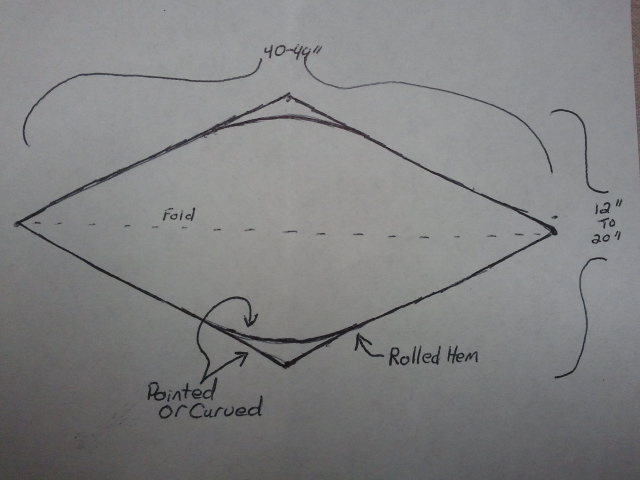
The edges can all be finished simply with a rolled hem. The short points can be rounded off into a nice curve as well. If you are good at fancy needlework, add something decorative as well.
Another type of kerchief is half of this design, as if it was cut and hemmed along the fold line in the illustration. This long triangle is half the fabric, thus half the bulk of the diamond version. This shape appears quite frequently in originals. Without tabulating to be certain, I suspect the triangular version appears more frequently than the diamond version. You can see examples here:
As you can see from each of the examples, a variety of materials were used. This is supported by this passage from The Ladies’ Work-Table Book. The passage mentions different treatments of the edges. It also mentions a curious bit about tapes which will be nice to learn more about.
Neck and Pocket Handkerchiefs – These are made of a great variety of materials, as silk, muslin, cambric, lawn, and net. The neck handkerchiefs are generally a half square, and are hemmed all around. It is a good plan to turn up the extreme corners, as it makes it more strong and durable. A tape is set on, which comes ‘round the waist, and ties in front. Sometimes a broad muslin hem is put on the two straight sides, which looks extremely well. Some ladies work a border to their neck handkerchief, which gives to those made of net the appearance of lace. Pocket handkerchiefs are neatly hemmed, and sometimes have a worked border. Those used by gentlemen are of a larger size than those of ladies. (The Ladies’ Work-Table Book.)






 If I Had My Own Blue Box:
Thank you so much for this, Anna! As an 1850s reenactor, I could definitely use some more kerchiefs for my impressions. 😉
You are welcome. I’m toying with another pattern post idea that would be great for your later 50s impressions.
Oh gosh, please share it! You can’t just tease me like that. 😉
Anna – What fabric do you like best for this fabric? I want to stay away from silk as it’s pretty hot down here already, and I need something washable. Do you think batiste would work?
I’ll be working on it this next week. Hopefully I will have it together soon.
I like a light weight cotton like a lawn for most times. I think the one in the fence photo is leftover muslin. A similar weight linen would also work. Some may prefer something heavier depending on the use. On the other hand something sheer and light weight can be worked nicely & very pretty. So…. there are many, many options.