This week a friend asked advice about purchasing a shawl. The answer was a definite yes, as long as she sent me pictures. In the end, she ended up with two great shawls.

Her asking about the shawl in question brought up a couple points on shawls. Barbara was looking for a double square, wool shawl. Using some of her words, she was looking for a big fluffy WARM shawl and not a foo-foo shawl. When I get questions about a shawl being purchasable, the shawl is usually one from the paisley family or occasionally a printed shawl. It is less often I get questions about a common woven wool shawl. The reality is, it should be the other way around. The majority of the paisley family of shawls were on the higher end of the cost spectrum, being worn for nicer occasions. The printed shawls became a more affordable response, with the aid of advancing industrial processes, to the desire for nicer, fancier shawls. While many women, and men, may have owned a shawl from the paisley family, the average woman would have had more occasion to wear a wool shawl. In living history terms, we are more likely to be interpreting situations where a woven wool shawl is appropriate then a nicer paisley or printed shawl. A nicer shawl is appropriate for some dinners, some evening social events, some church services, some weddings and other ceremonies. An everyday shawl is more appropriate for wearing while sewing at home, going to market, visiting on a regular day, running out to the barn or chicken coop, gardening, volunteering at the aid society, basic everyday life. This everyday shawl, in my opinion, should be a staple in each interpreter’s wardrobe. Cheers to Barbara!!
Now on to her shawls.
The shawl she initially asked about was this beautiful double square red check. I was thrilled to see a surviving double square in a red check available. (a double square is a shawl that is twice as long as it is wide, usually 60″ by 120″, also called a plaid regardless of design.) What stuck in my mind as this shawl found its new owner, was the tendency of reenactors and interpreters to play it safe, buying what they see or are comfortable with, whether accurate or not. How does this related to this shawl? The check. When it comes to buying or making an everyday wool shawl, it seems we most often go with a symmetrical plaid or a solid (see the close-up of her other shawl below.) I don’t see a check like this worn often at all. Why? I have a couple thoughts. The first is we wear what we see and what we are comfortable with. Second, extant documentation under represents what I believe was actually available. Going huh? Basically, there are fewer surviving examples of small check shawls then women actually had. In general, there are fewer everyday, working class shawls remaining then the nicer paisleys, lace and higher end silks. A few things may have happened to cause this. The everyday shawls could have been worn out in their day. These shawls could have been deemed by the owner not worth saving. Or, at some point between the mid-19th century and now, the shawls were deemed not as important and worth conserving as other items. Either way, we have fewer examples of everyday shawls to look at and even fewer small checks. Does this mean they didn’t exist as much? Of course not. When looking at original images, we see small check shawls represented. This post-war image shows a small check with a border design. (Sorry, only one on hand until I find the right disk with more images.)
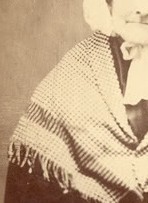 Small check wools are an acceptable choice for a shawl when purchasing a shawl or fabric for a shawl.
I am very glad Barbara was able to acquire these shawls and allow me to talk about them.








 If I Had My Own Blue Box:
Leave a comment