The What-not; or Ladies’ Handy-book “How to Wear a Shawl”
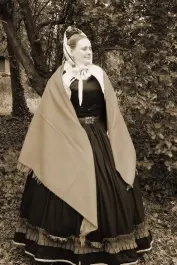
On the subject of wearing shawls, both long and square, much may be said, on some of our fair readers having expressed to us their desire that we should publish some details upon the best system to be adopted in wearing shawls gracefully, we purpose doing so to the best of our ability. In the first place we must premise that, as there does not and cannot exist a universal panacea for effacing wrinkles or making the hair to grow on bald places, there cannot be an absolute system for draping shawls. One substance suitable, or rather inoffensive for some ladies, may be essentially prejudicial to the appearance of others. One fashion of wearing a shawl may appear very graceful on a slender figure, but will transform into a bundle a woman of rounder and fuller proportions. If the so called long shawl be somewhat shorter than usual it should not be evenly folded, that is to say one end should be left longer than the other, in order that it may fall lower. This is indispensable in the striped shawls, which are now so fashionable for morning toilettes, as they are much shorter than bordered shawls. They should be folded so that one end may not appear exactly over the other. If these two points in fact, were to be placed on the same line, the longer end of the shawl would then be too short. Round the neck, two or three folds should be made, which are fixed in their proper position by a long pin; this is done in order to disengage the head which would otherwise be confined by the folds of the shawl. Nothing looks so ungraceful as to see the curtain of the bonnet in constant and ungraceful contact with the awkward wraps of a badly folded shawl. It is then necessary to be careful that the neck be perfectly free, while, at the same time, it is protected by the folds. But these rules do not suffice for the graceful wearing of a shawl. To succeed we must have not only the experience that is acquired, but the instinct which is innate. A woman must then know her own figure, and not be led away by illusions in this respect. Drooping shoulders are those which bear most becomingly the long or square shawl. High and pointed, and consequently narrow shoulders are less adapted for the square shawl. For ladies so circumstanced by nature in the latter respect, we would recommend the long shawl, which being quadrupled over the shoulders, takes off the angular appearance which would otherwise disagreeably prominent. A thin woman should fold her shawl in such a manner that the upper point may fall in the centre of the back. A woman of a stouter figure should so arrange her shawl that this point may be larger and descend lower, about to the waist. It may be easily understood that this quadrupled shawl augments considerably the volume of the bust. And when the bust is sufficiently full, it is necessary that the upper point should fall lower, so as to envelope the body without increasing the size. The longer side of the shawl is ordinarily placed to the left, the right arm raising the shorter end; but this depends entirely on acquired habits, and there is no reason why the shawl should not be worn in an inverse way. Square shawls should be raised on both arms, and a very tall, or very stout woman, ought carefully to avoid folding a square shawl exactly double. One side should be longer than the other, in order to augment the proportions ¡of the shawl, which would otherwise be too short, and consequently ungraceful, if she neglected this precaution. We may add that all shawls should be as much as possible draped upon the woman who wears them, and sustained by the arms being pressed upon the bust ; but we must also add that we hare displayed to our readers but the material part of this difficult art, and unfortunately it is the only one we can analyze, for grace is not demonstrated, and taste is a natural gift which escapes every definition and all commentary. Wealth cannot replace it, nor can experience supply its want.Literary Gem 1854 “How to Wear a Shawl”
If a lady sports a shawl at all, and only very falling shoulders should venture to do so, we should recommend it to be always either falling off or putting on, which produces pretty action. Or she should wear it upon one shoulder, and down the other, or in some way drawn irregularly, so as to break the uniformity. One of the faults of the present costume, as every real artist knows, is that it offers too few diagonal lines. Nothing is more picturesque than a line across the bust, like the broad rilibon of the order of the garter, as worn by Queen Victoria, or the loose girdle, sloping across the hips, in the costume of the early Plantagenets. On this very account, the long scarf shawl is as picturesque a thing as a lady can wear. With the broad pattern sweeping over one shoulder, and a narrow one, or none at all, on the other, it supplies the eye with that irregularity which drapery requires; while the slanting form and colors of the border, lying carelessly round the figure, gives that eastern idea which every shawl more or less implies. What Oriental would ever wear one straight up and down, and uniform on both sides, as our ladies often do?—Quarterly Review.Hurry-Graphs by Nathaniel Parker Willis “Shawl Aristocracy”
The degree to which ladies care more for each other’s opinion of their gentility of appearance, than for the opinion of gentlemen, on the same point, is, at least, equal to the difference between a French shawl and a Cashmere—one worth fifty dollars and the other worth from five hundred to a thousand—for, though no man knows the imitation from the real shawl, as he sees it worn, a fashionable woman without a Cashmere, feels like a recruit unarmed and unequipped. The pilgrimage to Mecca, which entitles to the privilege of wearing the green turban, would not, by the majority of women, be considered too much to undergo for this distinction—recognizable, though it be, by female eyes only. “She had on a real Cashmere” would be sweeter, to numbers of ladies, as a mention when absent, than ” she had a beautiful expression about her mouth,” or “she had such loveable manners,” or “she is always trying to make somebody happier,” or “she is too contented at home to care much about society.” It is, moreover, a portable certificate of character and position. A lady “with a real Cashmere on,” would be made way for, at a counter of Stewart’s—differently received when introducing herself at a first call—sooner offered the head seat in a pew criticized, as to manners, and very differently estimated in a guesst as to who she might be, in any new city or place of public resort where she chanced to be a stranger. The prices of the best Cashmeres vary from four hundred to fifteen hundred dollars.* There are two plausible arguments in their favor, usually pleaded by ladies—first, that they fall in more graceful folds than any other shawl, and have an “indefinable air of elegance,” and, second, that, as they never wear out, they are heir-looms which can be bequeathed to daughters. The difference between a thousand dollar shawl given to a daughter after twenty years’ wear, and the same thousand dollars invested for a daughter and given to her with twenty years’ interest, puts this latter argument upon its truest ground; but one word as to the superior becomingness of Cashmeres.
There are very few women, out of Prance, who wear any shawl becomingly—for it requires either the taste of an artistic mind, or a special education, to know its effects and arrange it to show the figure to advantage—but a Cashmere, by the very pliability which is subservient to grace, betrays awkwardness or a bad figure just as readily. For a round back, flat chest, or arms held at inelegant angles, there is more concealment in the French shawl, than in the slighter tissue of an India one; but, either way, we fancy, the difference is too trifling to be recognizable by one person in a thousand. As to the beauty of color and texture, we are very sure that, to men’s eyes, the dull complexion of a
Cashmere conveys the impression of a cover-all, grown somewhat shabby, and which the wearer would not have put on if she had “expected to meet anybody.” There is not one lady in a hundred, of those who own Cashmeres, who do not look better dressed, (to most female and all male eyes,) in any other out-of- door covering.
As our city readers know, there has been a three days’ exhibition and auction of Cashmere shawls, in the large hall over the theatre at Niblo’s. The vessel in which this precious cargo was being conveyed to England, was abandoned at sea by the crew, and, an American ship securing the cargo and bringing it to this country, the goods were sold by the British Consul, to arrange salvage and remit the remainder to right owners. The shawls were hung upon lines, up and down the immense hall, and, between these aisles of Cashmere, the fashionable ladies of the city promenaded, with close scrutiny and comparison of opinion— (and with a degree of keen interest .that we should like to see given to a gallery of pictures!) Having, ourself, fortunately secured the company of Mr. Flandin, who was the only importer of Cashmeres to this country for twenty or thirty years, (and whose eye, for better reasons, is familiar with the Parisian grace of a shawl’s wear, and its value in becomingness,) we took the opportunity to enrich our knowledge in the matter. After having all the advantages of the India fabric pointed out to us, however, and hearing, from our well-informed friend, what class were the purchasers, and what made the difference of hundreds of dollars in the cost of shawls which to a common eye would seem of equal value, we came away satisfied that a better present could be made with five hundred dollars, than to bury it in a Cashmere shawl— that things better worth having could be had for a quarter of the money—and that the arbitrary aristocracy, which is based upon the wearing of them, is one of those illusory valuations which this common-sense age is constantly on the look-out to put down.
(* It is a curious foreshadowing of the anticipation of income by which such expensive articles are sometimes obtained, that the finest and costliest of these shawls are made from the down of the lambs taken from the womb before birth.)





 If I Had My Own Blue Box:
Leave a comment