(Wedding reception attire)
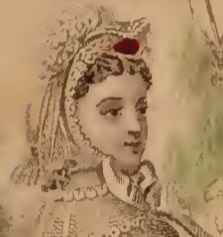
Bonnet of white crepe, trimmed with very light feathers and point lace. A fall
of the latter drops over the brim in the Marie Stuart style. The inside
trimming is of tulle and cerise flowers.
(Wedding reception attire)
Bonnet of white crepe, trimmed with very light feathers and point lace. A fall
of the latter drops over the brim in the Marie Stuart style. The inside
trimming is of tulle and cerise flowers.

It is said that, as regards to invention, one milliner does more in a month than the world architects in a score of years. We are forcibly reminded of this while walking, lately, through the show rooms of Mme. N. Tilman, of 143 East Ninth Street, New York. At this establishment we are constantly surprised with novelties; nothing pretty or new appears in Europe in the millinery line, but is to beyond at the Maison Tilman.
An entire novelty consists of straw guipure, equal in appearance to the finest lace. Straw ribbons are also something quite new, and just introduced on the new spring bonnets. Mother of pearl, of which we have already spoken as being worn on coiffures and ball dresses, is now adopted for bonnets, and, in contrast with trimmings of rich velvet, produces an admirable effect. We are able now to speak with certainty of the spring style bonnets, as announced by the most distinguished artistes.
Scotch plaid, in silk and velvet, is very much in vogue; but we notice that Mme. Tilman uses is sparingly, and only in the finest and choicest patterns and combinations. The following will serve as examples. –
A rich wrought Neapolitan, the braids an inch apart, and each displaying a fine cord-like edge of blue, green, and crimson plaid. The curtain was composed of a shell of plaid silk upon blonde, also in a shell pattern. A puff of ribbon and meadow grass, tipped with dew, constituted the decoration, which was placed high on one side of the brim.
Trimming of all kinds is used very moderately, but it must be of the very best, whether in flowers, lace, or ribbon. It is no longer masses on the top of the brim, but is arranged on the top or side of the crown, or across the side of the brim from its tip to the crown. The shape is perfect, neither too large nor too small, but serving as a modest frame for a fair face. It is still rather high in the front, very much compressed at the sides, and slopes low behind to the base of the crown, which is wider than formerly, in order to allow for the present style of coiffure.
A charming novelty imported by Mme. Tilman consists of fine white and black Neapolitans embroidered in flowers and trailing branches in a fine jet. The design is so delicate and graceful, the workmanship so exquisite, that there is nothing of the ordinary appearance which is frequently objected to in embroidered bonnets. On the contrary, in black upon white, and black upon black, we have rarely seen anything so elegantly effective. Very little trimming, in addition to the cape of velvet or lace, and the decorations of the interior, is required for these bonnets.
Fringes of crystal and jet now replace the feather fringes, and are arranged to fall over the front of the bonnet and shade the interior. (Godey’s, May 1864)
Bonnet for second mourning. The front of the bonnet is of black silk. The crown is of a light lavender silk, covered with a network of black chenille. The bow on the top of the bonnet is of lavender silk, edged with black velvet, and the ends embroidered and trimmed with black chenille. The inside trimmings is composed of white and black lace, and loops of lavender-colored ribbon. (Godey’s, May 1864)
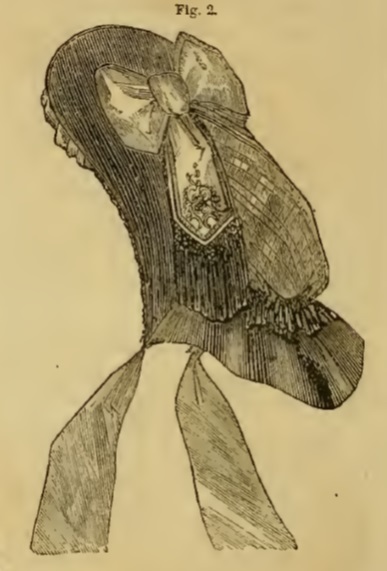

This bonnet has a front of drawn green silk. The graceful soft crown is of white silk. The trimming consists of a tuft of meadow grass and field flowers, also loops of white silk placed directly over the crown. The inside trimmings is of white and black lace and field flowers. (Godey’s, May 1864)
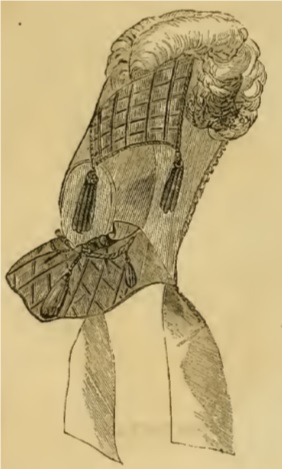
Spring bonnet of white crepe, trimmed with a fanchon of bright plaid velvet and chenille tassels. The cape is of plaid velvet, ornamented by chenille cord and tassels. A long white
plume curls over the front of the bonnet. The inside trimmings is composed of Scotch thistles and heather. (Godey’s, May 1864)
Bonnets are very much more becoming in shape that formerly. They are very close to the face at the sides, but not nearly so high at the top, and slightly flattened at the forehead. The trimming is place at the side or on the crown near the top. If flowers are used, it is generally a large one, such as an iris, or water-lily, and the leaves are left to fall gracefully over the crown. If a single rose, either pink or yellow is used, with one spray of leaves; then, at the side of the flower, there is a bow of ribbon, not the ordinary bow, but a collection of loops standing upright and arranged carelessly; from these loops an end of ribbon is carried across the crown, and finished off at the curtain with a smaller rose, or bouquet of flowers, then at the top of the crown. (Peterson’s, May 1864)
White crepe bonnet, made over white silk. A straw guipure lace falls over the face, and trims the outside of the bonnet. A straw colored feather is laid gracefully over the front. (Godey’s, May 1864)
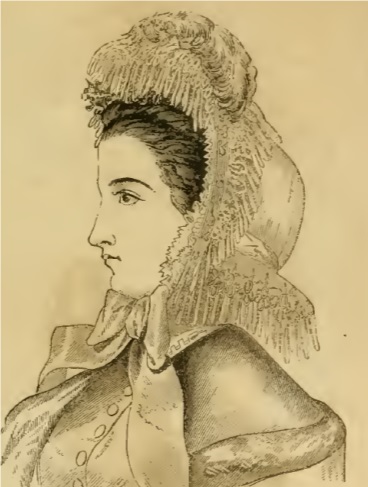
Violet crepe bonnet, trimmed on the front with a black lace insertion. The cape is covered by a rich white blonde, headed by a black lace. On top of the bonnet is a light violet
feather, and a pompon of spun glass. The inside trimming is of black and white lace, mixed with scarlet-berries and fancy grasses. A black lace barbe is tied in with the violet strings. (Godey’s, May 1864)
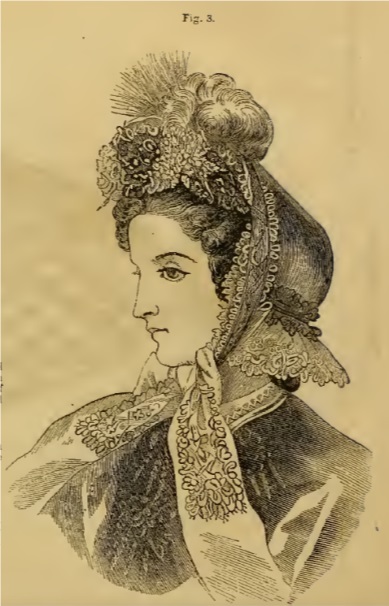
The bonnet of drawn cuir-colored crepe, trimmed on the front with a fanchon of white lace, loops of green ribbon, and Scotch feathers. The inside trimming is of bright flowers, of the
Scotch colors. The cape is covered with a fall of white blonde. (Godey’s, May 1864)
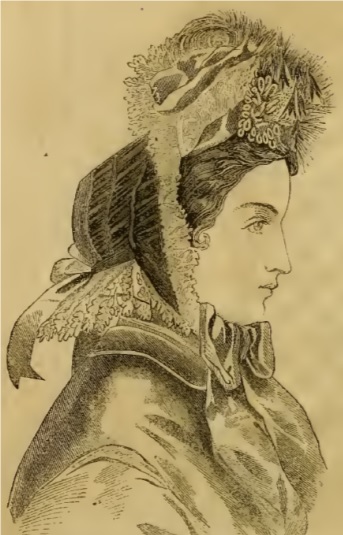
Left – The bonnet is of black and white crin, or horsehair, bound with black velvet, and trimmed with a natural feather. The inside trimming is of scarlet geraniums, and the strings are of black ribbon.
Right – Leghorn bonnet, with violet silk cape, and trimmed with violet-colored flowers. (Godey’s, May 1864)
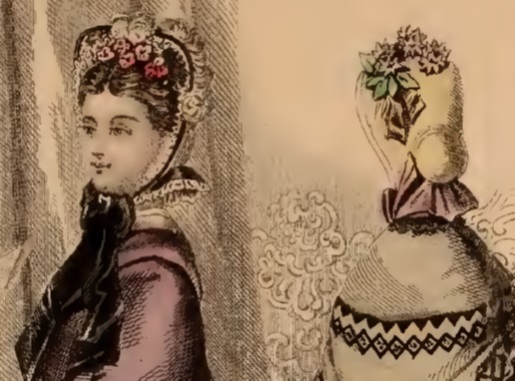
In bonnets we see a great variety of colored chips trimmed with ribbon to match or a good contrast. The fashionable flowers seem to be the elegant scarlet cactus, in bright, soft shades of velvet, which give it a peculiar lustre, magnolias, water-lilies, and geranium. Bright flowers, with brown grass and heather, have an excellent effect on the caps of bonnets which are trimmed with plaids.
Black crin, or horse-hair bonnets, are very much worn, and the new color Milan, which is between a salmon and a corn color, looks particularly well on them. Roses of this color, with scarlet berries and black ribbon, make a very stylish trimming.
Another new color is called flame de punch, from its resembling the bright, flickering light from the punch bowl. This color is particularly pretty for a white straw or ship bonnet. Amethyst is also one of the new colors.
Black crin also look[s] well trimmed with feathers having plaid tips. This is arranged by tipping each little feathery strand with a different color, which produces a plaid-like effect. Anther style of trimming for a black bonnet is a green and blue ribbon or velvet, and peacock’s tips; the last being very fashionable for children’s hats, for head-dress, and for trimming of ball dresses.
Tufts of feathers studded with jet, steel, and crystal, are much in vogue for bonnets and headdresses.
Travelling bonnets are made of silk to match the dress, or of colored straw. They are very much trimmed with chenille fringe, tipped with large beads falling over the face and crown. (Godey’s, April, 1864)




 If I Had My Own Blue Box: