Strawberry Emory

Most of us have grown up with the tomato pin-cushion from which dangles the strawberry emery. This fruit and veggie pair seems to be the strongest survivors of almost tasty looking fruit and vegetable shaped pin-cushions that appear to have peaked in popularity towards the end of the nineteenth century. Often made of velvets, silks and wools, these take shape as apples, pears and carrots to name just a few. These fruit and vegetable shapes are an occasional curiosity of mine. So, when I stumbled upon this fun description of the strawberry emeries, I had to share it with you.

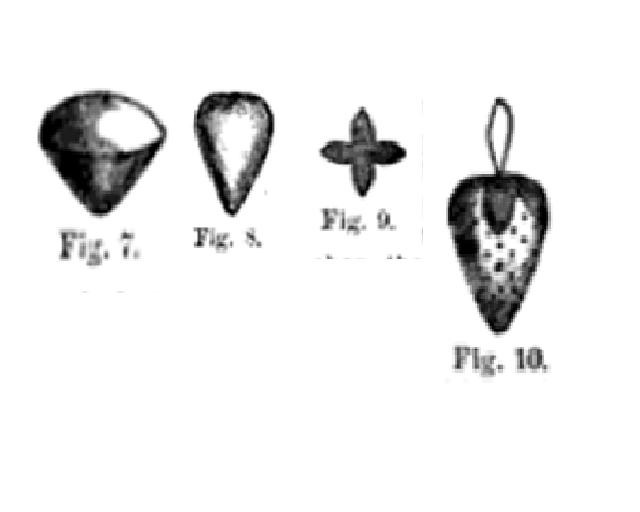
“She was just telling me she had finished stitching the strawberry seeds into the emeries, and wanted another job. She made most of the emeries. I cut out the strong cotton bags, and let her sew them up over a similarly shaped woolen sack filled with emery. She made the red silk sacks, and fastened them on, ready for the green leaves and the cord. She stitched in the seeds with yellow saddler’s silk. I think they are very pretty, and she is delighted with them.”(American Agriculturalist, December 1867)

By the way, this conversational passage, which goes on, was followed by this nifty little labyrinth:

UPDATE

Here is another strawberry emery, knit, found in both Peterson’s and Godey’s in 1859:

Household Decorative Art – Embroidery

Cassell’s Household Guide: Being a Complete Encyclopedia of Domestic and Social Economy Volume II, 1869 (published in London and New York.) While this is the final part of the entry, to me it seems like it should be the first or the second.

Nearly all embroidery is, when circumstances will permit, best worked when stretched in a frame, and lengths which are too great when stretched at one time, may be put in the frame in successive pieces. The best kind of frame for canvas is one in which the material is secured by blunt points, attached to the sides and covered with a wooden bar, cut half round, and having a groove, of a same width as the points, running along it; the canvas is stretched and the sides secured by screws. But all other materials would be injured by being fixed by such points, and must, therefore, be secured to the frame by being sewn to webbing. A frame capable of holding a piece of work three feet square is a convenient size, and costs about 10s. 6d. It is better that the frame should exceed the size of the work by some inches, and it is well, to secure a good purchase, that the material should be sewn to the extreme end of the webbing on either side. The selvage sides of the material should be sewn to the webbing, so as to leave an equal space at either end, with strong, double thread, in stitches of six to an inch, and a piece of tape to secure them, stitched along the wool ends of the material. The frame is then put together, stretched and secured by its pegs, and the woof ends are in their turn secured by sewing through the tape through the tape and over the opposite bars with twine.

In working at the frame, there will, at first, be some difficulty experienced in using the left hand simultaneously with the right, and particularly in bringing up the needle from beneath in the exact spot. The power of doing this can only be attained by perseverance, and the beginner should practice till the needle can be used as well with the one hand as the other. The worker should sit in as upright position as possible, and the frame should be fixed accordingly; as regards to light, a side light is best. In doing long stitch or gold bullion embroidery, both hands are rarely required above the frame; in couching, one hand guides the silk along the material, while the other sews it down, and in applying nearly all edging cords, the hands are occupied in the same way. While working with floss-silk it is necessary to keep the hands smooth, or they will catch it, and It is not well, for the same reason to wear rings. Perfect cleanliness of the hands is, of course, indispensable.

The implements required are needles, which should be large in proportion to the silk they have to carry, and with large, round eyes; from 7 to 9 are the sizes most often in use; the former few sewing-silks, and the latter for crochet and other coarse silks. Nos. 8, 9, and 10 are good sizes for gold bullion. Pins of a small size will be found requisite. As both hands are employed, two plain silver thimbles should be provided, scissors, &c.  A stiletto will be required, and a steel piercer rounded and pointed at the end, and then becoming flat-sided, will be useful for regulating gold bullion, passing, pearl-purl, &c.

The embroidery paste, of which we have spoke is made by adding to three tablespoonfuls of flour as much resin as will lie on a shilling, mixing them smoothly in a half pint of water, stirring, mixing them smoothly allowing them to boil five minutes, when the paste should be turned out and left till cold.

The silks to be used are floss, Dacca, Berlin, three-cord, crochet-twist, and seedling. In the best old work, floss is the silk chiefly employed, either in vertical lines kept down by cross rows of fine gold thread, or split fine for flesh and hair; sometimes a thick line of it is used for outlines, while at others ,rows of twisted silk sewn down with it are used for that purpose. Dacca is a floss-silk , so made as to be easily divided into two filaments or plies, which can again be subdivided to any extent which is necessary, besides being more easily split than floss. Dacca is made in more shades; the English is he best, the French being deficient in softness and brilliancy. Berlin has a smooth, loose twist, and is well adapted for flat masses of colour, as also for scrolls and leaves. Three-cord is a close-twisted silk of three plies and best simulates gold bullion. The apricot shade is very beautiful, but, as it turns white, the more metallic yellows are to be used in preference. Three-cord is made in other colours that gold, but not in such variety as Dacca or Berlin; the French is not equal to the English. Crochet-twist is also of three piles, but is coarser and less tightly twisted than the above. It is most valuable of larger designs to be used in imitation of gold, and may be either applied in modern embroidery over card, or couched, either single or double, by stitches of purse silk, or it may be used as a substitute for cord in edging appliqué. Purse-silks are of three sizes – coarse, medium, and fine. The first is used in places where three-cord would be too clumsy; the second when a strong, even, and tolerably fine silk is needed; the third for such purposes as couching crochet-silk on an even surface. In sewing-silk, there is only one first-class quality, which should always be used (drapers’ silk on reels is value-less), and the best is bough in hanks, of from half an ounce to an ounce. Passing, that is gold thread, should be couched with sewing-silk.

Where twist-silk is being used, it is not possible to fill gaps with extra stitches, as in using floss; every stitch must, therefore, be laid with regularity, the piercer being constantly used to keep it in place; care should be taken that the stitches are of uniform tightness, and a needleful should never be gone on with when the silk dulls or strains, but another should be taken at once.  A large-eyed needle should be used, and never too great a length of silk – twenty-seven inches is a very good length for a needleful.

Pearl-purl is gold cord , which resembles a close string of beads, and is used for edging bullion embroidery; it should be sewn down with single silk, previously waxed and the stitches concealed. Spangles are frequently useful for enriching embroidery; they are made both flat and concave, the latter have the best effect. Passing is a bright, smooth thread, formed by silver-gilt wire spun round yellow silk. Generally speaking, it should not be pulled through material, but should be couched and sewn down with colored silk.

At present day, an important employment for the various kinds of embroidery we have described, is the decoration of church furniture; for which, indeed, such methods of work are alone properly applicable. The number of domestic purposes to which, also, it is now growing fashionable to apply them, is very large, some of the most favourite being, as borders for curtains and tablecloths, as hangings for mantelpieces, and, in narrow strips, to be affixed to various articles of furniture.
Published in: on October 21, 2012 at 1:14 am  Leave a Comment  

Household Decorative Art – Embroidery

Cassell’s Household Guide: Being a Complete Encyclopedia of Domestic and Social Economy Volume II, 1869 (published in London and New York.)

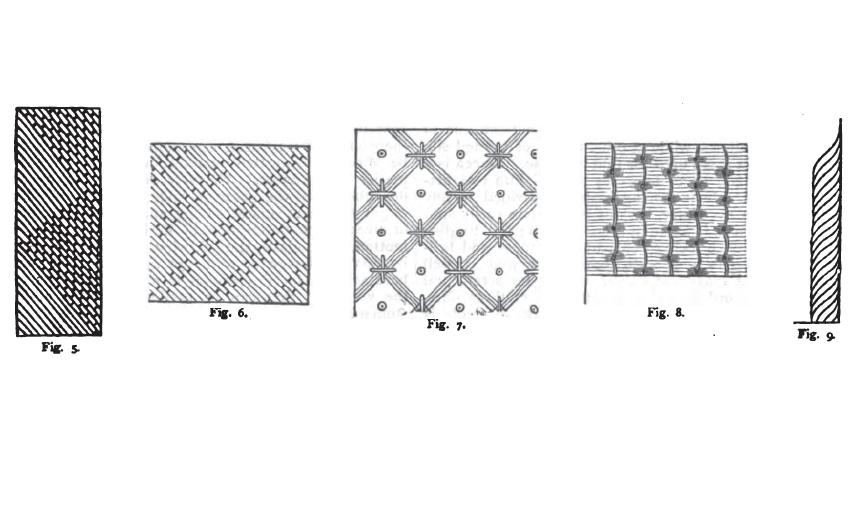
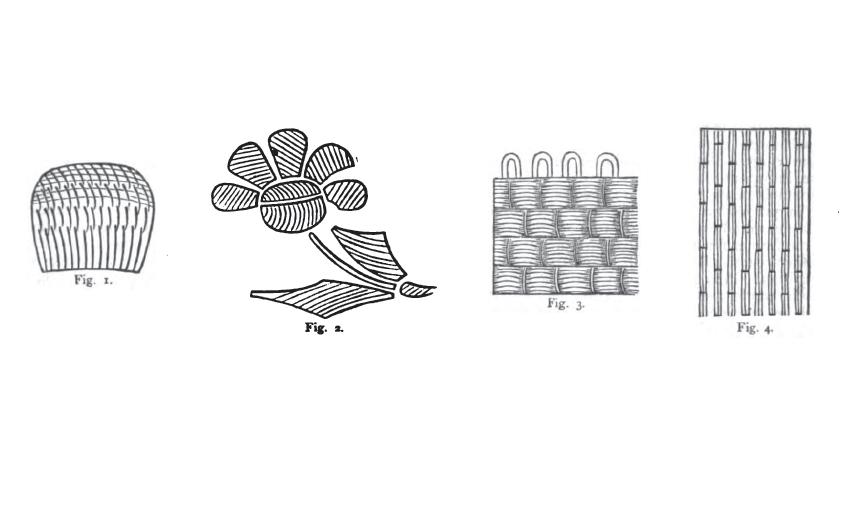
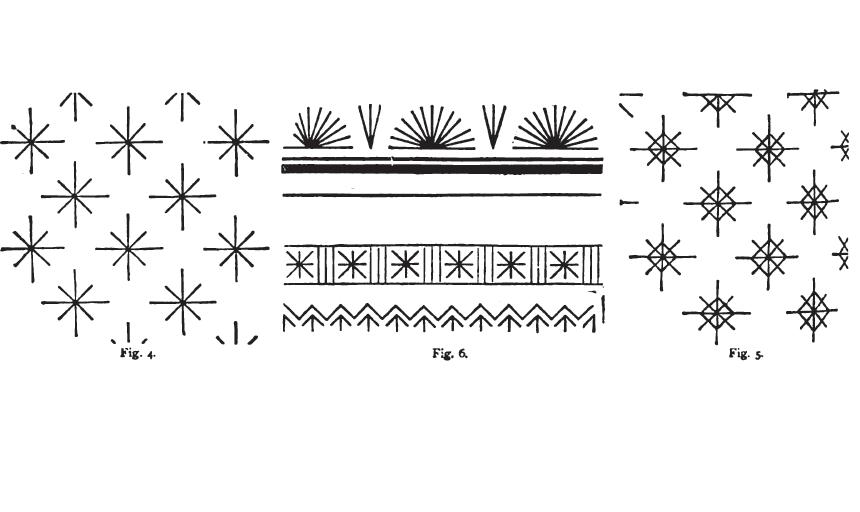
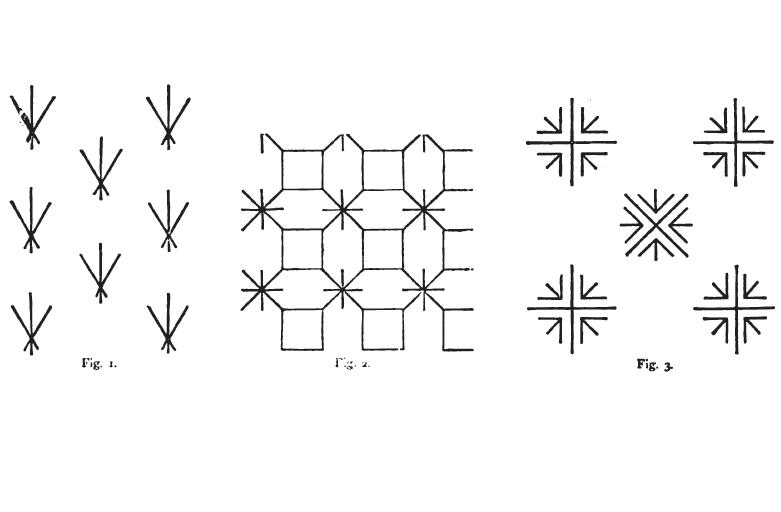
Of all the stitches used in embroidery, the long stitch is that in most general use, and all shaded work be done in it. In the somewhat fashionable “Brenton work,” however, shaded forms are filled in with short stitches taken promiscuously, instead of long stitch. In using it, all stitches should be taken from the outside edge of the figure, and worked towards the centre. In a figure of equal sides, the first stitch should be taken from the very centre of the edge, and the work proceeded with from first one and then the other side of this stitch. In working leaves and scrolls, the stitches ought, invariably, to be take in a slanting direction. The lighter parts of the leaves are first worked in from the edges, and the darker shades towards the central veins filled in afterwards, the veins themselves being put in last; gold should not be applied till after the silk-work is done. The last thing is to put a neat and careful outline to the leaves. In shaded work, the upper side of the design, upon which the light would be supposed to fall, should be worked in the lightest shade, and the high lights should not be so dark by four degrees as those shades next to them. In leaves, scrolls or conventional forms, a small number of shades, and those arbitrarily used look best, but more may be introduced with good effect in draperies. In fig. 1 we give a diagram of shading in long stitch, from the petal of a flower, in old English embroidery. Satin stitch is most useful for making raised leaves, &c, as in Chinese conventional flower, fig 2. The chain stitch, which is an imitation of the old tambour stitch, is formed by carrying the thread at the back of the fabric, catching it through, and laying it along the surface with a fine crochet-hook, which is, under a modern name, the same instrument as the old tambour-needle. Basket-stitch (fig 3) is formed by laying any even number of rows of twine, from four upwards, upon the foundation, and securing them there; the silk, &c, is carried over these two at a time. This is useful for borders. Couching was much used in old work. Passing or gold thread is frequently applied in this way, being laid over the ground and secured by short stitches in coloured silk over each single thread. These last are sometimes introduced promiscuously; sometimes so arranged as to form a variety of diapers and patterns, as in figs 4, 5, 6 and 7. Sometimes, as in fig 8, instead of these short stitches passing over every thread, the couching is accomplished by other threads crossing at right angles, and secured by stitches. Twist-stitch is produced by working equal stitches diagonally, one behind the other on an  even line, as in Fig 9. French knots are frequently used and pretty for forming the centres of flowers and in diapers, they are supposed to be introduced in several of our designs. They are made by first bringing the needle through the material, taking the tread and holding it with the left hand midway between the needle and work, and with the right hand twisting the needle round the silk in such a manner as to form a loop; this having been slipped down to the point of the needle, the latter can be repassed through the stuff, close to the place where it came through, and while it is drawn down by the right hand, the silk is held by the left, till the loop settles into a knot upon the surface.

Published in: on October 19, 2012 at 1:06 am  Leave a Comment  

Household Decorative Art – Embroidery

Cassell’s Household Guide: Being a Complete Encyclopedia of Domestic and Social Economy Volume II, 1869 (published in London and New York.)

In ordinary flat embroidery, no applied materials, as of pieces of fabric, cord, or spangles are used, nor is any part of the pattern part of the pattern raised by cardboard, or other packing beneath it, and the design depends entirely for its effect upon the coloured stitches used in it. This was the kind of work most in vogue in the days of our grandmothers, and it is, as admits of shading, the most delicate and beautiful, if not the most striking kind. The beautiful Eastern embroidery – Indian, Chinese, and Japanese – is mostly of this class, and may, In arrangements of colour, form good examples for imitation.

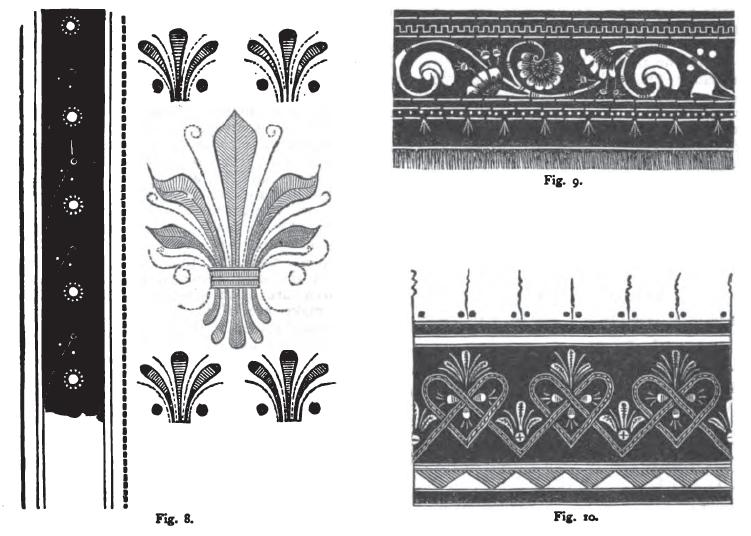
In raised embroidery, different substances are placed over the material to give it the effect of relief to the stitches. An approved modern method of working, is by taking cardboard – that known as thin mounting-board is good – tracing upon it the design to be raised, and cutting it out, care being taken to leave sufficient points of attachment in the more delicate parts of the design. The pieces of card have then to be sewn strong in their places, upon the material which is to from the ground, with cotton, and the bits of cardboard left for support cut away. If the design is to be still further raised, as would be recommended in working the large fleur-de-lis in fig 8, a line of even twine should be sewn down over the center of the figure, and over this a silk or gold thread can be worked. More than one row of twine should not be used, or the effect will be spoilt; and the thickness of it must depend upon the amount of relief required. If the figure is to be worked in gold or gold colour, the card beneath it should be coloured with gamboges. Fig 8 is a design for an embroidered curtain-border, with an edging of velvet, the principal parts of the pattern to be worked in relief; this will look very handsome if the fleur-de-lis is worked in gold thread or gold-coloured silk. Fig 9 is a mantelpiece hanging, in which the fan-shaped flowers are also in gold, raised upon card, the line of twine being near their outer extremity; they may, however, if preferred, be worked in coloured silks; the ground should be dark velvet. In fig 10, which is intened for the border of a table-cover, the raising of the embroidery is effected by merely laying on the coloured cord up the centre of the running pattern, and sewing it down.

Published in: on October 17, 2012 at 1:27 am  Leave a Comment  

Household Decorative Art – Embroidery

Cassell’s Household Guide: Being a Complete Encyclopedia of Domestic and Social Economy Volume II, 1869 (published in London and New York.) This shorter passage I am allowing to stand alone because I had not considered appliqué a form of embroidery. I would love to hear readers’ thoughts on this.

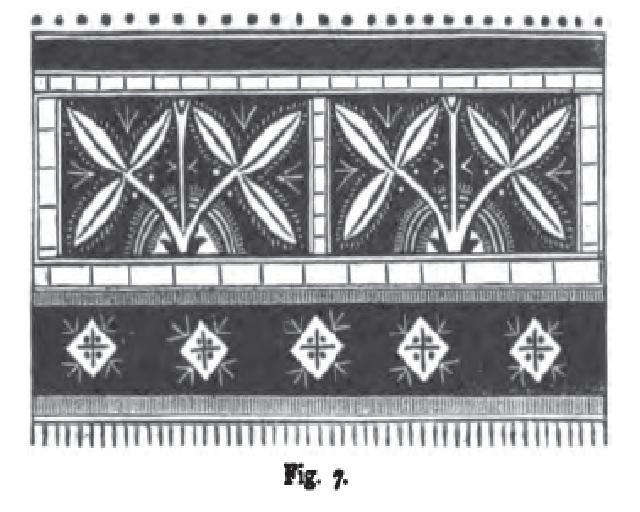
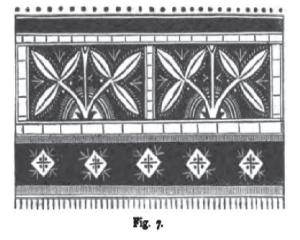
In appliqué, which is a very ancient and always a favourite method of embroidery, broad, flat masses of colour are gained by fixing one fabric over another. In fig 7 we give a design for a mantelpiece hanging to be worked in this manner. For appliqué the materials chosen are usually velvet, silk, cloth, and cloth of gold or silver; when velvet is used it should always be silk velvet. In may be employed for a variety of purposes, such as cushions, curtains, the covering of chairs &c., and though shading cannot be attempted in it, it produces rich and fine effects in flat patterns.

The ordinary method of preparing the materials is, by stretching some thin grey holland, say about a shilling a yard, on a common embroidery frame and covering it evenly with paste. The paste used by shoemakers, and to be bought from them will do, but in the section which we shall devote to materials, a receipt for proper embroidery paste will be given. The material must be laid upon the holland and smoothed till it adheres evenly. It will require about twenty-four hours to dry, and after being removed from the frame, the designs which are to be formed in the material may be traced upon the back of the holland, and cut out with a sharp pair of scissors. The above preparation refers more especially to cloth, velvet, &c; for silk, white lawn is preferable, as a black and whit starch should be used with it instead of paste; and indeed for all white materials a white back-lining should be used. Different parts of the design may of course, be formed in different colours, each to be prepared in the same way. Being cut out, they have to be laid upon the background, which, in our illustration, is supposed to be of black, or dark purple, or maroon cloth, and fastened to it round the edges with sewing silk. There are two ordinary ways of edging the pieces the pieces laid on in appliqué, that which has the richest effect is bordering them with a moderately stiff cord (as shown round the trefoils in our illustration) and sewing over this with silk. Gold-twist makes the most splendid bordering of this kind. The other is that shown round the semi-circular pieces at the roots of the stems, and which consists in working round the applied material with bright-coloured silk in button-hole stitch. It will be observed that a considerable space is left between these stitches to give them their full effect.

Published in: on October 15, 2012 at 1:00 am  Leave a Comment  

Household Decorative Art – Embroidery

Cassell’s Household Guide: Being a Complete Encyclopedia of Domestic and Social Economy Volume II, 1869 (published in London and New York.) We propose in the course of this article to give some description of the various methods of working and of the stitches used in them, as well as of the materials required. We shall also give a series of original designs, but we trust that our readers will not, after perusing the above remarks [previous post] content themselves with merely copying these, but will use them only as stepping stones to embroidery work in which patterns will be of their own devising.

The methods of embroidery practiced at different times and in different times and in different countries, as well as the various stitches employed in them, are almost endless. Taylor, the water poet, in 1640, mentioned by name no less that twenty-one distinct stitches as being in vogue among the English embroideresses of his day. We have not, however, at the present time to deal with the antiquarian aspects of embroidery, but to speak of it as it may be applied to modern practice.

Between ordinary German wool-work and legitimate embroidery there is an intermediate style, which has latterly been somewhat freely practiced. It is susceptible of far better effects than the former, and is by now means difficult. Over the ground of German wool, worked in cross-stitch upon canvas, diapers such as those given in figs 1 to 6 are over-stitched on silk. Thus treated the German wool-work loses its objectionable flatness, and gains great brilliancy. While on the subject of German wool-work, we would beg our readers to remember, if they continue to practice it in preference to better styles of embroidery, that though it is capable of being enriched as above, it is a method of work which is, artistically speaking, exceedingly limited, and really fitted for the production of flat patterns only, such as geometric designs, of conventional ornaments, In cross-stitch it is impossible to shade objects in such a manner as to give them any satisfactory resemblance to nature, and the representations of animals and flowers which have been attempted in it, are as numerous as they have been lamentable failures, and ought merely to be preserved as examples of bad taste.

Published in: on October 13, 2012 at 11:38 am  Leave a Comment  

Household Decorative Art – Embroidery

I came across an interesting section on embroidery in Cassell’s Household Guide: Being a Complete Encyclopedia of Domestic and Social Economy Volume II, 1869 (published in London and New York.) The book divides it into two parts. I will divide it up a little more for ease of reading. I find this article to be interesting because it shows one mid to late nineteenth century perspective of a skill many of us try to imitate. I will start with this section looking at history with a bit of contemporary observation… “The art of embroidery was originally derived, like many other of our arts and sciences, from the Spanish Moors, by whom it was introduced into Europe early in the Middle Ages. As applied to tapestry hangings, it was at first ued among Christian nations for the decorations of churches, and for employment on State occasions only, till Eleanor of Castile set the example of using it for domestic purposes, which was soon generally followed by the wealthier classes. Throughout the Middle Ages needlework embroidery, chiefly for hangings, but also for some other uses, formed the great occupation of ladies when not engaged in domestic or other duties; and the beauty of their work, together with the invention and design which they displayed in it, are such as might well raise the admiration and envy of the ladies of the present day. These old works have not merely the conventional prettiness which is generally the only, though not the invariable, characteristic of modern needlework, but have often real artistic beauty, and display not merely fancy, beu even imagination, in the designs. In this respect certainly they have little in common with modern “fancy work,” which is apparently so called in a sarcastic sense, from the utter absence of any fancy displayed in it. The modern lady, instead of exercising her inventive powers, simply copies a pattern set before her, stitch by stitch, without the slightest idea of deviating from it if its forms are bad, or of developing this mere copying and counting of stitches demands too much mental exertion, and she must either purchase her “fancy work” ready begun, and the pattern laid out for her, or perhaps even with the ornamental group of flowers or other device already finished, and with nothing left to be done beyond filling in the back ground. This degeneracy in skill and taste from even the standard of those qualities in their own grandmothers, is in great measure to be attributed to the substitution of so limited a style of work as German wool embroidery for the more beautiful and legitimate styles that preceded it. In Berlin wool-work, as it has usually been practiced for the last forty years, anything like real beauty or flow of fancy is an impossibility. That this absence of invention and good taste in their lighter occupations, should continue among ladies is neither necessary pations, should continue among ladies is neither necessary nor desirable. An abundant fancy is a characteristic of the female brain, and ladies would be far happier and better in many ways if they would allow its free development. Few things could be better calculated to effect this than a return to the graceful and beautiful occupation of their female ancestors. There is at the present time much desire for this shown among the upper classes, and legitimate embroidery is again rapidly becoming a fashionable employment.

Published in: on October 11, 2012 at 6:00 pm  Leave a Comment  

“Travelers and Traveling” from 1860

I stumbled across this article, “Travelers and Traveling” by Mary A. Denison in Peterson’s Magazine from 1860.

I rather enjoyed the first part, but then it took quite a twist.

“Think for a moment of the masses moving in every direction. From homes of wealth and of poverty they come – from the emigrant’s little cabin of mud by the wayside, and the palace of the titled noble – on the they throng, men, women, and children – sick and well – joyful and sorrowful. Some are in the first flush of wedded happiness, on their bridal tour – some are leaving the home of youth and childhood, where they have been sheltered and fondled, to seek a scanty living in a heartless world. Some go at the call of husbands to the land of the golden mountains – some to while away a leisure that is wearisome, to fill a void no earthly pleasure can satisfy. What endless packing of trunks and bags is perpetually in progress from the rising of the sun till its going down! Did you ever think of it, reader? How all th avenues of commerce are crowded with the constant coming and going of articles needed for transportation. Fourteen trunks carried off from the steps of our next door neighbor, who is going to show her two or three dozen new “loves” of dresses at Saratoga. “That place where really noblemen go sometimes, dear!” Truly man (and woman too) is a living locomotive, under full pressure, flying flashing from town to town, from country to country, never at rest, puffing and blowing, and steaming it through the world. Those who have pockets full of money, and can afford to wait for detention of boat or car, ought to enjoy all the delights of traveling. They can stop when they please, put up at the most expensive hotels, keep a hody-guard of waiters about them, all the time, by a liberal supply of the cash – be stared at, talked about, admired, and envied to their hearts’ content. To such, there is scarcely a higher pleasure than to make a sensation. They love to hear the sly side of communication, “Guess he’s rich.” They love to sit in state, on the right hand of the master of ceremonies – to have the wants of their wives and daughters attended to first, and themselves listened to as “Sir Oracles.” So, their little hearts are contented. Then they smack their lips, and talk smoothly of the little things, whose cognizance has chanced to pass through the avenue of their very limited brains. Others, languid and faint, to whom a straw is a burden, endure with indescribable anguish the discomforts of travel. How often have we seen some pale face, touching in its uncomplaining sorrow, leaning wearily upon the seat of car or steamboat! When the bosom is burdened with sighs, and brain and heart are throbbing with pain, the loud laugh of the throughtless, the chit-chat of the happy, the bounding steps of the little child – how strange they seem! One thought only fills the mind – one star shines through the deep gloom – it is the thought and the star of home! They are going home! The dear, old mother is there. At her touch the fires of the brain will sink into slumber; the heart will throb less heavily. The pillow and the couch are waiting there – the voice of love – the prayer of faith. So long the earth –weary for heaven! Sometimes there is a fugitive from justice on board, who sits in sullen silence, with clenched hands and teeth, and hat drawn over his brows. He dares not look at a single face, for he feels that on his own is branded an indelible mark. As the train nears the village or the town, he cowers in deadly fear, for he knows the very lightnings[sic] have proclaimed his guilt, and the officers of outraged justice are on his track. Poor, guilty wretch! was the paltry gain worth all this shame and anguish? The selfish traveler makes his mark. The windows shall be shut and opened, as his sovereign will dictate; though the winds, soothing to him, strike the chill of death through a tenderer frame, he never disturbs his precious self. He is an unabated nuisance – turn him out. It is passing strange, that many travelers, especially mothers with little children, will not take the precaution to provide themselves with water for the journey; a flask and dipper, or tumbler, would not take up an inconvenient amount of room, and would save much annoyance. Once, in traveling, we were seated near a little family, consisting of a mother and two children – one of whom was quite ill – and an aged grandparent. For the first part of the journey all went well, water could be obtained at the depots, to cool the parched lips of the little stranger. But night came on – a stormy night of wind and tempest, and the child grew very sick and impatient; we seem to hear her moaning little voice, faint, weak, and imploring; we see those large, languid blue eyes floating in tears. “Drink, mamma! – drink, drink, mamma!” resounded at constant intervals, accompanied sometimes with bitter cries. We wondered that we had not thought of obtaining water. The mother, worn out with watching and fatigue, burst into teas and sobbed piteously, while the little voice kept up its pleading, monotonous cry, “Drink, mamma, drink!” The fever burned her lips; her cheeks blazed; her breath was like fire – yet no water could be had for love or money, along the route of the rushing train. Think of it, the child was dying of thirst – absolutely perishing for water – and the thoughtless mother had no resort but teas. Could they but quench the poor child’s thirst, we could have wept till morning. Alas! when morning came the little sufferer had put on wing. She died in the cars, and – here we will leave the subject. It may induce some to think.”

Published in: on September 18, 2012 at 1:00 am  Comments (1)  
Tags:

Footwear related tid-bits

From Vicki Betts’ newspaper research:

NASHVILLE DISPATCH, October 24, 1863, p. 2, c. 2
“About Stockings.
                The Empress Eugenie, having established crinoline, has allowed her imagination to take a lower flight, and aspire to set the feminine world its fashion in the matter of stockings.  She has discarded white stockings, and wears blue and white striped, though she should have added a third color, namely, red, and then she should have the tri-color just where the legitimists would to have it like under her foot.  Can her hostility to white stockings be based on the circumstances that white is the old Bourbon color, if white can be called a color?  Certainly the change she has introduced cannot be held an improvement, white stockings being for woman the prettiest things in which they can put their pretty feet.  “A white stocking is infinitely more effective than a black one,” says Mr. Hawthorne, speaking with express reference to young women’s feet, and so forth; and few will dissent from his opinion.  It is better than any other kind of stocking.  James II, when Duke of York, preferred to green stockings, on an interesting occasion, as readers of Grammont will recollect; but he was not a disinterested judge.  Blue stockings are objects of prejudice, though Francis Jeffrey said that it mattered little how blue the stocking is, provided the petticoats be long enough to hide it; but long petticoats are a nuisance, and petticoats never can be tolerated long anywhere.  Black stockings ought to be worn only under peculiar circumstances.  Flesh-colored stockings are open to the charge of being delusive.  The yellow stocking belongs properly only to English charity boys; and the red stocking should be confined to very young people, or to persons old enough to be in their second childhood, or to cardinals.  Pink stockings are nice in their places, which are the feet of young women, but they do not show well on either middle-aged or large ladies, who are often very handsome, and therefore should have handsome footings.  In fact, the pink stocking is fit for girls only.  Grey stockings go well with grey hairs. Mixed, or speckled, or spotted, or ringed, or streaked stockings can be used for show only by children, though some of them answer for a change.  But none or all of these can displace the white stocking, which is an old favorite, and not to be put down, though occasionally it may be thrown into the back ground.  Like the hoop, it is never long out of fashion.  The French Empress will find that she has “put her foot into it” by taking it out of the white stocking, which is to women what to the garden is the white rose.”

MEMPHIS DAILY APPEAL [MEMPHIS, TN], March 3, 1861, p. 1, c. 2-3
“Ladies’ Dresses in Muddy Weather.
            It is an unpleasant sight to see the ladies on the streets, on rainy days, allow their dresses to rail in the mud.  This is unpardonable.  There is no impropriety in raising the skirts high enough to keep them out of the dirt.  There is a very unladylike prudery in refusing to raise them slightly when cleanliness requires it. It is not necessary, however, for any lady to hold her dress with her hands to keep it out of the mud.  The English woman, says an European writer, understanding these things better than we, go out walking in rain and mud, wearing long dresses, and without taking their hands from their muffs, come home with the clothing as clean as when they started.  How do they do it?  They wear skirts that do not reach lower than the ankle; short enough, in fact, to keep clear of the mud without any lifting.  The dress is worn long, but is looped up when the lady is in the street.  The loops are a late invention, and are now the fashion in Great Britain.  A woman who should go out in muddy weather without them would be considered a prude.  They are made thus:
            There is a belt of black ribbon, three quarters of an inch wide, and long enough to go around the lady’s waist, with a hook at one end and an eye at the other, as a fastening; a piece of the same kind of ribbon, three yards long, is attached to the end and the middle of the belt.  The belt is now put on with the hook and eye in front; and hanging down on each side is a loop of black ribbon, three quarters of a yard long.  When a lady is about to go out, she puts on her belt, and puts a part of the lower portion of her dress through each loop, which is thus raised into four festoons, and all of it is above the lower edge of the petticoat.
            She then walks out with her hands free, her dress clear, and her conscience at ease; and if she wishes to enter a house, she can take her dress out of the loops in an instant.  The looped dress is not only clean but graceful, and it shows a white petticoat, one of the most beautiful articles of ladies’ apparel, to much advantage.  In England, however, a white petticoat is not considered indispensable; on the contrary, scarlet woolen petticoats are much worn by most fashionable people, as are also red woolen stockings.  Indeed the white cotton stockings are the exception, and not the rule for London wear in winter.  Wool is ordinarily worn, sometimes scarlet, or scarlet with black stripes, or plaid with a variety of colors.  And then, the shoes are not of thin cloth with paper soles, but Balmoral boots, with heavy uppers and thick soles, lacing up in front, as if they were made for beings of flesh and blood, bred on roast beef, and good for real service, hard work, sturdy health and long life.  Our American women are too much in the habit of following bad fashions, and neglecting good ones.  If they will just adopt the healthful practices, as well as the expensive luxuries, of European aristocracy, it will be far better, as well as more creditable to them.  We are glad to see, however, that a correct taste is being exercised by our ladies.  They study health and comfort more than the fashions, and we may expect to see them as rosy-cheeked and robust as any of our English cousins.—Home Journal.” 

DAILY CONSTITUTIONALIST [AUGUSTA, GA], April 14, 1861, p. 3, c. 2.
            “Protection for Woman’s Foot.—Women must go much in the open air at all seasons of the year, or become pale and feeble.  But in order to do this, their boots must be radically changed.
            As preliminary to this greatly needed reform, we must first get rid of the strange hallucination that where a strong man needs cowhide, a feeble woman needs only morrocco; that where a strong man needs an inch of hard, impervious sole, a feeble woman needs only a quarter inch of soft, spongy sole; that where the strongest Irishman needs thick woolen socks, a delicate, consumptive lady needs only a gauzy silk stocking.  This singular madness must be first scattered.
            But surely one need not seriously discuss such a matter.  If women must go much in the open air at all seasons of the year, (and no one with five grains of common sense doubts it,) then it needs no argument to show that women should wear as much protection on their feet as men find it necessary to wear.  Neither can it require much argument to show that those rubbers which prove so pernicious to the feet of men, must, to say the least, be quite as unhealthy for women.
            Prescriptions for a Fashionable Lady.—Madame, allow me to prescribe for you.  I have had a long experience in the management of delicate women, and believe I can give you some important advice.  For the present, I prescribe only for your feet:
            1.  Procure a quantity of woolen stockings, not such as you buy at the store, under the name of lamb’s wool, that you can read a newspaper through, but the kind that your Aunt Jerusha in the country knits for you, thick as a board, that will keep you dry and warm, in spite of wind and weather.
            2.  If you want to be really thorough, change them every morning, having the fresh ones hang by the fire during the night.
            3.  Procure thick calf skin boots, double uppers and triple soles, and wear them from the first of October until the first of April.  Make frequent applications of some good oil blacking.
            4.  Avoid rubbers altogether, except a thick layer, which you should have cemented to the bottom of the soles.
            5.  Hold your feet in cold water an inch deep, five or six minutes before going to bed, and have them rubbed hard with some one’s naked hand.
            6.  Now, Madame, go much out of doors at all seasons, and believe me not only will your feet have a good circulation, but, as a consequence, your head will be relieved of its pain and congestion, and your heart be relieved of its accumulations.—Boston Journal of Physical Culture.  ”

(Hmmm… found the text limit when posting from my phone.)

Published in: on August 30, 2012 at 5:08 pm  Comments (1)  

The Life and Age of Woman

 When I saw this over the weekend, I really, really wanted it. But, I couldn’t cover the price. *pout* I’ve wanted to have my own copy

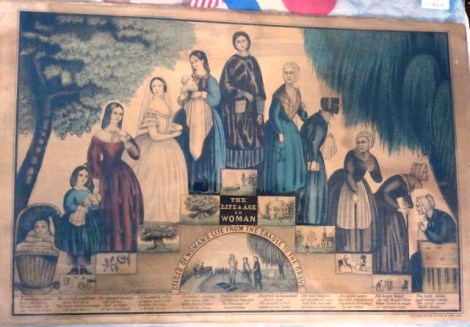
This hand-colored lithograph may be attributable to Kelloggs & Comstock. I say may because there are several similar image that each attributed to a different person or persons between 1848 and 1850. (See below for some variations.) Moving up and down the stairs we see a woman at at each stage of her life. At the left and right we see trees symbolizing youthful vitality and motherly caring. Beneath the women are miniature illustrations of that stage in life.

In the very center of the stairs is the burial plot. Along the bottom we read of each stage of life:


This is a different version attributed to Nathaniel Currier and James Merritt Ives, ca 1848-50. Here is yet another variation attributed to James Baille, ca 1848. This site provides a nice zoom tool for seeing Baille’s version. This version at Harvard, is one I would really like because the top figure is wearing a shawl. Yes, I have an obsession.

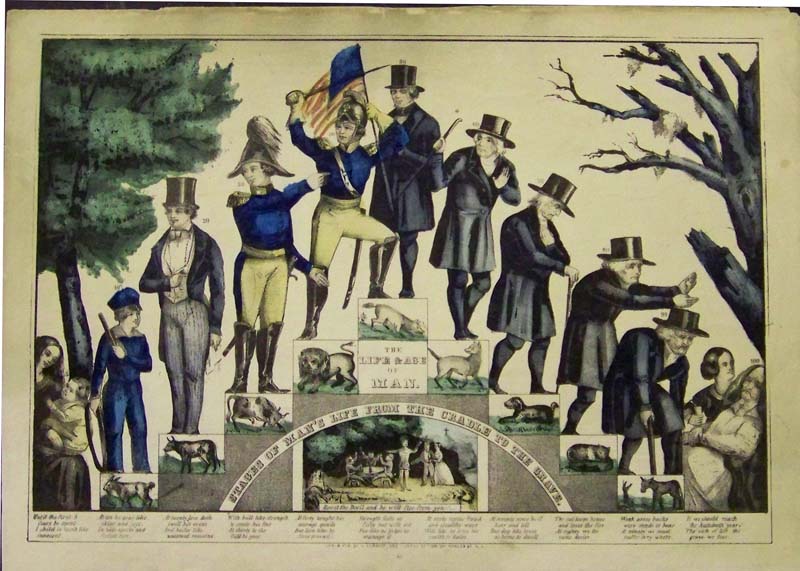
A similar look at the life of man was also created as well as a temperance look at alcohol.

Published in: on June 6, 2012 at 4:27 pm  Comments (3)