Queries for Aunt Betsey

Moore’s Rural New-Yorker

April 13, 1861

Queries for Aunt Betsey

Dear Aunt Betsey: – Will you allow one of the “girls” who hasread what you thing of “Woman’s Rights” to say a few words? I like to look at the bright side. Now, honored Aunt, I know that woman’s home is, in many respects, her “world,” and that there are many things to learn away from boardin’s schools and ‘cademys; but Aunty, do you really think we are all going to get our necks broken when we jump off that “precipice” you told up about? I know you did not exactly say so, but then, )we have no precipices on the prairies,) in all the stories we read about people jumping or falling off them, they are sure to get killed. Do you really think, too, that when we “get married” and “go tagging after a man,” we shall “never see him at home?” Are you sure he never will bring in a pail of water or an armful of wood? Will he never ask if there is anyting he can do to help us? Do you know he will be unable to find his own shirt, if we, (as we ought,) have a place for it and keep it there? Must we always leave the shirts till there are a dozen to mend? Do you think it will “take half an hour to find a needle” every time we want one? Is it imposisble to get along without a “honey moon”? – or, can we not have the “butter and honey” spread all over the bread rather than on one spot? Now, Aunty, I will know there will be a great many “briars and sticks.” But will he never help us over them?

If you are sure all these evils will befall me if I get married, your admonitions will save one of your nieces from a “woman’s fate.” Please tell me, Aunt Betsey.

Respectfully, your niece, O. Princeville, Ill., 1861.

Read more “Their Life; Their Words

Published in: on May 2, 2014 at 4:01 pm  Leave a Comment  
Tags:

Woman’s Duties

Moore’s Rural New-Yorker
April 6, 1861

Woman’s Duties
My subject you may call a trite one, and such I fancy it will be unto the end of time, if the newspapers of our land continue, as persistently as ever, to herald forth the duties, obligations, and dependency of woman. I must say I have become perfectly disgusted with this constant prating. One might as well imagine that woman was utterly ignorant of her peculiar duties and adaptations, and that the rest of the race, in commiseration thereof, had set them selves up as her instructors. Now, with all due deference to the wondrous knowledge possessed by the “lords of creation,” it certainly seems to me that females are usually quite as intelligent as the other sex, and I imagine they know about as well how to “act well their part in life.”
We are told again and again, that home happiness depends mostly upon the wife, mother, sister, and daughter. Don’t we know this? Don’t we know that after a day has been spent in the discharge of the many wearisome household duties, and the husband and father, sons and brothers, return from their labor, or, as in frequently the case, from lounging in some public place talking politics, – listening to or retailing scandle, – don’t we know that, under such circumstances, some tact is necessary to meet dissatisfaction and discord with content and pleasantness? to have things so righted round, and straightened out, that home shall present a cheerful aspect?
Besides this, there is a wonderful cry among some about the dependence of woman upon man. It sounds in our ears from the Atlantic to the Pacific, – by priest and people. Why, they say, of course, they are particularly dependant [sic] upon us, – of course, they Bible says do. I have known men that could quoite only one passage of scripture correctly, and that you will find in Collossians, iiic, 18v. Moreover, common sense teaches it. If this is common sense, I am glad I was endowed with it.
Now, we know that we are, in some sense, dependant creatures, – that one person must rely, somewhat, upon another; but the wife is no more dependant on her husband, than he upon his wife. Supposing his earning do provide the provisions and clothing, what’s it all going to amount to if his wife does not know how to use these things to the best advantage? How is a man to gain wealth, if his wife or daughters spend faster than he can earn. Many a man has acquired wealth who never would but for the economy and thrift of his industrious wife, and many are struggling now to provide the mere necessities of life, who might have been prospering, had they, in the management of their business, heeded the advice of the wife. But, dear me, no, – they are not going to have a woman interfering in their affairs; and thus they often come to be dependant upon the exertions of their “better half,” for the support of themselves and families.
They talk to us, too, of our great influence upon society, – how essential it is that we should be models of purity and goodness, so that all who come within this magical influence shall be metamorphosed there-by. Now, how potent soever this may be in some cases, when I see the sons of some of the best mothers following so closely in the footsteps of upworthy fathers, I am convinced it is necessary somebody should be good besides the mother.
When clouds of darkness and sorrow surround the pathway, who endures best the blast of adversity, – is it man? Nay. In the severe trials of life, the stern man is often the soonest shaken, and finds himself dependent upon the weak woman for aid and sympathy, – the closest observers of human nature have testified to the truth of this.
Some talk much of the great necessity of woman being Christians. Is it because the soal of man is less precious, – because he is holier by nature, or because his responsibility to the Creator is less? – that he considers it so much more oblicatory upon females to yieled their wills to the Saviour? Such is not the case. They know that the influence of the Gosple is to make one meek, patient, long-suffering, under all circumstances, and such a spirit as this they like to deal with. One that will not conflit with their pet whims and might wills. In most instances, when you really probe to the bottom of the thing, you will find it is all selfishness which prompts this cry about the great adaptation of religion ot the hear and life of woman. That there are noble exceptions I grant, but among the masses they are few.
You men who are so supremely particular about your food, your clothes, and, in fact, everything, – who want your wives and children always to be apple-pie order, and think they can keep so, no matter what engaged in, how do you suppose you would manage to gratify your exquisite taste, without the aid of some one or more of those depenant beings called women? Don’t you believe there would be some muddy coffee, – some burnt cakes, – some ragged garments, and some tumbled linen? It really distresses me to think of it. But, after all, what’s the use of talking or writign? To be sure it frees my mind a little, but that is not much consolation, when the conviction is constantly forcing itself upon me that,
“A man convinced against his will,
Is of the same opinion still.”
Gainesville, N.Y., 1861. Maude Elliott

Read more “Their Life; Their Words

Published in: on May 1, 2014 at 4:06 pm  Comments (1)  
Tags:

Woman – Incentives to Duty

Moore’s Rural New-Yorker

March 30, 1861

Woman – Incentives to Duty

It is a well-proved fact that woman is an inferior existence; – that she never ascends to the highest pinnacle of intelligence, and takes the blessings which Heaven offers? Is her soul so dead that she never longs to drink from the deep fountain of intellectuality, at which her brother man satiates his thirst for immortal good?

With one earnest glance of life, all these interrogations arise, and a solution, either correct or incorrect, followers. In studying these living marvels, we find it to be an invariable fact, that the of intelligence which illuminate the human mind, are convergent in the mind of man, and divergent in the mind of woman. Man concentrated every ray of truth upon a specific object until he can clearly see to perfectly accomplish that object. He perfects the thought that interests him most, and thereby makes proficiency in something. Woman’s thoughts are seldom, if ever, brought to a focus; consequently there is not the requisite light in her mind to enable her to penetrate any intricate subject, and, therefore, she makes proficiency in nothing. The fault is not that Nature did not make an equal distribution of gifts, but that woman, by will and circumstance, has become almost incapable of excelling in anything useful. It is true that some, comparatively very few, have excelled in literature, science, and aft, but these few have scrupulously obeyed the aspirations of the soul, and listened to the whisperings of genius as to the commands of a divinely commissioned teacher.

Another cause of the mental inferiority of woman is, that she allows herself to be attracted by every passing vanity, and instead of consulting the garden of the mind, she neglects it altogether, and spends the golded moments “in stooping the pinion back to earth, which beareth up to heaven.”

It is the climax of folly for women to complain of oppression, until she better improves the privileges that she now possesses. When the era shall arrive in which woman will walk just as far as permitted in the field of truth, then we shall see the gates opening into other, and more extended, avenues, that she may go on and on, until she reaches the fountain of perfect justice. Worthiness will secure for her the longed-for equality! It is but seldom we find a woman who possesses genuine nobility of soul, – that sterling principle which causes her to be a purifying element in society, – and it is because she has so long stooped to the conformity of foolish and fashionable customs, that she is mentally deformed; and while she is being “delightfully entertained” in the gossiping circle, man is pursuing something useful, and increasing, therefore, the disparity of mind, and also position!

Impatience is another cause of woman ever being with the substrata of society. If, perchance, a glorious thought springs up in her mind, she cannot wait for its maturity, but, in her eagerness, she gives it to the world only half grown. She evidently cannot learn that a thought needs time, as well as a nutriment, to complete its beauty and usefulness.

Man is not the oppose of the elevation of woman that is frequently supposed. How often have we heard good old orthodox people say that, “we can have the religion we live for.” Thus it is with woman, she can have all the rights for which she will live.

Amie W. Livonia, N.Y., 1861

Read more “Their Life; Their Words

Published in: on April 30, 2014 at 4:00 pm  Leave a Comment  
Tags:

Readings for Rural Life

From Moore’s Rural New-Yorker in Rochester, NY

April 30th, 1864

Wherewithal Shall We be Clothed

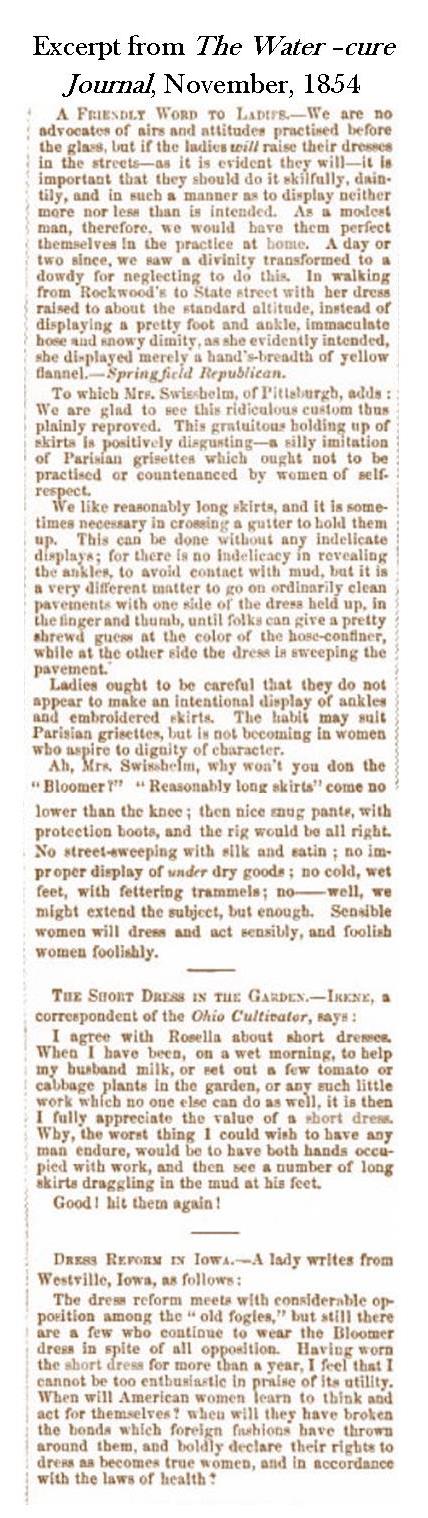
I was much pleased with an article in the Rural (March 26th,) on hook skirts, but I should have been more so if so sensible a person, as a writer evidently is, had told us what (in her opinion) woman should wear. I can not think the former custom of wearing a half dozen skirts to make a figure to come up to the fashionable standard, less objectionable as regards health. Then what are we to wear? There is certainly a great need of a revolution in ladies’ clothing, especially farmer’s wives and daughters; and I think it would have been effected long since, but that ladies of wealth and fashion have not felt it so much an encombrance as they would if they were mechanically employed, and, as Faith Wayne says, but for its increasing their capacity to carry fantistic adornments; therefore the custom has become so prevalent and deeply rooted over most parts of the  civilized world, that to dress in any thing but flowing robes is considered indelicate, unfeminine, bold, &c.

What a fuss was made over the Bloomer dress! How the dear press did deride and caricature it, and yet, (though not acquanted with all its details except the short skirt and pantalettes,) it was a health-giving device, and the originator should be honored among mankand [sic], and held in grateful remembrance by all posterity.

I confess I cannot do the subject the justice its magnitude merits; but I feel impelled to lift my voice in favor of a radical change. For years I have considered myself a slave of my dress, hoops or not; and if there is a farmer’s wife or daughter who have not felt the same inconvenience in the performance of their domestic duties, from their skirts, they must be more of a philosopher than I am.

How many times a day do we go up stairs and down cellar, each time carrying half of what we otherwise could if we had not to carry our dress in one hand; and even then one will step on the dress sometimes, and then the ugly rent must be mended. It may do for those who have nothing else to do to have the care and carry their swaddling clothes or hire others to do it, but for us, – the working bees of this world – away with it; it is nothing but slavery to fashion as ancient as the Heather Mythology, of more ancient still for what I know.

I recently saw in a Hamilton, Canada West, paper and editorial (!) commenting on the ladies’ style of dress, and enumerating the different articles of gentlemen’s apparel the ladies’ had apprpriated to themselves; and concluding with the fear that they next would be confiscating the pants, and calling on gentlemen to resist, to the death, any such effort. Now, I have no doubt but this is the sentiment of most men; and this forces me to the conclusion that the gentlemen are afraid of losing this last vestige of their sovereignty – hense they are enjoying a distinction of authority they have no right to, else why care? But, gentlemne, we don’t want your pants, we only want our own. We sould like to be as conveniently and comfortably clad as yourselves, and I bellieve there are many ways to do so and still make a wide distinction in the dress of the two sexes.

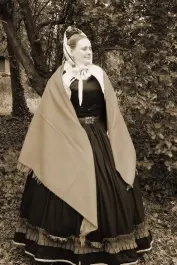
If I were to name a fitting dress for woman in all the varied walks of life, I should give them as great latitude, in regard to their upper garments, as their tastes should dictate or fashion demand; but I should insist on two point to be always observed in their general costume, namely: – long hair, confined or not, and warm, loose pants confinded at the ankle by a band. I hope to see this subject agitated until not a yard of cotton (to say nothing of silk or other costly fabrics,) shall sweep the universe except in the shape of mops.

Mrs. Smith. Saltfleet, C.W. 1864


Aunt Betsy on Woman’s Rights

Moore’s Rural New-Yorker
March 23rd, 1861
Aunt Betsy on Woman’s Rights
We had been talking of “Woman’s Rights,” one winter evening in Aunt Betsy’s room- talking girl fashion, but none the less ‘decidedly’ or enthusiastically, from the fact that it was a subject we knew little but fancied much about.
At last Alice said, looking around to where she sat, – her specs pushed up, and her eyes fixed rather quizzically on us, – “What do you think about ‘Women’s Rights,’ Aunt Betsy?”
“Well, girls,” she said, after a moment’s pause, “I can tell you just what I think, and I’ve a sort of an idea that it won’t do you any hurt either, seeing that I’ve seen more of the world than you have.”
“Why, Aunt,” broke in Alice, “you’ve never been out of Saddlersville in your life, and we’ve been to the Falls, and the Springs, and ever so many other places.”
“That may all be, child; but talking about “Woman’s Rights, – her rights are in her world, aint they? And her home is her world, isn’t it? I think, may be, my dear, that I know full as much about the falls and springs of that sort of world as any body, – falls and springs of feeling, and love, and temper, too.”
It was quite a sentimental speech for the old lady and she sat thinking for a moment, till we began to fidget in our chairs.
“I suppose you all think,” she began at last “that when you’re once launched on the “Sea of Matrimony,” as some of them big writers tell about, you’ll ‘become possessed of your own inalienable and individual rights,’ and so on, but, girls, there’s a heap of knowledge, that isn’t to be found in your boardin’-schools and ‘cademys, got to be drilled into your innocent heads yet.
“When you get married, and leave your mother, and sisters, and aunts, to go tagging after a man, that you never see in his own home, – whose shirt-bosoms and sock-heels you never even thought of, – you’re just jumpin’ off a precipice with your eyes blinded, and the land you pitch your tent in, after you’ve jumped, will have to have a blessed lot of sunshine to keep your mind off the little briars and sticks that catch hold of your dresses and tear your ankles.
“It’ll be all butter and honey at first, to be sure, till just then, your weddin’-tour will be over, and the next thing will be to get to house-keeping. You, who never scratched your finger without crying, will tug up and down stairs, and scrub, and wash and sweep, to get things in order, and maybe you’ll think about them that it’s one of your ‘inalienable rights’ to have a little help; but pretty soon in he’ll come- out of the air and sunshine, wide-awake as can be – and laugh at you about the hooks burst off the back of your dress, looking round at the things approvingly, and finally throwing himself into the rocking-chair, and with the remark that he ‘thinks he’ll have a clean shirt!’
“’Where is it, my-dear!’ says he, and you’ll take your hands out of your dish-water, as meekly as though you hadn’t an individual right in the world, – go a trudgin’ off up-stairs, or somewhere, after it, shut the drawers ruefully on a dozen that need patching, and hunt half an hour for a needle to sew on a button-with.
“That’s the beginning of your rights, and though you may get what folks call ‘one of the best men that ever was,’ and you ‘love him like a pisen,’ as some one says, there’ll be a dozen times every day that he’ll tread one of your mights under his heel, and another under his toe; and you’ll look the other way, – like enough grease the boots he does it with.
“Just you take my advice, girls, and don’t say any more about your rights, for you’ll
be pretty likely to ‘haul on your colors,’ when the time comes, and woman’s fate with it.
“I’m sure I don’t know whether we’re born so or now, but sensible women, that have got to be as old as I am, are pretty apt to think it’s better to put up with a few less rights for the sake of a little more peace.”
E.C.L.K. Charlotte Center, N.Y., 1861

Read more “Their Life; Their Words”


Published in: on April 29, 2014 at 4:00 pm  Leave a Comment  
Tags:

Vulgarity is often clothed in a silken garb

Moore’s Rural New-Yorker

February 2nd 1861

Over-Dressing, Again

It is well that the Rural has opened its pages to discussion upon this subject, for extravagance in dress has become the national sin of American women, and notwithstanding Linda’s spirited defense, they are without excuse.

The fact that husbands are often bought by an expensive toilet, is the very reason that over-dressing should be avoided, for what true women would wish to marry a man who wedded only for wealth. However, that class is small which, in seeking a bride, places of wealth before personal attractions, and when introductions are solicited to “that little butterfly of a coquette, made radiantly beautiful by silks and laces,” in nine cases out of ten it is something in the look, word, manner, or in the taste displayed that is the chief feature of attraction; and, generally speaking, an elaborate and showy wardrobe does little to assist in gaining admiration. On the contrary, (if we dress to please the gentlemen,) they must often be displeased, if not disgusted at the low standard by which we judge their taste in our extravagant attire. I am sure they would be better pleased, if the fair ones used a little more common sense, becoming women of America in the nineteenth century.

Linda says that “personal beauty is rarely appreciated, except it be assisted with the elegance of dress.” In good society at present, personal beauty in simple but tasteful array in appreciated more highly than plainer features associated with rich apparel. But few things have a great bearing upon our success in society than dress, which depends not so much upon its elegance, as its grace and fitness. Expensive attire may usually be dispense with, but taste and neatness can never be omitted. I know a beautiful lassie who was woed and won in a corn-colored print, and whose suitor was highly educated and refined, moving in the first circles in our great metropolis. Her beauty was none the less appreciated because of her simple dress. Vulgarity is often clothed in a silken garb, but refinement cannot be mistaken in tasteful though unassuming garments.

“And often the chief attraction of the handsome face is dependent on some peculiarity of style, or shade of color in dress, which is made the subject of study by those who know the secret of their power in society.” It is the duty and privilege of woman to make her dress a subject of study, and adopt that which is most becoming. Every delineation of form and feature should be taken into consideration, and from among the great variety of styles in fashion, that one selected which will enable her to appear to the best advantage. Expensive and superfluous dress is not necessary to produce a pleasing effect. It is good judgement and skill in every department of the toilet, however minute. If I were to appear an evening in company with a view to charm an ideal admirer, I should certainly choose the dress which would give the best effect, though it were of plain material, rather than the most elegant, if it were deficient in any particular. Let the clothing be fashionable and faultless, but it need not be superfluous to be admired.

Certainly, American gentlemen do not prefer the stolid English, the phlegmatic German, or the plain features of the French, to our fair and spirited women, with all their sin of dress; but if the dear little wife who presides in the sweet vine-wreathed the sober colors of the English, would study more perfectly the true science and art of dress, in which the French excel, she could, with less inconvenience, be arrayed becomingly in the style her husband most dearly loves to see, which is oftener the tidy print, or the robe of plain material. Is it not, gentlemen? As we like to please the fastidious of the other sex, let us hear their views upon this important subject.

Jane E. Higby. Piffard, N.Y., Jan., 1861

For the continued disucssion of dress and over-dress, please click: Following the question

Over-Dressing (From the Rural)

Moore’s Rural New-Yorker
January 5th, 1861
Over-dressing
“The over-dressing of American ladies in the streets, at hotels, and in the churches, is a subject remark among travelers from abroad, as well as sensible people at home.” Rural New Yorker
There is a foreign savor about your discourse, Mr. Celebs. The true sons of “Uncle Sam” do not sit in judgment against the wives and daughters of their own country. Hav’nt [sic] you been taking a jaunt in the Queen’s dominions, and been accustomed to the sight of those somber-colored satin dresses that last from one generation to another, and from thence drawn your conclusions? Doubtless you have encased yourself in an armor of impenetrable reserve while the “conflict of” charms is viewed afar off, and while good care is taken that your position is beyond the reach of “Cupid’s darts.” Who are the sensible people you speak or? Are there any who do not make obeisance to keeping up appearances , especially in dress? A few prodigies of excellence and economy may exist; but the torch of Diogenes would evidently be required to find them. Suppose the American Ladies are somewhat in advance of those on the other side of the “big pond,” is there any rule by which they can be judged? Is there any judging in matters of dress? Surely nothing is more capricious than taste.
But if fault exists in matters of dress, where does it originate? For what purpose do they array their dear little selves in the most becoming style? Is it for their own gratification alone? On whom do gentlemen lavish their unceasing attention at “the Springs,” at Newport, at the ball, and, if you please, at the little private party in your own circle? To whom do gentlemen solicit introductions? Is it the plainly-dressed, unpretentious young lady? Or is it that little butterfly of a coquette, made radiantly beautiful by silks and laces? If I am not mistaken, men seldom value a jewel unless it be handsomely set. Dress, or over-dress, has a semblance of wealth, and husbands are not unfrequently bought with the lustre of money alone, and the conclusion of the matter sometimes is, that they find themselves beautifully “sold.”
Personal beauty is worshiped next to mammon, but is rarely appreciated except it be assisted with elegance of dress, and often the chief attraction of the handsome face is dependent on some peculiarity of style, or shade of color in dress, which is made the subject of study by those who know the secret of their power in society. Indeed, the great wonder is that so much attention is paid to mental culture and general intelligence. Goodness and intelligence must receive the homage that is due for their sakes alone, before a reform in dress can be expected. Newspaperdom is not the path to this field of reform. Honestly, Mr. Celebs, does not an American woman possess more attractions for a better-half with her great fault of over-dressing, or, rather, her fault of trying to please, than any of those English ladies who possess such a keen relish for roast beef and porter? Would you like to be taken captive by any of those German beauties whose liking for lager bear is equal to that exhibited by Artemas Ward’s musician – or would you prefer a French lass to serve up frogs in your dish of fricassee, and keep you spending half your life at a “café?” – instead of a neat little American home, where the vine and shrubbery grow undisturbed, and where the sunshine can play hide and seek, and the dear wife, arrayed in the becoming dress you so dearly love to see, is ever ready to welcome you. Linda Bennett. Hammondsport, N.Y., 1860
We wonder if Linda is not indulging in a sly hit at the occupants of the Rural sanctum, – administering her castigation over the shoulders of the devoted “Celebe?” At all events, she comes to the defense of American ladies with true spirit and courage, – genuine feminine grit, – and while we must, with the most profound respect, acknowledge the ardor displayed, we beg leave to enter our protest at being thus summarily read out of either the Union Federal, or Union Matrimonial, For the first, – and we include that naughty little sister, Miss S. Carolina, – we cherish a devotion that will last while pulse beats or heart throbs, and latter, bless your dear heart, Linda, we love with all our powers of body and soul. We speak knowingly, too; for instead of “keeping beyond the reach of Cupid’s arrows,” one of the aforesaid weapons touched us delicious years agone, as those who compose “our own circle” at home, – the little ones who clamber upon our knees and dally with locks where the frosts of winter are somewhat thickly sown, – could testify. In Linda’s remarks relative to the male race, there is unfortunately, too much of truth; we think, however, that the cause of this moral delinquency is not rightly judged. As to the question of dress, and the modes of styles thereof, we do not consider ourselves competent critics, and will take the advice of witty writer she mentions: – “Never don’t do nothin’ which it isn’t your Fort.” Our correspondent has broached the subject, – the ladies have the matter in charge, – and we will be glad to have them discuss its influence upon their sex, in a philosophical and hygienic point of view, through the columns of the Rural.


For the continued disucssion of dress and over-dress, please click: Following the question

Readings for Rural Life – The Amiable Woman Photographed

From Moore’s Rural New-Yorker in Rochester, NY

April 23rd, 1864

The Amiable Woman Photographed

Mrs. Bland is an exceedingly popular personage, indeed, esteemed quite a model by herself; and also by that class of highly respectable and incomparable individuals who congratulate themselves upon having the ability to please the whole world in consequence of possessing that wonderfully desirable trait of character – amiability.

We do not mean amiability as defined by Webster, but as understood by the class referred to; who should certainly be appreciated in “these degenerate days.” They are so excessively punctilious. And how entertaining and instructive! In their society one fears no wounds from keen, sparkling repartee, from scorching, dazzling wit, of meteor- like brilliancy. Nor is there danger of experiencing that uncomfortable feeling – envy. Nor do their genius, talents, individuality, or intellectual attainments, tempt to a violation of the seventeenth commandment; neither are they so deplorably ignorant as to call things by their proper names, unpleasant morals being known in their vocabulary; nor do they adhere to an opinion longer than is perfectly convenient. Neither have they the bad taste to insist upon the possession of their own souls! (granting they have any, which some uncharitable people doubt,) but seem quite ready to humbly beg pardon for committing the impropriety of entering the world at all.

True, they cannot understand lofty principle, nobility of soul, immutablility of opinion, speaking for the oppressed, and, if need be, battling for the right. But do they not veer round to all points of the compass to please? With consciences India-rubber-like, avowing loyal sentiments to the loyal union man loving his contry next to God, and the next moment agreeing with a vile, slimy, creeping copperhead, a rank secessionist, hissing forth treason and venom.

Their motto is, – be always popular; for if a man, there is the hope of office; if a woman, the prospect of matrimony. For do not many of the generous, liberal-minded, and discerning “Lords of Creation,” prefer a gentle, plastic, creature, an artificial nonentity, to a noble, whole-souled, high-minded woman, lest the contrast between them be too suggestive? One with intellect of Lilliputian order, seldom fancies have a wife’s colossal.

So anxious mamas desire their daughters to copy Mrs. Bland, who never offends Mrs. Grundy, and is too amiable to possess strong feelings, but whose limited stock is invariably called into exercise if a woman ventures to have an opinion, or, far worse, has the audacity to express one at variance with old, pre-conceived notions. And, if so “unwomanly” as to differ from a “gentleman,” she witheringly exclaims, “I had before supposed Miss Lawton was an amiable young lady!”

And did not this pattern for imitation, – this woman, par example, when her parents wished, break the engagement existing between herself and a poor young man, though with all her capacity loving him, when a merchant (who had failed, and was therefore rich) solicited her hand, and she married him, while attached to the other. For, as she remarked, “there is nothing like having all one’s friends satisfied.”

True, the poor young man soon after attained high eminence, and, in a pecuniary point of view, (as well as every other,) was a more desirable match than Mr. Bland; but that could not be forseen, and Mrs. Bland is far too amiable, if she feels any regrets at the irrevocable step, to express them. Lancilotte. Southold, Suffolk Co., N.Y. 1864.


Published in: on April 23, 2014 at 6:06 am  Leave a Comment  
Tags:

Readings for Rural Life

From Moore’s Rural New-Yorker in Rochester, NY

April 16th, 1864

High Dresses

We are thankful for at least one of the dame Fashion’s freaks: she has turned her back upon low-necked dresses, and rather insists that collar-bones and shoulder-blades shall be covered. It is certainly a great improvement – not only because the study of anatomy in private parlors is not desirable, and that American damsels are apt to run to bone as some tall flowers do to seed., and because spinsters of uncertain age, fearful of being outdone by the nieces, presented such vast expanse of yellow neck and shoulder to the view at evening parties as were calculated to alarm nervous people seriously; but because since custom obliges us to wear garments, there can certainly be no reason why we should leave the most delicate portion of our frame without protection. Plumb shoulders and arms are pretty. But so (let us whisper) are plump legs. The mother who should fail to provide her daughter with stockings would be considered a cruel wretch, yet a year ago she might neglect to cover her chest and arms with impunity. We trust this state of things is over. We hope that the wisdom which causes every prudent parent to protect the pretty shoulders of her little girls with comfortable woolen sacques or capes will be appreciated; that sense will conquer vanity, and that in a little while it will be as absurd to say a woman in a low-necked dress as it would to-day to see a man in low-necked coat. – Sunday Times.


Readings for Rural Life – High Dresses

From Moore’s Rural New-Yorker in Rochester, NY

April 23rd, 1864

Working Dresses.

It is not my province to dictate any particular form of dress; but when, as is often the case, I see wives and daughters doing their necessary housework with crinoline and long skirts, or in other words, in full dress, I am led to inquire why will they not use their good judgment in this as in other particulars, and accommodate their dress to their duties.

Now, just take some of those long dresses that have become faded at the bottom and in front, take out the front breadths, leaving about five, tear off the bottom leaving the skirt long enough to come half way from the knees to ankle joints, use the parts taken out for pants, prepare skirts to suit the length of the dress, running “shurs” in one for three or four hoops from the discarded skeleton, and with good thick-soled shoes or bootees you are well, becomingly dressed for any and all kinds of work that may fall to your lot. And, if called to help fill the place of a father, husband, brother or son, who has nobly gone to the defence of his country, you have nothing to hinder you in this arduous yet noble extra toil. Such toil and such dresses show our hearts true to the interest of our country; and though the future looks dark, there is no way to make it light but to throw off the shackles false price and false delicacy have trammeld us with, prepare our heats for every trial by entire consecration to, and trust or faith in, God, our bodies with proper dress and care; and lay hold on every duty presented to us with an energy and courage that knows defeat, and will not listen to the doubts of the croaking.

Sisters, let me entreat you, do your duty faithfully, and when those dear ones return, you will not only meet a reward in their kind welcome and approving smiles, but will learn that useful exercise and refreshing breezes, and now and then a day in the hot sun, have brought light to your eyes, roses to your cheeks and a thrill of life to your veins that were never yours before.

True, you have given (or allowed to go) to the rescue of your country your support and home; but don’t wait for these to return and find you in sorrow, listlessly waiting for them, or some movement of Providence to bring light out of darkness, or hope out of despair; but arise, don the costume at once graceful, becoming and useful, and help to work out the salvation of our country, ever praying to, and trusting in, God, who is the author of our faith.

This is no fancy advice; ‘tis wrought out by experience of near two years, and my health is better. I can endure far more fatigue and enjoy life far better, for I have the consciousness of knowing that I have toiled and sacrificed for the good of my country; and when my husband returns our joy will be mutual, that we have together helped her rid of her enemy, slavery. May this be our privilege. Go thou and do likewise. Mrs. C.H.

EDIT: Additional Related Clips:

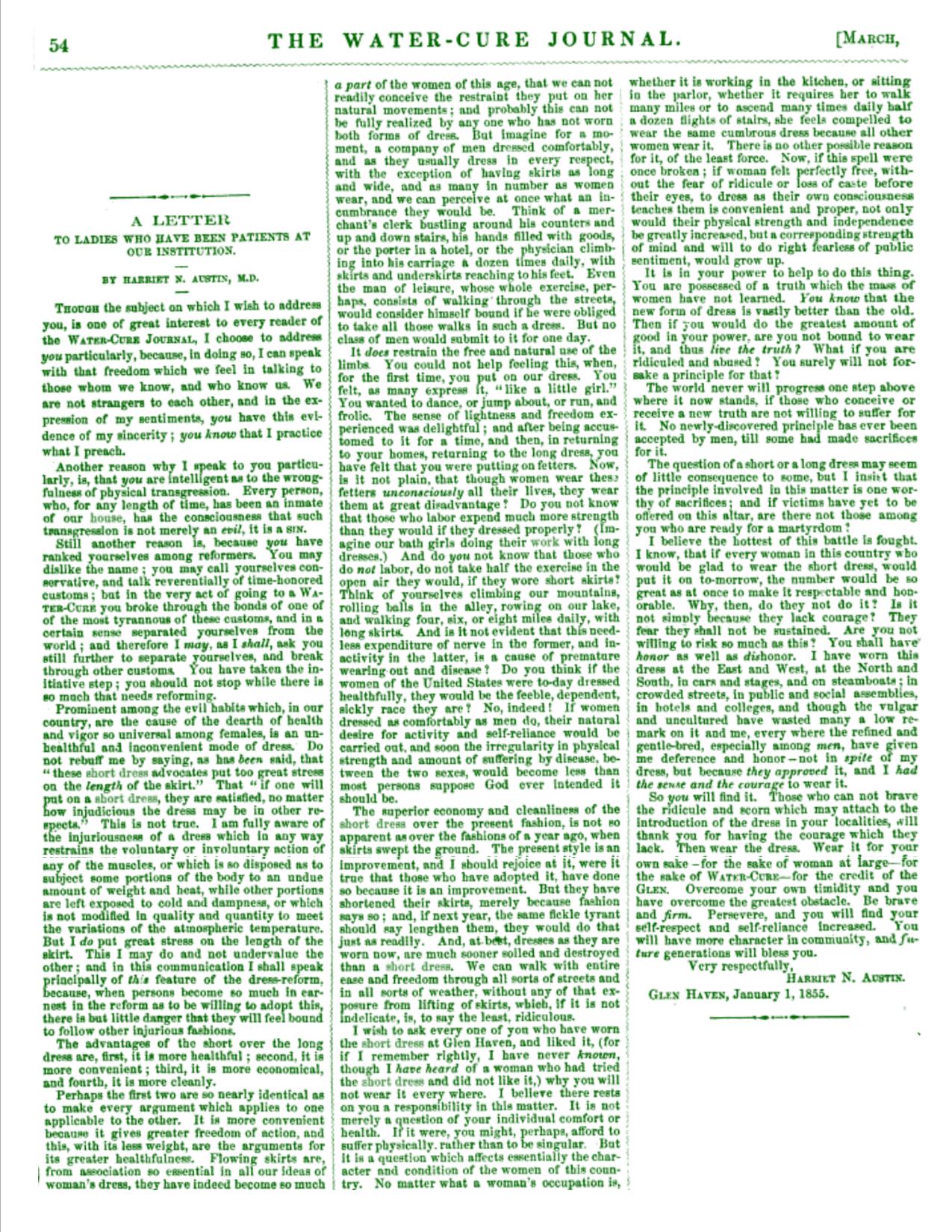
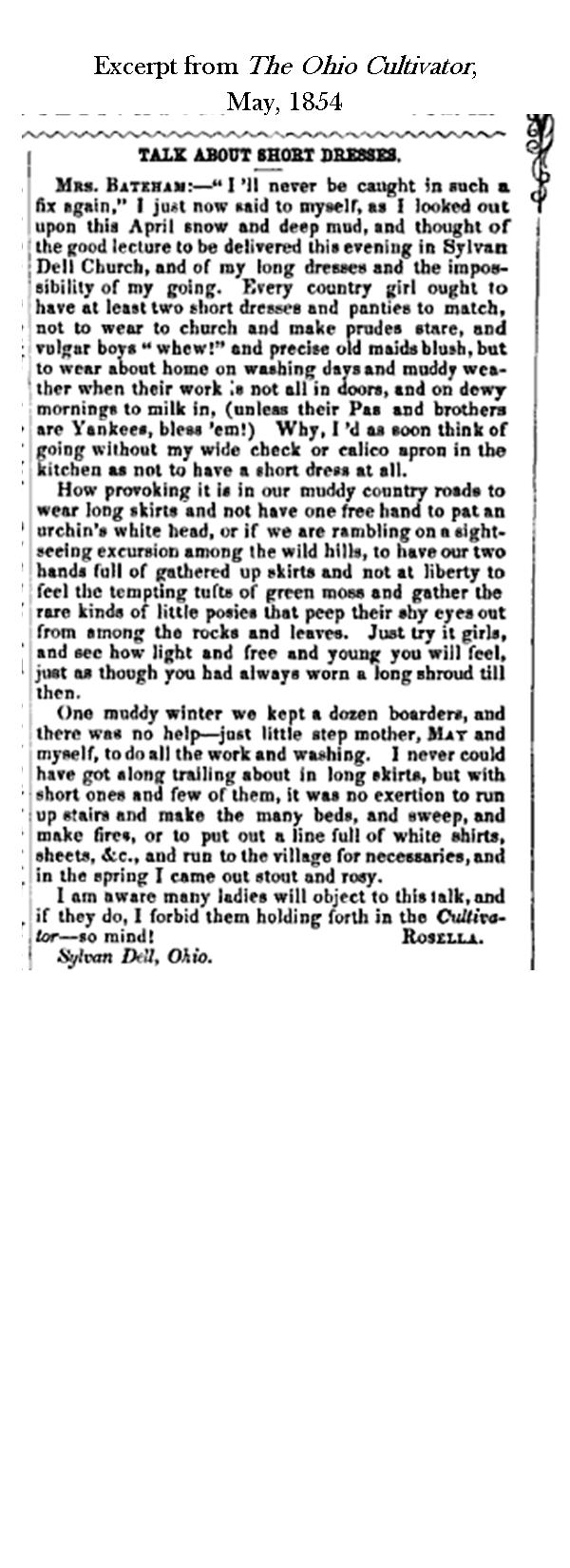
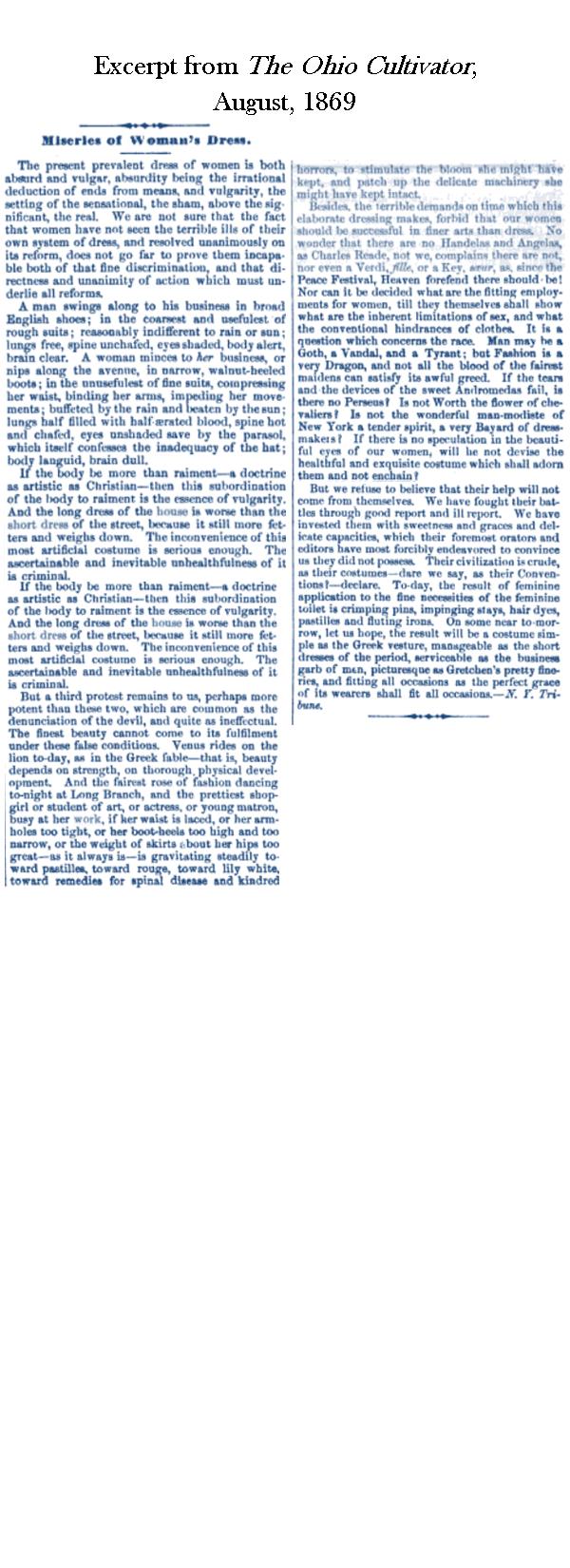
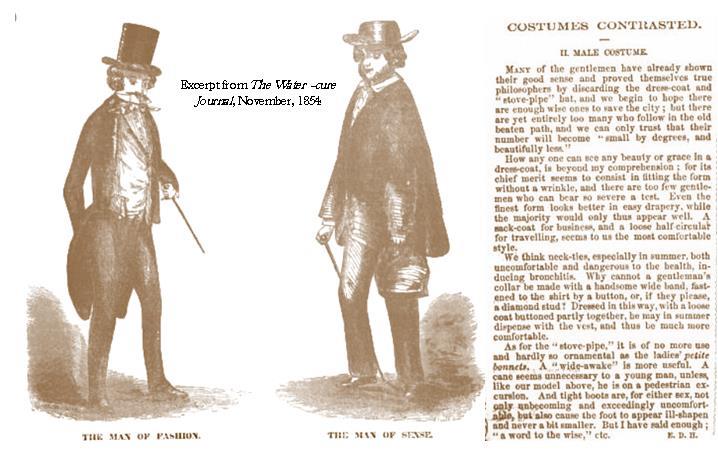
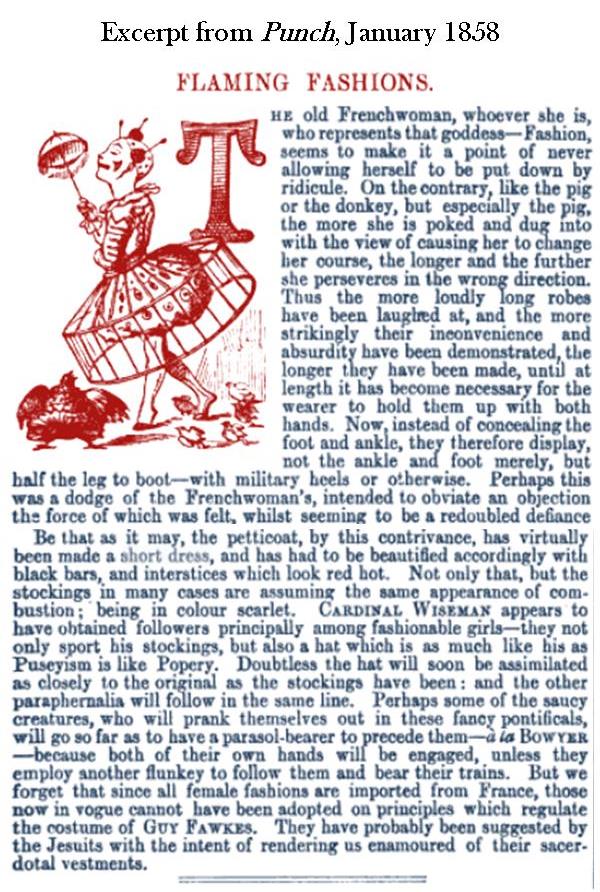
Clip Excerpt from The Prairie Farmer, Clip Short dress March 1855 Clip The Oneida Circular The Ohio Cultivator 1854 b The Ohio Cultivator 1854Clip Miseries later

This whole book is worth a download. It is on Google Books.Clip Watercure 54 aClip Watercure 54 bclip Punch