To start the year, lets look at the “Proprieties of Traveling”, in this passage from At Home and Abroad; or, How to Behave, by Mrs. Manners. (Evans & Dickerson: New York, 1854.)
Proprieties in Traveling
It is not an uncommon thing to find young people who are considered well-bred, and pleasant-mannered at home, not simply regardless of proprieties in traveling, but so inconsiderate of any thing but their own comfort, that they become great nuisances to other travelers. This is the case with such children as are only superficial in their conduct; I mean such as behave, because they have been taught that this thing or that is vulgar, and low-bred, rather than because their hearts are trained to kindness, and their politeness is its outworking. When thrown into new scenes, and exposed to disagreeable circumstances, they act out the natural impulses of their selfish, or querulous spirits, and become wonderfully unpleasant companions,
In bright contrast to these is the conduct of the amiable and unselfish. To be an agreeable traveling companion is a great recommendation, and is a character all would wish to bear if only they could “see themselves as others see them.”
I have traveled much in the last few years, both by sea and land, and, as I am apt to do, I have made many observations on the people around me. I have had occasion to note the well-bred and the ill-bred, the amiable and the unamiable, and have drawn from their conduct some important lessons.
Before I speak of behaviour, however, I wish to refer to some proprieties of dress and other preparations for a journey, which it is desirable to attend to.
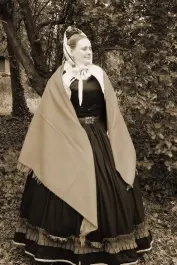
Nobody who is aware of the “wear and tear” which assails her garments on a journey, will wear fine or light, or otherwise delicate dresses, or shawls or bonnets. Exposure to the weather, which may unexpectedly become stormy; to the dust, and to the rudeness of those around, in the rush and crush which are the characteristics of traveling now-a-days, will effectually ruin almost any kind of clothing. Ladies, therefore, are accustomed now to provide themselves and their children, the plainest and most substantial kinds of dresses, shoes, shawls, coats, bonnets, and hats. All silks, laces, embroideries, fine ribbons, muslins, and jewelry, are considered, very properly, to be in bad taste in railroad cars or steamboats.
If it is desirable to wear a broach, let it be of the plainest and simplest kind. Wear your watch chain out of sight, or suspend your watch, as some do, by a black cord or ribbon. A thick veil is indispensable, as you are liable to be much annoyed by dust, or smoke and cinders, and also by the stares of rude and vulgar people with whom you are liable anywhere to come in close contact.
As for dresses, a plain-coloured foularde in summer, or a neat linen chambrey, or better still , a de bage, are appropriate materials. Plain straw bonnets, with green or other very neat coloured ribbons on them; linen collars, under handkerchiefs, and cambric sleeves, gloves to match the dress in hue, and gaiter boots, completes a neat traveling costume for ladies. Gentlemen usually carry traveling caps in their pockets, and wear loose brown linen sacques over their coats. It is a good plan to provide yourselves with convenient baskets which will bold night clothes, combs, and brushes, a small needle-case – containing sewing materials, and a pincushion. In addition to these, a bottle of good cologne is of great use; its odor is reviving, and it will refresh you to rub your hands and face with it, where it is not possible to make as plentiful use of water as you desire. I carry, in addition to these, one or two small towels, and a sponge. Children want crackers, oftentimes; and apples are good for them. But candies, cakes, juicy fruits, tarts, &c., are not only unwholesome, but make their faces, hands, and clothes so dirty, that they are to be avoided by all means. Linen coats, trowsers, sacques, and aprons, are best for children’s clothes, unless the weather is very cold.
As children seldom travel alone, it is to be supposed their parents, or those who have the care of them, will keep a close observance of all they do, and try to prevent their becoming annoyances to those around them. On thing, however, the children themselves must attend to. That is, that they pay the most entire and unquestioning obedience to any command given to them, or wish expressed, by those older. There are so many perils attending journeys, especially in these latter days , that there cannot be too much care exercised by their guardians, or too implicit obedience paid by the children. I shall reserve, for another chapter, my personal observations in my journeys.






 If I Had My Own Blue Box:
Neat! Thanks for sharing this. It’s so interesting to read about what to wear and, more importantly, the reasons for wearing those things.
Best,
Quinn
Dear Anna,
The advice is as well taken today as in the 1850s, for the most part!
For our family’s case, avoiding giving the boys anything sticky, especially…
Very best,
Natalie
I know I’ve already commented on this post, but… I’ve nominated it for “A Lovely Blog Award!” and I just wanted to let you know!
http://quinnmburgess.wordpress.com/2013/01/15/a-lovely-blog-award/
Best,
Quinn
Thank you very much!!! I am flattered to receive your Lovely Blog Award!