Most of us have grown up with the tomato pin-cushion from which dangles the strawberry emery. This fruit and veggie pair seems to be the strongest survivors of almost tasty looking fruit and vegetable shaped pin-cushions that appear to have peaked in popularity towards the end of the nineteenth century. Often made of velvets, silks and wools, these take shape as apples, pears and carrots to name just a few. These fruit and vegetable shapes are an occasional curiosity of mine. So, when I stumbled upon this fun description of the strawberry emeries, I had to share it with you.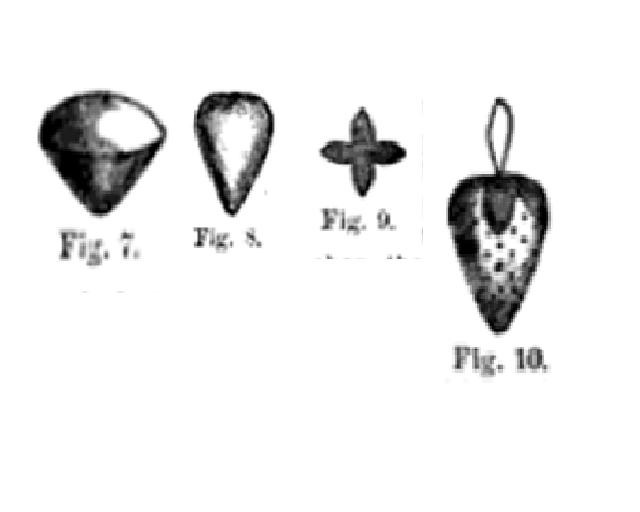
“She was just telling me she had finished stitching the strawberry seeds into the emeries, and wanted another job. She made most of the emeries. I cut out the strong cotton bags, and let her sew them up over a similarly shaped woolen sack filled with emery. She made the red silk sacks, and fastened them on, ready for the green leaves and the cord. She stitched in the seeds with yellow saddler’s silk. I think they are very pretty, and she is delighted with them.”(American Agriculturalist, December 1867)
By the way, this conversational passage, which goes on, was followed by this nifty little labyrinth:

UPDATE
Here is another strawberry emery, knit, found in both Peterson’s and Godey’s in 1859:








 If I Had My Own Blue Box:
Ohh, too cute! I need to make one of these. I love the idea of sewing a tiny strawberry with all these itty bitty beads….all for the utilitarian task of keeping your pins and needles sharp and rust-free. It’s an interesting juxtaposition.
You just hit on why I named the book what I did.
Indeed! It’s a delightful Victorian juxtaposition. And the beaded strawberry might just take the cake!
I’ve added a knit strawberry emery above.