Cassell’s Household Guide: Being a Complete Encyclopedia of Domestic and Social Economy Volume II, 1869 (published in London and New York.)
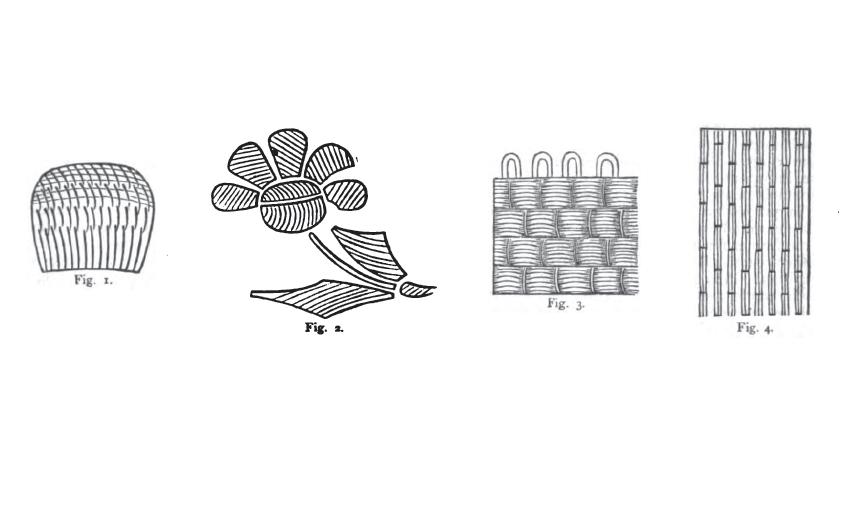
Of all the stitches used in embroidery, the long stitch is that in most general use, and all shaded work be done in it. In the somewhat fashionable “Brenton work,” however, shaded forms are filled in with short stitches taken promiscuously, instead of long stitch. In using it, all stitches should be taken from the outside edge of the figure, and worked towards the centre. In a figure of equal sides, the first stitch should be taken from the very centre of the edge, and the work proceeded with from first one and then the other side of this stitch. In working leaves and scrolls, the stitches ought, invariably, to be take in a slanting direction. The lighter parts of the leaves are first worked in from the edges, and the darker shades towards the central veins filled in afterwards, the veins themselves being put in last; gold should not be applied till after the silk-work is done. The last thing is to put a neat and careful outline to the leaves. In shaded work, the upper side of the design, upon which the light would be supposed to fall, should be worked in the lightest shade, and the high lights should not be so dark by four degrees as those shades next to them. In leaves, scrolls or conventional forms, a small number of shades, and those arbitrarily used look best, but more may be introduced with good effect in draperies. In fig. 1 we give a diagram of shading in long stitch, from the petal of a flower, in old English embroidery. Satin stitch is most useful for making raised leaves, &c, as in Chinese conventional flower, fig 2. The chain stitch, which is an imitation of the old tambour stitch, is formed by carrying the thread at the back of the fabric, catching it through, and laying it along the surface with a fine crochet-hook, which is, under a modern name, the same instrument as the old tambour-needle. Basket-stitch (fig 3) is formed by laying any even number of rows of twine, from four upwards, upon the foundation, and securing them there; the silk, &c, is carried over these two at a time. This is useful for borders. Couching was much used in old work. Passing or gold thread is frequently applied in this way, being laid over the ground and secured by short stitches in coloured silk over each single thread. These last are sometimes introduced promiscuously; sometimes so arranged as to form a variety of diapers and patterns, as in figs 4, 5, 6 and 7. Sometimes, as in fig 8, instead of these short stitches passing over every thread, the couching is accomplished by other threads crossing at right angles, and secured by stitches. Twist-stitch is produced by working equal stitches diagonally, one behind the other on an even line, as in Fig 9. French knots are frequently used and pretty for forming the centres of flowers and in diapers, they are supposed to be introduced in several of our designs. They are made by first bringing the needle through the material, taking the tread and holding it with the left hand midway between the needle and work, and with the right hand twisting the needle round the silk in such a manner as to form a loop; this having been slipped down to the point of the needle, the latter can be repassed through the stuff, close to the place where it came through, and while it is drawn down by the right hand, the silk is held by the left, till the loop settles into a knot upon the surface. 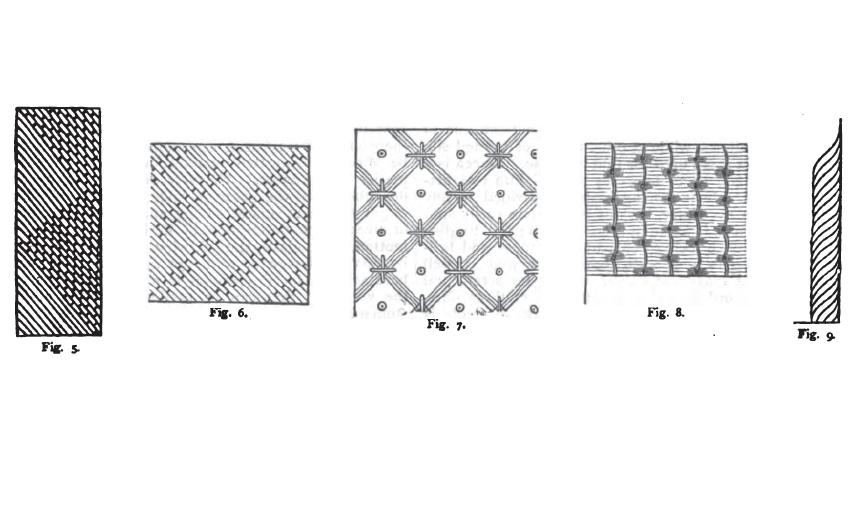







 If I Had My Own Blue Box:
Leave a comment