Cassell’s Household Guide: Being a Complete Encyclopedia of Domestic and Social Economy Volume II, 1869 (published in London and New York.)
In ordinary flat embroidery, no applied materials, as of pieces of fabric, cord, or spangles are used, nor is any part of the pattern part of the pattern raised by cardboard, or other packing beneath it, and the design depends entirely for its effect upon the coloured stitches used in it. This was the kind of work most in vogue in the days of our grandmothers, and it is, as admits of shading, the most delicate and beautiful, if not the most striking kind. The beautiful Eastern embroidery – Indian, Chinese, and Japanese – is mostly of this class, and may, In arrangements of colour, form good examples for imitation.
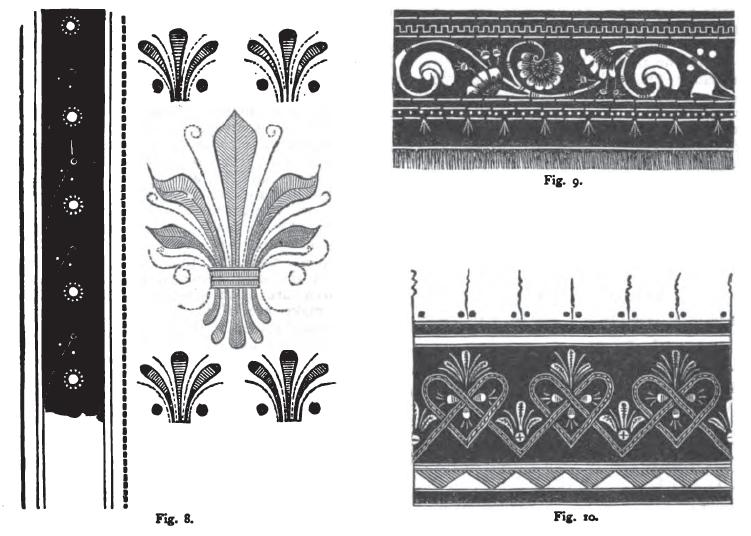
In raised embroidery, different substances are placed over the material to give it the effect of relief to the stitches. An approved modern method of working, is by taking cardboard – that known as thin mounting-board is good – tracing upon it the design to be raised, and cutting it out, care being taken to leave sufficient points of attachment in the more delicate parts of the design. The pieces of card have then to be sewn strong in their places, upon the material which is to from the ground, with cotton, and the bits of cardboard left for support cut away. If the design is to be still further raised, as would be recommended in working the large fleur-de-lis in fig 8, a line of even twine should be sewn down over the center of the figure, and over this a silk or gold thread can be worked. More than one row of twine should not be used, or the effect will be spoilt; and the thickness of it must depend upon the amount of relief required. If the figure is to be worked in gold or gold colour, the card beneath it should be coloured with gamboges. Fig 8 is a design for an embroidered curtain-border, with an edging of velvet, the principal parts of the pattern to be worked in relief; this will look very handsome if the fleur-de-lis is worked in gold thread or gold-coloured silk. Fig 9 is a mantelpiece hanging, in which the fan-shaped flowers are also in gold, raised upon card, the line of twine being near their outer extremity; they may, however, if preferred, be worked in coloured silks; the ground should be dark velvet. In fig 10, which is intened for the border of a table-cover, the raising of the embroidery is effected by merely laying on the coloured cord up the centre of the running pattern, and sewing it down.






 If I Had My Own Blue Box:
Leave a comment