 Cassell’s Household Guide: Being a Complete Encyclopedia of Domestic and Social Economy Volume II, 1869 (published in London and New York.) This shorter passage I am allowing to stand alone because I had not considered appliqué a form of embroidery. I would love to hear readers’ thoughts on this.
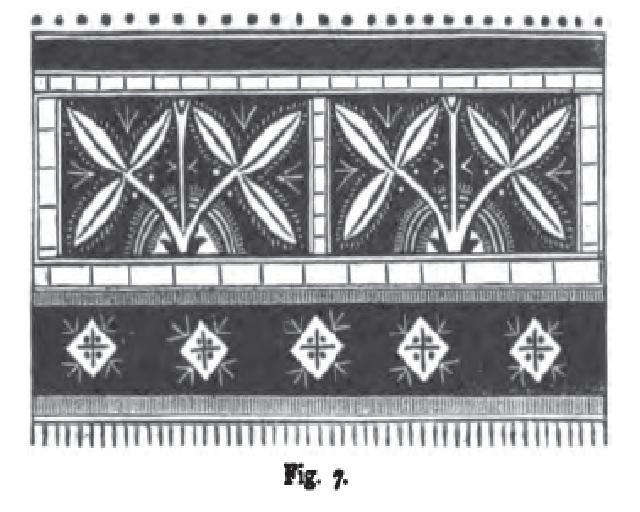
In appliqué, which is a very ancient and always a favourite method of embroidery, broad, flat masses of colour are gained by fixing one fabric over another. In fig 7 we give a design for a mantelpiece hanging to be worked in this manner. For appliqué the materials chosen are usually velvet, silk, cloth, and cloth of gold or silver; when velvet is used it should always be silk velvet. In may be employed for a variety of purposes, such as cushions, curtains, the covering of chairs &c., and though shading cannot be attempted in it, it produces rich and fine effects in flat patterns.
The ordinary method of preparing the materials is, by stretching some thin grey holland, say about a shilling a yard, on a common embroidery frame and covering it evenly with paste. The paste used by shoemakers, and to be bought from them will do, but in the section which we shall devote to materials, a receipt for proper embroidery paste will be given. The material must be laid upon the holland and smoothed till it adheres evenly. It will require about twenty-four hours to dry, and after being removed from the frame, the designs which are to be formed in the material may be traced upon the back of the holland, and cut out with a sharp pair of scissors. The above preparation refers more especially to cloth, velvet, &c; for silk, white lawn is preferable, as a black and whit starch should be used with it instead of paste; and indeed for all white materials a white back-lining should be used. Different parts of the design may of course, be formed in different colours, each to be prepared in the same way. Being cut out, they have to be laid upon the background, which, in our illustration, is supposed to be of black, or dark purple, or maroon cloth, and fastened to it round the edges with sewing silk. There are two ordinary ways of edging the pieces the pieces laid on in appliqué, that which has the richest effect is bordering them with a moderately stiff cord (as shown round the trefoils in our illustration) and sewing over this with silk. Gold-twist makes the most splendid bordering of this kind. The other is that shown round the semi-circular pieces at the roots of the stems, and which consists in working round the applied material with bright-coloured silk in button-hole stitch. It will be observed that a considerable space is left between these stitches to give them their full effect.





 If I Had My Own Blue Box:
Leave a comment