Cassell’s Household Guide: Being a Complete Encyclopedia of Domestic and Social Economy Volume II, 1869 (published in London and New York.) We propose in the course of this article to give some description of the various methods of working and of the stitches used in them, as well as of the materials required. We shall also give a series of original designs, but we trust that our readers will not, after perusing the above remarks [previous post] content themselves with merely copying these, but will use them only as stepping stones to embroidery work in which patterns will be of their own devising.
The methods of embroidery practiced at different times and in different times and in different countries, as well as the various stitches employed in them, are almost endless. Taylor, the water poet, in 1640, mentioned by name no less that twenty-one distinct stitches as being in vogue among the English embroideresses of his day. We have not, however, at the present time to deal with the antiquarian aspects of embroidery, but to speak of it as it may be applied to modern practice.
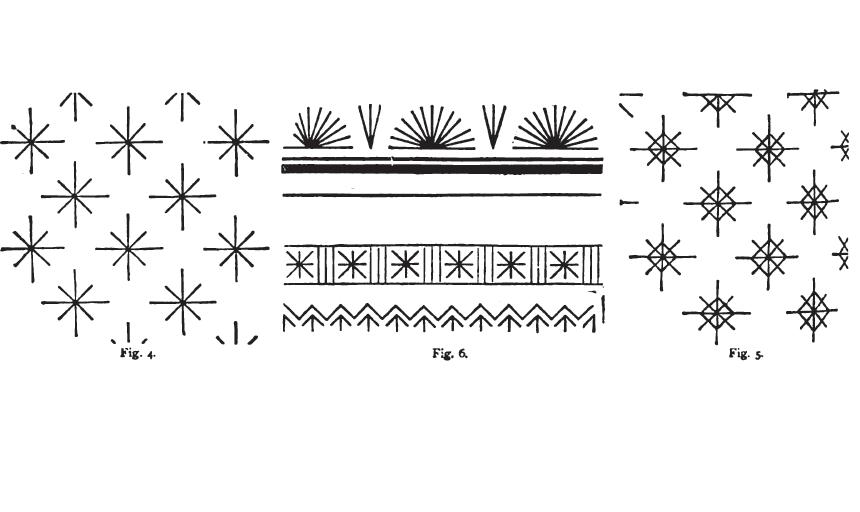
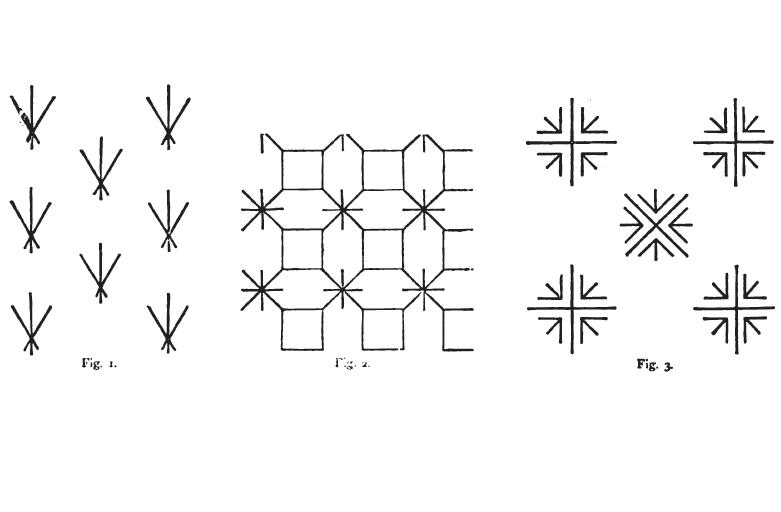
Between ordinary German wool-work and legitimate embroidery there is an intermediate style, which has latterly been somewhat freely practiced. It is susceptible of far better effects than the former, and is by now means difficult. Over the ground of German wool, worked in cross-stitch upon canvas, diapers such as those given in figs 1 to 6 are over-stitched on silk. Thus treated the German wool-work loses its objectionable flatness, and gains great brilliancy. While on the subject of German wool-work, we would beg our readers to remember, if they continue to practice it in preference to better styles of embroidery, that though it is capable of being enriched as above, it is a method of work which is, artistically speaking, exceedingly limited, and really fitted for the production of flat patterns only, such as geometric designs, of conventional ornaments, In cross-stitch it is impossible to shade objects in such a manner as to give them any satisfactory resemblance to nature, and the representations of animals and flowers which have been attempted in it, are as numerous as they have been lamentable failures, and ought merely to be preserved as examples of bad taste.







 If I Had My Own Blue Box:
Leave a comment