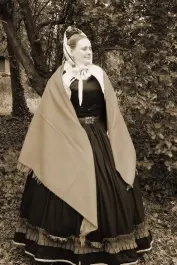
Today we have a guest post by Ashley Goldsmith who brings us a look at Hanukkah in Mid 19th Century America.
It surprises some people to learn that Hanukkah is actually a very minor Jewish holiday and not a “Jewish Christmas”. Unlike other holidays there is no prohibition against working and aside from lighting candles and saying special prayers, there isn’t much in the way of religious ritual. The holiday celebrates a military victory. Hanukkah as we know it today in America began it’s birth in the 19th century. Many Jews when they came to this country tried to assimilate while still maintaining their customs. Imagine being a small minority in the middle of winter when most of your neighbors are celebrating a major holiday with gifts and festivities. In particular imagine being a Jewish parent watching your child see all this activity from the outside. People began to fear that this would not only make their children feel left out, but could prompt them later to abandon their Jewish faith. They looked around for answers and realized that very often the Jewish calendar date 25th of Kislev often fell very near or close to December. Suddenly their was a holiday Jews could celebrate.
The basic story of Hanukkah is that the Greek -Syrians had taken over Jerusalem and the Temple. The Maccabees fought and took back both. When they got to the temple they found defiled. In order to ritual cleanse the temple again for worship they need to burn oil for eight days. They discovered they only had oil for one day, but miraculously it burned for eight days.
The mid 19th century Jews would have seen the lighting of a special menorah called the Hanukiyah. The Hanukiyah had room for nine candles. The first candle to be lit would be shamesh also known as the worker candle. This candle would be used to light the other candles. On the first night the shamesh and one candle would be lite. Each night another candle was added to the Hanukiyah until the entire Hanukiyah was filled. Special prayers were said each night with the lighting of the candles. The candles were commonly lite by the mother or by another member of the family. The Hanukiyah was placed in the front window of the home so any passerby could look in and see what night of Hanukkah it was by counting the candles.
Traditionally as with most holidays there were traditional foods. Since Jews came from different parts of the world traditional Hanukkah foods varied. European Jews and immigrants were more likely to have lahtkes which are potato and onion pancakes fried in oil. Jews of Spanish descent or who lived in the South in America had small deep fried sugar cookies. One thing the foods had in common is that they were cooked in oil to symbolize the one day of oil that lasted for eight.
By this time the tradition of giving gifts instead of Hanukkah gelt money was well under way. In a letter to a Miss Sallie, 1st Lt. Edwin Kursheedt of the Washington Artillery wrote December 28th 1864 where he was station in Petersburg, VA, “I have not been able to see the Chanucka lights this year. Last year I was with my aunt and officiated in reading the service as I always did at home, for in addition to lighting the lamps in Synagogue we always did so at home. This was our Christmas, as children and we always rec’d presents & enjoyed ourselves…”(1)
For most Civil War soldiers Hanukkah seemed less important than other major holidays such as Passover. There are many examples of soldiers writing about hoping they would be home for Passover seder. It is likely many soldiers on both sides knowing the military significance of the origin of the holiday Hanukkah felt it could be celebrated by fighting for their homeland.
Surprisingly there is not as much information on 19th century Hanukkah celebrations as one would expect to find. Right now more and more early to mid 19th century papers and journals of Jews are being released at several museums in the country so hopefully in the future we will have more resources will be available so we can get a better view of American Jewry during the Civil War era and their religious practices including Hanukkah. However I did find an early melody composed by Felix Mendelssohn called “Candles Burning” that is supposedly an early 19th century Hanukkah melody.
Notes
(1) American Jewry, Korn, page 90.





 If I Had My Own Blue Box:
Leave a comment