I’ve been working on an 1830s travel program for GCVM. In the process I’ve learned a few things about travel, as well as a few other things I would like to share.
First, I have a big challenge going from an 1850s and 60s ‘mindset’ to an 1830s ‘mindset’. I am such a visual person, I need the aid of photographs and paintings to help me develop that mental picture. I also find I really need maps, detailed maps to aid in this visual. Another aspect is that I’ve spent my time from college on focusing on the time frame between approx 1848 and 1865 often obsessing right down to the minute detail. This amount of time can not compare to June, July and August.
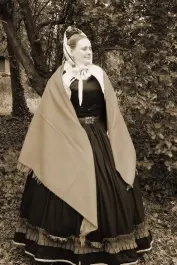
In terms of clothing, the guide books I focused on suggested a dress to have sleeves that were not tight to prevent sweating. I altered my dress to have deeper armscyes and looser sleeves, especially through the upper arm. I find this aspect of the dress to be exceptionally comfortable. I have full movement of my arms comfortably. I believe even in exceptionally hot and humid weather, the sleeve will do well with not sticking or bunching against the skin. I do think the armscye is rather noticable in the front. This also throws off my attempt at a 30s sleeve since the change from the upper part of my sleeve, which is loosely fitted around my larger upper arms, to the larger lower sleeve is minimal. (I’ll see if I can get a good photo of that.)
When it came to the bodice, I couldn’t see how the back closing dresses of the 30s could possibly work for a woman who was supposed to be traveling alone. With several nights at inns and with rough travel, she would need a comfortable front closing dress. I opted for a cross-over bodice closing at the waist in the front. I fully admit, now that it is done it feels far more like a 50s bodice than a 30s. While sitting the neckline sits just above the drop of my shoulder but when standing it does not have the wider neckline of the time. If I were to have been working on a later 50s or 60s version, I definitally would have opted for a sacque & petti or sacque and dress combination in a seasonall appropriate material, ie linen or wool.
The weekend before the session run-through I learned the challenges of soot. I found out to late that my straw bonnet got smooshed while being stored in the car. (FYI – Hot, humid cars are not a good place to store bonnets.) Instead of the straw, I wore my white sheer cotton drawn bonnet. The material was a magnet for the soot coming from the steam engine. Before I knew it my white bonnet was speckled with little black spots. These little black spots do not come off. Of course, upon learning this first hand, I needed to include it in my discussion.
During that same event I found reason to question the wearing of white petticoats during railroad travel. With the second day’s weather being so wet, the soot gathered on the landing and steps of each car. While the front of my skirts could be controlled to avoid much of the layer of black, sticky soot mud, the backs could not. My inner petticoat, that directly over my cage, became black with soot a good foot up the inside. I should mention these are petticoats that get cleaned once a season due to the time involved in the starching and ironing. While I was able to wash most of the soot out with a good soak and wash in oxyclean, I am not certain when a traveler would have the time to have her petticoats washed. She certainly wouldn’t be able to on a regular basis during the journey even if washing services were available at the inns she stayed at. Would she go about in blackened petticoats? Would she opt for petticoats of a different color? I don’t know.
Boots, shoes and slippers. The wearing of stout leather boots certainly makes sense to any of us who have stood at the edge of a giant puddle while wearing something pretty on our feet. Some authors (I’ll double-check who if you need me to) suggest packing a pair of slippers in your travel bag, the one you carry with you. initially, when I read this years back I thought is was a nice idea. I didn’t think much beyond that. I think I figured out why these are so important. I’ve found if one sits too long in tight stockings, held snug at the knee, and tight boots, that the feet and ankles tend to swell. If on longer railroad or packet boat trips, one is able to remove her boots and loosen her stockings, there will be significantly more comfort. Now of course the question is, how does a woman do this while maintaining all decency? In the case of a woman staying in a ladies’ car, this would not be a big challenge. But what about a woman traveling in combined company?
Oh back to bonnets. There is a good reason why guide books suggest traveling hoods. When you need to rest your head due to a long journey, or a weather induced migraine in my case, a bonnet is exceptionally uncomfortable to lean you head against a seat or side of the rail car. I suppose the same would be true on a stage. So, I really understand the suggestion of a hood. But, my quandary is what we are seeing in images. Most of them show women in bonnets with traveling veils. So, do you board in your bonnet then change to you hood when you need to rest? The challenge I see there is where to put the bonnet. Do you have your band box with you? Is there even room for it to be carried with you? If you opt to wear your hood, do you, and if so, how do you attach a veil to a traveling hood? There are items like a bonnet shade or ugly intended for use with a bonnet during travel. These would suggest wearing the bonnet for the duration of travel, at least during non-rest times. At the same time, there are a great number of hoods. (But, these are more mid-century rather than the earlier 30s which I don’t know as well.)
Relatively random reflections on this process. Maybe in September I’ll have reflections on a scripted presentation style program verse an interactive student focused one.






 If I Had My Own Blue Box:
Leave a comment