Graham’s American Monthly Magazine of Literature, Art, and Fashion – August 1855
Head coverings, both for man and woman, naturally—or rather, historically, divide themselves into three classes: First, the simple bonnet, or the Phrygian cap of liberty, free-and-easy, and in all ages made symbolical of a state of rude political freedom; second, the turban, or mysterious bonnet, composed of innumerable complicated folds. It is a long serpent of muslin, wound round the head. Third, the hat, the head costume of the men, of what is called, vaguely enough, the “civilized world.” The hat is the emblem of practicality, gravity, and decorum. Judgment belongs to the North. The Chinese wear the hat, but they have it peaked at the top like a sugar-loaf—an emblem of folly and gravity combined. The Quakers have adopted the very gravest form of the hat—low-crowned and broad-brimmed. It is in perfect consonance with their assumed character. Were a Quaker to raise the crown of his hat, like the chevalier of the seventeenth century, he would look more like Wamba, the son of Witless, than like a follower of the grave, the venerable and thoughtful George Fox; and were ho to clip off a portion of the projecting eaves, the world would perceive at once, perhaps without knowing why, that he was giving way to the temptations of the flesh, and restating the spirit of non-conformity, that gives inspiration to his brethren.
As there are different characters for hats, so also are there for bonnets. Some are emblematical of liberty, others of subjection; but even the latter involve the idea of a state of social disorder. The turban is mystery personified; and all who wear it, whether male or female, are involved in its tortuous folds. The monks used to wear skull-caps; so did the Reformers, Luther, Calvin, and others. It was the ecclesiastical fashion of the day. The skull-cap in a very close fit. It is impossible for an ago to be very free in its genius, with such a cap. It is too exclusive. It acts like a censorship on the press. Those who wear it are stern and powerful, but conscientious, bigots. Poets eschew the skull-cap; they prefer even the fools-cap or night-cap. Pope and Cowper are generally represented in these. They give, at least, scope to genius. But as they do not stand erect, they tend to nourish moroseness, melancholy, and bad humor
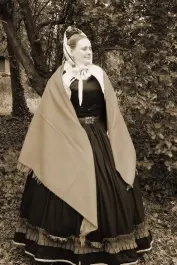
Women’s caps and hats are not so easily classed as those of men; but the general law is applicable to them also. The cap without a rim is the widow’s cap, because she is then free. So long as a woman’s husband is alive, as the Apostle says, she is under the law of her husband; but when the husband is dead, she is free from that law, and therefore, she wears a cap without a rim, as the proper widow’s cap is. But the widows are gradually infringing on the old law, like the Quakeresses, and conforming more and more to the gay fashion of the day. The border or rim belongs appropriately to the cap of the discreet matron ; the turban to the mysterious intriguants, whose ways are as cunning as those of a serpent on a rock—one of the four things which Solomon could not understand.
A small bonnet, for a lady, is an emblem of gayety and liberty. She can, in such a bonnet, see with the corners of her eyes, and survey the whole semicircle of which her nose is the centre. But in a Quakeress’ bonnet, she can only see beyond her nose, and a few degrees on each side of it. If a gentleman should look at her from the opposite side of the street, she observeth him not. Even if a horse should make a snap at her arm, as she passeth along the pavement, she doth not perceive it. (And that this is a matter of serious consideration, is demonstrated from the fact that, a few years ago, a young lady’s cheek was bitten off by a horse which was standing close to the sidewalk of a crowded thoroughfare.) A woman in such a bonnet, is imprisoned in a coal- scuttle, contrived on purpose both to elude and prevent observation.
But, with the modern gay little bonnet, hung upon the back hair, the forehead all exposed, and the eyes at full liberty to describe the whole field of vision, a lady is made up for conjugating the verb to tee, active and passive voice, in all Its moods, tenses, and persons. This gay bonnet forebodes the same revolutionary, anarchical proceedings in the domestic sphere, which the bonnet rouge foreshadowed in the political world.
Nothing so quiet, and sober, and maturely-looking for a woman, as a large Leghorn, that ties round the chin, and hangs down the back like a coal-heaver’s hat, or rolls up behind like a parson’s shovel—not cocking up as if the face were behind, in the Nell Gwynn style. A woman so attired, is sure to be discreet, modest, subject, timorous, apt to scream, very much afraid of all strange people, and well armed with jealousy and suspicion of all evil-looking persons, such as foreigners (or natives either) with drab-colored moustaches hanging over their mouths, or gentlemen whose shirt-bosoms are not visible, but whose manners, notwithstanding, affect those of the court or stage, or something very different from ordinary life. Such a woman is an affectionate wife, a fond mother, an excellent economist, and a severe critic of all irregular living, at home or abroad. Such ladies, we fear, have of late years been rapidly going out of fashion—all owing to the small, flaring bonnet, which, from being so easily put on and carried about, makes them sad gad-abouts and gossips. But, to all these coverings for the head, certainly the one combining at once grace and modesty, destined at once to embellish and conceal, is the veil. The veil, which has gone entirely out of fashion in the most civilized countries, those in which fashions are the most studied, has been retained by the cloistered nun,” whom we never see, and by the bride, who wears it of such transparent and flimsy texture that it actually conceals less than the most expansive of bonnets.
Veils are still worn in Italy and Spain. The Empress Eugenie, in virtue of her Spanish associations, tried to introduce the black mantilla into France, but its sombre hue and monotonous folds were unsuited to French taste, and met with most violent opposition not only from the fair devotees of fashion but from a whole population of florist- feather cullers, ribbon makers, frame makers and milliners—finish a host docs it take to manufacture the modern bonnet— against which the small shot of philosophy appears specially to be directed; but in a utilitarian age, where the cry is employment and encouragement to the working classes, the bonnet actually turns out to be quite a philanthropic institution, one not to be sneered at, but to be both praised and encouraged





 If I Had My Own Blue Box:
Leave a comment