Tid-bits for serving tea….
“In the first place, dust off your table clean, and spread your cloth neatly, observing that the centre crease of your cloth is right in the centre of the table, and that it don’t hang longer at one end than at the other; then proceed to set out your breakfast tray; laying a cup and saucer for each person, with a teaspoon in each saucer, at the right hand side of the cup; then set in the centre of the tray, your sugar pot on the right hand, your cream pot on the left, and your slop bowl in the centre, with your teapot behind them, so as to be right under the tea urn, and that the tap of the urn may reach it, when on the table. As soon as you have this done, set your tray at the end of the table where the lady sits that pours out the tea, then put around your plates, one for each person…… If your breakfast table is rather small you must spread a napkin on a small stand, place it on the left hand side of the lady that makes tea; place on this the tea caddy, and if there is not room on the breakfast try, for all your cups and saucers to be placed uniform, you may put the remainder on the stand.” (Roberts Guide for Butlers and Household Staff, p43.)
The Suisse. Etiquette requires a round table for the The Suisse, a snow white table-cloth, and in addition to tea, coffee, and bread-and-butter, a great variety of cakes, jellies, and confectionery.
“Tea cannot be so hastily dispatched.
“After a late dinner it is a matter of minor importance. It is merely handed round with sugar and cream, by the servants in waiting.
“When especial invitations are given by quiet people to a sociable ‘cup of tea,’ it is generally served up, with all the tea equipage, on the drawing-room table. It is presided over by the lady, or the eldest daughter, of the house, and the gentlemen who are invited render themselves useful in replenishing the tea-pot from the shining copper tea-kettle (supposing there is no urn), and in handing about the bread-and- utter, tea-cakes, muffins, and crumpets.
“For a large evening party, it is well to set apart a room for the tea and coffee. Here on of the daughters of the house may preside, and supply the guests with tea, coffee, and biscuits, or bread-and-butter, before they proceed to the reception or drawing-room. “In some families confidential servants preside in the tearooms on the occasion of a large evening party. “Another style of tea, and one at which juvenile as well as grown-up guests are often present, is the tea called the
“The guests assemble round the table, and the repast is rather a protracted one. Conversation, games, and music follow, but no supper is deemed necessary. (The Hand-Book of Etiquette: Being a Complete Guide to the Usages of Polite Society. London: Cassell, Petter & Galpin, 1860. P25-28.)
“If you prefer a set table, place your waiter at the head, with teapot, coffee-urn, cups, saucers, sugar, cream, etc., and the placing of the remainder of your table equipage will be readily known to an intelligent mistress.
“But allow me to recommend another mode of serving tea, much more agreeable, convenient, and elegant.
“Have the waiter containing your teapot, coffee-urn, etc. placed on a side-table in your parlor, at which seat yourself to serve your guests or family. Then on another table, near by, have another waiter placed, containing other refreshments. If you have quartettes, or small tables, have these placed before your guests; then let one servant hand around the plates, knives, and forks, while the other hands the waiter containing cakes, etc.
“By this arrangement you will the better exercise the impulses of the agreeable entertainer, and promote sociability. You give your gentlemen guests an opportunity of being both gallant and agreeable, and the ladies of displaying both graciousness and grace.
“Never have your tea poured out in another room. It allows to servants an opportunity of loitering, causes them to supply you with cold tea and coffee, besides trying unduly your patience and amiability.” (Mason, Mary. The Young Housewife’s Counselor and Friend: Containing Directions in Every Department of Housekeeping, Including the Duties of Wife and Mother. New York: E.J.Hale & Son, 1875. p 309)
“Green or black tea, to be drunk in perfection,
must be made with boiling water,–boiling at the time of being poured on the tea; and black tea is the better for boiling some ten minutes.
“Do not trust this operation to servants, as it is very common, with most of them, to believe that water once boiled is boiling water. Although the kettle, on boiling, is removed from the fire so far as entirely to stop the ebullition of the water, it is thought nevertheless boiling water, and tea is made of such, in most cases, if the eye of the mistress is not upon it. “Of best green tea three teaspoonfuls will be sufficient for six persons, though if you wish tea for one, a spoonful will be needed. For black tea a larger proportion will be necessary, perhaps double. “If a silver teapot is used, the tea should first be made in an earthen pot, and kept at boiling heat near the fire till about to be served; then the silver pot should be scalded with boiling water, and the tea immediately transferred into it and served.“Three things it would be well to avoid in tea,–tea of inferior quality, weak tea, and cold tea: unless persons desire iced tea,–then it should be
well iced. Tepid tea is nauseous, especially if weak. (Mason, Mary. The Young Housewife’s Counselor and Friend: Containing Directions in Every Department of Housekeeping, Including the Duties of Wife and Mother. New York: E.J.Hale & Son, 1875. p126. )
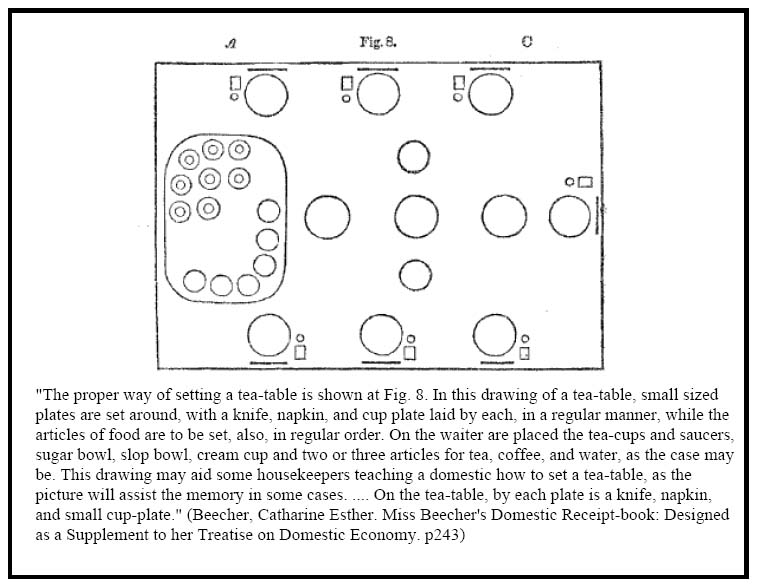
“Tea Parties and Evening Company” “In one respect, fashion has aided to relieve a house-keeper of much care in providing evening entertainments. It is now fashionable to spread a table for evening parties, and not to serve tea and coffee, as was formerly done. As this is the easiest, and most rational way of entertaining evening company, no other method will be so minutely described. “If a lady designs to invite from forty to sixty friends to pass the evening, of even to have a much larger company invited, the following would be called a plain but genteel arrangement, for company in New York, Philadelphia, or any of our large cities. “Set a long table in the dining-room, and cover it with a handsome damask cloth. Set some high article containing flowers, or some ornamental article, in the centre. Set Champagne glasses with flowers at each corner. Set loaves of cake at regular distances, and dispose in some regular order about the table, preserves, jellies, lemonade, and any other articles that may be selected from the abundant variety offered in the collection of Receipts for Evening Parties in this book. “Where a very large company is to be collected, and a larger treat is thought to be required, then a long table is set in the center of the room, as above, and on it are placed cakes, pastry, jellies, and confectionary. Then smaller tables are set each side of a mantle, or in corners, one of which is furnished with sandwiches, oysters, salad, celery, and wine, and the other with coffee, chocolate, and lemonade. Sometimes all are placed on one long table, and in this case, cakes, jellies, and confectionary are put in the centre, coffee and lemonade ate one end, and oysters, sandwiches, celery, and wines at the other. A great deal of taste may be displayed in preparing and arranging such a table. “As it is often the case, that the old mode of serving tea and coffee will be resorted to, on modification is proposed, which decreases the labour and anxiety to the housekeeper, and increases the enjoyment of the company. It is this. Set a table in one of the parlors, and cover it with a damask cloth. Let the tea and coffee be served at this table, the lady of the house presiding. Then let the gentlemen wait upon the ladies around the room, and then help themselves. This is particularly convenient when it is difficult to get good waiters. “Most of the articles used for evening parties (with the exception of rich cakes, wine, and highseasoned chicken salad are not unhealthful, if taken moderately. “When these parties break up at seasonable hours, then may prove one of the most rational and harmless modes of securing social enjoyment; but when connected with highly exciting amusements, and late hours, they are sure to wear upon the constitution and health and rational and conscientious persons, for these and other reasons, will avoid them.” (Beecher, Catharine Esther. Miss Beecher’s Domestic Receipt-book: Designed as a Supplement to her Treatise on Domestic Economy. p241-242)
TEAnotes – These are plain notes, no formating, not cross checking.







 If I Had My Own Blue Box:
Leave a comment