I lack words for how much you must see this….
1746-1823 album with swatches, sketches, illustrations and notes.
***Please see Carolann’s note below in the comments about the published version of this.***
I lack words for how much you must see this….
1746-1823 album with swatches, sketches, illustrations and notes.
***Please see Carolann’s note below in the comments about the published version of this.***

Articles and blogging about originals:
Articles and blogging on making pin balls:
Needlework ideas and patterns:
Needlework helpers
A nice example of a Turn-Over Shawl is on Ebay this week. I hope they keep the photos up for a good long while.
A “Turn-Over Shawl” is A shawl that when folded in a triangle, shows all four finished borders. This is done by attaching 2 borders on the right side and 2 on the wrong side.
The three-quarter back view shows the Vs of the two border pairs. These are set on opposite sides so when folded over, both sets of borders form their Vs. You can see the “right side” construction of the top V in one of the photos. This shawl is made with a center piece of black wool, 4 paisley type borders and black wool borders that are frayed. The right and wrong sides of the paisley type borders can be seen in the other two photos. A border such as this one could have been purchased at the time.


There is another one over on Etsy as well. This shawl is 58″ square, within the common size perimeters for the mid-century. Again we can see the borders set in pairs on opposite sides so they will make Vs when the shawl is folded. While this border is narrower than the Ebay shawl’s, the way it is folded and photographed really shows how dramatic and lovely the look can be. The seller includes a teaser photo of one corner showing the right and wrong sides of the border. The color thread clearly shows the construction details. (btw – Please do not dry clean an antique shawl as the seller suggest.)


I believe Genteel Arts just did a workshop on making a turn-over shawl.
Additional examples:
http://www.meg-andrews.com/item-sold-details/Norwich-Turnover-Shawl/8011
http://www.clevelandart.org/art/2012.447
https://www.augusta-auction.com/component/auctions/?view=lot&id=14956&auction_file_id=33
http://www.powerhousemuseum.com/collection/database/?irn=149561
http://www.antique-textiles.net/shawls/1820-1825-turnover.html
Yesterday, some of the Sew Along ladies asked if they could have the next set of directions early so they could sew during the storm they are expecting this weekend.
This made me really wish I had thought ahead to write up a special set of “Snowed in” project directions. What a neat idea would that have been?
We do have a fun Work Bag Sew Along project we are in week 3 of. You are welcome to hop back to Week 1 of the Sew Along to keep your hands busy and warm inside.
I do have these FanU templates to offer. These projects can easily use what you have in the stash:
A boot 
A button keep, aka “balloon bag” 
An additional Sea Shell 
A Tri-lobed Needle-book 
Two Christmas Ornaments 

By special request due to the storm approaching the east coast, I am sharing this post early.
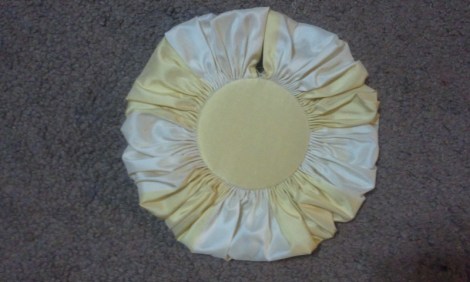
This week we are attaching the balloony section we gauged last week to the covered paste board.
Cotton Work Bag
We are attaching the long section we gauged last week to two of the the covered pasteboards (the ones that are backed with the lining fabric.) The gauged fabric will be attached along the curved section of the pasteboard. The flat side will not have fabric attached.

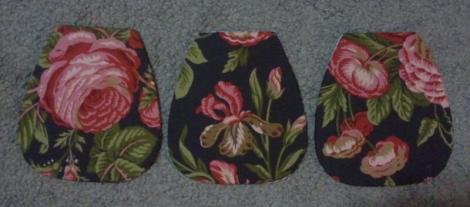
We will attach the pasteboard and the gauged fabric right sides together with the decorative side of the pasteboard, using a whip stitch. Line up the center point you marked on one side of the gauged fabric with the bottom center of the pasteboard. Pin these points together. Line up the quarter points with just above the curve on the pasteboard. (I’ll get a better photo of that.)
On each end, fold a quarter inch of the gauged fabric under. Line this fold up with the top of the pasteboard curve where it meets the flat side. Pin both ends as well. (sorry, I will try to get a photo of this.)
Using a whip stitch, attach the folds of the gauging to the pasteboard. Go through both the decorative and lining fabrics, but not the paste board.
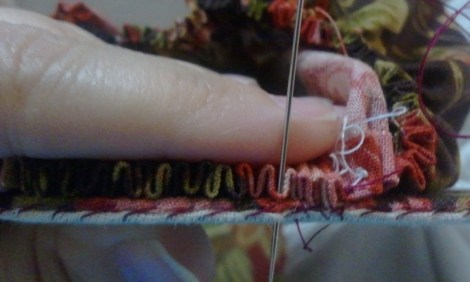
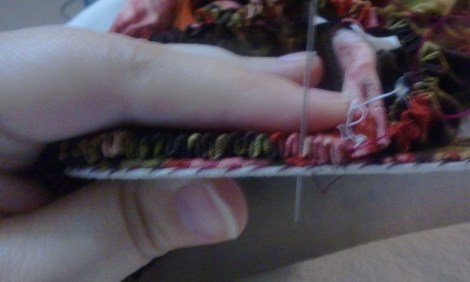

When one side is finished, it will look something like this. You may need to coax the gauged fabric to lay flat aligned with the pasteboard. (outside and inside shots.) (Yes, I make use of the salvege.) 

Repeat the pinning and whip stitching process with the second covered pasteboard.
When finished, you will have two sorta horse shoes attached to the gauged fabric. Take some time to play around with how these fit together. It is a rather nifty combination. 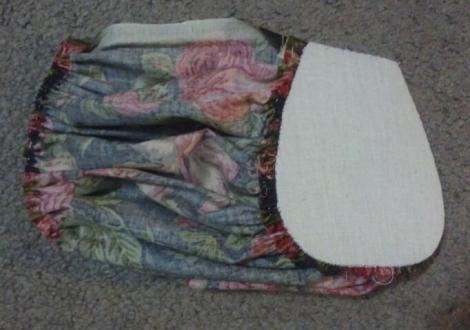


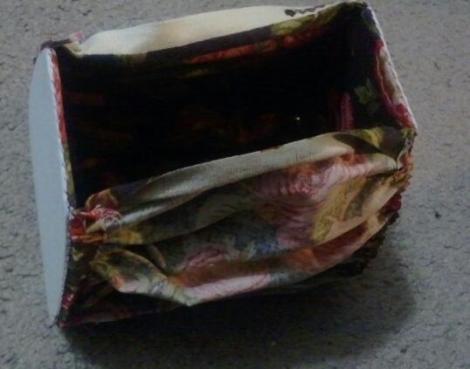
Lay the workbag out flat to check your stitches. 
You have completed this week’s step. (You can turn it right side out if you want.)
——————————————————————————————————————————-
Silk Work Bag
We are attaching the long section we gauged last week to two of the the covered pasteboards (the ones that are backed with the lining fabric.) The gauged fabric will be attached around the entire circle on each side.
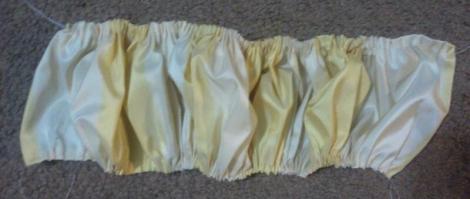

We will attach the pasteboard and the gauged fabric right sides together with the decorative side of the pasteboard, using a whip stitch. Mark each circle in quarters. (pencil on the inside lining is fine.)
With the first pasteboard – Fold a quarter inch under on each end. Line these up with the top point on the pasteboard. Pin. Line center point of the gauged fabric up with the bottom point on the pasteboard and pin. Do the same with the side quarter points. (Sorry for the lack of photo.)
Using a whip stitch, attach the folds of the gauging to the pasteboard. Go through both the decorative and lining fabrics, but not the paste board.
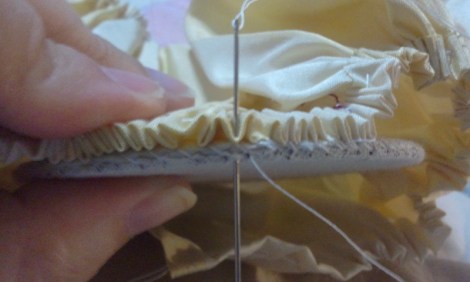

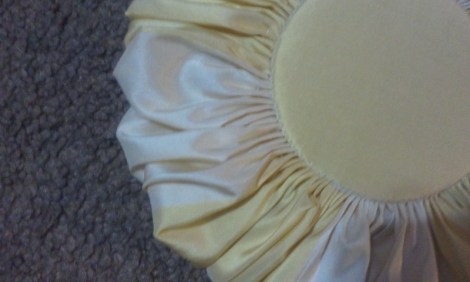
When one side is finished, it will look something like this. You may need to coax the gauged fabric to lay flat aligned with the pasteboard.
Repeat the pinning and whip stitch with the other pasteboard side.
When finished, check your work. Once you turn this one right side out, it will be be difficult to turn it inside out again.
For more in-depth information, read Paisley, Plaid, & Purled: Shawls of the Mid-Nineteenth Century
The exceptions to these standard sizes include lace, knit or crochet shawls.
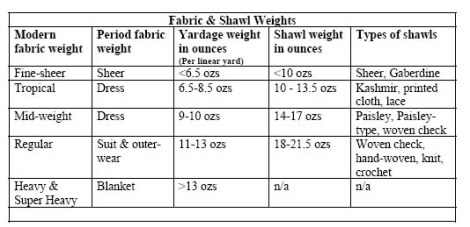
Next, consider weight. One of the mistakes I observe is the use of wool which is more of a blanket weight than a shawl weight. The weight of fabric is determined in ounces per linear yard. If you want to think of wool weights in terms of modern suit weights, a tropical weight is the lightest and regular is generally the fabric worn for a winter suit.
For more in-depth information, read Paisley, Plaid, & Purled: Shawls of the Mid-Nineteenth Century
After test driving the Sew Alongs in two formats with making a Work Bag and a Pin Ball, I have decided to continue them through the year. I think a couple months for each will be a comfortable pace that will not overwhelm. (sorta like the fort-nightly challenges just spread out.)
This year’s Sew Alongs will include:
Sew Alongs are open to any historical era and skill level.
House Keeping: We will continue to use this blog and Facebook for sharing and support. For those not on Facebook or those who do not blog, please comment below and feel comfortable emailing me your project results so I can post them in the blog.
Please, share your progress as you work through your projects either in the comments section for that Sew Along or in the Facebook Group. Encourage each other as we work along. Remember, we are a mix of historical eras, skill levels and with different goals. (Yes, we have an assortment of site interpreters, reenactors and theatrical costumers.) The span of the Sew Along is a guideline, not a deadline. Continue to share your progress even after a new Sew Along has begun. Do not feel there is a firm deadline. We simply are going to encourage each other to work towards completion.
Upon completion of your project, which can be any time after the Sew Along starts, please share:
Last year we took a nice cruise on the Canandaigua Lady. I am now pondering what we could do this year….
?Another cruise?
?A picnic?
?A trip on the canal?
I really want to do a warm us up tea at the Caledonia Village Inn. A Saturday afternoon by their warm fire sounds so nice right now. I need to pick a date that soon. (though, I am noticing they open at 4.)
I stumbled upon Granger Homestead’s Mystery Tea. While this is different than what I have in mind, is sounds like it could be fun. What do you think? This is such a lovely home.
I also want to do a couple of those sewing get togethers that seemed to fall through the cracks this past year.
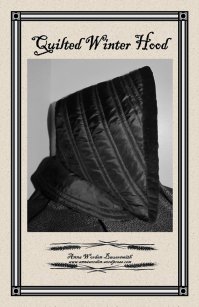
Michaela, The Farming Daughter, shared the winter bonnet she made with my pattern. Please, take a look: http://thefarmingdaughter.com/2016/01/18/the-bess-bonnet/







 If I Had My Own Blue Box: